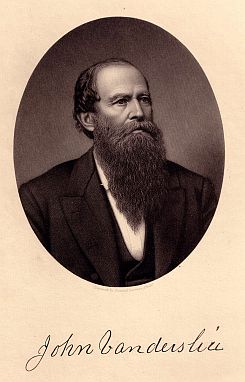
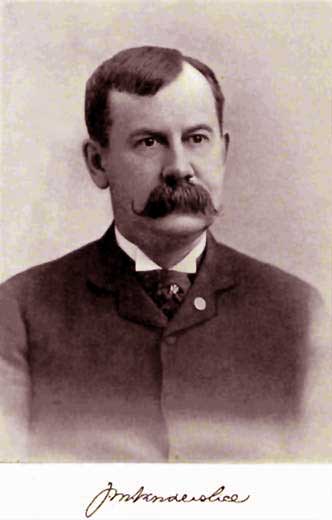
Henry Vanderslice read the Declaration of Independence
As Sheriff of Berks County, Henry Vanderslice (1726–1797) had the duty of carrying the news to the people. On July 8, 1776, the courthouse bell on Penn Square — since known as the Berks County Liberty Bell — was rung to summon the townspeople, and Henry read the newly adopted Declaration aloud from the courthouse steps in Reading. Because so much of the county was German-speaking, he read it in both English and German — among the first times the Declaration was proclaimed in German anywhere. He then enlisted, serving as Wagon-Master in General Muhlenberg's brigade through the New Jersey campaign and the winter at Valley Forge.
Before that day, he was a surveyor. He was born March 9, 1726 in Providence Township — then part of Philadelphia County — and learned surveying from his maternal grandfather Hendrick Pannebecker, who had come from the upper Rhine in 1699 and become surveyor of public lands for the Penns. On his grandfather's death Henry succeeded him as a commonwealth surveyor. In 1758 he surveyed a large tract in the Oley hills that became Rockland Township, and is listed as the township's founder. The Exeter Township tax rolls of 1761 and 1767 show him assessed for 40 acres, three horses, two cows and no servants, owing eight shillings. Among his land purchases was a tract bought from Mary Rogers, widow of Mordecai Lincoln — Abraham Lincoln's great-great-grandfather. He was first appointed sheriff in 1774 by John Penn, and reappointed in 1775.
Then nine years of war. As Berks County's wagon master he ran supplies out of the Pennsylvania German settlements of Berks, Lancaster and Chester — the so-called bread basket — to troops as far off as Newark, New Jersey. Over the course of the war roughly 1,100 Berks County men served as wagoneers under him, an early version of the quartermaster corps. Besides food and shoes and the output of the county's twelve forges and foundries, he sought out the Berks gunsmiths making the Pennsylvania rifle; his brigade is credited with buying horses in Heidelberg Township to replace the hundreds that died at Valley Forge, and his wagons carted Hessian prisoners, German soldiers hired to fight for Britain. He kept journals of it, and two survive (see below). In 1779 he became deputy surveyor of Berks County, in which role he sold off the estates confiscated from Tories, the colonists who stayed loyal to the British Crown.
Where he lies is not known. Henry died in Reading on February 10, 1797. The records of the First United Church of Christ, at Reed and Washington streets, show he was buried in its churchyard — but they give no sign that his body was among those moved in the 1870s, when the graves were cleared and re-interred at Charles Evans Cemetery to make room for the church to expand. A Henry Vanderslice does lie at Charles Evans; family genealogists have determined that he is a grandson. Descendants have long hoped to place a plaque for him somewhere — at the church, or wherever the family can agree.
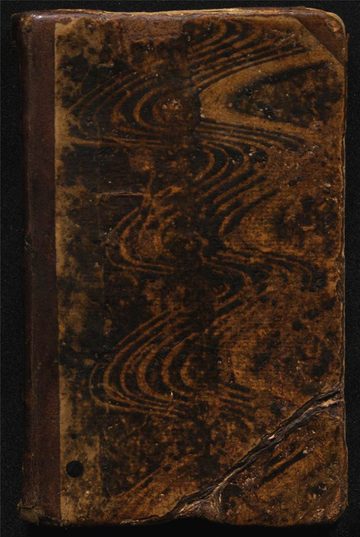
Henry's wagon-master journal, 1777
A small leather-bound notebook in Henry's own hand, signed "Henry Vanderslice" on its first page. It is his working account book as wagon master: the names of the wagoners and their monthly wages, the days each man served, receipts, and the forage, oats, hay and provisions he bought and delivered for the army from 1777 onward. It reads more like a ledger than a diary, but it records the men of Berks County who drove his wagons, and the day-to-day work of keeping the army supplied. Henry used it from both ends, so the pages are not in order.
This is the second of his wartime journals. The first, a diary of 1777–1778, was found in the 1920s by the Berks County historian Arthur D. Graeff, and a transcription of it is printed in the 1929 family book. This one belongs to the Historical Society of Trappe, Collegeville, Perkiomen Valley, which has asked for volunteers to help transcribe it; it has never been published in full.
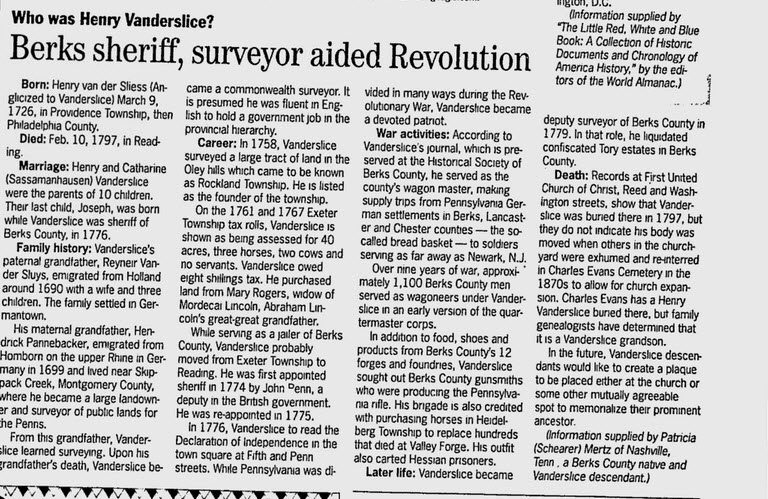
📰 Read the newspaper article on Henry
Berks County still marks the anniversary every July 8 with a bell-ringing and public reading. Henry also appears in the Vanderslice line, as Generation 3.
Two small conflicts, kept honest: the article has Henry appointed sheriff in 1774 and reappointed in 1775, where the older family accounts say elected in 1775 — both may be right, since the office was filled by the governor from the top vote-getters. And its opening line has Reynier arriving from Holland "around 1690 with a wife and three children," which the Dutch records above now correct: he was still in Dordrecht in 1696 and sailed in 1701.
Sources: newspaper feature "Who was Henry Vanderslice?" (information supplied by Patricia (Schearer) Mertz, a Vanderslice descendant, and from The Little Red, White and Blue Book, ed. the editors of the World Almanac); Van der Slice and Allied Families (1929); Berks History Center; County of Berks; Henry's wagon-master journal (1777 onward), Historical Society of Trappe, Collegeville, Perkiomen Valley; Celia Caust-Ellenbogen, "1770s Wagon Master Journal at HS of Trappe," Historical Society of Pennsylvania blog.