For a long time Reynier was a man who appeared in Holland only once, on a Leiden marriage register in July 1685, and then again in Germantown. In September 2026, ahead of a visit to Dordrecht, his records there began to surface through the Open Archieven index and the digitized registers of the Regionaal Archief Dordrecht, Erfgoed Leiden and Het Utrechts Archief. He turns out to have left a long trail: parents and grandparents on a single Dordrecht street, a wife from a Leiden family, a trade, a guild, a house that is still standing, and the debts that sent him across the ocean. Dutch words and old trade terms are explained in the glossary at the end.
At a glance
- Born
- Dordrecht, Holland, about 1655–1663 (his baptism has not been found)
- Parents
- Adriaen Jansz. van der Sluijs, grocer, and Lijntgen Pieters Daremans, married 1652
- Grandparents
- Jan Gillisz. van der Sluijs and Ariaentje Adriaens, both dead by 1671
- Trade
- Grutter, a groat-miller: he hulled and sold grain
- Married
- Anna Spruijt (bapt. Woerden 1664); banns (the formal notice of intent to marry) registered at Leiden, July 11, 1685; married in the Grote Kerk, Dordrecht, October 28, 1685
- The mill
- The family’s horse-mill on the Vriesestraat, beside the old chapel that is now the Lutheran Trinitatiskapel (Vriesestraat 22)
- House
- Corner of the Donkere Steiger, Voorstraat, Dordrecht; bought 1686, sold in his bankruptcy 1696; very likely today's Voorstraat 267
- Emigrated
- About 1701, to Germantown, Pennsylvania; naturalized with his son Adrian, September 29, 1709
- In America
- A baker in the city of Philadelphia, as his will and estate inventory both call him
- Died
- July 1713, Philadelphia, between making his will on July 3 and its proving on July 13; the will named six children
Grocers, a baker, and a groat-miller
Annekenunmarried Maeijkenunmarried Elijsabethm. Tielman van Terneij, tailor Jan Jansz.a minor in 1671
Green: the direct line. The link from Adriaen to Reynier is almost certain but rests on several records taken together; see below.
The grandparents
The oldest record of the family is a division of an inheritance, registered on June 27, 1671. It names Adriaen vander Sluijs, cruijdenier (grocer) and burgher of this city (a burger, a full citizen of Dordrecht, with the right to keep a shop and join a guild), together with his sisters Anneken and Maeijken, both unmarried; his sister Elijsabeth, married to the master tailor Tielman van Terneij; and his younger brother Jan Jans vander Sluijs, still a minor, whose guardian was Bartholomeus Targier. They are described as "children and heirs of Ariaentje Ariens, widow of Jan Jillis vander Sluijs, their late father and mother." The house on the Vriesestraat where Anneken and Maeijken were living went to the two unmarried sisters. The division places it the way deeds did before houses were numbered, by its neighbours: between the baker Jan Pouwels and the painter Matthijs Paijant. Which house that is today has not yet been worked out. Eight days earlier, on June 19, Elijsabeth and her husband had made a joint will before a Dordrecht notary, the public official who drew up wills and contracts, naming her sisters and her brother Arien van der Sluijs as their heirs if they died without children.
So Reynier's grandparents were Jan Gillisz. van der Sluijs and Ariaentje Adriaens, and both had died by the summer of 1671, Jan first. Adriaen, whose mother was the daughter of an Adriaen, was named for his mother's father, as Dutch custom had it. The whole family lived on one street: by the 1690s Elijsabeth and her husband were across the way (the lantern-tax roll, a list of houses taxed to pay for the street lamps, lists 't Huijs van Tieleman Joris van Terneij on "the other side of the Vriesestraat"), and Bartholomeus Targier, the guardian of 1671, turns up again beside Reynier a quarter of a century later. A Jan van der Sluijs was nominated to head the groat-millers' guild in 1719, long after Reynier had sailed. He may well be Jan Jansz., the youngest of those siblings, Reynier's uncle, though nothing yet ties the two records together.
The parents
Adriaen Jansz. van der Sluijs married Lijntgen Pieters Daremans in Dordrecht on March 17, 1652. He was a kruidenier, a grocer, and later a shopkeeper. On March 19, 1682 he paid 1,150 guilders for a house on the Vriesestraat with a rosmolen, a horse-driven mill, attached, bought from the heirs of Geerken Jordens. The same day he borrowed 800 guilders against it, so most of the price was borrowed. On September 23, 1684 he borrowed 1,000 guilders against his house called "de Schaapherders" (the Shepherds) on the same street, between the painter Johannes Verhagen and the carpenter Dirck Stoop. Anna's father, as it happens, was a grocer too.
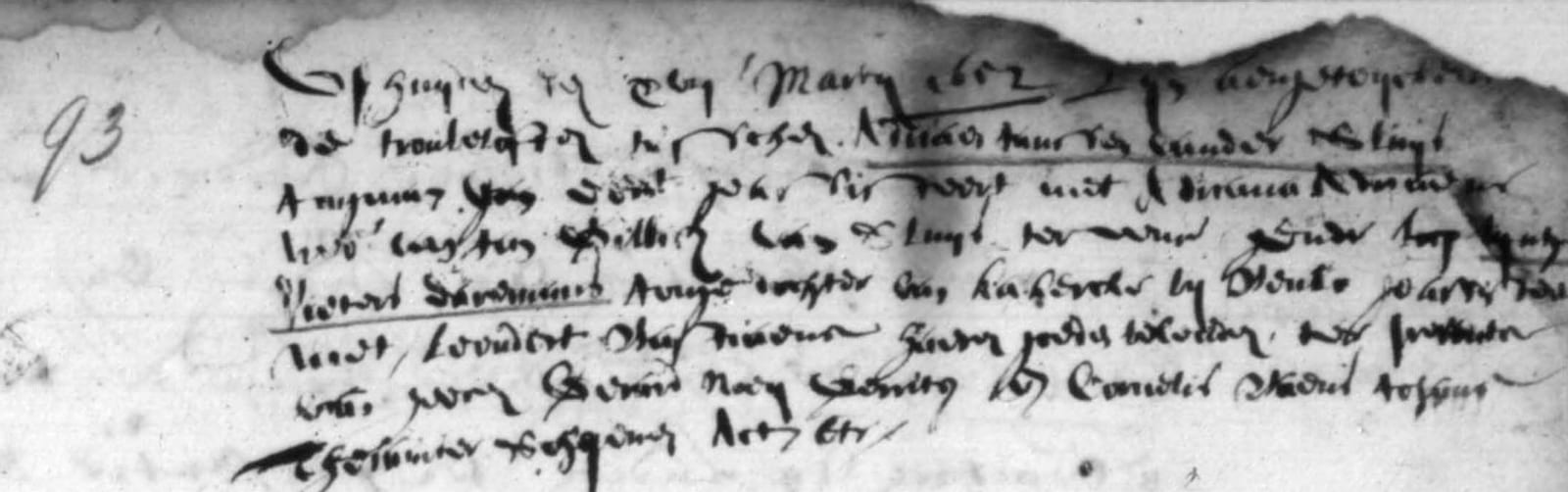
The book that marriage is written in says something about the family. It is not a church register. It is the city's register of marriages van de onderscheiden gezindten, of the "other denominations": couples outside the Reformed church (the Dutch Republic's official Protestant church), usually Catholics, Lutherans or Mennonites (a Protestant church that rejected infant baptism and oaths and refused to bear arms), who married before the magistrates at the town hall. It records only a dozen or so weddings a year, against thousands in the church books. Neither Reynier's parents nor his grandparents appear in Dordrecht's Reformed baptism or marriage books at all, although those are complete for the whole century. That is why Reynier's own baptism has not been found: his parents belonged to another church, and as the next section shows, it was the Mennonite one, which baptized only adults. Reynier himself turns up in the Reformed church's records, though not in all of them. His banns in 1685 were registered in Leiden's kerkelijk ondertrouwboek, the Reformed church's own banns register, and his son was baptized in Dordrecht's Reformed church in 1686. The couple married in Dordrecht on October 28, 1685, and the wedding is entered in the marriage register of the city's Dutch Reformed congregation, so they married in the Reformed church as well. No baptism of any of their other children has been found. Moving into the public church was a common path for families who wanted full standing in the city, but whether Reynier made that move from conviction or convenience, the records do not say.
A Mennonite family
The register of Dordrecht's Mennonite congregation, the Doopsgezinde (literally "baptism-minded"), survives, and it answers the question that marriage book raises. Mennonites baptized only adults, on their own confession of faith, so the register lists grown men and women, not infants. On Easter Sunday, April 23, 1628, the congregation's elder Adriaen Cornelisz. baptized and received among others “Jan Gillisz., koordewercker, en Ariaentge Jans, zyn huysvrou”: Jan Gillisz., a cord-maker, and Ariaentge, his wife. Twelve years later the congregation's list of deaths records “Jan Gillisz., passementwercker, sterf hier, den 17en Maert 1640”: Jan Gillisz., a braid-maker (a maker of decorative cord and trimming, close kin to the cord-maker's trade), died here on March 17, 1640, leaving Ariaentje a widow with young children, the youngest, Jan, still a minor thirty years later. They are very probably Reynier's grandparents. The entry gives no surname, and it calls her Ariaentge Jans where the 1671 division calls her Ariaentje Ariens, so it is not certain, but the names, the date and what follows all fit.
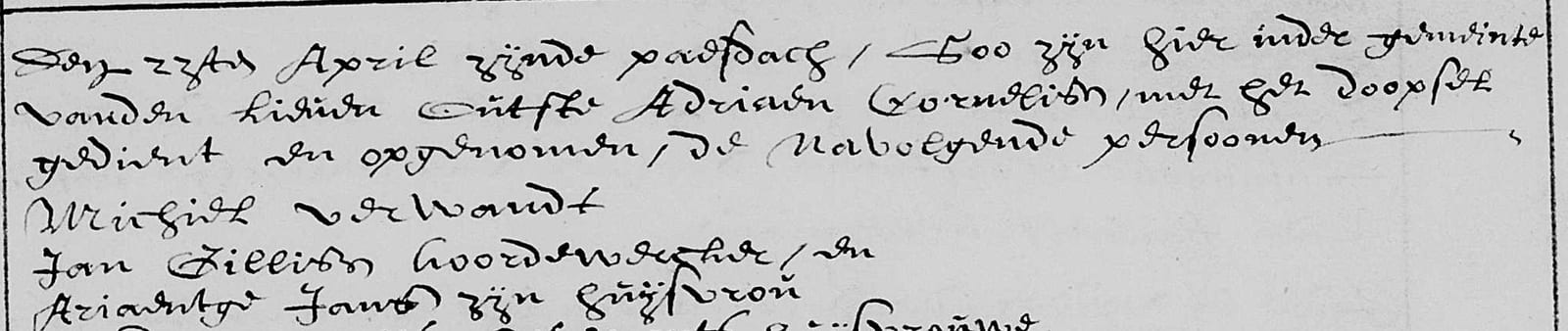

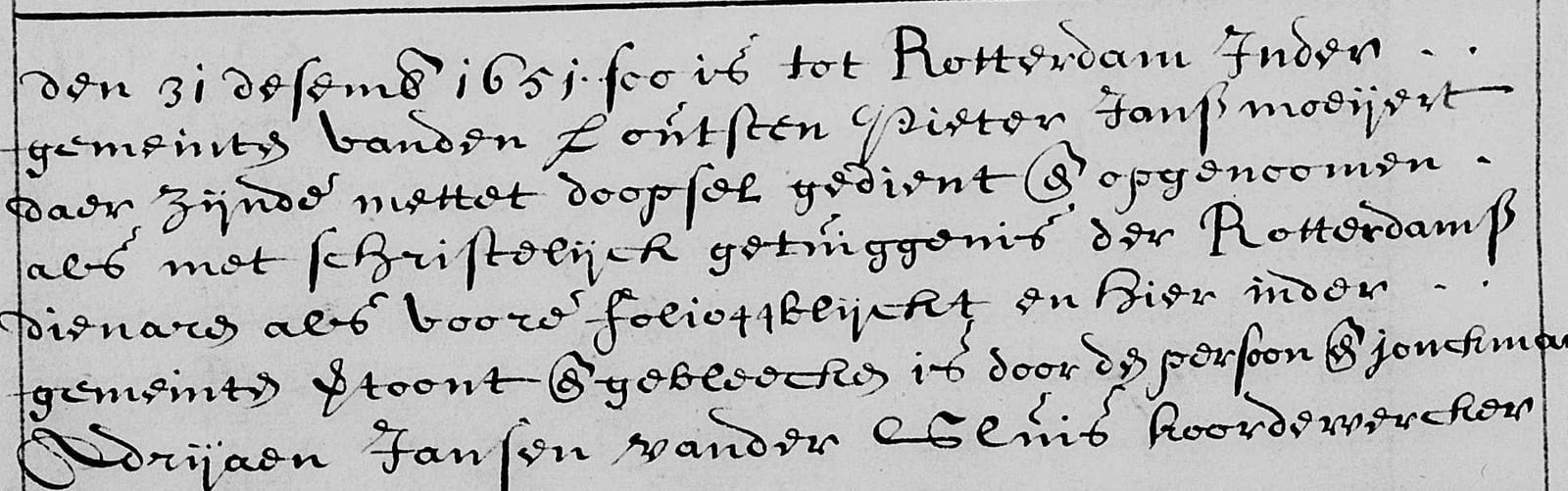
Their children followed. On Easter Sunday, April 1, 1646, the list includes “Anneken, Jan Gillisz. dochter”, the Anneken of the 1671 division. And on December 31, 1651, at Rotterdam, the elder Pieter Jansz. Moyaert baptized a young man of the Dordrecht congregation, recorded on the written testimony of the Rotterdam deacons as “Adrijaen Jansen vander Sluis, koordewercker”: Reynier's father, eleven weeks before his wedding in March 1652. Here the surname is written out, and the trade is the same as Jan Gillisz.'s in 1628: Adriaen was a cord-maker, like his father, before he became a grocer. That is what ties the 1628 couple to the family.
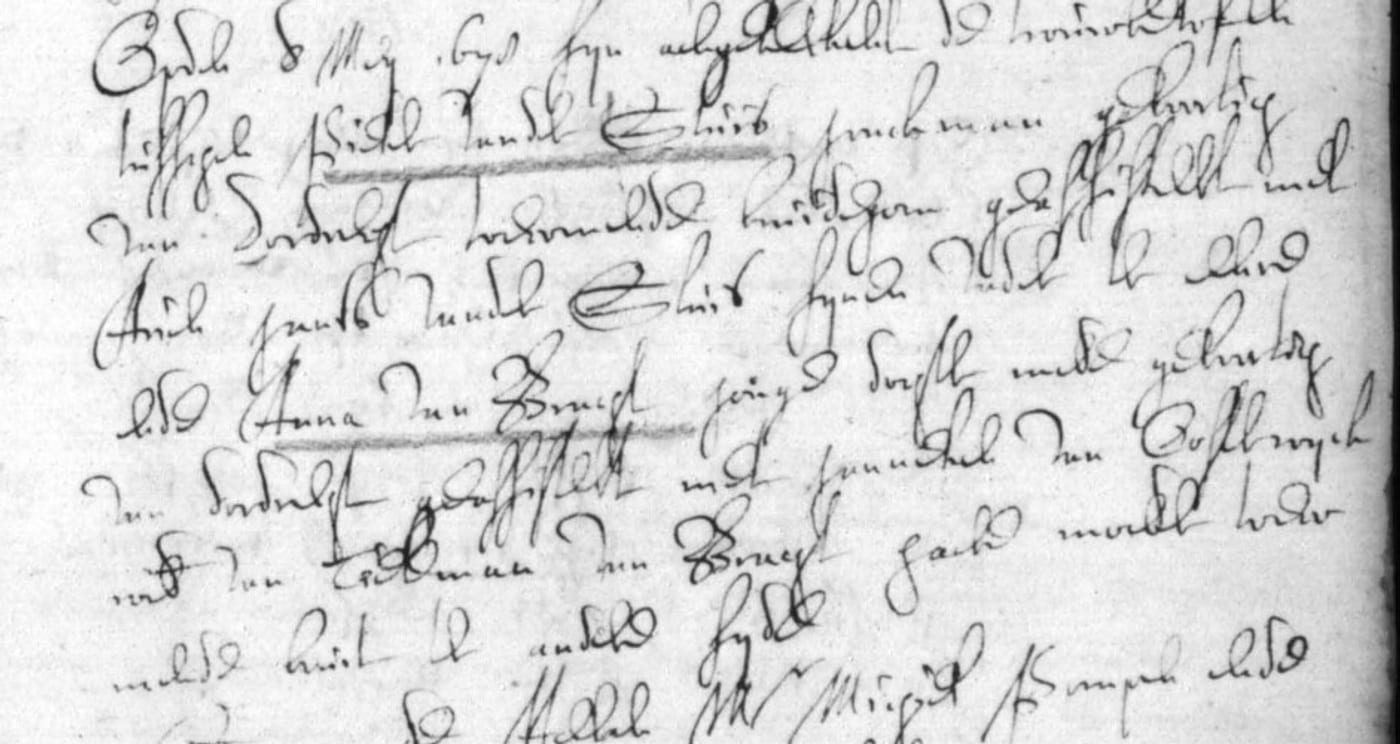
Three weeks after they had married before the magistrates, Adriaen and Lijntgen married again in their own church. The congregation's marriage register, in the same book, records that on April 7, 1652, “Arijen Jansz. vander Sluis, koordewercker, jonckman, ende Lijntie Pieters Daermans, jonge dochter” were married “here in the congregation” by the preacher Menno Simons, “after the banns had been read three times without any objection.” (He was a Dordrecht preacher of the 1650s, not the sixteenth-century founder whose name the Mennonites bear.) Both are named in full, he as a cord-maker, both as never married before. This is the wedding of Reynier's parents.

The same small congregation held another family that comes into this story. The very first baptisms in the register, in November 1626, include Jan Tielmansz. van Bracht, a cloth-finisher, and in 1644 his son Tieleman Jansz. van Braght was baptized. Tieleman became one of the congregation's preachers and wrote the Martyrs Mirror (1660), the great book of Anabaptist martyrs still kept in Amish and Mennonite homes. The same marriage register records his own wedding, on July 20, 1653, to Janneke Cornelis van Oosterwijck, and the Anna van Bracht whom Reynier's brother Pieter married in 1678, the daughter of “the widow of Tielman van Bracht”, was very probably their daughter. Tieleman died on October 7, 1664, mourned in the register as “onse lieve outste voorganger”, our dear elder and leader.
The same book follows Reynier's own family through the next thirty years. Its list of deaths records that “Adriaentie Ariens, weduwe”, a widow, died on May 20, 1670: Reynier's grandmother, a year before her children divided her estate. (Both the death list and the 1671 division call her Ariaentje Ariens, so the Jans of 1628 looks like a clerk's slip.) A Maeyken van der Sluijs, jonge dochter, was baptized at Easter 1671, and on August 12, 1674 a Maeyken van der Sluijs, bejaerde dochter, an older unmarried woman, died: very probably Adriaen's sister Maeijken of the 1671 division. In 1674 a young man named Jan Daermans was baptized, carrying Lijntgen's own family name, and on November 8, 1675 an Adriaentie van der Sluijs, jonge dochter, very likely Reynier's sister, named for her grandmother. Reynier's brother Pieter was baptized on April 6, 1678, a month before he married (see below). Reynier himself is not there. The baptisms from 1669 to the mid-1680s have been read without finding him, and he married in the Reformed church in 1685. He seems to have been the one member of the family who left the Mennonites, or never joined them.
His brother
The record that ties Reynier to these parents is his brother's. On May 5, 1678, in the same civil register, a baker named Pieter van der Sluijs, born in Dordrecht, promised to marry Anna van Bracht. The clerk wrote down who stood with the groom: Arien Jansz vander Sluijs, sijnen vader — Adriaen Jansz. van der Sluijs, his father. Pieter was named, as Dutch custom expected, for Lijntgen's father Pieter. Both bride and groom were Mennonites. Anna, written Anneken van Bracht, had been baptized in the congregation at Easter 1675, and Pieter on April 6, 1678, a month before the civil banns. On May 22, 1678 the congregation's elder Seger Dircksz. married “Pieter vander Sluijs, jonckman van hier, ende Anneken van Bracht, jonge dochter van hier”.
Then the family was struck twice. Pieter was dead by March 1695 and his wife by February 1696. In every record that settles their affairs, the same man appears beside Anna van Bracht's brother, the teacher Cornelis van Bragt: Reijnier van der Sluijs, grutter. He is executor of her will. He is named among those owed money on her house, with a Jannigje van der Sluijs, who was probably Pieter and Anna's daughter. In June 1695 he acts as voogd (guardian) in the estate of Anna's mother. That is the part a dead man's brother normally played.
How sure is it that Adriaen was Reynier's father?
Very nearly, though no single document says it in so many words. Four separate records point the same way. At his 1685 banns Reynier was accompanied by "Leyntge van der Sluys, his mother". The only Dordrecht marriage that fits her is Adriaen's to Lijntgen Pieters in 1652. In 1678 Adriaen is named as the father of Pieter van der Sluijs, and in 1695–96 Reynier acts for Pieter's family exactly as a brother would. And in 1702 "Lijntje Pieters, widow" sold the horse-mill Adriaen had bought in 1682, which ties the widow to him. Reynier also named a son Adriaen, the son who was naturalized with him in Pennsylvania in 1709.
One complication. A second Adriaan van der Sluijs, a cooper, lived on the same street with a wife also called Lijntje (Lijntje van Doren), and he had died by 1693. The records keep the two men apart by trade and by their wives' names. On January 27, 1687 the burial book records een baer voor Adriaen vander Sluys, inde Vriesestraet, a bier for Adriaen van der Sluys in the Vriesestraat. It gives no trade, but the orphan chamber settles it. On January 19, 1687, eight days before that burial, Adriaen Jansz. van der Sluijs and Lijntje Pieters Daelmans made a joint will before a Dordrecht notary, and in March 1687 the clause about their children was copied into the city's weesboek, the register of the orphan-masters (weesmeesters), who oversaw the estates of under-age children when a parent died. The couple named each other as guardian of any children still under age, with power to choose co-guardians, and shut the orphan-masters out of their estate altogether, a common clause for families who preferred to look after their own. A will on his deathbed, a burial a week later, and an entry in the orphan book within two months: the Adriaen buried on January 27, 1687 was Reynier's father, and he lived to see Reynier married.
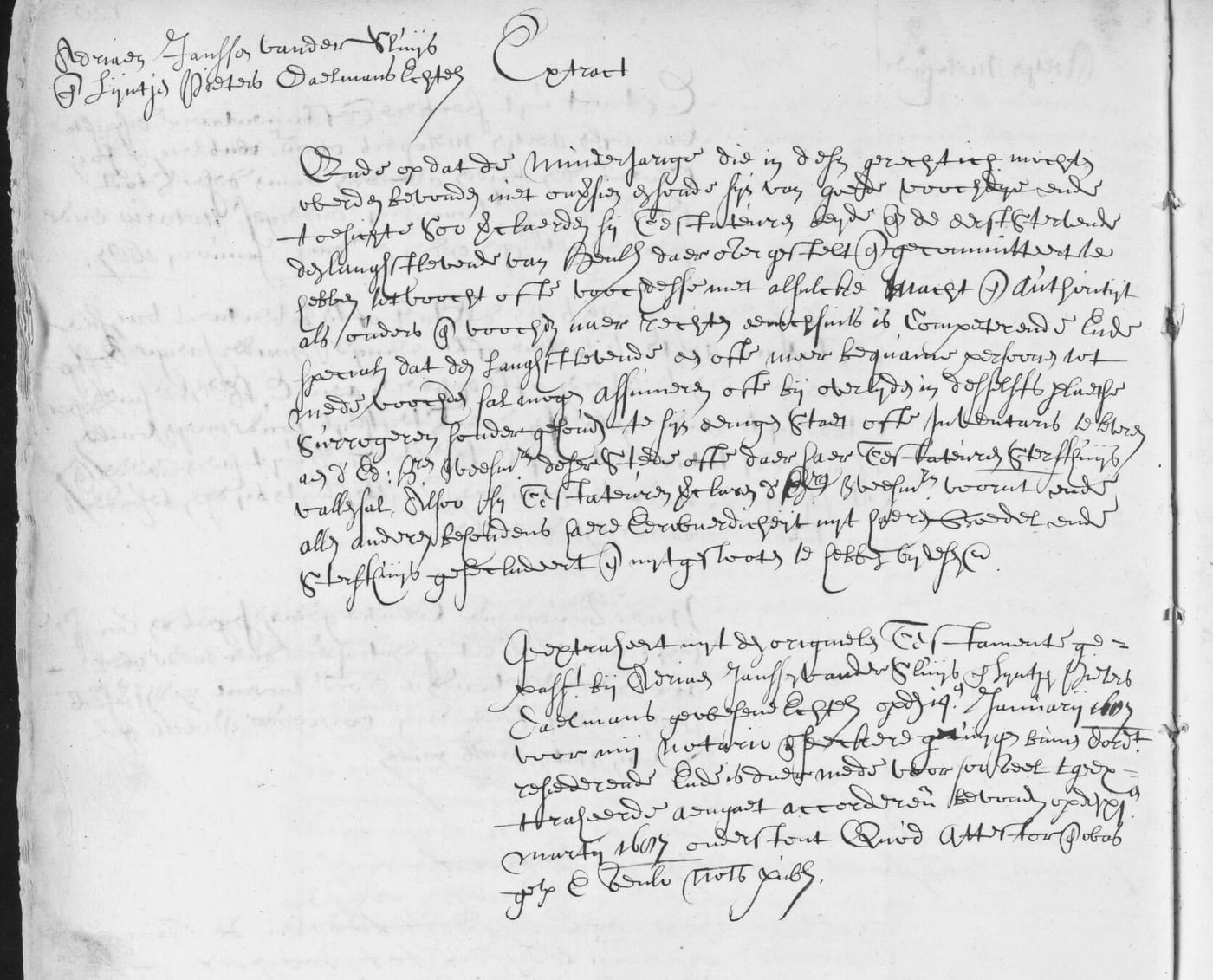
What would settle it: Reynier's own baptism, or an orphan-chamber entry naming him as the uncle of Pieter's children. He is not among the Mennonite baptisms of 1669 to the mid-1680s, so if he was ever baptized as a young man it was probably in the Reformed church, where he married.
His mother stayed
Lijntgen outlived her husband by many years. On May 18, 1702, Lijntje Pieters, widow, sold a house and lot called "de Rosmolen" (the Horse-mill) in the Vriesestraat to Jacob Lijten for 500 guilders, less than half what her husband had paid twenty years before. She is listed as the neighbour, so she was living next door. The same day Lijten signed a mortgage to her for the full 500 guilders: rather than being paid in cash, she lent him the price and would be paid back over time. When Reynier and Anna sailed for Pennsylvania, his mother was still alive in Dordrecht, on the street where the family had always lived. She had buried her husband and her son Pieter, and she would not see her other son again.
Where the mill stood
The horse-mill can be followed through the property records for a century after the family let it go. In February 1717, a mortgage on the house next door, called “De Waagschaal” (the Scale), describes it as standing “between the house of Dirck Stoop and the horse mill of vander Sluijs”: fifteen years after Lijntje sold it, the neighbours still called it by the family’s name. By June 1719 it belonged to a master mason, Gijsbert Claasz. Sliep, and was described as a house in the Vriesestraat “formerly called the Rosmolen”. The mill had become an ordinary house.
The Waagschaal’s own deeds run on to 1804, when it was numbered D 1065, and the city’s later registers and the 1832 land-register map put that number right beside the old chapel of the Blindeliedengasthuis, the city’s hospital for the blind. The hospital was pulled down in 1629, but its fourteenth-century chapel still stands: it is now the Lutheran Trinitatiskapel. The mill stood next door to the Waagschaal. The records don’t yet say which side, but either way it was in the small block between the chapel, the Vriesestraat and the narrow Blindeliedengasthuissteeg, within a few steps of a chapel that was already old when Reynier worked there. By 1830 the plots beside the chapel were empty lots, and no building from the mill’s time is known to survive.
To stand near the spot today, go to the Trinitatiskapel, Vriesestraat 22, Dordrecht, about 190 metres (a three-minute walk) from the house at Voorstraat 267. The mill stood beside it, between the chapel and the Blindeliedengasthuissteeg.
A grocer's daughter from Woerden and Leiden
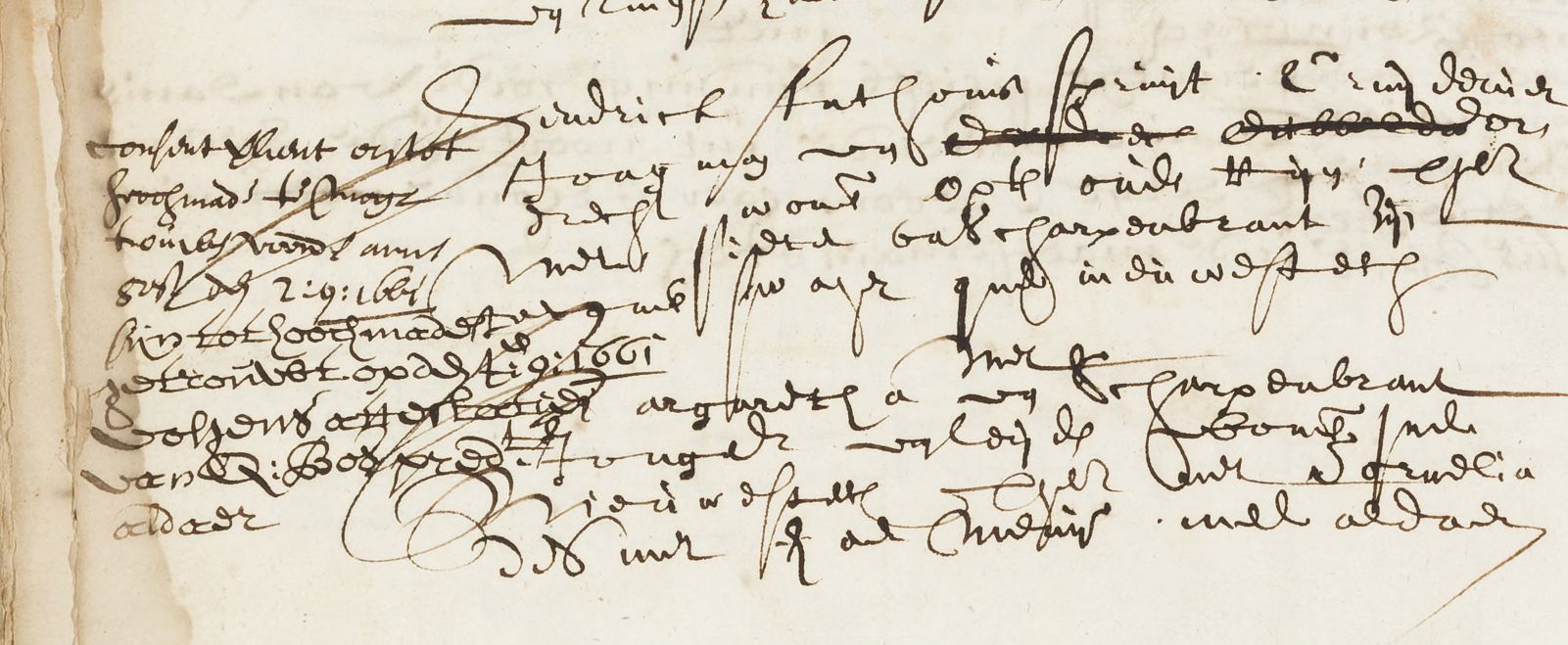
Anna's side comes through much more clearly. Her parents registered their banns at Leiden in August 1661: Hendrick Anthonisz. Spruyt, a kruidenier (grocer) and "young man of Dordrecht" then living on the Oude Rijn in Leiden, and Margaretha van Scharpenbrant of the Nieuwsteeg in Leiden, with her brother Pieter van Scharpenbrant as witness.
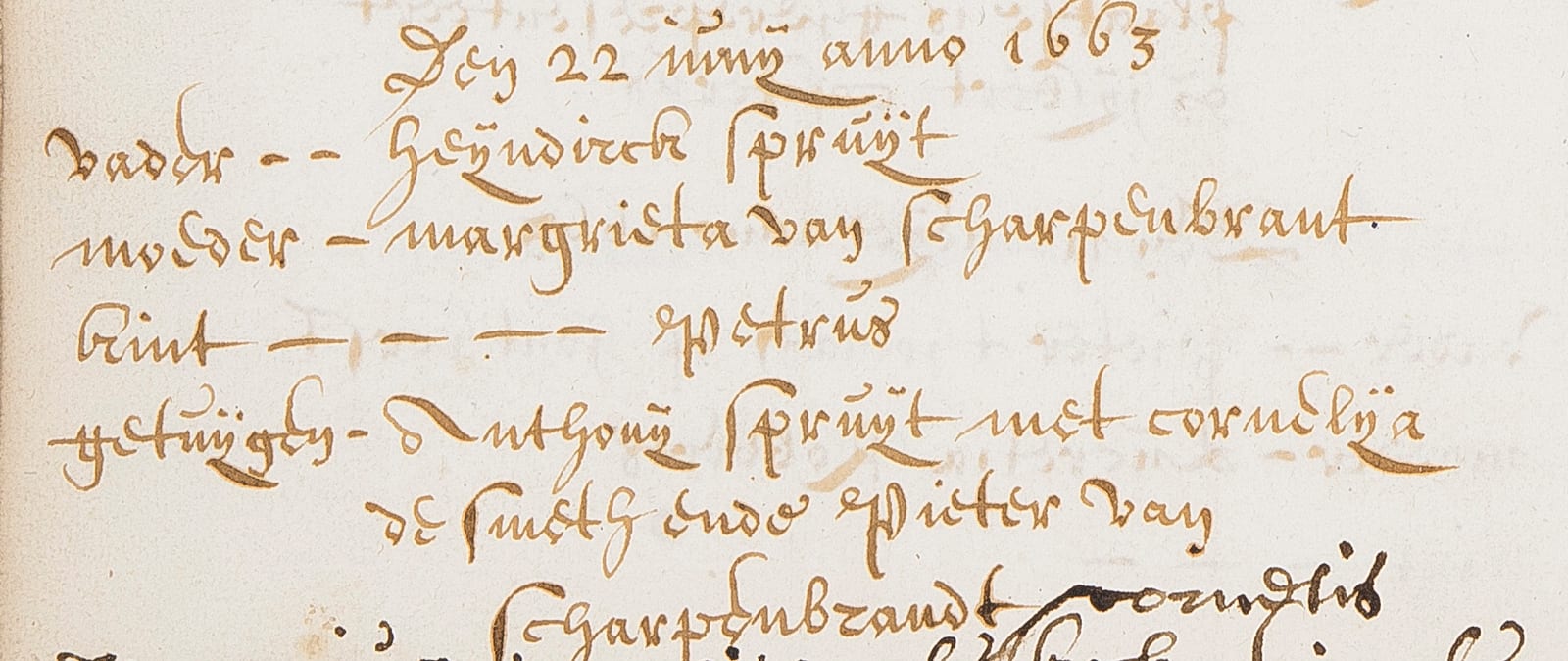
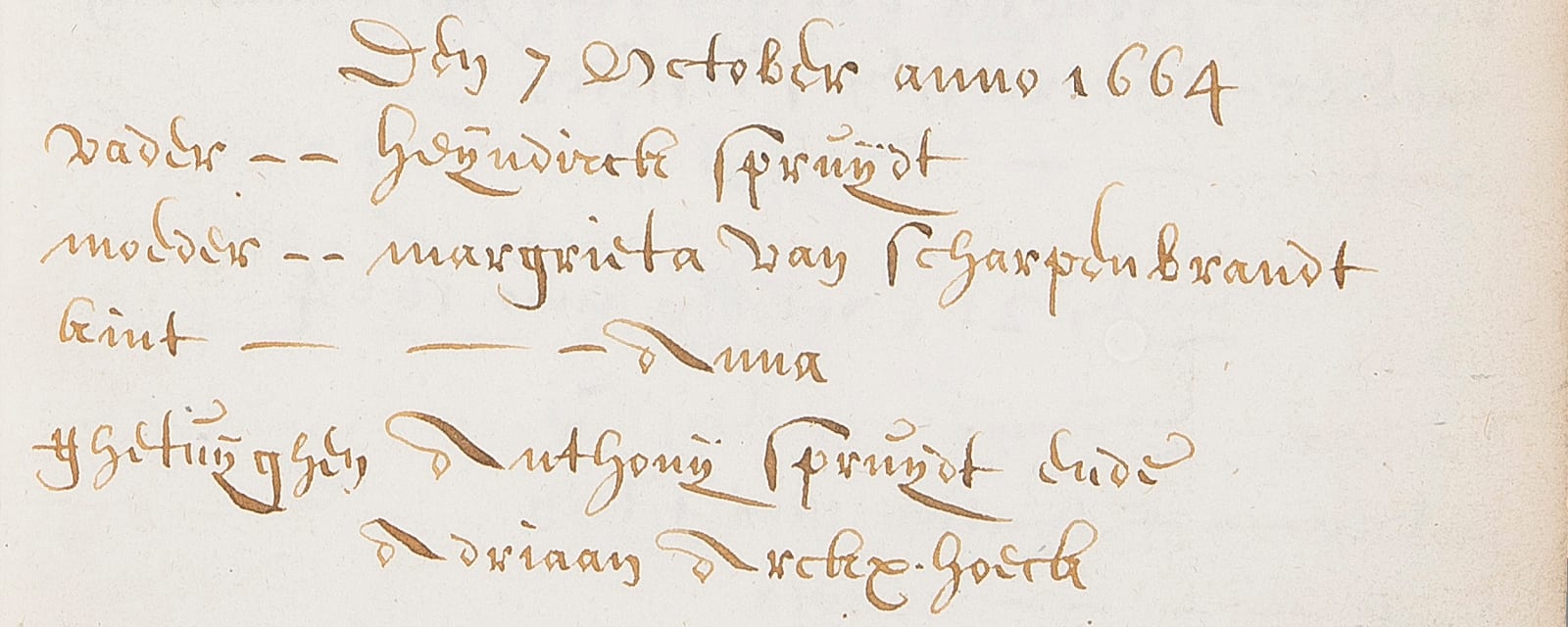
The couple began their family at Woerden, between Leiden and Utrecht. Their first son, Petrus (Pieter), was baptized there on June 22, 1663, with both sides of the family present: Anthonij Spruijt, and from Leiden Margaretha's aunt Cornelia de Smeth and her brother Pieter. Anna followed on October 7, 1664.
Then the family moved to Hendrick's home town, and four more children were baptized at Dordrecht: Adriaen (1666), Emmerentia (1668), Maria (1670) and Hendrik (1674). Anna's father died some time between 1674 and 1685. By the time of her engagement her mother had gone back to Leiden, and a few months later, in the same register, Margaretha remarried, to a widower named Geleyn van der Kay.
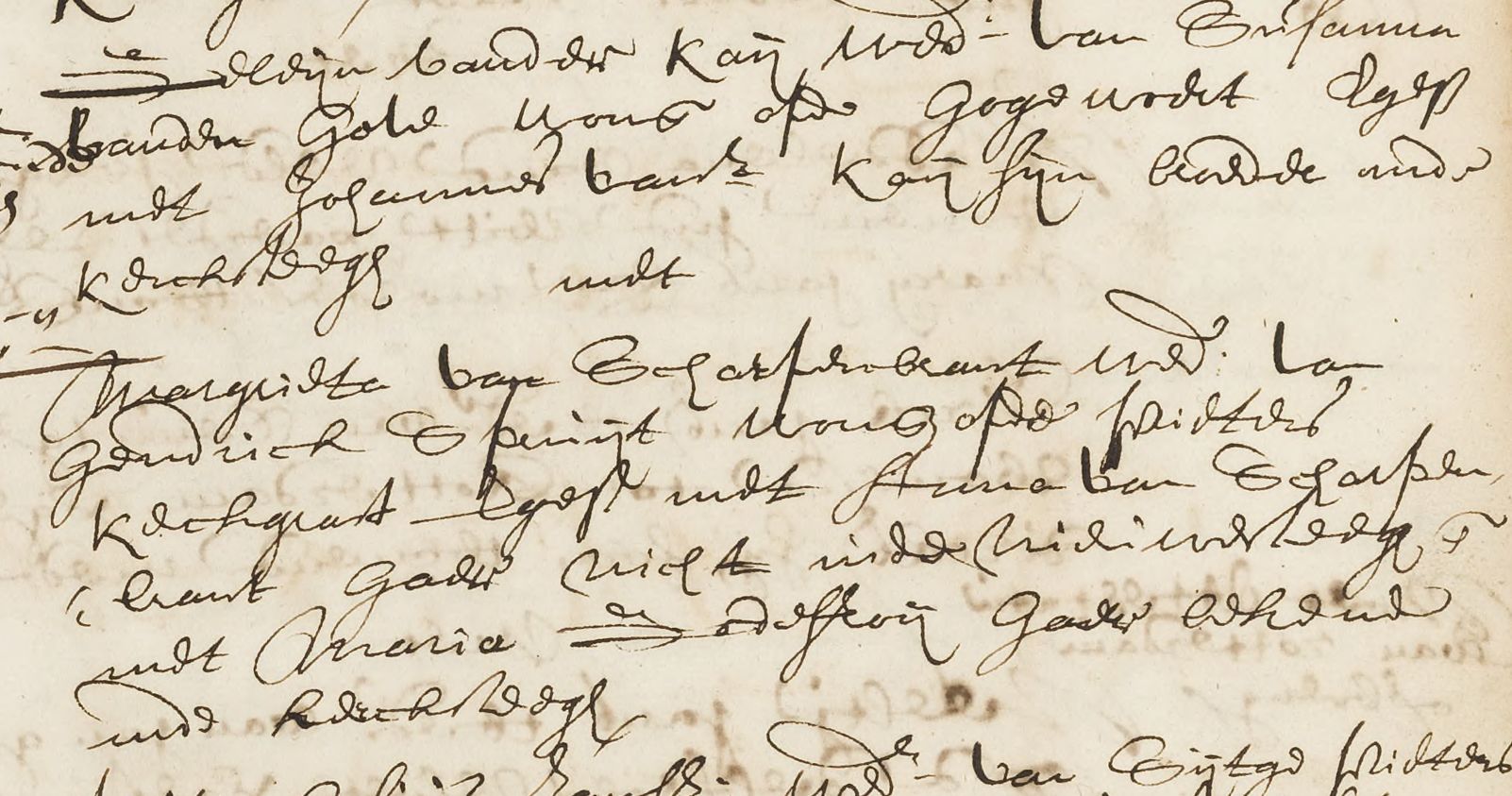
The Van Scharpenbrants were a Leiden family, and they turn up wherever Reynier needed money. The bond (a loan secured on the house, much like a mortgage) on his Voorstraat house in 1688 was held for the young heirs of Pieter Arcxhoeck van Scharpenbrant, a notary, and passed through the Leiden orphan-masters, the city board that managed the property of children who had lost a parent. And when the couple prepared to leave for Pennsylvania in 1701, it was Anna's mother who lent them the money for the voyage.
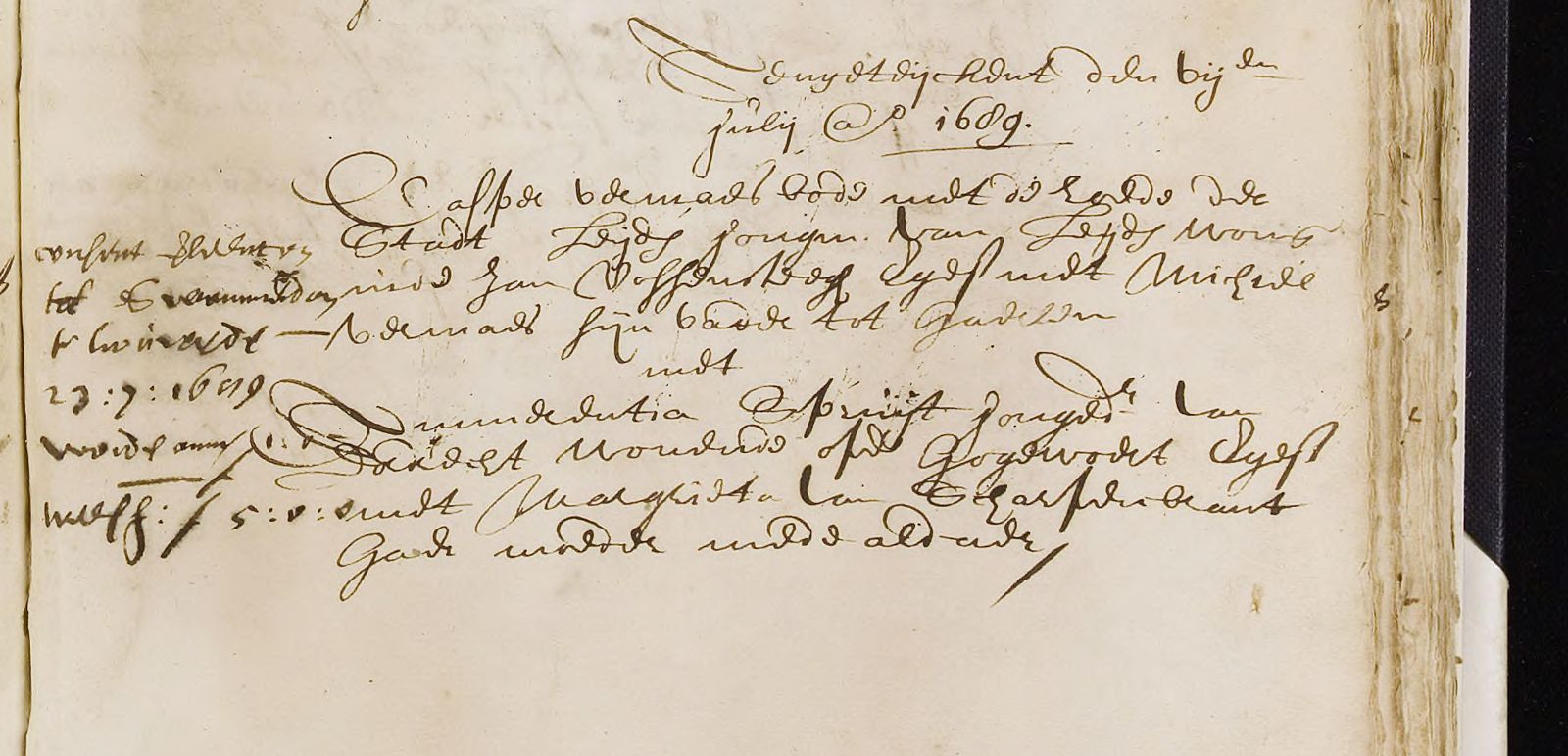
Anna's sister Emmerentia married Casper Vermaes, a court messenger (bode met de roede, literally "messenger with the rod", the officer who delivered the court's summonses and carried a staff as his badge of office) and the son of Michiel Vermaes of Haarlem, at Leiden in July 1689. He is the "brother-in-law Caspar Vermaes" to whom Reynier and Anna gave their power of attorney before they sailed. Margaretha was still alive in 1703, standing witness at Leiden for a grandson. And the Pieterskerk's own grave book records a grave in the choir ambulatory (the walkway around the choir at the east end of the church), number 120, in the names of Casper Vermaes and his wife: the church beside which Anna was living when she became engaged holds her sister's family.
Anna's Leiden
Leiden was then the second city of Holland after Amsterdam: home to the Netherlands' oldest university, founded in 1575, and to the greatest woollen-cloth industry in Europe, which had drawn weavers and refugees from Flanders and far beyond. Among those refugees were the English Separatists we remember as the Pilgrims, who came to Leiden in 1609 to worship freely and lived there for more than a decade before some of them left in 1620 for the voyage that became the Mayflower's.
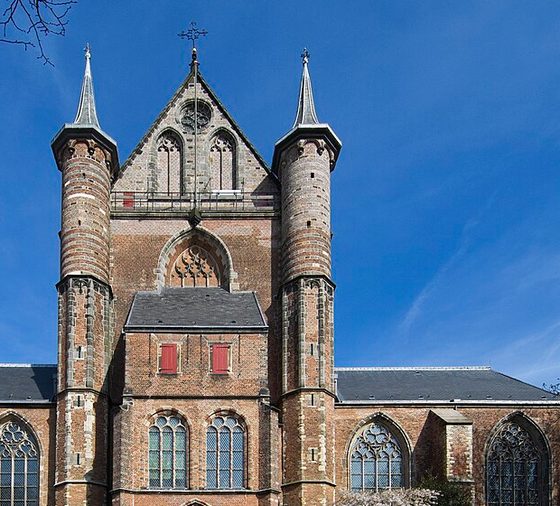
The church most bound up with their story is Leiden's Pieterskerk, the great late-Gothic church of St. Peter, begun around 1390, where the Pilgrims' pastor John Robinson lies buried, as does the scientist Willebrord Snellius. Anna was living beside it, on the Pieterskerkgracht, when she became engaged, and her sister Emmerentia and Casper Vermaes were later given a grave inside it.
I visited the Pieterskerk in 2025, before any of this was known. It was closed that day, so a return trip is owed. Visit the Pieterskerk's official site →
Dordrecht, the oldest city in Holland
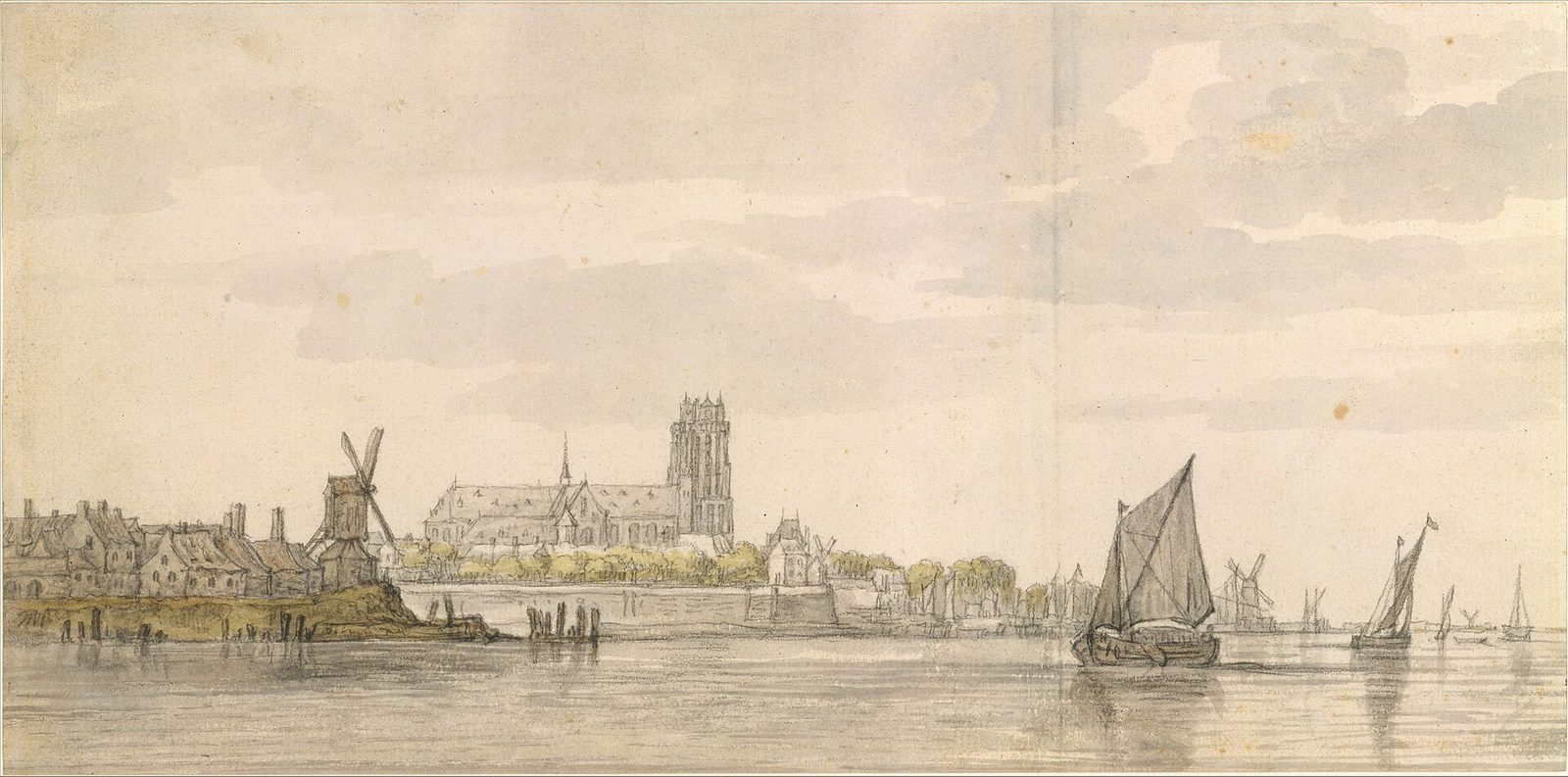
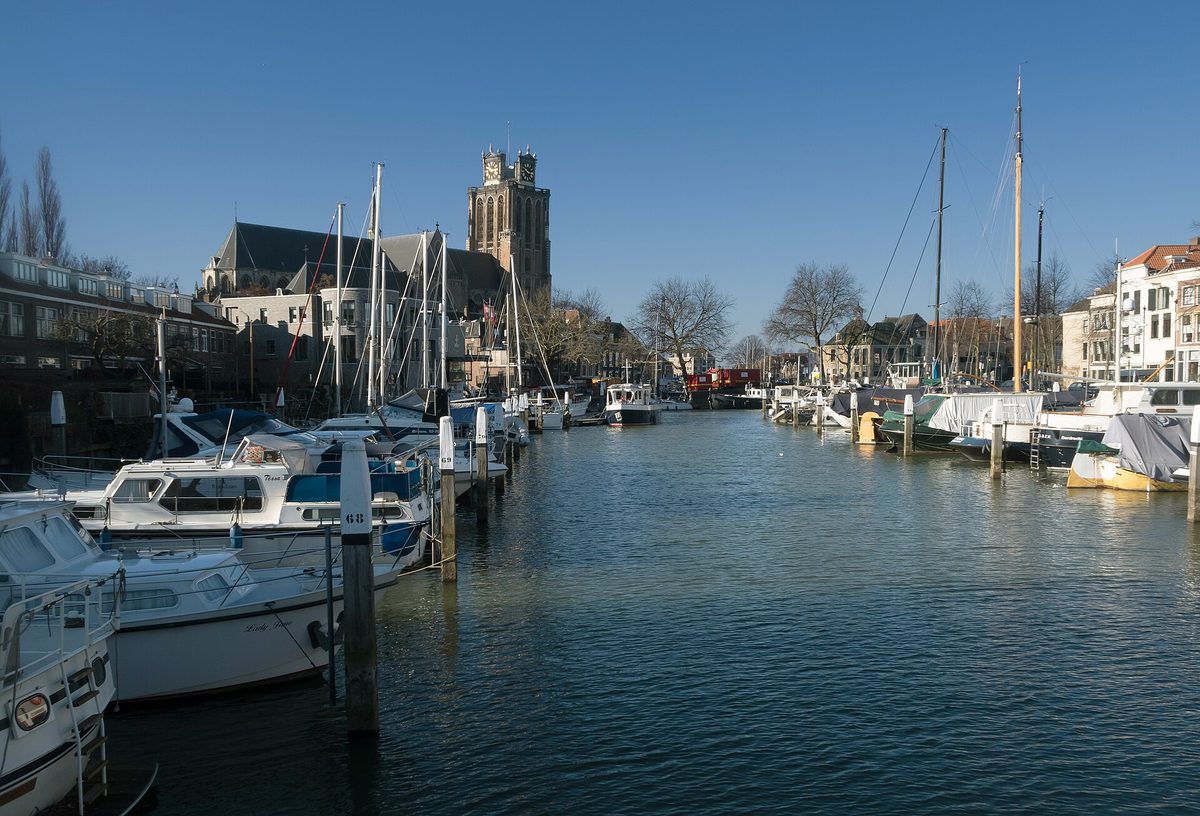
Reynier's city was Dordrecht, and in its day it was one of the great towns of the Netherlands. It received its city rights in 1220, the first town in the county of Holland to do so, and it stands where rivers meet: the Merwede, the Noord, the Oude Maas and the Dordtse Kil. Every boat between the German Rhineland and the sea passed its quays, the stone-walled landing places along its harbours. From 1299 the city held the stapelrecht, the staple right: goods carried down the rivers, above all Rhine wine, timber and grain, had to be unloaded at Dordrecht and offered for sale there before they could go any further. The street names still remember it: the Wijnstraat, the Wijnhaven, and the Wijnbrug, the "wine bridge", a few doors from Reynier's house.
Its place in Dutch history is larger than its size. In July 1572 the first free assembly of the States of Holland met in the Hof, the old Augustinian cloister, and declared for William of Orange against Spain, the founding moment of the Dutch Republic. The same building now houses the Regionaal Archief Dordrecht, where Reynier's own records are kept. In 1618–19 the Synod of Dort, a gathering of Reformed churches from across Europe, met here, settled the doctrine of the Dutch church, and ordered the translation of the Bible that Dutch Protestants would read for three centuries. Dordrecht took the first seat among the towns in the States of Holland. The statesman Johan de Witt, who led the Republic for twenty years, was born here in 1625, and so were the painters Aelbert Cuyp, Nicolaes Maes, Ferdinand Bol and Samuel van Hoogstraten.
By the time Reynier was born, the city's greatest years were behind it. Rotterdam downriver, and above all Amsterdam, had taken most of the sea trade. Dordrecht remained a busy river port and market town of perhaps eighteen to twenty thousand people, living on the Rhine trade, on wine, timber and grain, and on its crafts. A groat-miller fitted that world exactly: grain came down the rivers to Dordrecht's quays, and the grutters, or groat-millers, rubbed the husks off it in their mills and sold the hulled grain as groats, the barley, buckwheat and oats that ordinary people ate every day as porridge or in soup. (More on the trade below.)
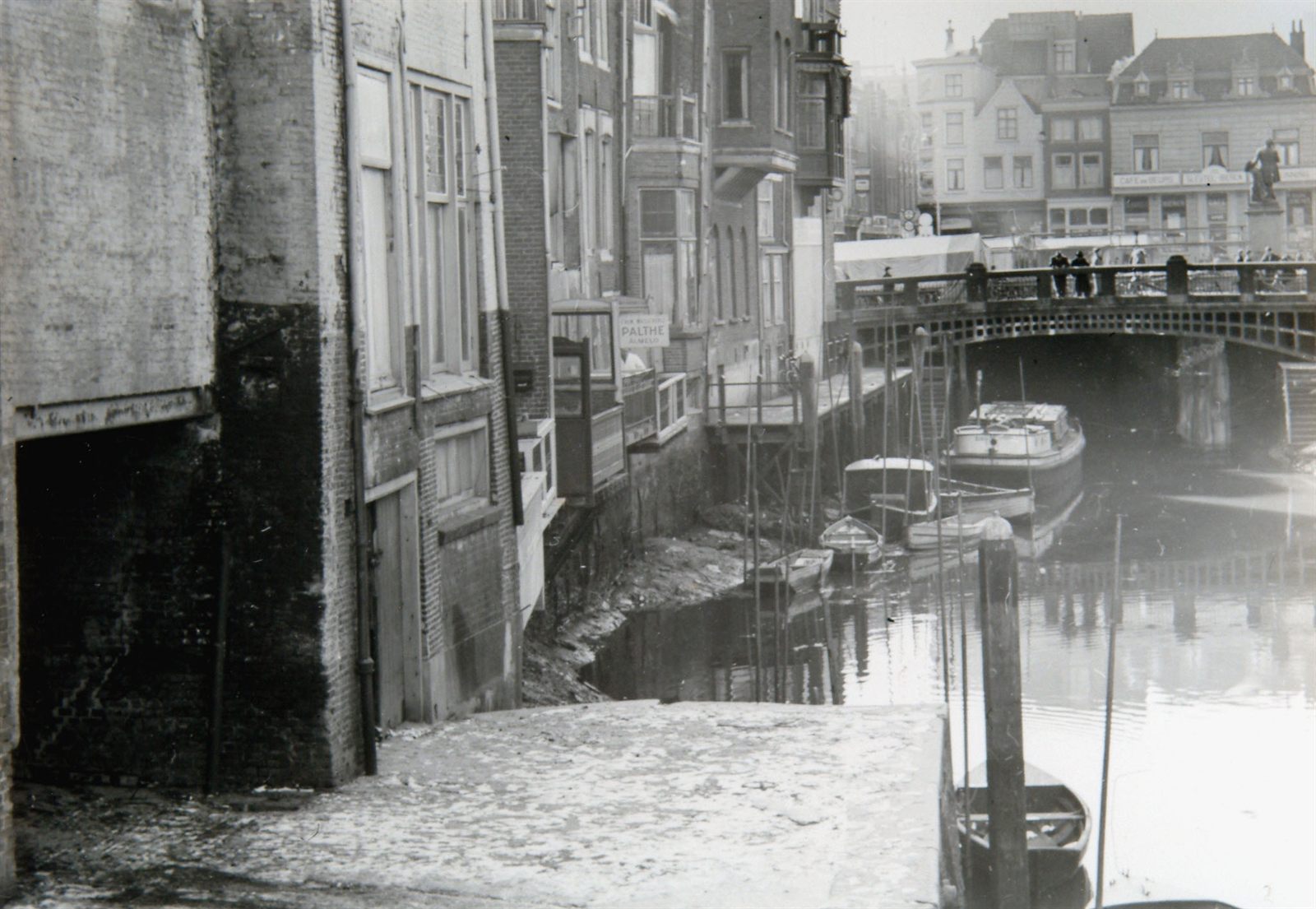
Much of that Dordrecht is still there: the street plan, the harbour, the narrow alleys running down to the water, and a great many of the houses. Walking the Voorstraat with the deeds in hand, it is easy to see Reynier's world.
Holland in Reynier's day
Reynier grew up at the end of what the Dutch call their Golden Age. The Republic of the Seven United Provinces was the richest country in Europe: a nation of traders, towns and ships, where more people could read than almost anywhere else, and where books, maps and newspapers were printed for half the continent. Its public church was the Reformed church, but others were tolerated as long as they kept out of sight. Catholics, Lutherans and Mennonites worshipped in hidden churches behind ordinary house fronts, and married before the magistrates at the town hall instead of in church, which is exactly how Reynier's parents married in 1652. His grandparents' marriage has not been found, but they do not appear in the Reformed books either.
The last decades of the century were hard. In 1672, the Rampjaar or "disaster year", France, England and two German bishoprics invaded the Republic at once, and Dordrecht's own Johan de Witt was lynched by a mob in The Hague. Wars with France followed for most of the next twenty-five years, paid for with heavy excise taxes, charged on everyday goods as they were sold, including the milling of grain. Then the 1690s brought failed harvests across Europe and some of the highest grain prices of the century. Reynier's bankruptcy, in 1695–96, came in the middle of those years. Whether they caused it is not known, but a man whose trade was buying grain and selling groats would have felt them.
Two mothers at the banns
When Reynier and Anna registered their intention to marry at Leiden on July 11, 1685, neither of their fathers came. The register records who did: for the groom, "Leyntge van der Sluys, of Dordrecht — his mother"; for the bride, Margarita van Scharpenbrant — "her mother", living on the Pieterskerkgracht in Leiden, the canal that runs beside the Pieterskerk. The same entry calls Reynier a koopman in granen, a grain dealer.
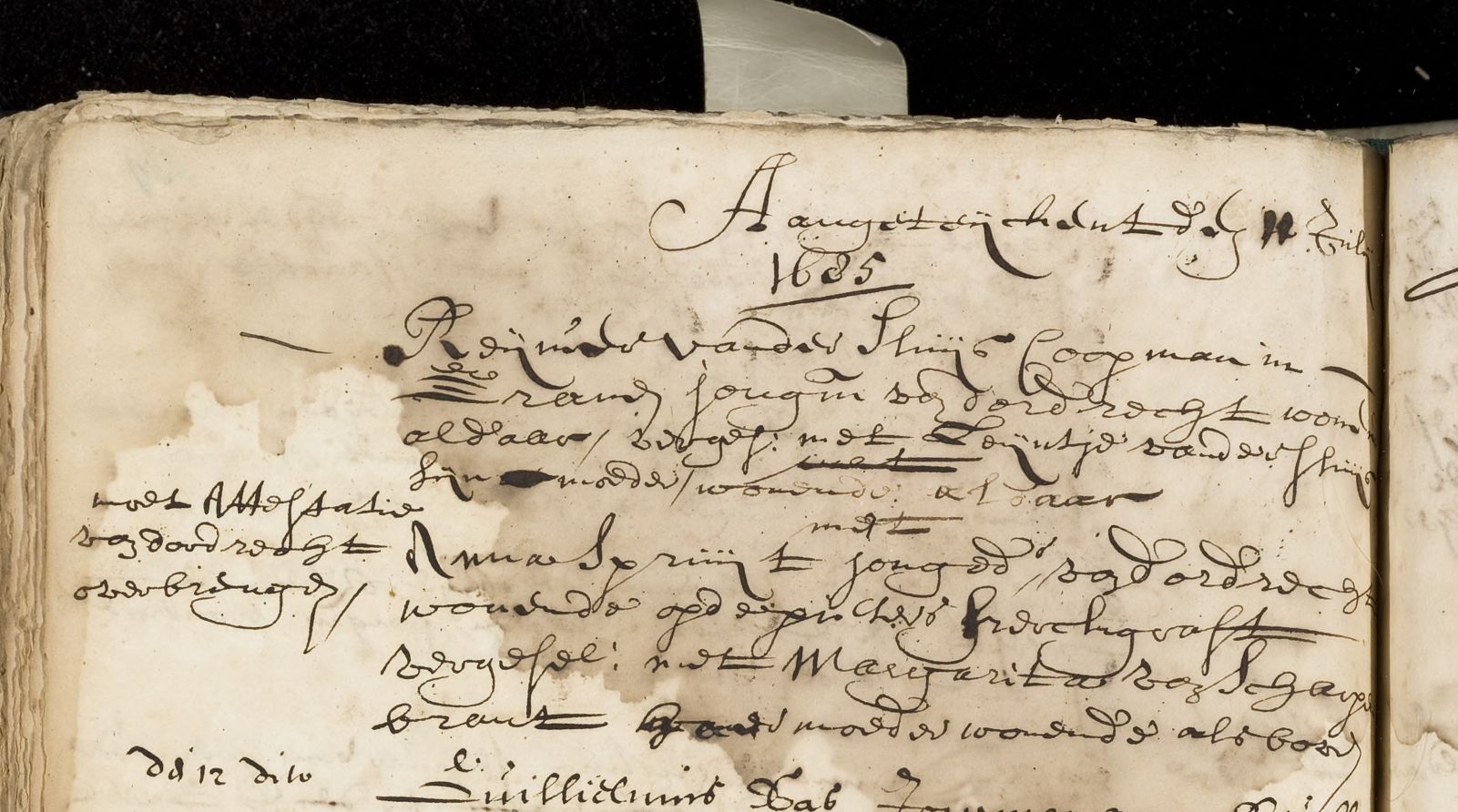
That entry also settles his age, roughly. Older compilations give his birth as 1673, which cannot be right: a boy of twelve does not publish marriage banns, make a will (Reynier and Anna made a joint one at Leiden in January 1686) or buy a house. Anna was twenty, and Reynier was probably a few years older, born around 1655–1663.
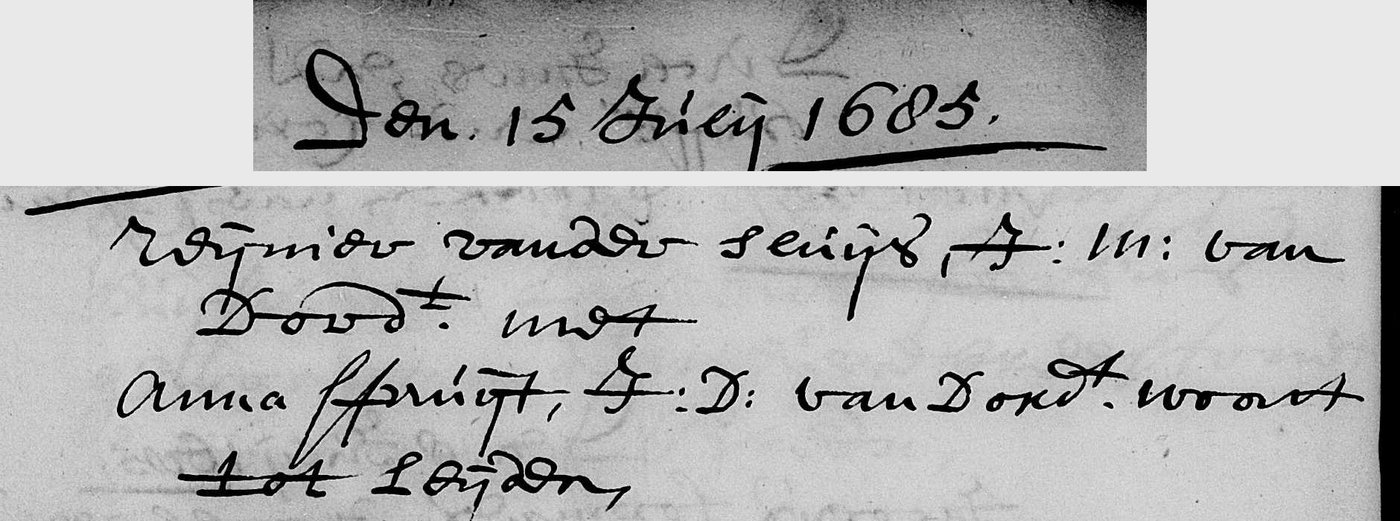
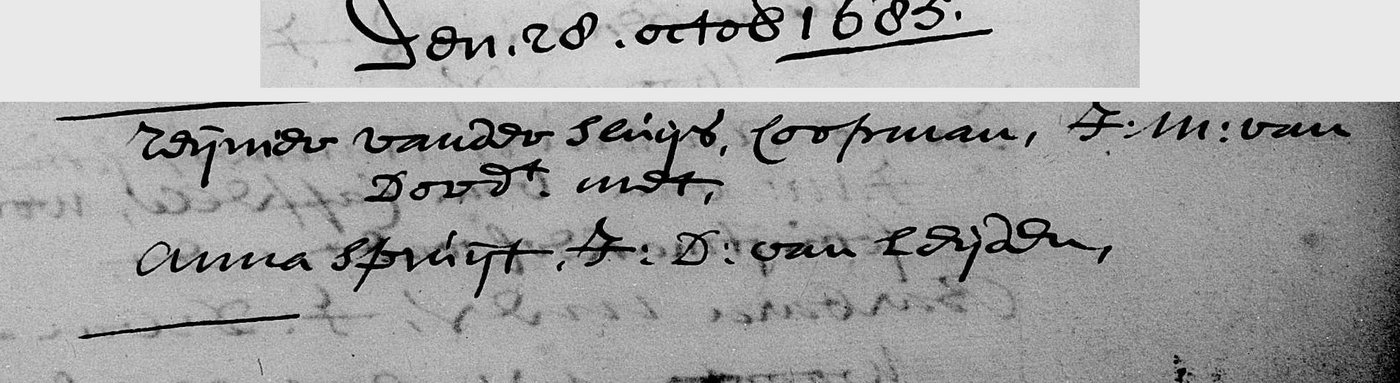
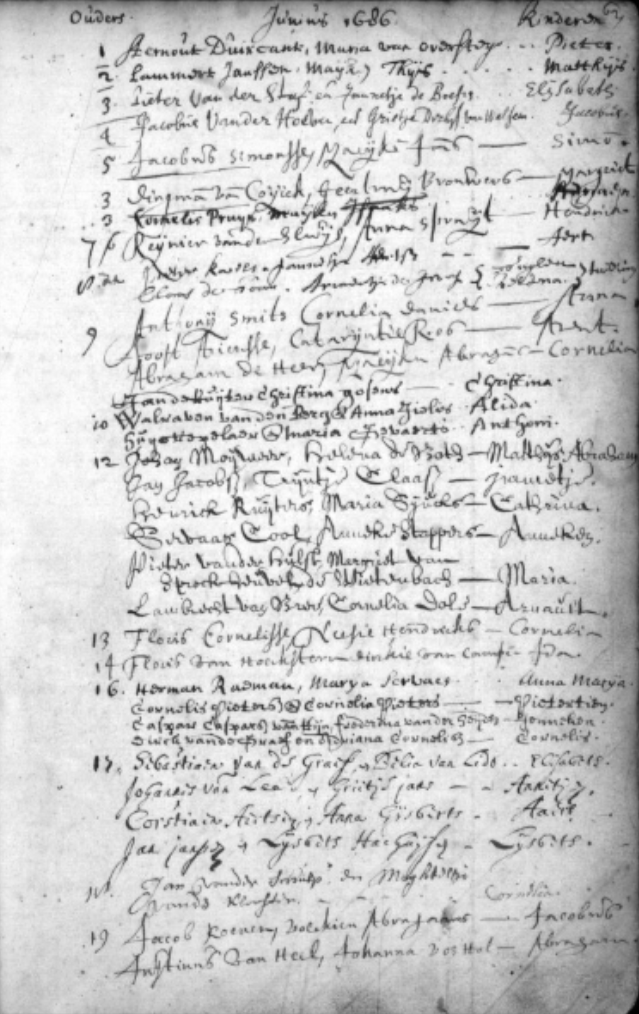
The banns were read in Dordrecht too, where they were entered on July 15, 1685, and the couple were married there on October 28, 1685. Both entries, found in September 2026 and shown below, are in the same register (Regionaal Archief Dordrecht, archief 11, inv. 24). The names are spelled Reynier van der Sluys and Anna Spruyt, which is why earlier searches under "Sluijs" and "Spruijt" missed them. The register also answers the question of the church. Dordrecht's Reformed congregation kept a separate marriage register for each of its churches, and these entries are in the register of the Grote Kerk, the great church of Our Lady on the harbour, whose tower still stands over the old city. Reynier and Anna were married there. (The Dutch researcher Marcel Verolme, writing on WikiTree, gives the Augustijnenkerk on the Voorstraat; the register points to the Grote Kerk.)
A child, a trade, a guild
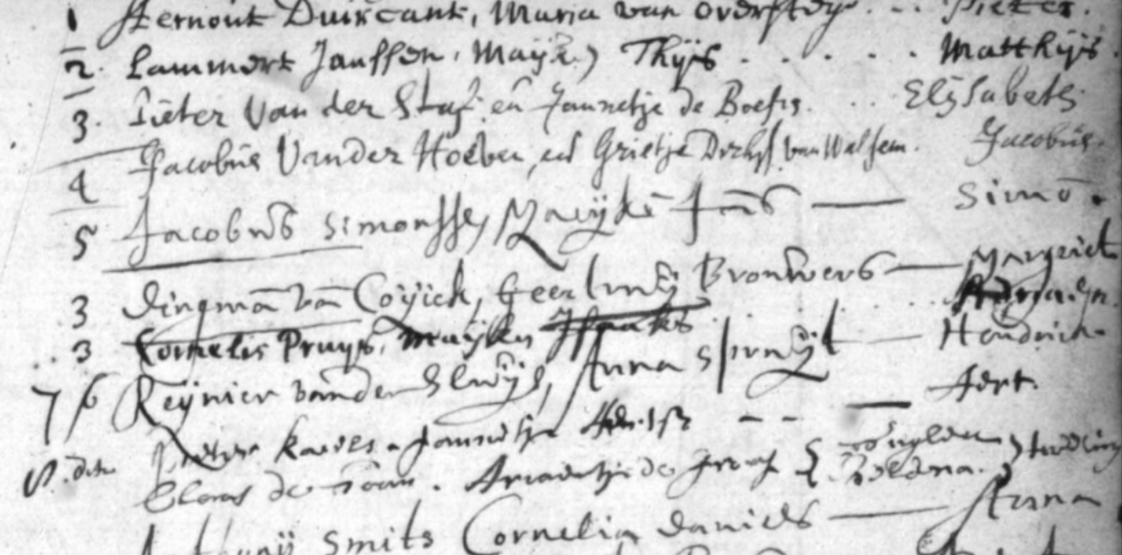
Eleven months after the banns the couple were living in Dordrecht. In the city's baptism register, under Junius 1686, on the seventh day of the month: Reijnier vander Sluijs, Anna Spruijt. The child's name is disputed: the modern index reads Hendrick, which was Anna's father's name, while the register page looks more like Aert.
The Dordrecht records give his trade more precisely than the Leiden banns: he was a grutter, a groat-miller, the tradesman who hulled grain and sold groats, and they name him so again and again. The groat-millers were organised in a confrerie, and each summer the guild put forward two names, from which the city's magistrates chose one to serve as its deken (head) for two years. Reynier was on that short list three years running, in July 1689, 1690 and 1691. He was nominated each time and, as far as the records show, never chosen: in 1691 the post went to Adriaan van Beest. The man chosen in 1688 is worth noticing: Damas Hooglander, the fellow groat-miller who would buy Reynier's house out of his bankruptcy.
What a groat-miller did
Groats (Dutch grutten, or gort for barley) are grain with the tough outer husk taken off: whole or cracked kernels of barley, buckwheat or oats. Boiled into porridge or used to thicken soup, they were the everyday food of ordinary Dutch families, and cheaper than bread. The grutter bought grain by the sack, much of it straight off the river boats, and ran it through a mill whose stones were set just far enough apart to rub the husks off without crushing the kernels. Many were turned by a horse walking in a circle, a rosmolen or horse-mill, like the one Reynier's father bought on the Vriesestraat in 1682. The hulled grain was then sifted and winnowed to blow away the chaff, cracked if a coarser grade was wanted, and sold from the shop by the measure, along with meal, dried peas and beans. The word has outlived the trade: in Dutch a grutter is still a small grocer, and grutterswaren are dry goods.
A house bought, and lost
On November 20, 1686 Reynier bought a corner house and lot on the Voorstraat, Dordrecht's main street, paying 2,000 guilders to a minister, Henricus van Rheenen, out of the estate of the widow Catharina Bor. That was a great deal of money: a skilled tradesman in Holland earned roughly a guilder a day, so the house cost something like seven years' wages (see what the money meant). Ten years later it was gone. The court appointed curators over his insolvent estate in December 1695: trustees who took charge of a bankrupt's property and sold it to pay his creditors. On March 17, 1696 they sold the house for 1,650 guilders to Damas Hooglander. It was a loss of 350 guilders, and with it went the family's footing in the city.
Where it stood
The deeds place it in the way seventeenth-century deeds do, by its corner and its neighbours, since houses were not numbered until around 1800. In 1688, pledging it against a bond, Reynier and Anna describe "a house on the corner of the Bolle- or St. Janssteiger, running back to the harbour, standing between the said alley and the house of Seger Blanckert." The 1696 sale repeats it: "a house in the Voorstraat between the Beurs and the Wijnbrug, standing on the corner of the Bollesteiger, between the house of Segert Blanckert, butcher, and that of the widow Van Claveren, running from the street at the front to the harbour at the back." A narrow, deep plot on the north side of the Voorstraat, its back to the water, with an alley down one side.
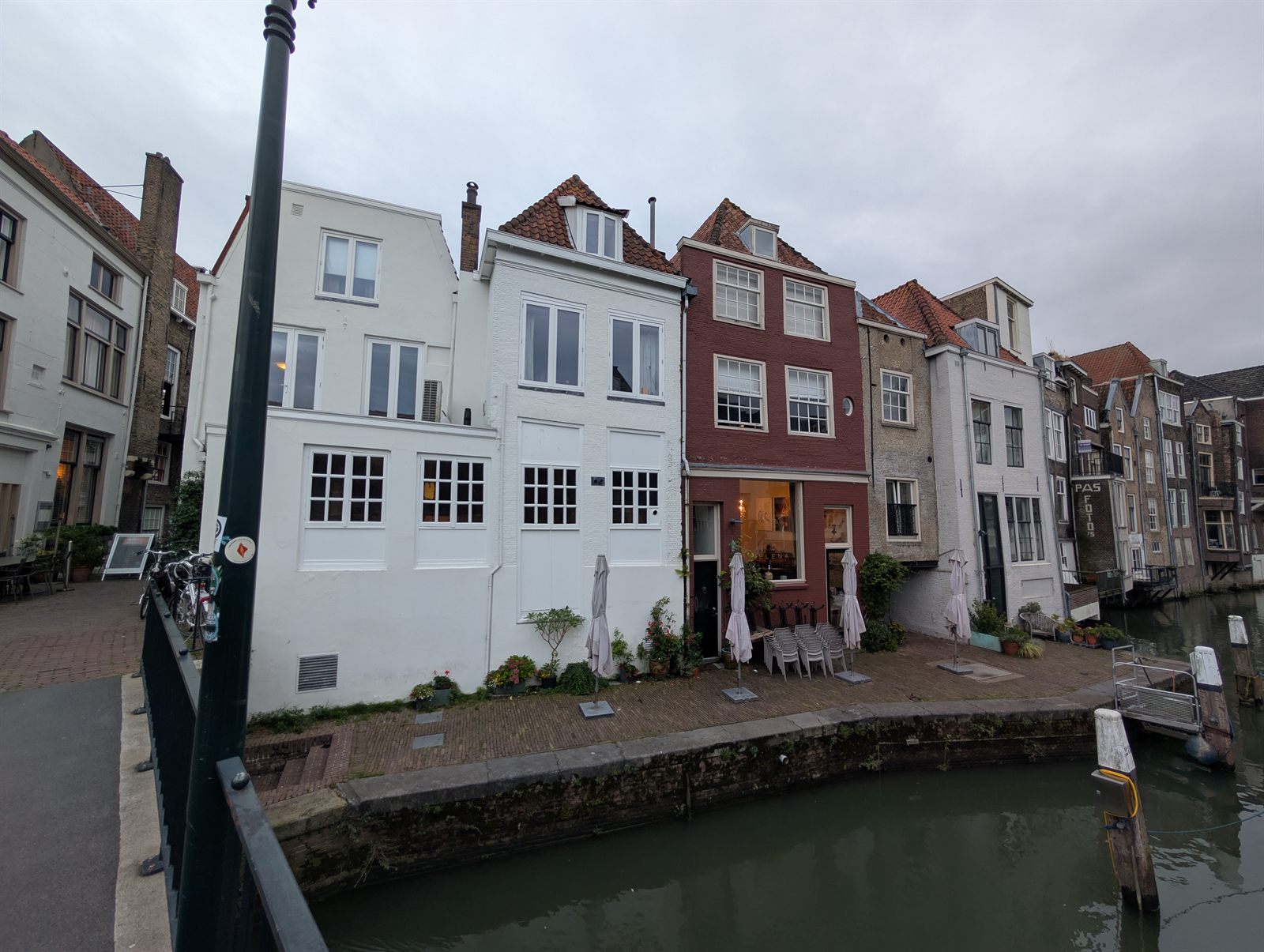
That alley still exists, and is now the Donkere Steiger. In Reynier's day it was the Sint Janssteiger or the Bollensteiger. It is the one alley in Dordrecht that was built over: the tiny house bridging it, one window wide, went up in 1632 and is known as the narrowest house in the city. It was already half a century old when Reynier moved in next door, and it is still there.
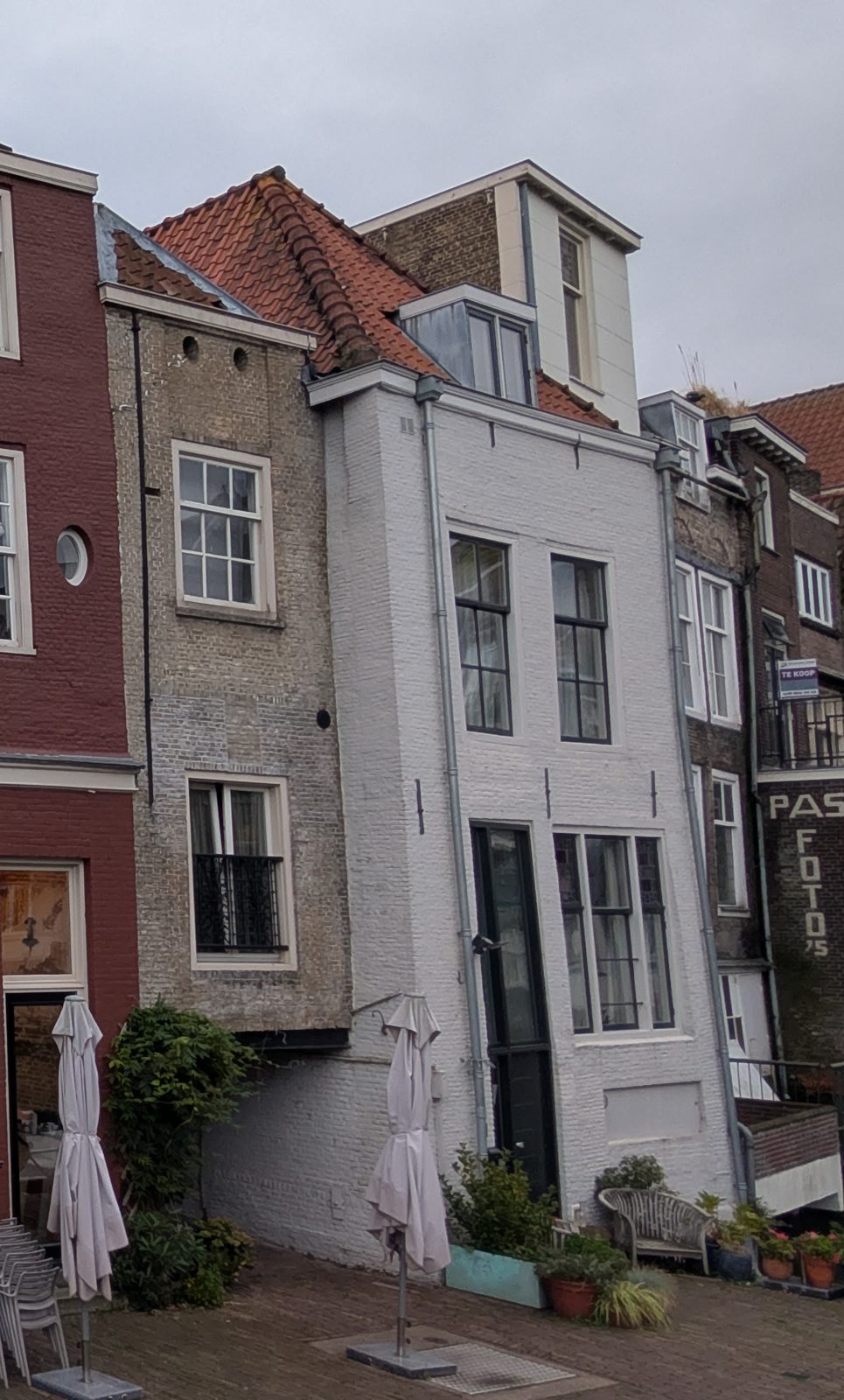
A 1693 lantern-tax roll walks the street door by door, and it catches him at home: Hendrik Tafelmaker, furrier — Seger Blankert, butcher — Reijnier van der Sluijs, grutter, 2 gulden 2 stuivers — juffrouw van Klaveren — Jasper van der Velde — Jacob de Leeuw — Jacob van Dalen, and then the Wijnbrug. Four households stood between the bridge and the alley in 1693; today there are three addresses, because Voorstraat 261 was later made out of two houses. Counting back from the bridge, the widow Van Claveren's house is today's 263, and Reynier's is the first house on the far side of the alley — Voorstraat 267.
How firm is the identification with Voorstraat 267?
The corner is certain: the deeds put the house on that alley, and the alley is the Donkere Steiger. Two independent lines of evidence then point to the same house. The first is the 1693 count from the bridge, which reconciles well because the national monument register independently records 261 as two houses since joined. The second is the chain of owners below, which follows the corner house from Reynier to the numbered house C 14, later 209 and now 267, and keeps it apart from the house on the other corner, which has its own separate owners.
What keeps it short of proof: the count assumes the tax roll lists every door in order, two links in the chain of owners rest on family names rather than on a deed that says so, and most of the deed wording comes from published abstracts and transcriptions rather than from the registers themselves. If the count were out by one, the answer would be 269 next door. Call it very likely.
Was the Voorstraat a wealthy address?
The name means "Front Street". It was, and still is, the city's main street, running along the old dike beside the Voorstraatshaven, with shops and houses whose backs stood on the water so that goods could come in by boat. When I visited in 2026, a local told me that anyone who lived on the Voorstraat was considered wealthy. That is partly true. It was the address of merchants and well-to-do shopkeepers, not of labourers. But Reynier's own records place him in the middle of it rather than at the top. His house cost 2,000 guilders, about seven years' wages for a skilled craftsman, which was a large sum but not the price of a mansion for one of the regents, the families who governed the city. In the 1693 lantern tax, a tax on each house to pay for the street lamps, he paid 2 gulden 2 stuivers, about the same as the butcher next door. He was a respectable tradesman, comfortably off but not rich, and his bankruptcy a few years later shows how thin that margin could be. (The same person told me that if I could afford to visit Dordrecht, I must have some wealth too. That is typical of the Dutch, who are famously direct: they say plainly what others might only hint at, and nothing rude is meant by it. It was said as a compliment, and I took it as one.)
Everyone who came after him
Put the deeds, tax books and directories end to end and the house can be followed owner by owner from 1686 to today:
| Year | Owner or occupant | How we know |
|---|---|---|
| 1686 | Reynier van der Sluijs, groat-miller | purchase, 2,000 guilders |
| 1696 | Damas Hooglander, groat-miller | bankruptcy sale, 1,650 |
| 1697 | Abraham Hordijck, plumber | resale, 1,650 |
| 1745 | Pieter Evenwel, mason | Hordijk sells the "corner house", 1,700 |
| 1752 | Hendrik de Visser, mason | sale, 1,800 |
| 1786 | Johannes de Haan, bread baker | De Visser's children sell "on the corner of the so-called Donkere Stijger", house C 14, 2,600 |
| 1822–24 | Joseph Keller; then Jan Baptist van der Maaden, fish-seller | sales |
| 1832 | J. B. van der Maaden | first land register: C 14 = parcel H 1108 |
| 1840–79 | Cornelis Dominicus Pennock, glass and earthenware | directories and tax lists |
| 1884 | B. Wirtz | renumbering: C 14 becomes 209 |
| 1930s | an ironmonger's shop | photograph (below) |
| 1957 | — | renumbering: 209 becomes 267 |
The other corner of the alley, house C 15, later 207 and now 263, had its own separate owners throughout: the De Haan bakery, whose back door also opened onto the alley. Two links in the chain above rest on family names rather than on a deed that says so: that the Abraham Hordijk who sold in 1745 was the heir of the one who bought in 1697, and that the Vissers who sold in 1786 were Hendrik de Visser's children.
Standing at the door, 2026
On September 13, 2026 I walked up the Voorstraat with the deeds in hand, and everything the seventeenth-century clerks described is still in place. The alley opens where it should. The little house of 1632 still bridges it, one window wide, with the passage running dark underneath. And the first door on the far side of it is 267.
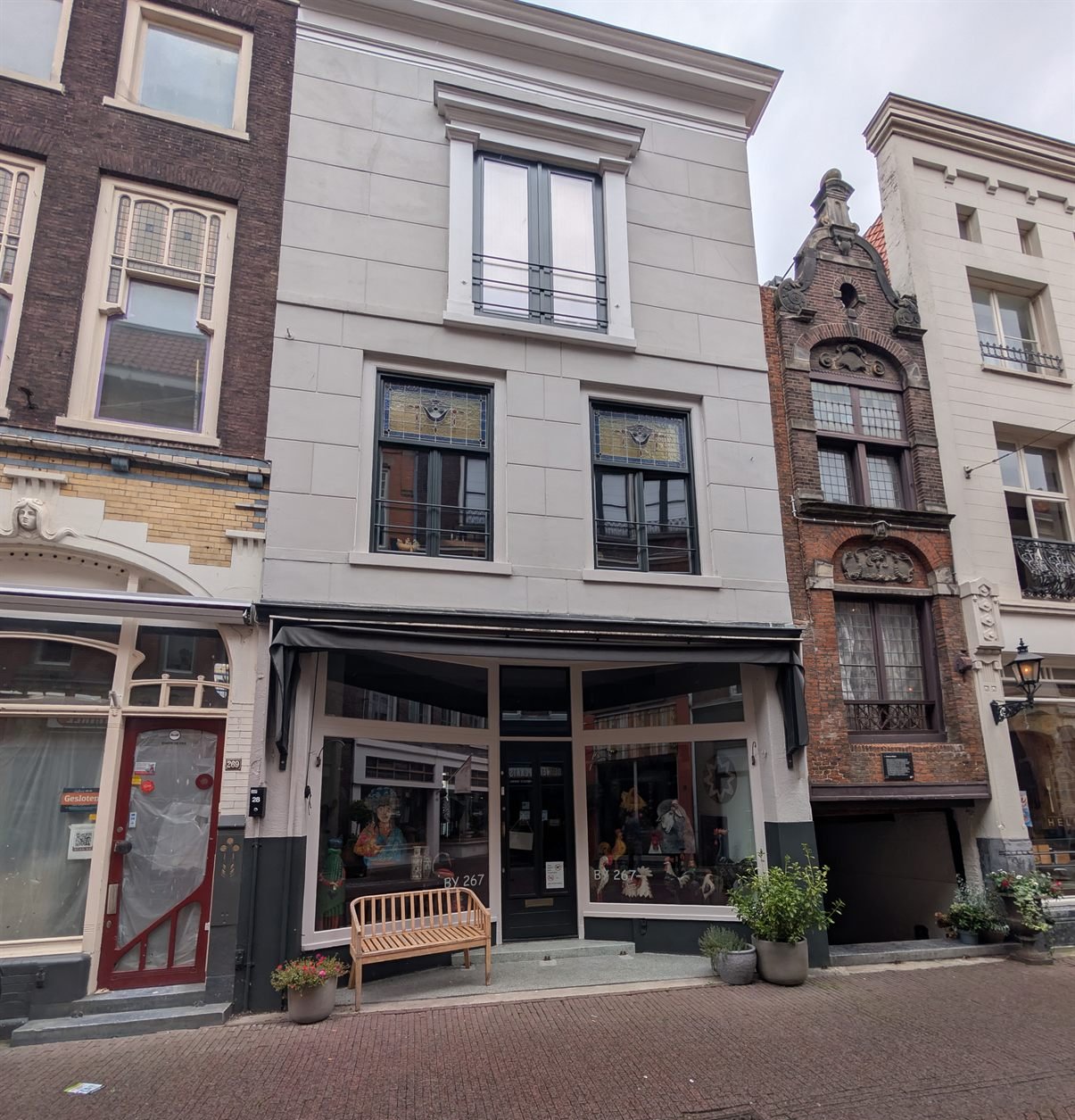
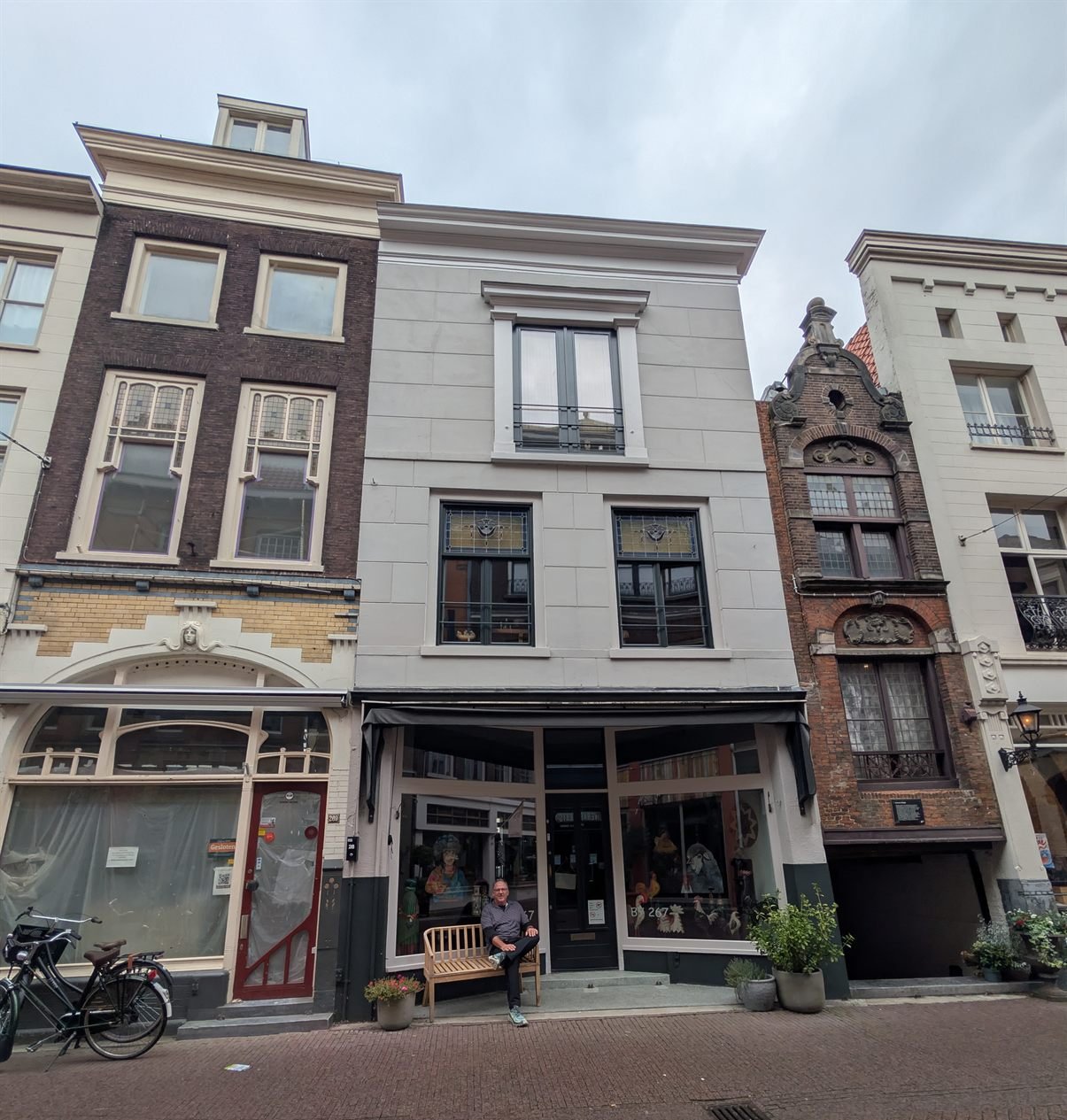
The street front is worth being honest about. The national monument register (no. 13797) dates it to the first part of the nineteenth century, more than a hundred years after Reynier sold the house and sailed. But it dates the Wijnhaven side, the wall over the water, to the seventeenth to eighteenth: the part of the house his deeds keep describing.
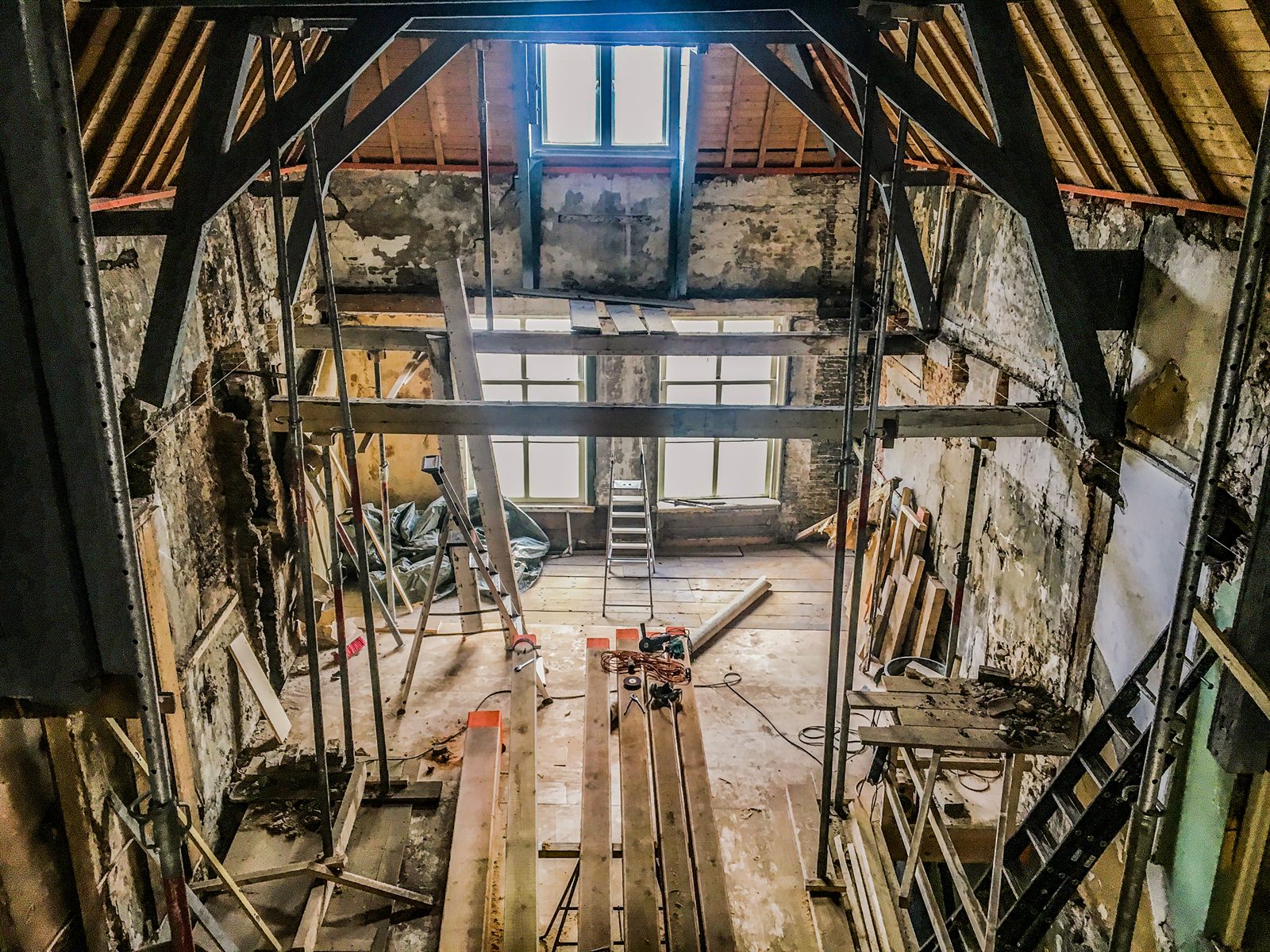
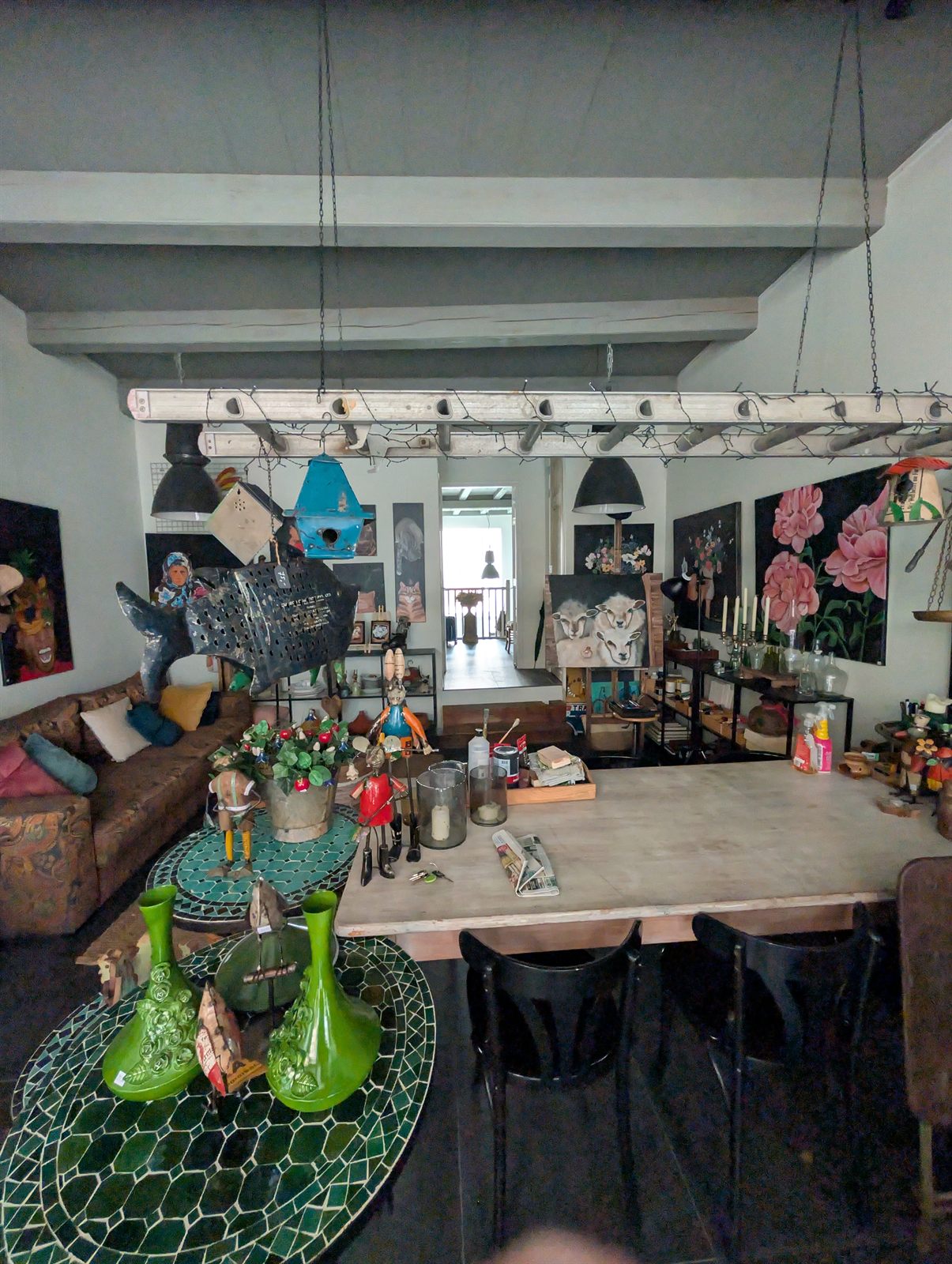
The present owners opened the door, talked about the building, and shared photographs of it, their own from the renovation and older ones they have gathered. Two of the old ones show the house as number 209, the number it carried from 1884 until 1957.
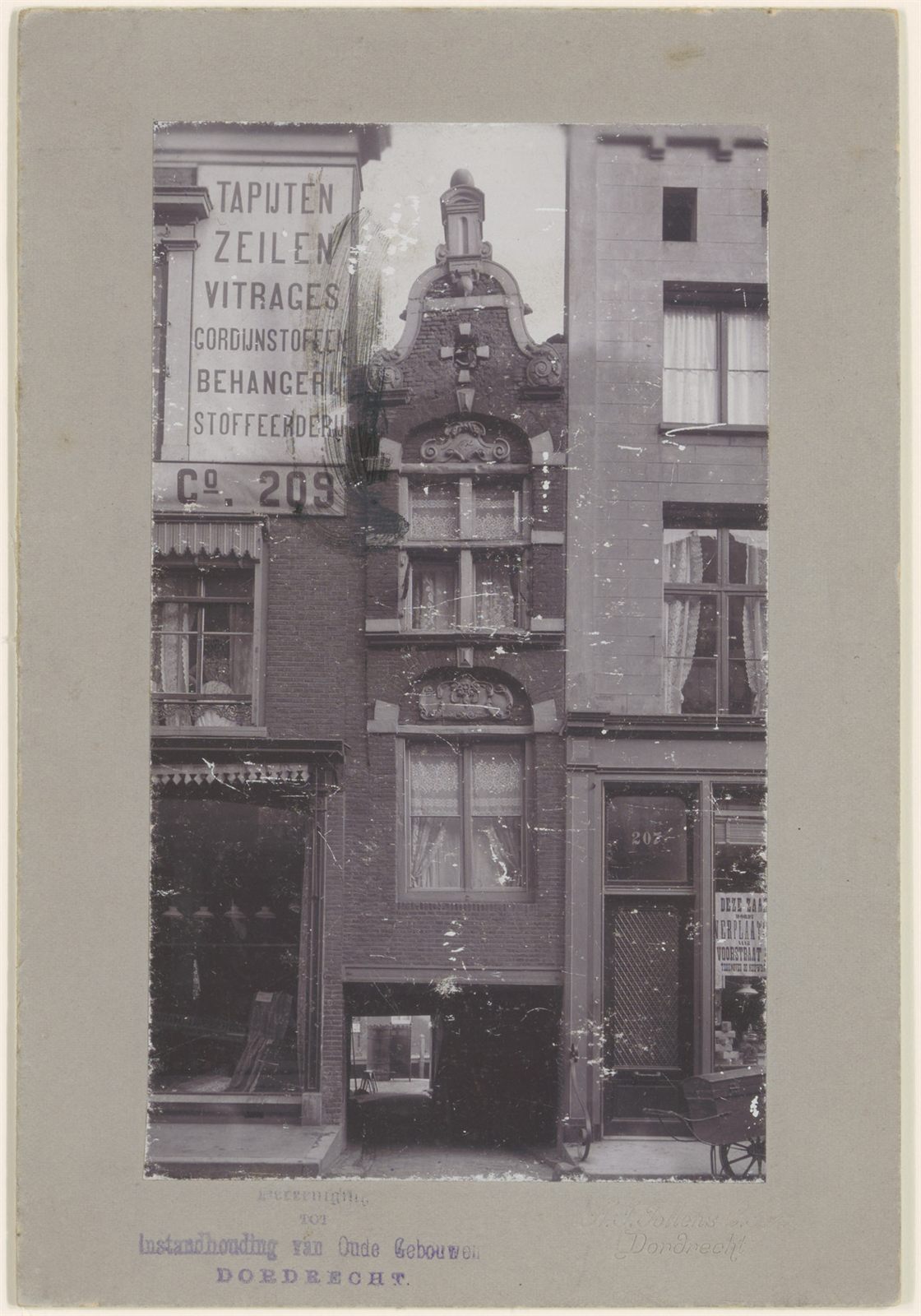
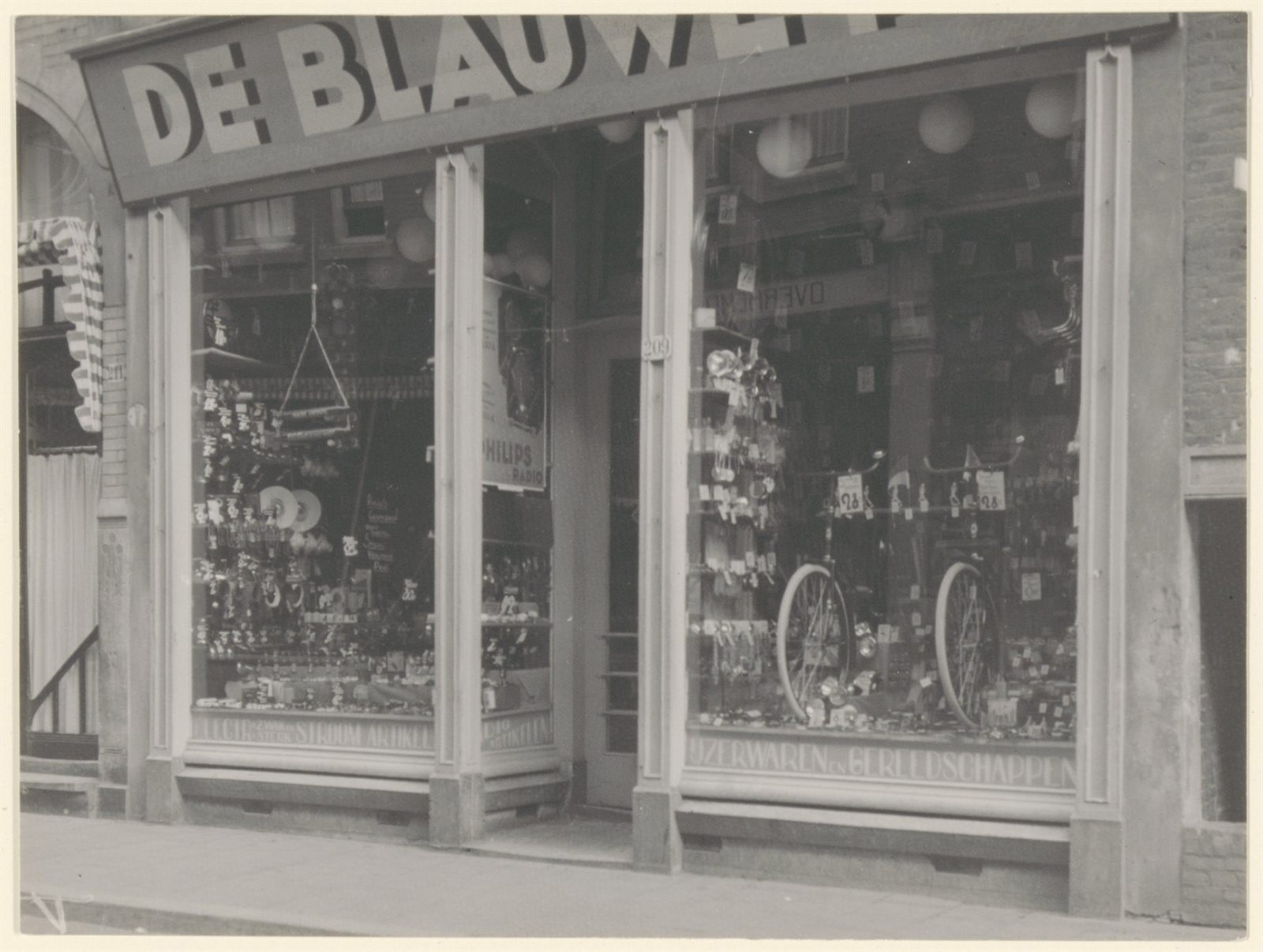
The half of the deed that is hardest to picture from the street is the phrase that keeps recurring in them: strekkende voor van de straat tot achter aan de haven, running from the street at the front to the harbour at the back. From the Wijnbrug you can see that half.
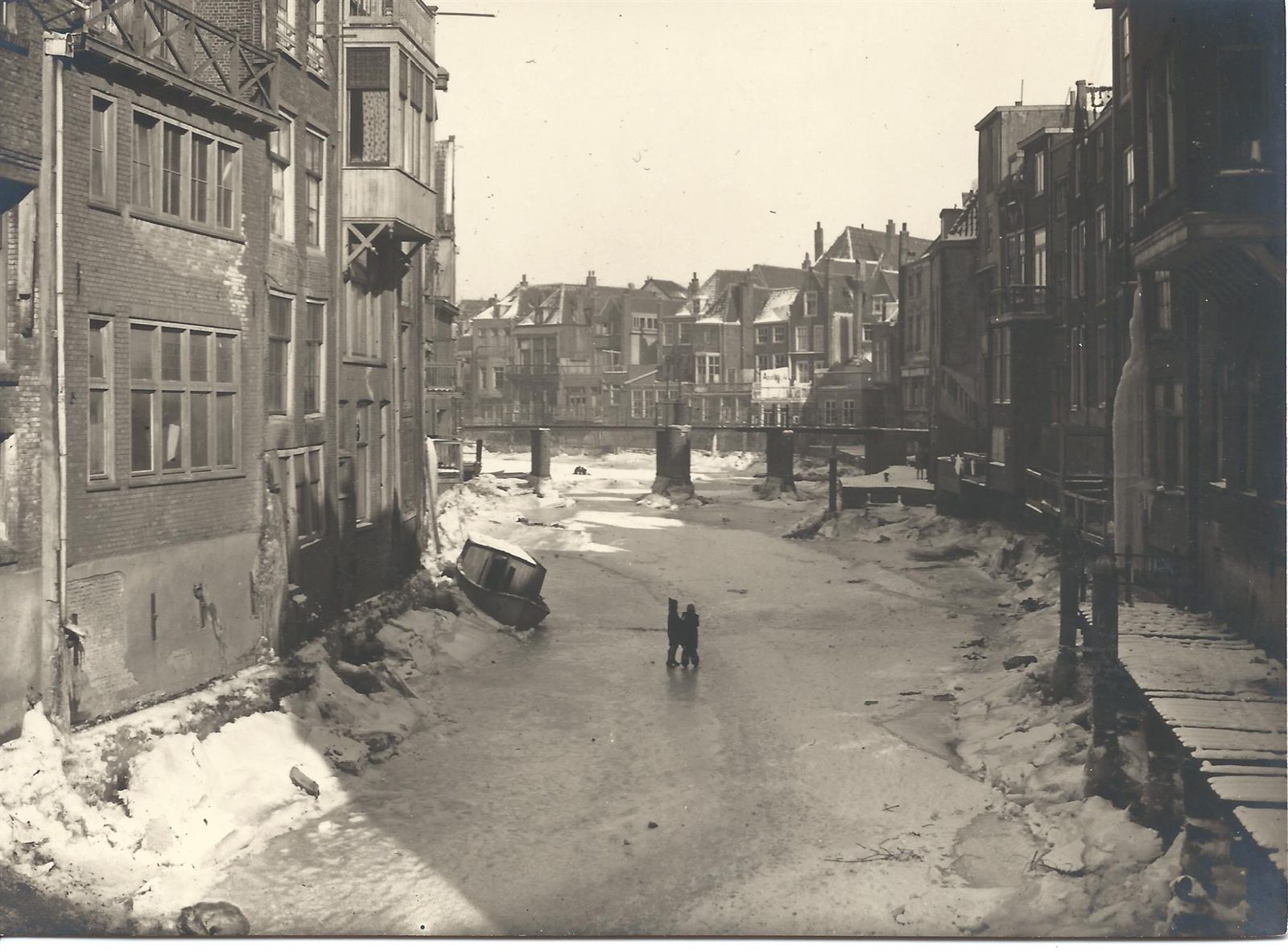
Why leave?
The bankruptcy of 1695–96 is the turning point. Reynier lost the house, and with it most of what he had built in ten years. The months before it show a man trying to keep going: a run of notarial acts in 1695, business over houses in the Vriesestraat and the Kromme Elleboog, and at the same time the estates of his brother Pieter and Pieter's wife to settle. He stayed on in Dordrecht for a few more years, and went back to the family street. On September 2, 1698 he and Anna borrowed 400 guilders from a fellow groat-miller, Cornelis Schippers, on the security of a groat-mill with a horse-mill in the Vriesestraat, and the deed names their neighbour as "the widow of Arij van der Sluijs": his mother, next door. Having lost the house on the Voorstraat, Reynier was working the mill his father had bought in 1682, and he had probably been working it for years. The mill’s neighbours show it: Elias Segersz. de Leeuw lived beside it when Adriaen bought it in 1682, and on May 10, 1695, months before the bankruptcy, a man of the same name bought the house next door, called “De Waagschaal” (the Scale), and the deed names its neighbour as Reynier van der Sluijs, grutter. In December 1699 he and Anna were at Leiden, giving a power of attorney before a notary there, and on August 26, 1701 they gave another, in Dordrecht, to Anna's brother-in-law Caspar Vermaes, to look after their affairs once they had gone.
That day's two acts survive in the book of the Dordrecht notary Hugo van Dijck, and they say in so many words where the family was going. Both open the same way: Reijnier van der Sluijs and Anna Spruijt, husband and wife, burghers of this city, gedestineert omme te doen den voyagie naer Pensilvanie, "intending to make the voyage to Pennsylvania". The first, act no. 60, a procuratie ad negotia, makes Caspar Vermaes, court messenger at Leiden, their attorney for all their affairs in Dordrecht, Leiden or anywhere in Holland, and in particular for whatever might come to them from Anna's mother, Margaretha van Scharpenbrant, and from the Scharpenbrant family. The second, act no. 61, is a bond: they acknowledge owing Sr. Margreta van Scharpenbrand, haer moeder en schoonmoeder respective, their mother and mother-in-law, five hundred and fifty Carolus guilders (the standard guilder used in accounts), paid over to them through Caspar Vermaes and spent on their voyage. Neither act names a ship or a sailing date.
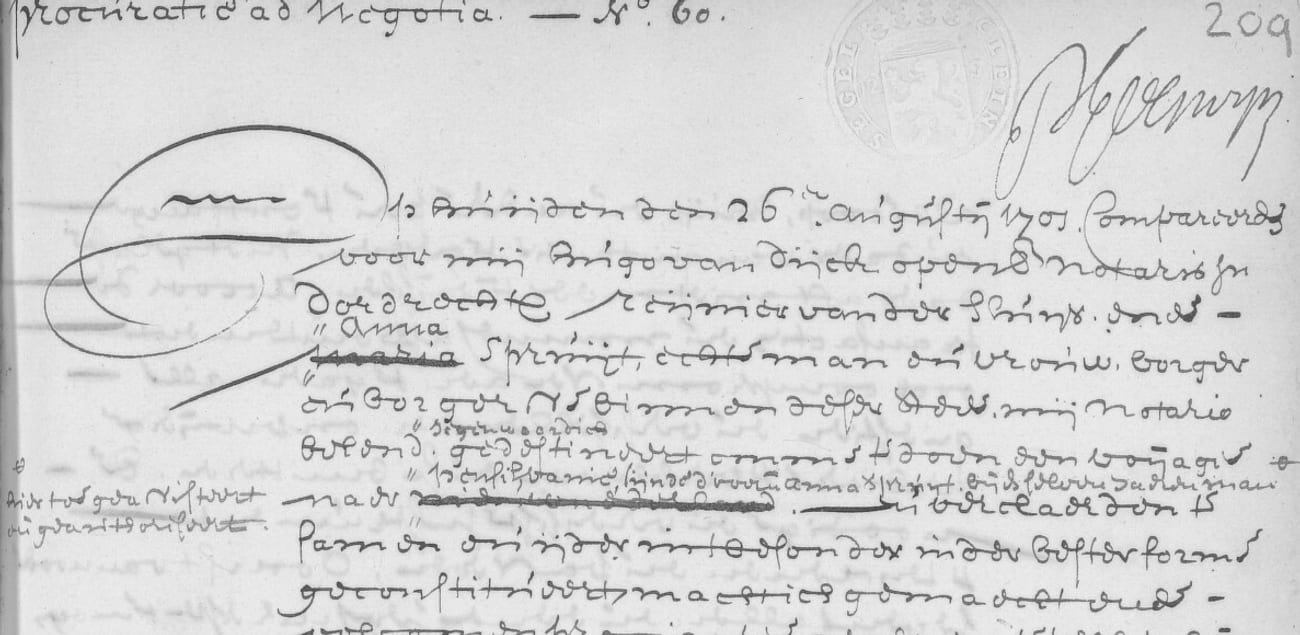
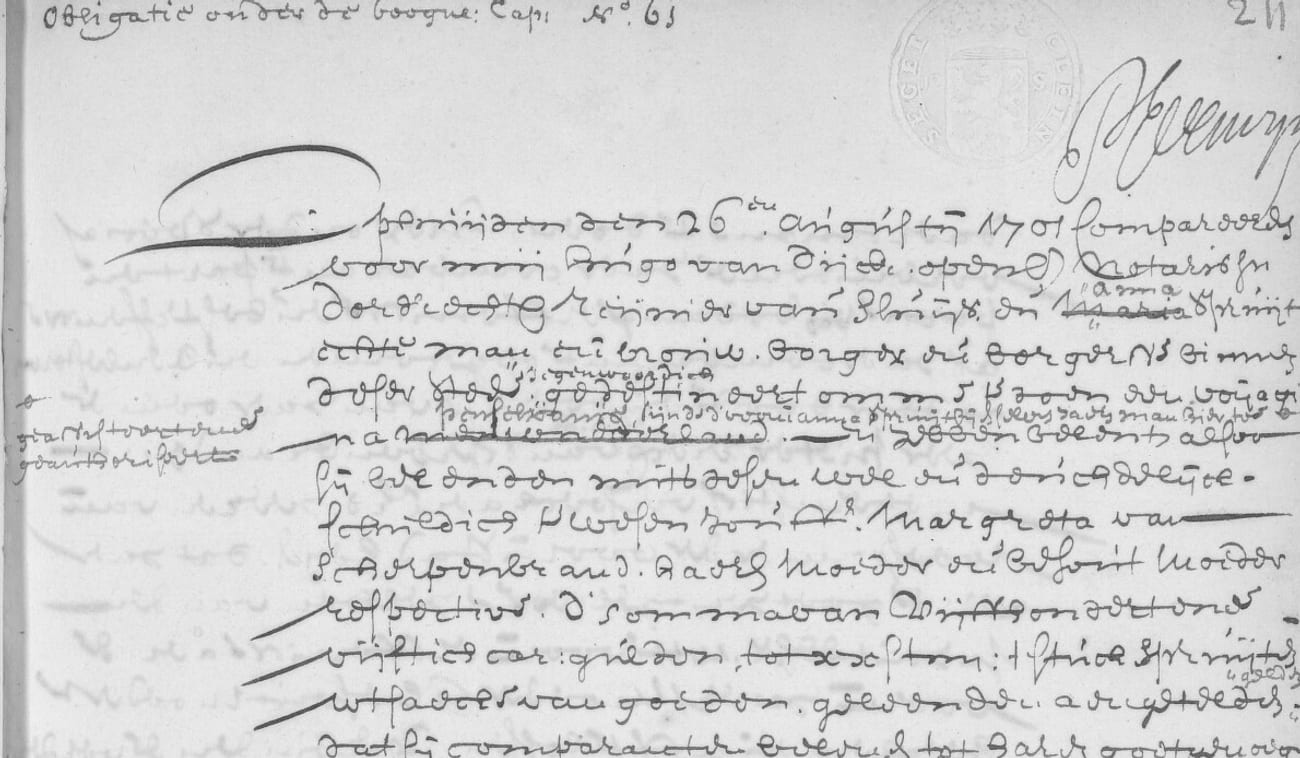
Why Pennsylvania, and why Germantown? No letter survives to say, but the circumstances point somewhere. Germantown had been founded in 1683 by Dutch- and German-speaking families from the Krefeld area, many of them Mennonites and Quakers, on land William Penn offered to people who wanted to worship freely and start again. Reynier's parents had married before the magistrates, outside the Reformed church, which is how Dutch Mennonites, among others, married. That may be coincidence: Reynier himself registered his banns and baptized a son in the Reformed church, and his son Anthony's family later belonged to the Lutheran church at Trappe. But a family with ties to one of Holland's dissenting churches would have heard about Germantown, and would have known people there.
What may have pushed them
Nothing in the records says why they went. No letter, diary or statement of Reynier's survives. What follows is reasoning from what the records do show: the events around him are documented, but whether they were his reasons is a guess, if a reasonable one.
- Ruin. In a trading city, a man's credit was his living. The bankruptcy of 1695–96 cost Reynier his house, and it put his name before the court and his creditors, among them a magistrate of the city. A bankrupt groat-miller in Dordrecht would find it hard to borrow, to buy grain on credit, or to be put forward for the guild again.
- Loss. His brother Pieter was dead by March 1695 and Pieter's wife by February 1696; the records that settle their estates name Reynier, so those deaths are documented. His father's death is less certain. An Adriaen van der Sluys was buried from the Vriesestraat in 1687, which may or may not be him, and the records only prove he was dead by September 1698, when a deed calls Lijntje his widow. The family he had grown up in was shrinking around him, but no record says that grief played any part in the decision.
- Hard times. The 1690s were a bad decade to be in the grain trade. War with France (1688–97) was paid for with heavy taxes, including a tax on the milling of grain, and failed harvests across Europe drove grain prices to some of their highest levels of the century.
- A city past its prime. Dordrecht was losing its trade to Rotterdam and Amsterdam. For a tradesman starting again from nothing, it offered little room to grow.
What may have drawn them
- Land of their own. In Holland, land was scarce and dear, and a craftsman's family could hope at best to own a town house. In Pennsylvania, William Penn was selling land cheaply to anyone who would settle it, and ownership brought a vote and security to pass on to one's children.
- A colony advertised in Dutch. Penn recruited actively on the Continent. In 1681 his account of the new colony was published in Dutch at Rotterdam, twenty kilometres down the river from Dordrecht, by his agent Benjamin Furly, who also arranged passages. News of Pennsylvania was close at hand.
- A Dutch-speaking town. Germantown had been founded in 1683 by thirteen families from Krefeld, many of them Dutch-speaking Mennonites and Quakers, and by 1700 it was a town of weavers and craftsmen where Dutch and German were heard as much as English. A Dordrecht family could arrive among people who spoke their language.
- Freedom. Pennsylvania promised liberty of conscience to all who believed in God. There were no guilds to join and no one who knew about the bankruptcy. If the family's roots lay in one of Holland's tolerated but second-class churches, that freedom may have counted for a great deal.
What the money meant
To pay for the voyage and a new start, Anna's mother lent them 550 guilders. (Earlier accounts give it as 553; the bond itself reads vijffhondert ende vijftich, five hundred and fifty.) Converting old money is never exact, and the two usual methods give very different answers:
| Amount | In wages around 1700 | In today's money, by wages | By prices |
|---|---|---|---|
| 1 guilder | about a day's pay for a skilled tradesman | €100–150 / $110–165 | €10–12 |
| 550 guilders (the loan) | about two years' earnings | €60,000–90,000 / $65,000–100,000 | about €6,000 |
| 2,000 guilders (the house) | about seven years' earnings | €200,000–300,000 | about €22,000 |
The "by prices" column measures what a guilder could buy in bread, cloth or rent. The "by wages" column measures how long it took to earn one, and it is the fairer comparison for a family's finances, because people then spent most of what they earned on necessities. By that measure, 550 guilders was a large sum: not a fortune, but enough to carry a family across the ocean and give them a real start. For a man just out of bankruptcy, it was a loan he could not have raised anywhere else. His mother-in-law was backing him.
In English money, 550 guilders came to about £50 sterling. The fare to Pennsylvania was a few pounds for each adult, less for children, and a family also had to pay for food on the voyage and the carriage of its goods, so the crossing alone would have taken a good part of it. What remained went much further in Pennsylvania than in Holland. Land there was cheap by Dutch standards, and a few tens of pounds could buy a Germantown house lot with a modest dwelling, or the start of a farm, though not both with much to spare. That fits what we know: the Van der Sluijs family arrived with some means, but not wealth.
A note on the figures. These are ranges, not exact values. Wage rates follow the standard studies of the Dutch economy around 1700, and the price-based figures follow the International Institute of Social History's historical value calculator for the guilder. The fares and land prices are the general levels of the time; no record of what Reynier actually paid has been found.
What they gave up, and those left behind
Going meant leaving nearly everyone. In Dordrecht, Reynier's mother was still living on the Vriesestraat, with his aunts Anneken and Maeijken nearby and his aunt Elijsabeth across the street. In Leiden there was Anna's mother, who had paid for the voyage, and her sister Emmerentia. A letter across the Atlantic took months to arrive, if it arrived at all, and families who crossed rarely came back. When the ship left Rotterdam, Reynier and Anna must have known they would probably never see their parents again.
What his family and neighbours thought is not written down anywhere, so this is reasoning, not record. For Reynier's mother, a widow of around seventy, it meant losing her second son a few years after burying her first. For Anna's mother, who paid for the voyage, it meant losing a daughter and grandchildren to a colony few Dutch families had seen. They may also have seen it as the sensible course: a man with a trade and a young family, whose credit in Dordrecht was gone, going where land was cheap and newcomers were welcome. The ties were not cut completely. Caspar Vermaes stayed behind with the power of attorney, and there was family on both sides who could write, send news and settle accounts.
Rotterdam to Philadelphia
No record of the ship has been found, and there may never have been one to find: Pennsylvania did not begin keeping lists of arriving immigrants until 1727. What the voyage was like can be said with some confidence, because the route was the same for everyone who made it in those years.
- The route. Most emigrants from the Dutch Republic sailed from Rotterdam. Under England's navigation laws, ships bound for an English colony had to clear through an English port first, usually Cowes on the Isle of Wight or Deal in Kent, and then crossed to Philadelphia, landing at the wharves on the Delaware. Germantown lay about six miles north.
- How long. The ocean crossing took roughly seven to ten weeks, sometimes more against the westerly winds. With the waiting in port at both ends, two to four months from Holland to Pennsylvania was typical.
- On board. Passengers lived below deck in close quarters, on salt meat, ship's biscuit, dried peas and stale water, with little light or air. Seasickness, fevers and dysentery were common, and children were the most at risk. Deaths on a crossing were expected, not unusual.
- Who went. Reynier and Anna and their children. Their son Adrian, who was naturalized with his father in 1709 and so was an adult by then, was most likely born in Dordrecht and made the crossing as a boy. Anthony, the son through whom this family's line descends, was born in America about 1703, soon after they arrived.
A new life at Germantown
By about 1701–02 the family was settled at Germantown, then a single long street of houses and orchards on the road north from Philadelphia, where Dutch and German were spoken as much as English. On September 29, 1709 Reynier and his son Adrian were naturalized by act of the Pennsylvania assembly, which made them subjects of the English crown, able to own land securely and pass it to their children. Reynier died in July 1713. His will named six children, of whom the 1929 family history traced two, John, whose branch settled in Chester County, and Anthony, who farmed in Providence Township and is buried at the Augustus Lutheran Church at Trappe. Anna survived him and died in Germantown.
A baker in Philadelphia
What Reynier did for a living in America is known from two documents written at the end of his life. His will, made on July 3, 1713, opens: "I, Reijner Vander Sluyse, of the City of Philadelphia, in the Province of Pennsylvania, Baker, being sick and weak in body, but of sound mind and memory…" The inventory of his goods, taken for Anna that August, calls him "Reynier Vander Sluyse of Philadelphia, Baker, deceased." So by 1713 the family was living in the city itself, a few miles south of Germantown, and Reynier had gone back to the trade of bread. It suited a man who had spent his working life in Dordrecht buying grain and milling it, and the Dutch researcher Marcel Verolme reports that he had started out as a baker's apprentice there in the 1670s and was again described as a baker in 1699.
The inventory shows the business. Its most valuable item, at £18, is entered in the printed copy as a "Rolling mill, 12 reels & cases", almost certainly a misreading of bolting mill: a set of cloth-covered reels that sifted meal into flours of different grades, the equipment of a baker or flour dealer. There was a balance with scales and weights, and more "money, scales & weights in the cellar", where he probably kept his stock and sold by weight. The rest is a comfortable household rather than a rich one: four beds, black-walnut chairs and a table, a chest of drawers, a clock, two looking glasses, four maps, pewter plates, a brass teakettle and a set of coffee cups, still something of a novelty at the time. Everything together was valued at £132 17s 6d. The 1929 family history concludes that he "lived in tolerable comfort", which seems fair.
The will itself is short. Reynier left everything to Anna, "as well in Europe as America", a sign that something was still owed to him in Holland, and made her sole executrix. Each of the six children, Arnold, Henry, Johannes, Anthony, Anna and Elentha, received five shillings, to be paid when they came of age or married, with the rest to be divided among them as Anna saw fit. The son Adrian, naturalized with his father in 1709, is not named and had probably died. The will was written out by John Cadwalader, a Quaker, who signed as a witness, with a German named Sprogel. Reynier signed in the Dutch way, Reijner, and the will was proved on July 13, 1713, so he died within ten days of making it.
No image of the will is reproduced here yet. The original is at the Philadelphia Register of Wills (Will Book C, p. 350), and the text above follows the transcription printed in Van der Slice and Allied Families (1929), pp. 218–220.
Of the six, only two can be followed in the records. Anthony is the direct line. His older brother Johannes, known as John, was a shoemaker (a cordwainer) in Springfield Township, next to Germantown, when on May 13, 1726 he bought 99½ acres with a house near Skippack Creek from John Roelfs van der Werf and his wife Deborah. He paid £64 12s. 6d. and took over a £38 mortgage still owed on the land. He moved his family there, into what became Worcester Township, and served for a time as a school trustee. He had died by 1742, when his widow Frances made her will naming their children Anne, Reynier, Mary, Jacob and John. One of the two executors she chose was her brother-in-law, Anthony.
From Anthony the line runs on to the present day, eleven generations from Reynier to me, and the family history calls the Vanderslices "one of the oldest families in Pennsylvania." Follow the line from Reynier →
Where a record of the voyage might still be found
The 1701 acts, checked. The power of attorney and the bond of August 26, 1701 (notarial archive 20, inv. 289, acts 60 and 61) have been read: they name Pennsylvania as the destination, but no ship, skipper or date.
Rotterdam notarial records of 1701, where skippers made contracts with passengers and shippers (Stadsarchief Rotterdam, indexed on Open Archieven).
The papers of Benjamin Furly, William Penn's agent in Rotterdam, who arranged many of these passages.
Germantown and Philadelphia records: the Germantown court book (from 1691), Philadelphia deeds, and the 1709 naturalization act, which fix when and where Reynier first appears.