🚴 Bicycle Tour · June 2022
Munich to Venice by Bike
Across the Bavarian Alps, the Tyrol, and the Dolomites — a ride to Venice that began with a broken-down van and a scramble to the start line.
Across the Bavarian Alps, the Tyrol, and the Dolomites — a ride to Venice that began with a broken-down van and a scramble to the start line.
The plan was clean on paper. Fly Phoenix → Detroit → Munich; pick up rental touring bikes that a bike-tour company would deliver to us in Munich; and ride south across the Alps to Venice over about nine days, June 11 to 19. The same company would carry our non-cycling luggage ahead to Venice, where we'd hand back the bikes, catch a train to Florence to meet my wife and Doug's girlfriend for a few days, and then head on to the Cinque Terre. Simple.
Then, sitting in the airport lounge in Detroit waiting on our overnight flight to Munich, an email landed from the rental company.
So there we were, boarding an overnight flight to a continent where every bike shop was already closed for the night, with no bikes waiting on the other end. What followed was the most creative problem-solving of any trip I've done — and it's why Day 1 doesn't start in Munich at all.
Drag to pan, use +/− to zoom. Days 1–3 are drawn from our recorded GPS tracks. Days 4–7 (dashed) are the planned route we navigated by — we have no GPS logged after Day 3, so these follow the line to the towns we slept in. The short grey dashes between Innsbruck and Vipiteno mark the train over the Brenner Pass and the descent into Italy, which weren't recorded.
38.9 miles · ~1,520 ft climbed · Germany · the ride that almost wasn't
The email reached us in the Detroit airport, waiting on our overnight flight to Munich — which meant it was already late in the day back in Europe, and nothing was open. We couldn't reach a single business to sort out bikes, so we chased option after option from the airport lounge instead. The break came from a tour-company owner I'd met once at an event: I emailed her, she answered quickly, and she passed along the bike shop she used in Garmisch-Partenkirchen — bikeverleih.de — since we couldn't turn up anything in Munich. I messaged them our whole predicament that night. It wasn't until we landed in Munich the next morning and I got them on the phone that I could confirm it: yes, they could rent us bikes.
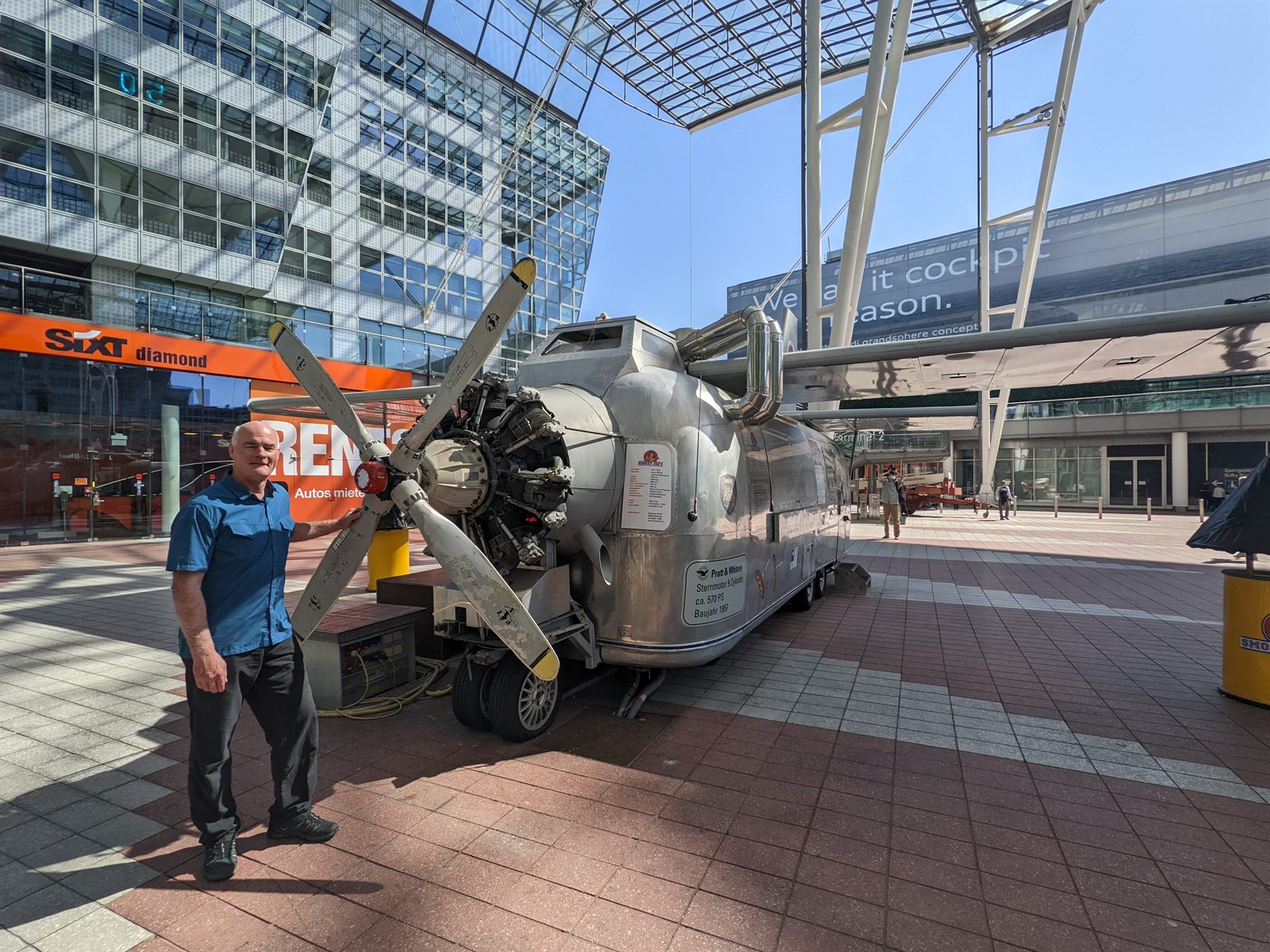
Now we just had to get to Garmisch. The train was out — just over a week before, on June 3, a derailment near Garmisch on that same Munich line had killed five people and injured dozens. Luckily FlixBus was running, so we booked a bus to the bike shop and settled in to wait at the airport. Sometimes a trip hands you a problem to solve; this one demanded genuine creativity before we'd even turned a pedal.
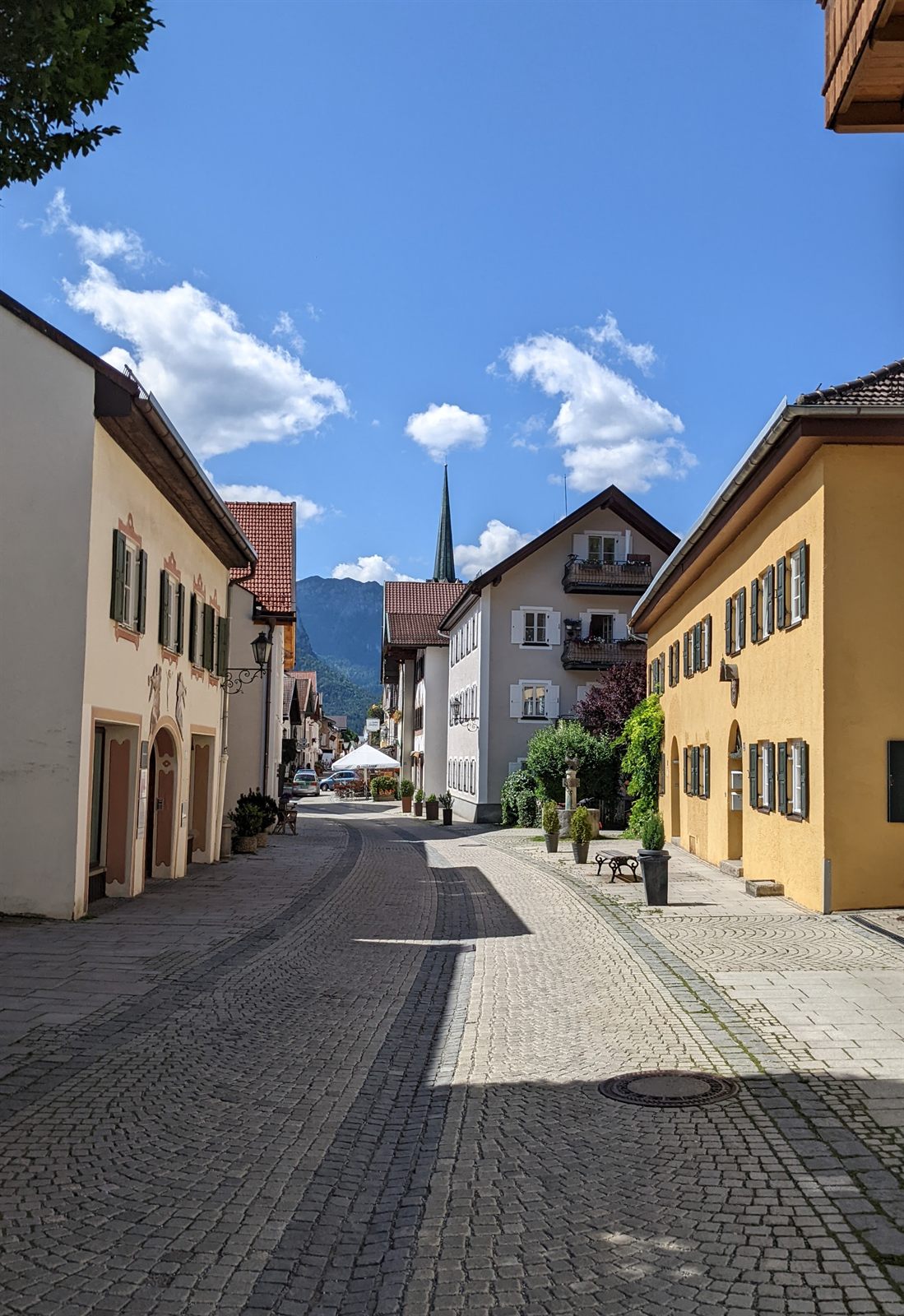
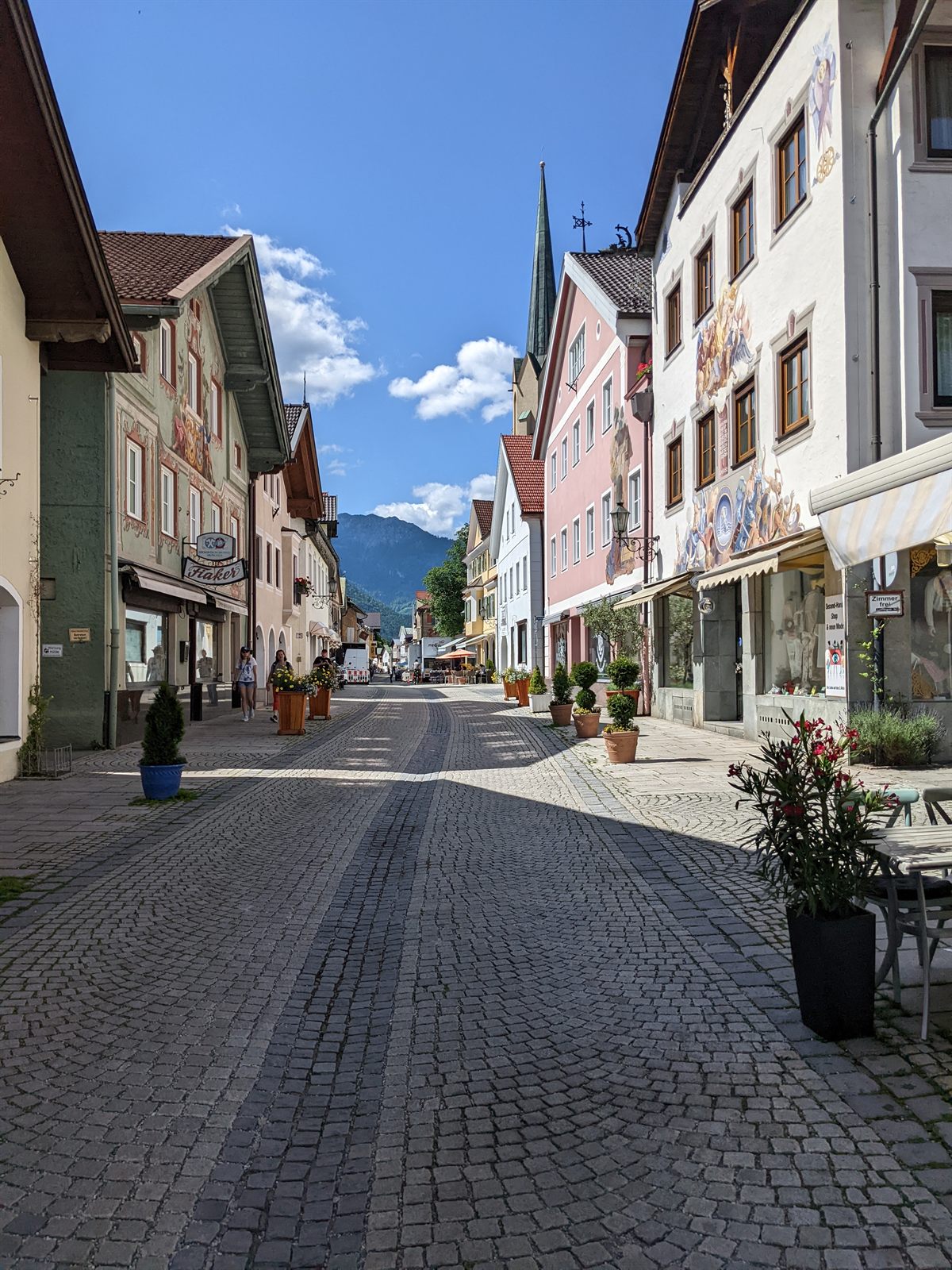
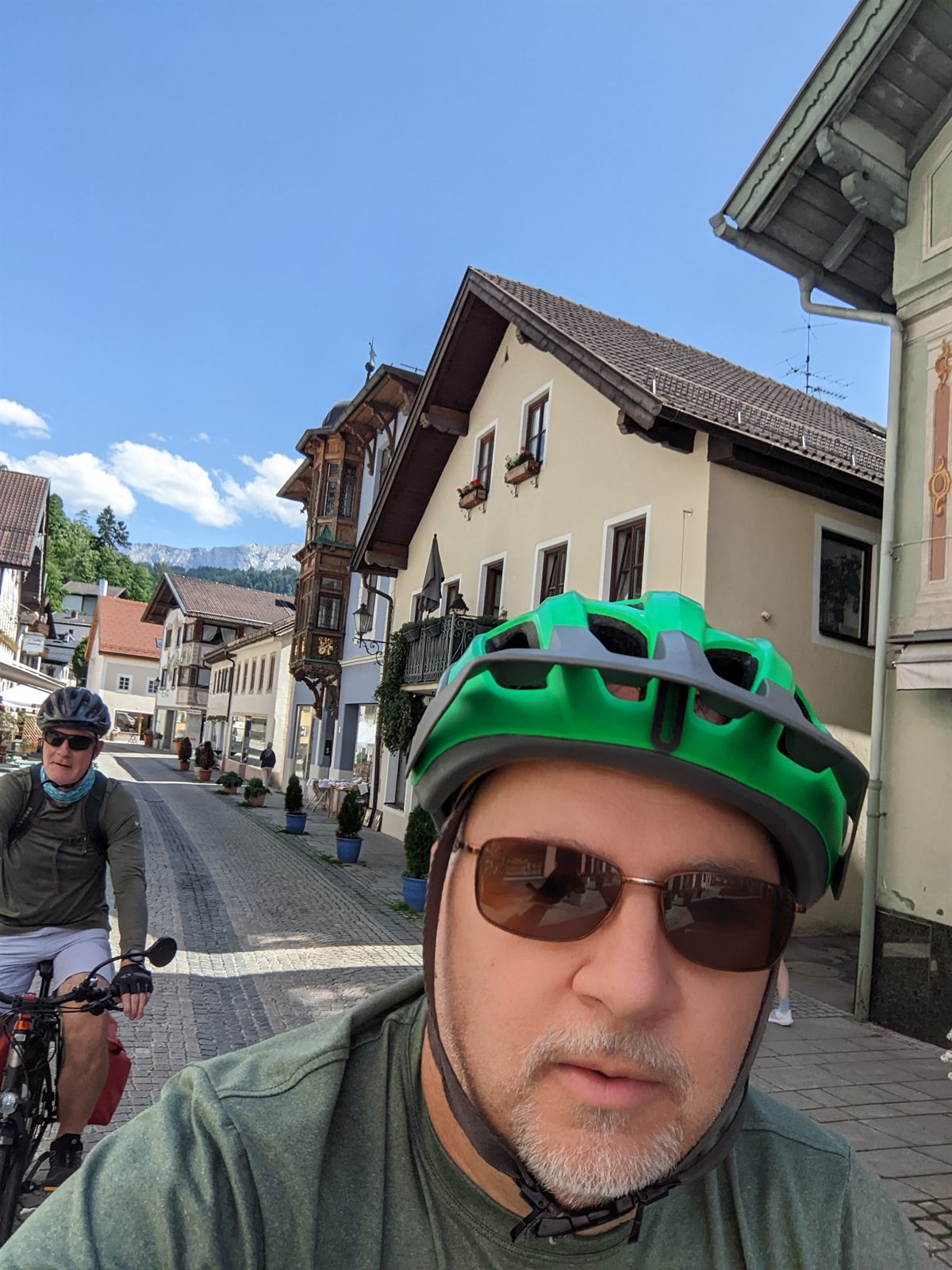
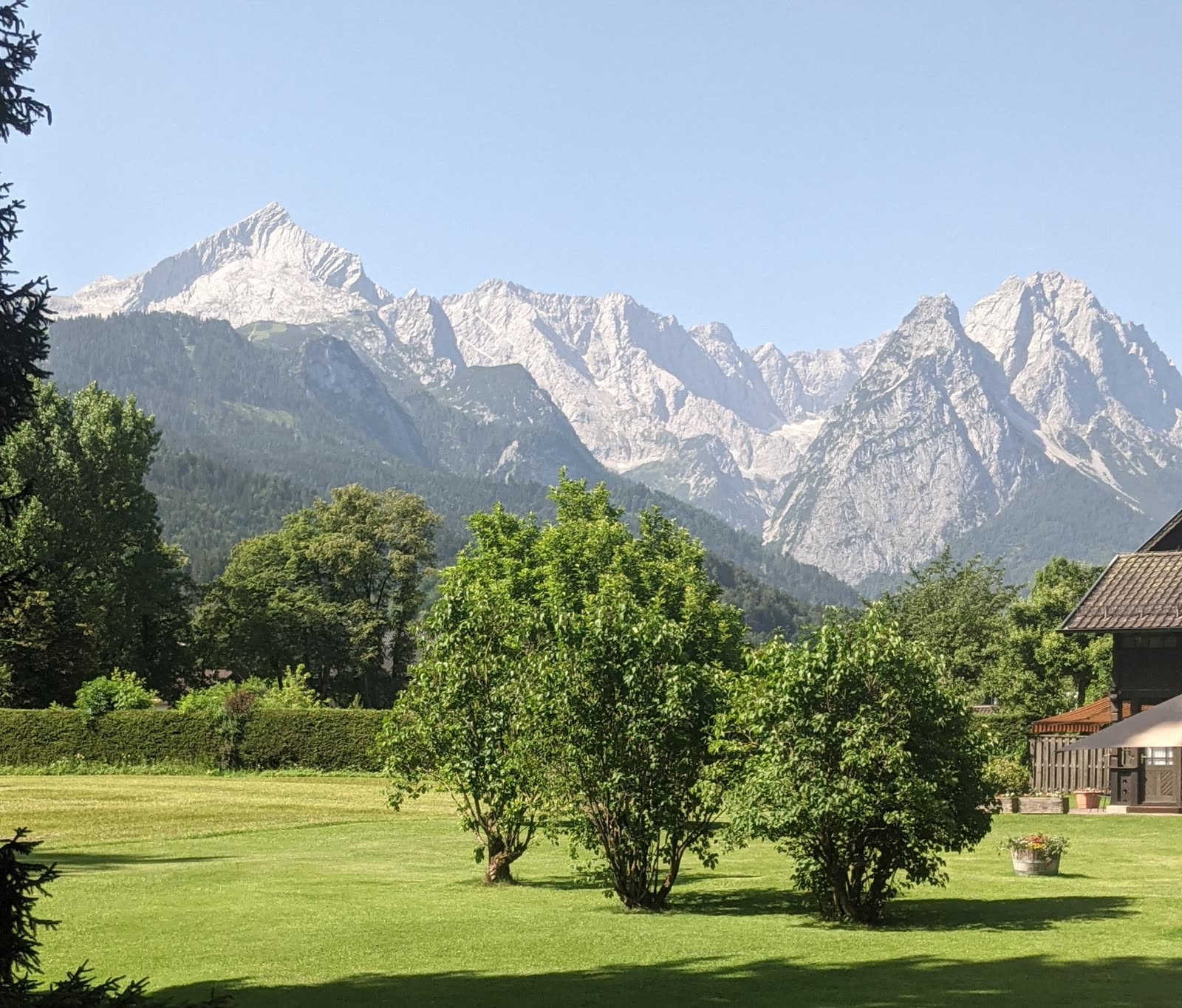
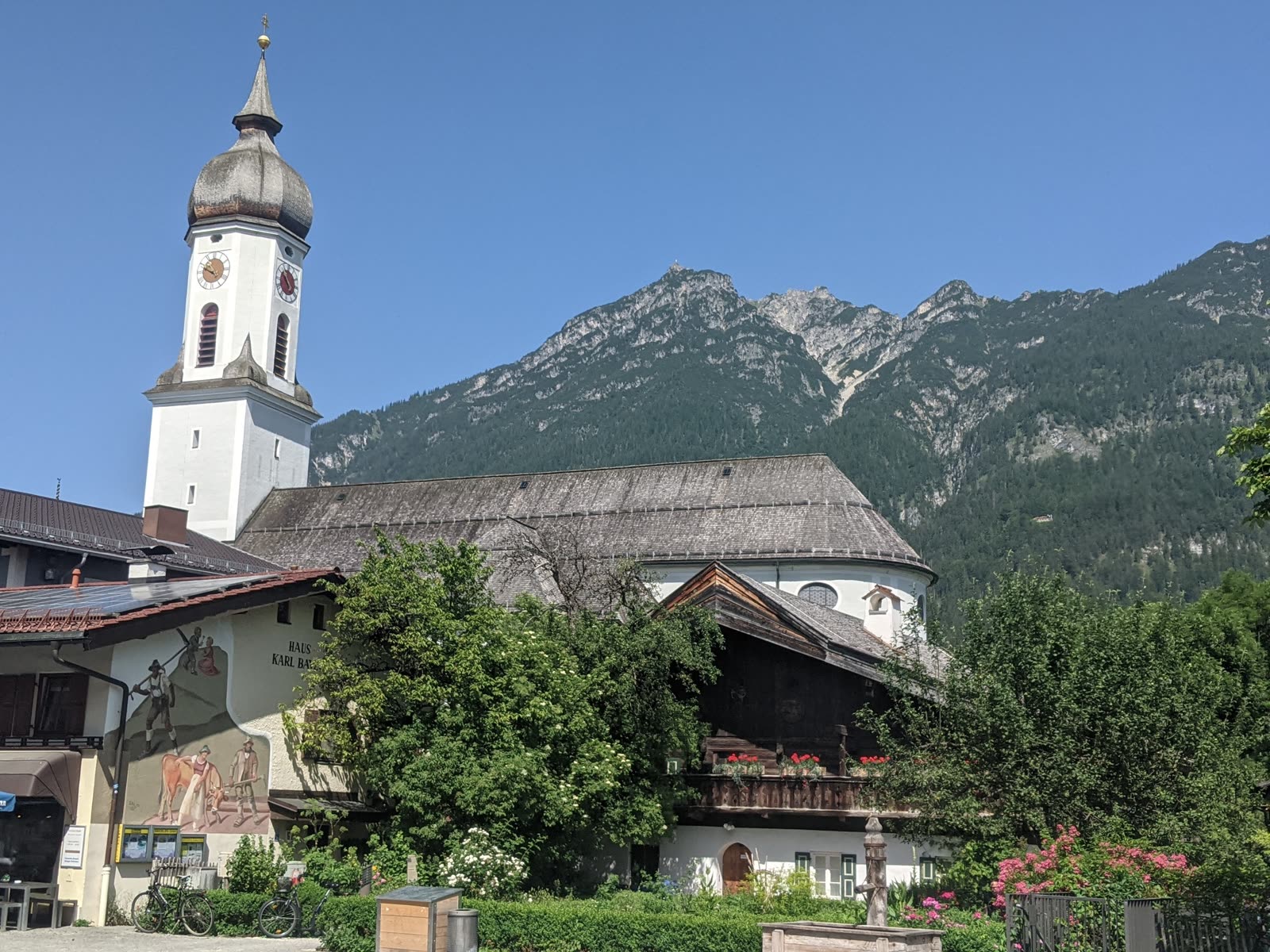
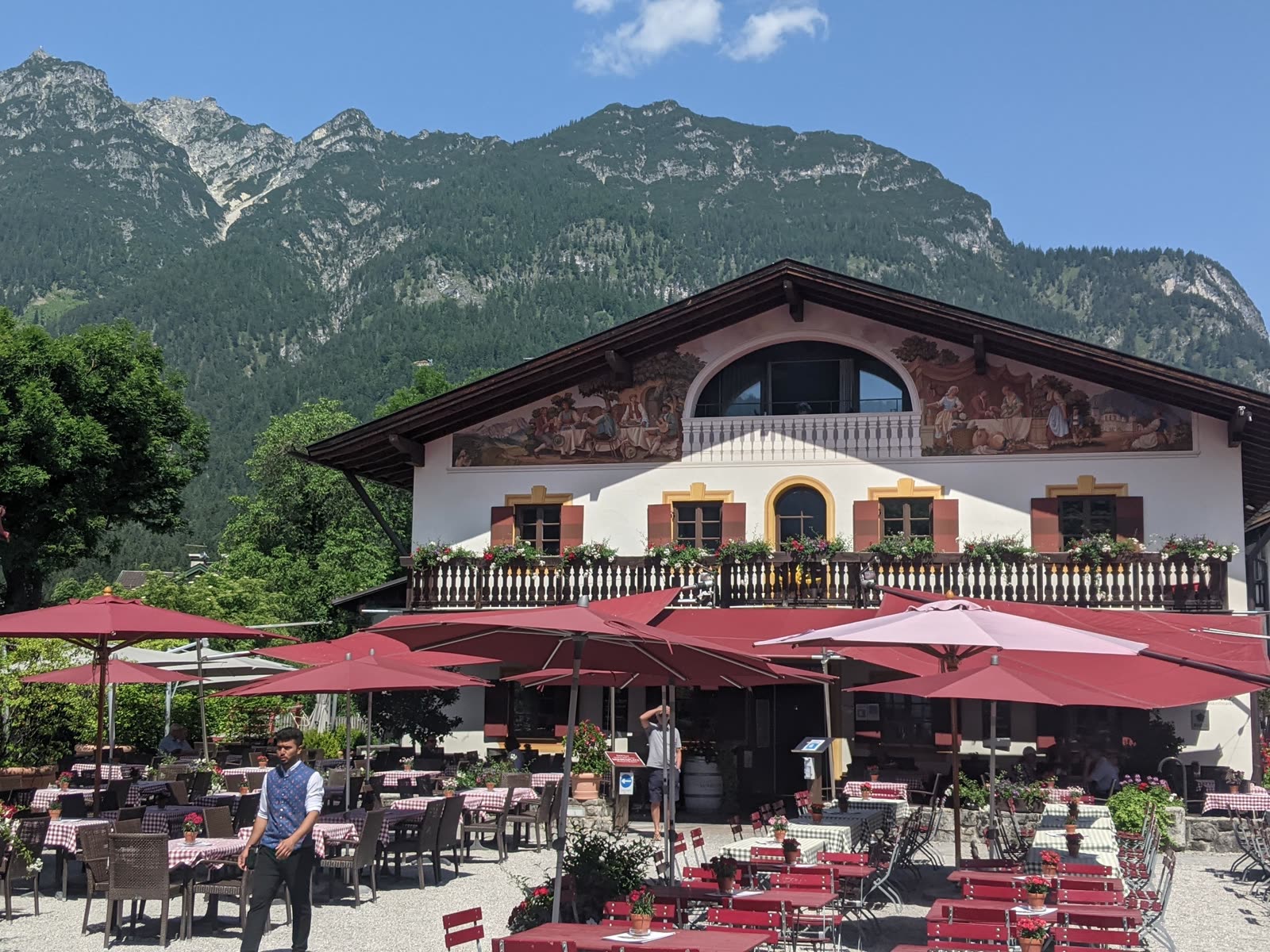
If we had to start somewhere other than Munich, we could have done a lot worse. Garmisch-Partenkirchen is stunning — an alpine resort town tucked beneath the Zugspitze, Germany's highest peak, and host of the 1936 Winter Olympics. We rode our rental bikes through cobblestone streets lined with the region's signature Lüftlmalerei — the elaborate frescoes painted right onto the house facades — with the Wetterstein peaks standing over the rooftops. For a start line we hadn't planned on 24 hours earlier, it was hard to complain.
Here's the twist in the twist: our Munich-to-Venice ride actually began by heading the wrong way — north — before we could ever turn south for Italy. Part of that was the hotel: our room that first night was already booked in Bad Tölz, which sits north of Garmisch. But the bigger reason was that we wanted to salvage as much of our planned route as we could. Riding north put us back on it, and meant we wouldn't have to skip the Achensee and the rest of the stunning country waiting for us in Germany and Austria. So off we went, two jet-lagged Arizonans on unfamiliar rental bikes, pointing away from Venice on Day 1.
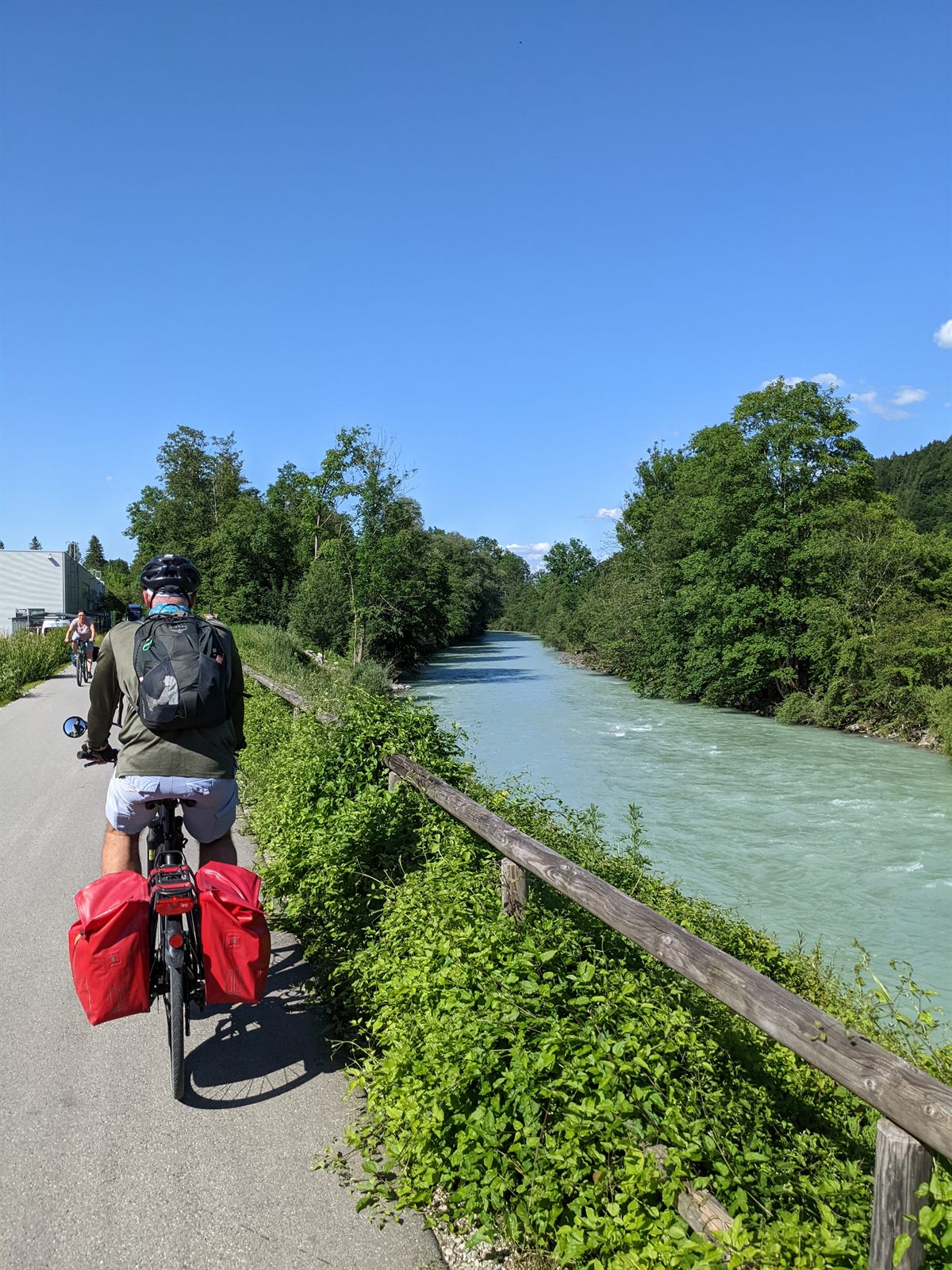
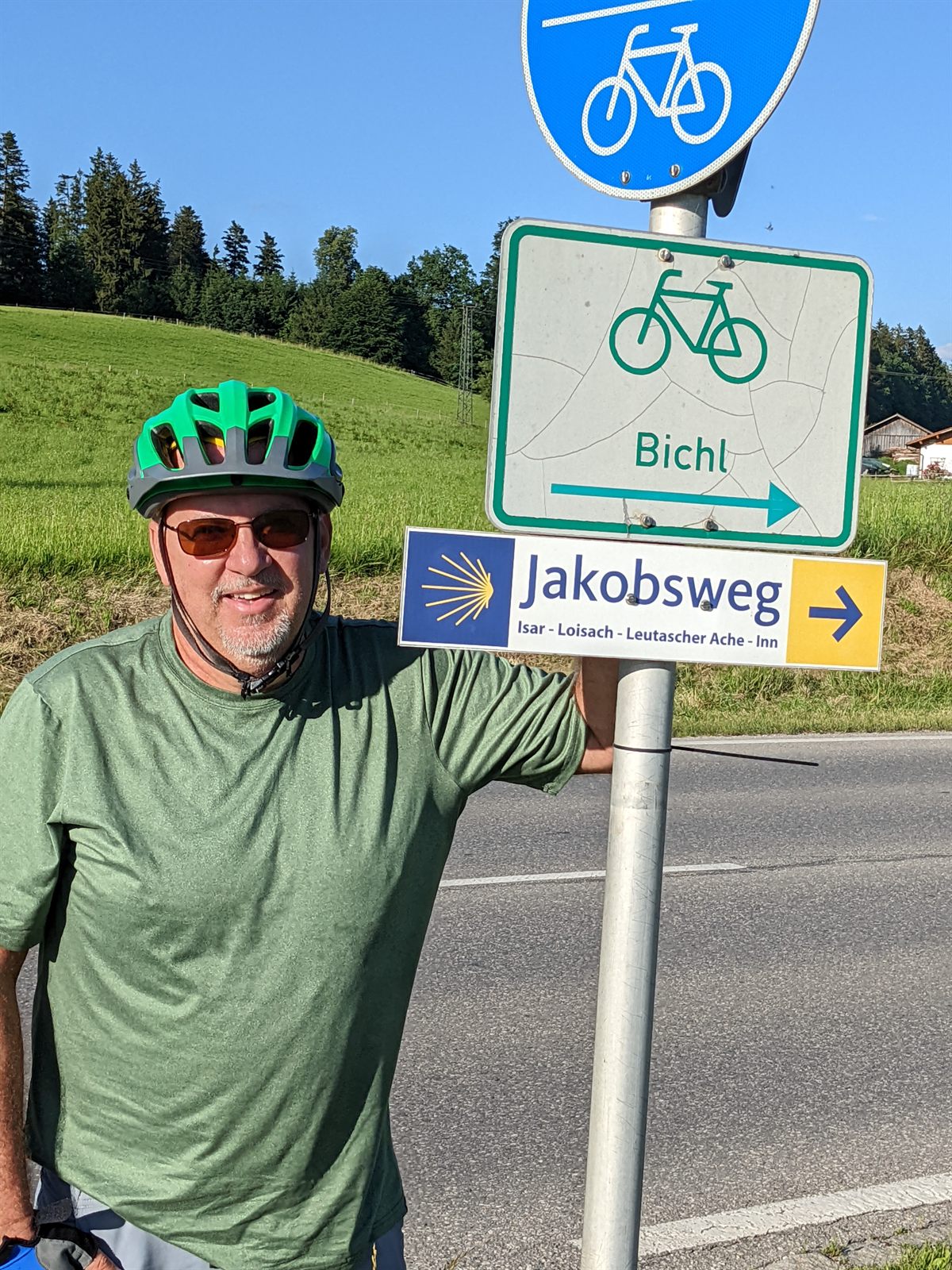
The riding was gentle and gorgeous to start — miles of flat, car-free path tracing the Loisach river, its glacier-fed water a startling turquoise, with the Karwendel range filling the sky. Eventually the path handed us over to some roads and the first real hills of the trip. Along the way we passed a signpost for the Jakobsweg — the German branch of the Camino de Santiago, the Way of St. James. Fittingly, a few years earlier Doug and I had done our own Camino in coastal Spain, so the scallop-shell waymark felt like an old friend.
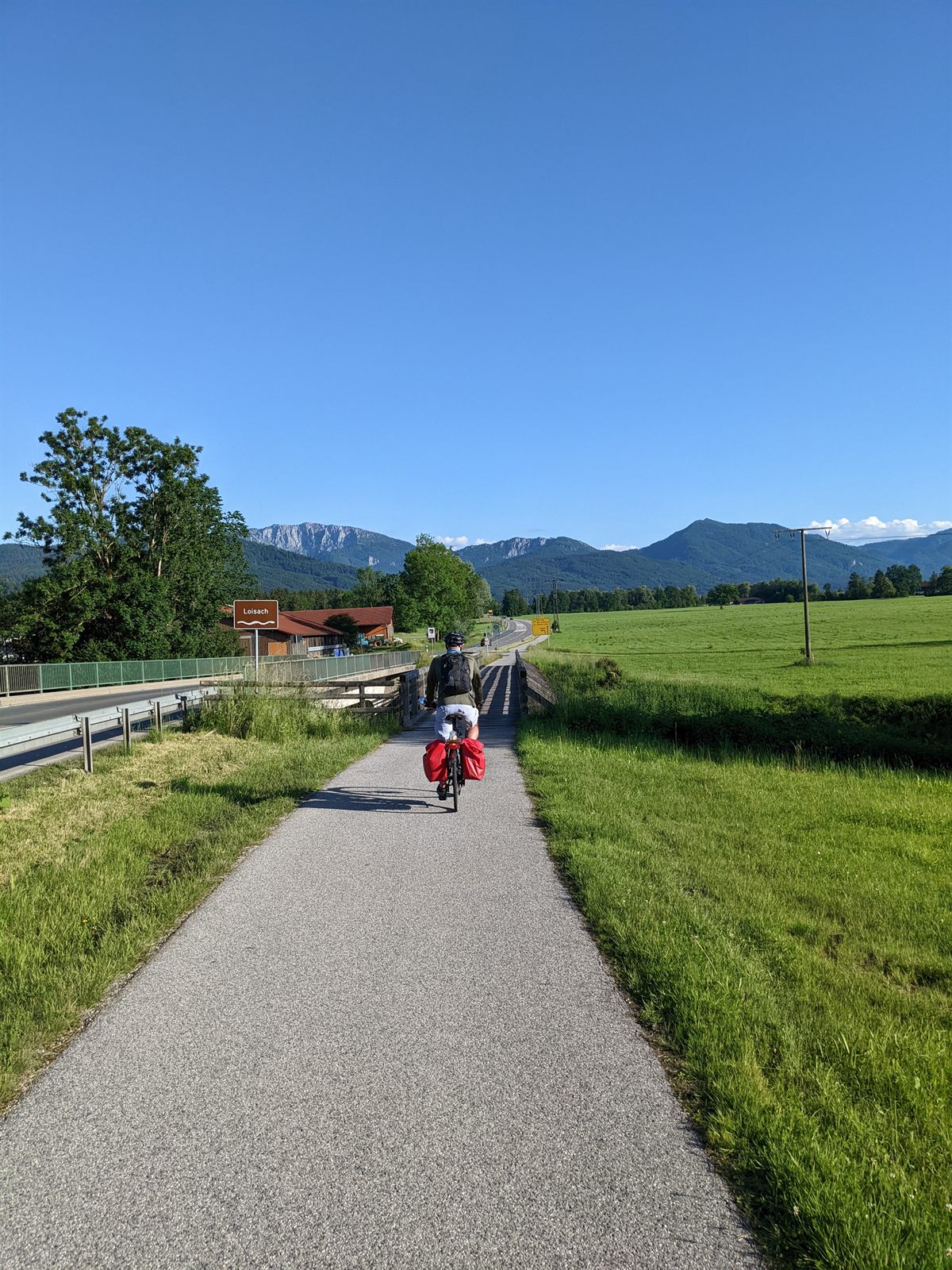
Jet-lagged and mentally fried from a full day of solving our bike-rental crisis and re-drawing the route, we were more than happy to reach Bad Tölz as the light went. We landed at the Posthotel Kolberbräu, a wonderfully bike-friendly spot that tucked our bikes into a secure underground garage alongside those of an organized tour group. Hungry, we found one of the few restaurants still open — a Mexican restaurant, of all things — and ate outside by the Isar river. There's a particular kind of funny in flying from Phoenix, where Mexican food is on every corner, all the way to Bavaria… to eat Mexican. We slept hard.
43.1 miles · 3,490 ft up / 2,560 ft down · Germany → Austria · a day of short, steep climbs
Bad Tölz sent us off with a proper breakfast — and a little perspective on how we were doing this. Sharing the hotel was an organized group tour, a whole cluster of riders who each morning left their luggage in a neat pile for a support van to ferry ahead to their next stop. We, meanwhile, loaded everything back onto our own bikes. We'd packed light enough that it was no real burden — we had exactly what we needed and not much more — but there's a quiet satisfaction in watching the van pull away and knowing you're carrying your entire trip yourself.
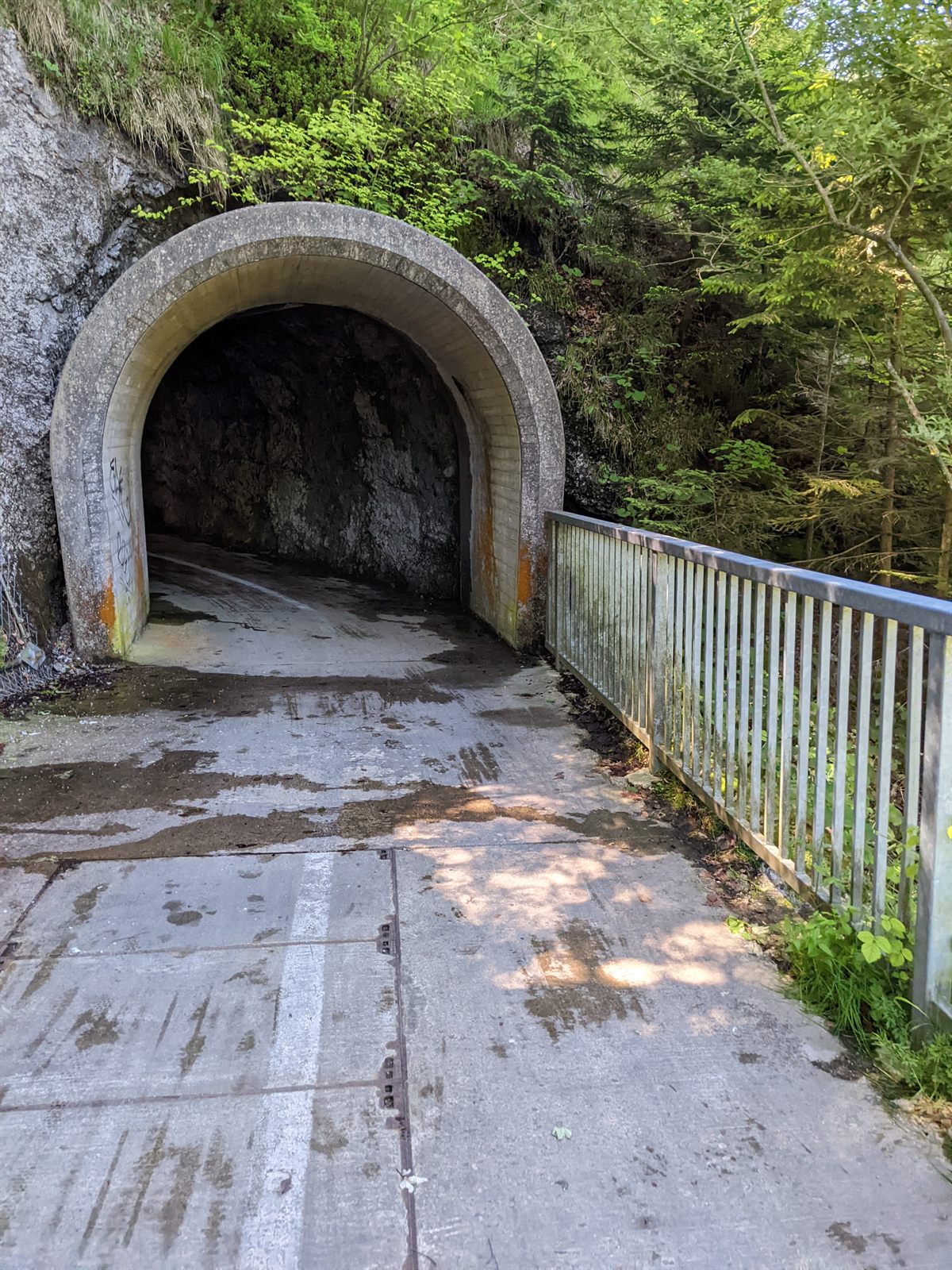
We spent the first stretch just biking through part of Bad Tölz, soaking up the beauty and the historic buildings. It's an old spa town on the Isar — the Bad means "bath," and the town made its name first on the salt trade and later on its iodine-rich springs — and its steep, cobbled Marktstraße is lined with tall Baroque facades painted in the Bavarian Lüftlmalerei tradition. From there we crossed the Isar and picked up the path heading upstream, mostly gravel and mostly quiet. We hit some rougher gravel roads here and there, but all of it was perfectly rideable, and at one point an old stone-arched tunnel carried the path straight through the rock along a ledge above the river.
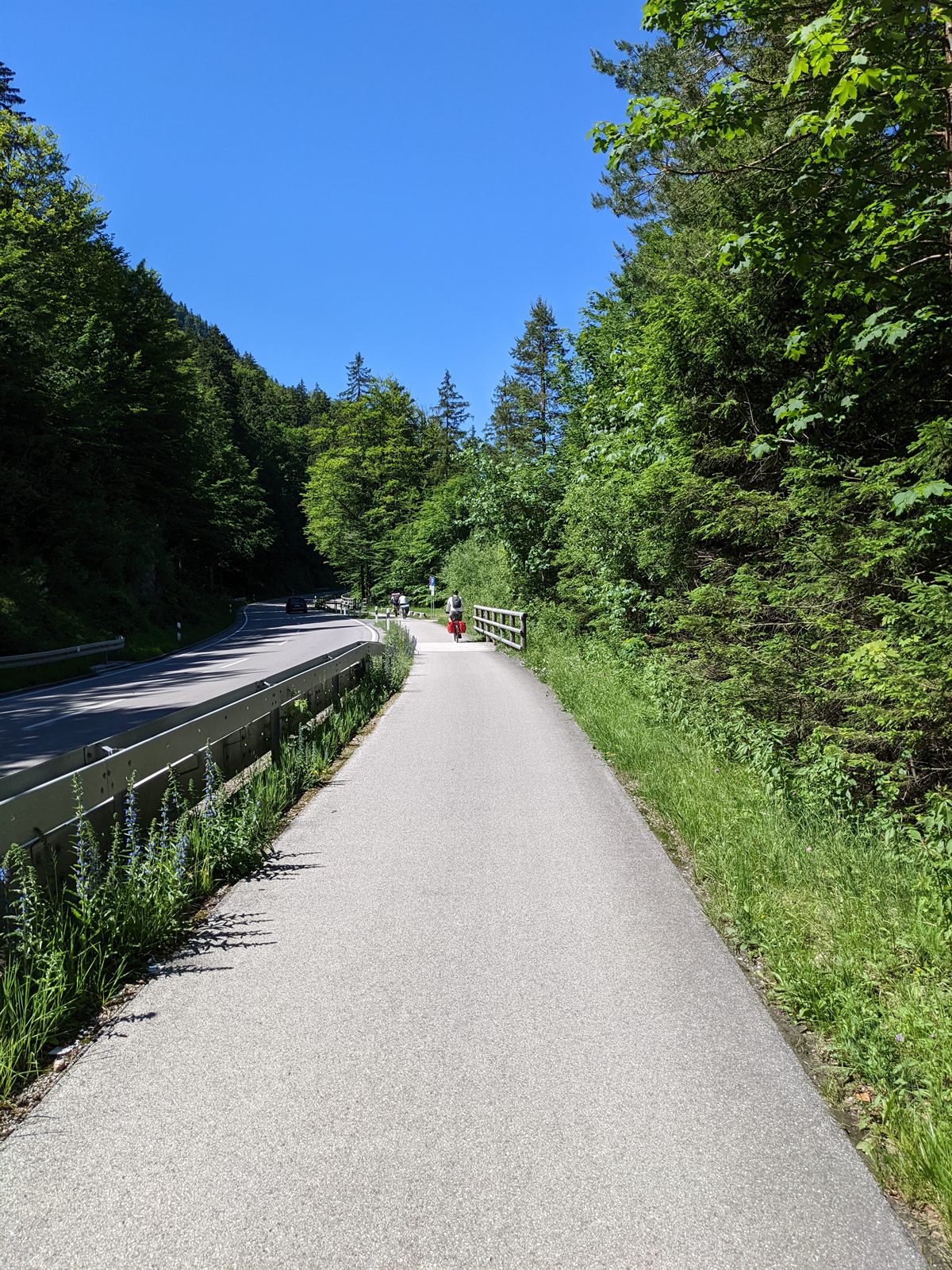
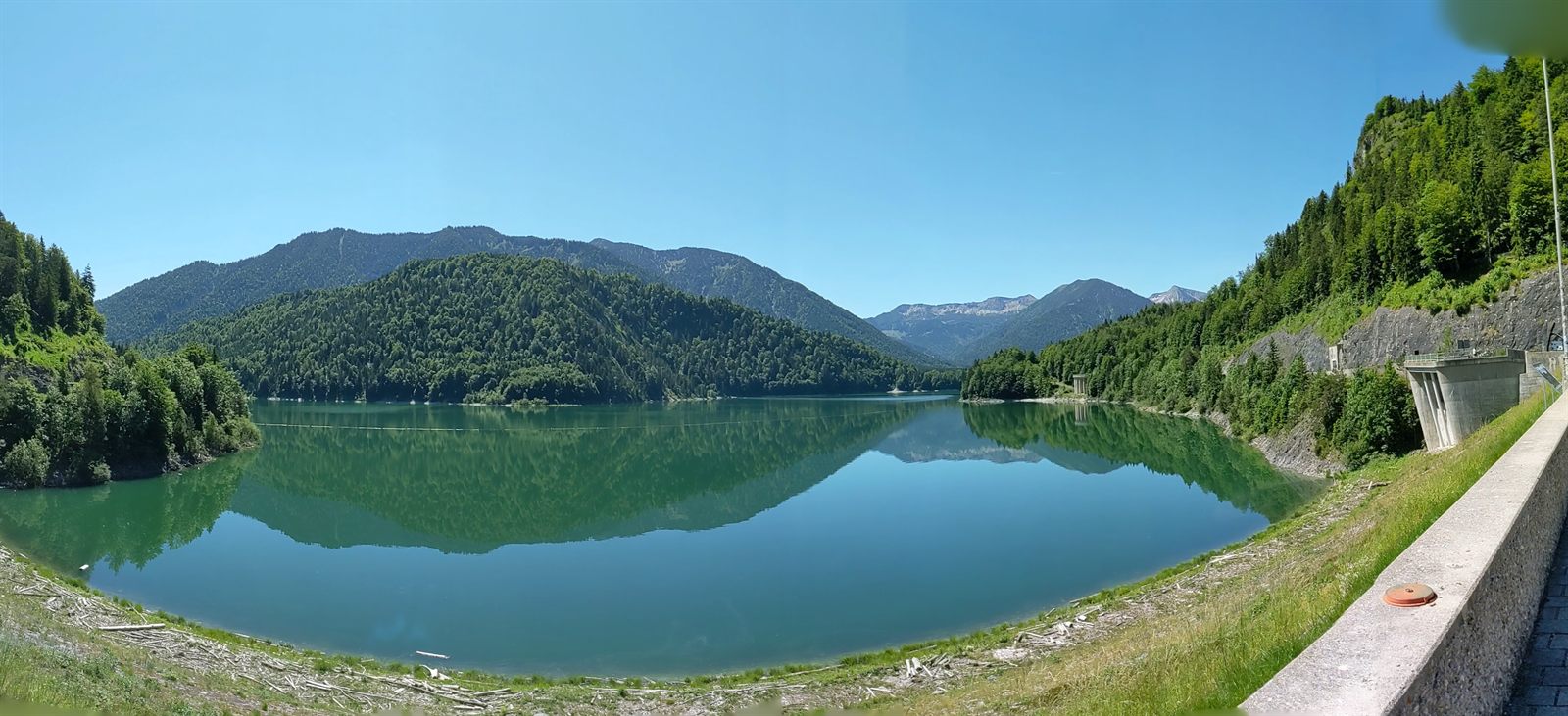
The valley tightened, and then it opened up to some nice lake views — the Sylvensteinspeicher, a big reservoir held back by a dam, its water a glassy turquoise with the forested mountains mirrored across the surface. It was pretty, though (as it turned out) nothing like the beauty still ahead of us. A brief stretch put us out on the main road — scenic, but busier, with cars and not much shoulder — and carried us across a high, dramatic bridge over the water. On the far side we turned left through a cluster of hotels and guesthouses, the kind of spot that felt like a local favorite for a day at the lake.
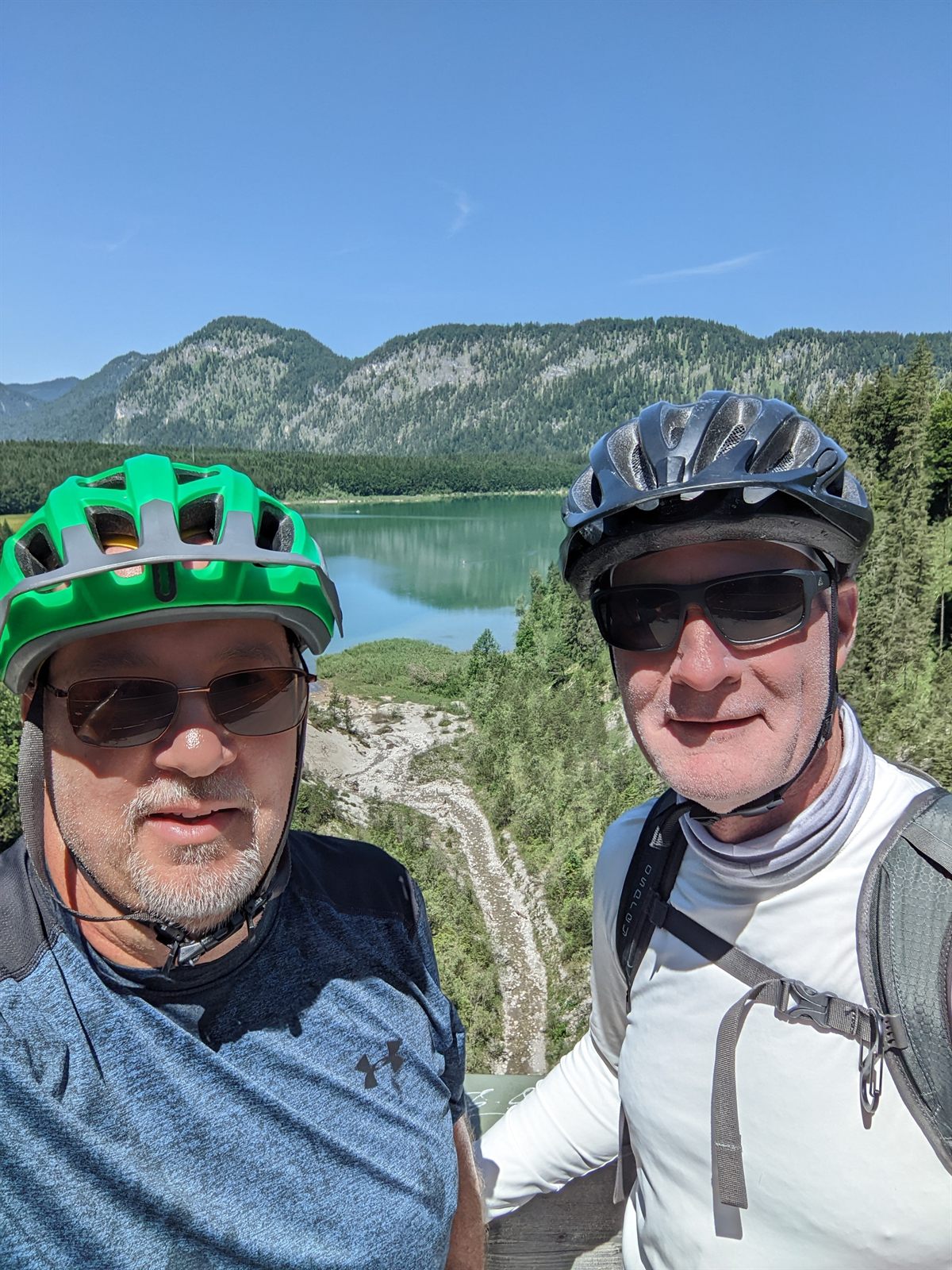
Past the reservoir the pavement gave out. There were sections that were hilly or rougher gravel — we even walked the bikes up a few of the short, rough pitches — but we were rewarded with the occasional view of the lake, a waterfall, and, thankfully, no cars. Somewhere along here we slipped quietly out of Germany and into Austria, climbing as we went. This was the day's real work: a string of short but genuinely steep pitches that kept adding up. We only netted about a thousand feet by the time it was done, but the profile above tells the truer story — it was up and down and up again all day long.
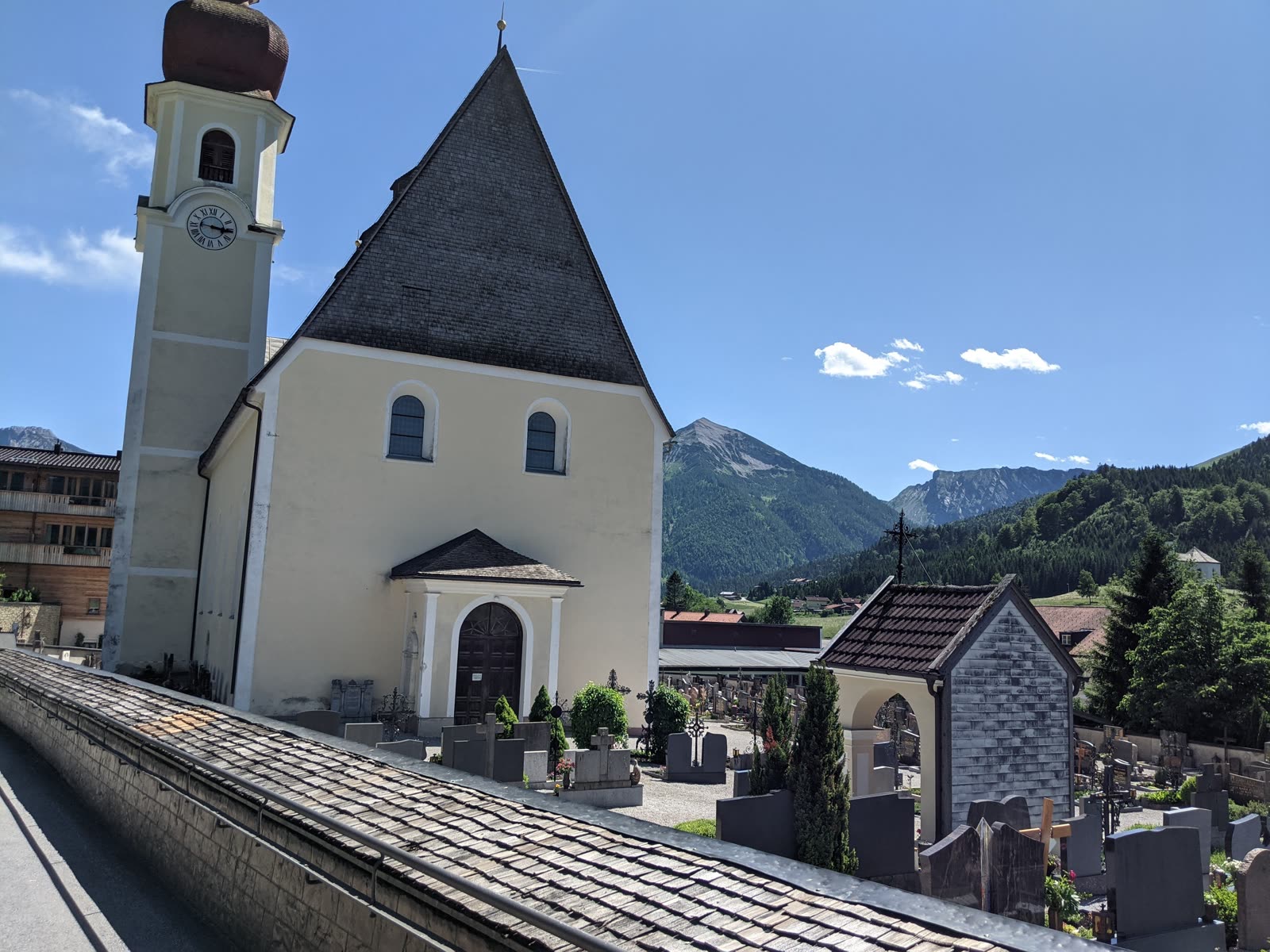
And then, the payoff: the Achensee, the largest lake in the Tyrol, a long ribbon of blue-green water pinned between the Karwendel and Rofan ranges. We rolled down to it and stopped for a proper break — pulled off our shoes and stuck our feet in the water, which was shockingly cold, straight off the snowmelt still running down from the peaks. We wandered the tourist area a while, watched swimmers and sailboats and windsurfers work the lake, and just took it in.
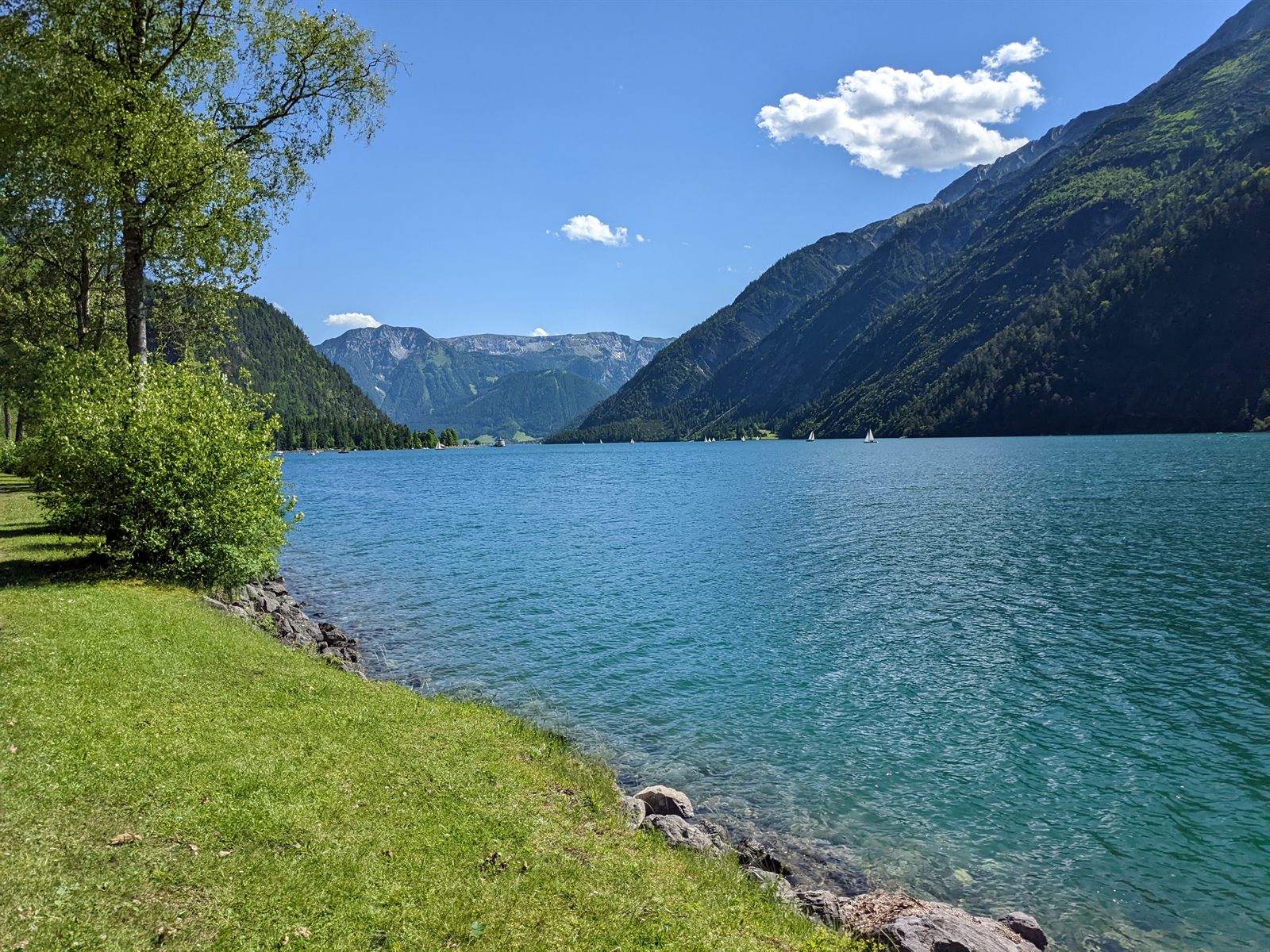
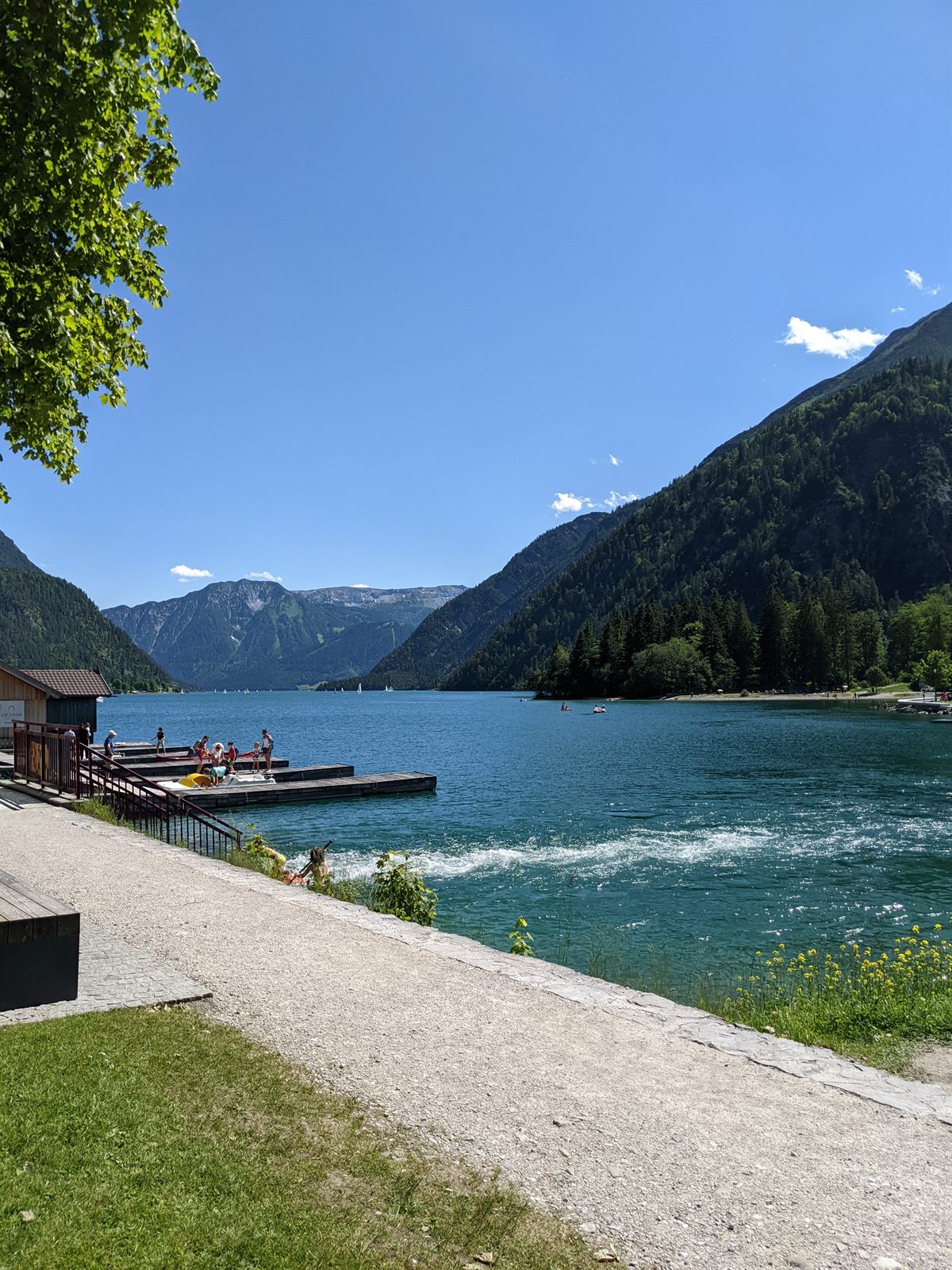
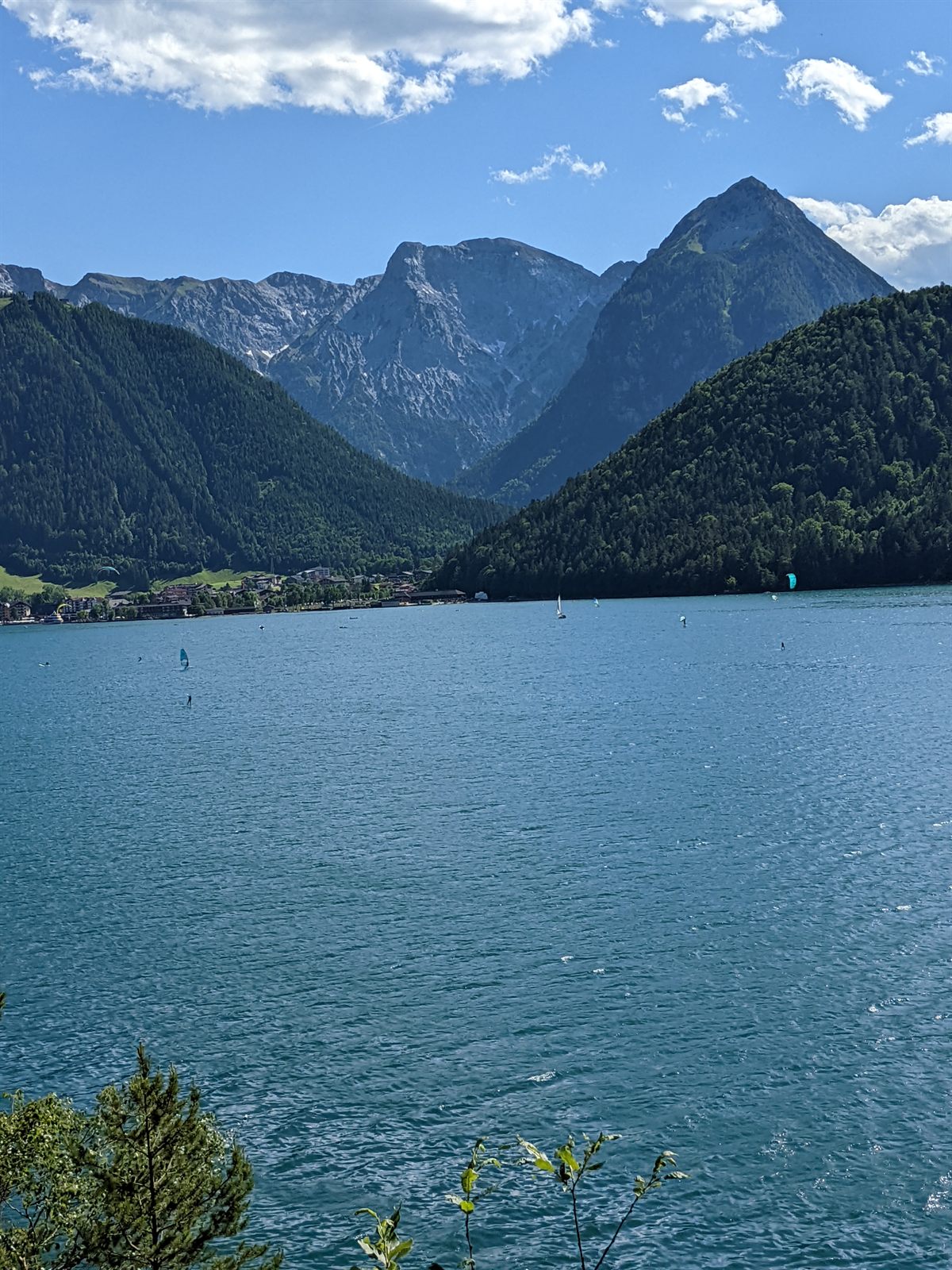
The stretch along the Achensee was, easily, a top-ten spot for beauty on the entire trip — the path hugging the shoreline high above that impossible blue. I pulled out my GoPro and filmed a bit of Doug riding, then handed it off so he could record me rolling along out in front of him too.
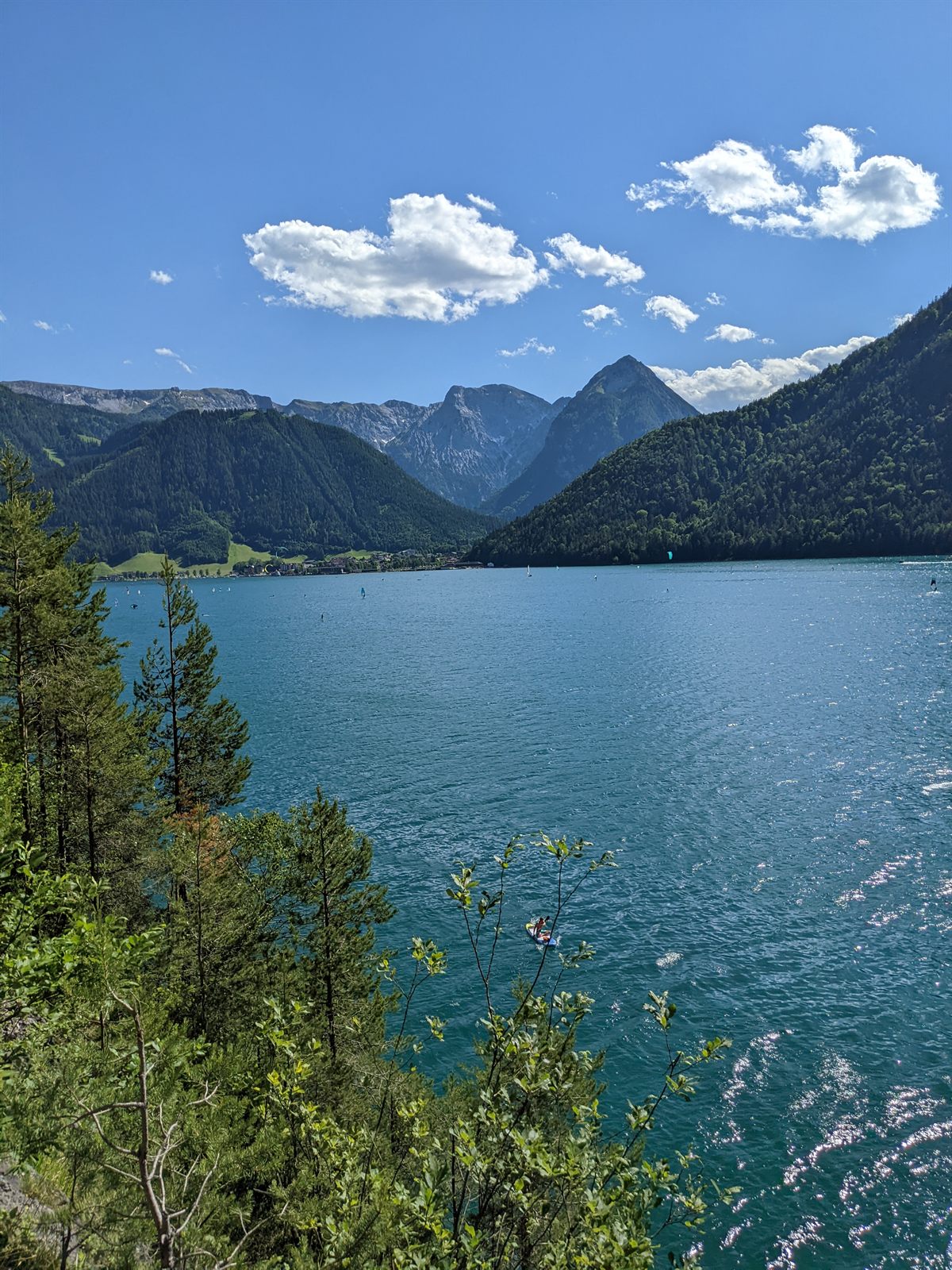
🎥 Along the Achensee on the GoPro — Doug riding, then me out in front.
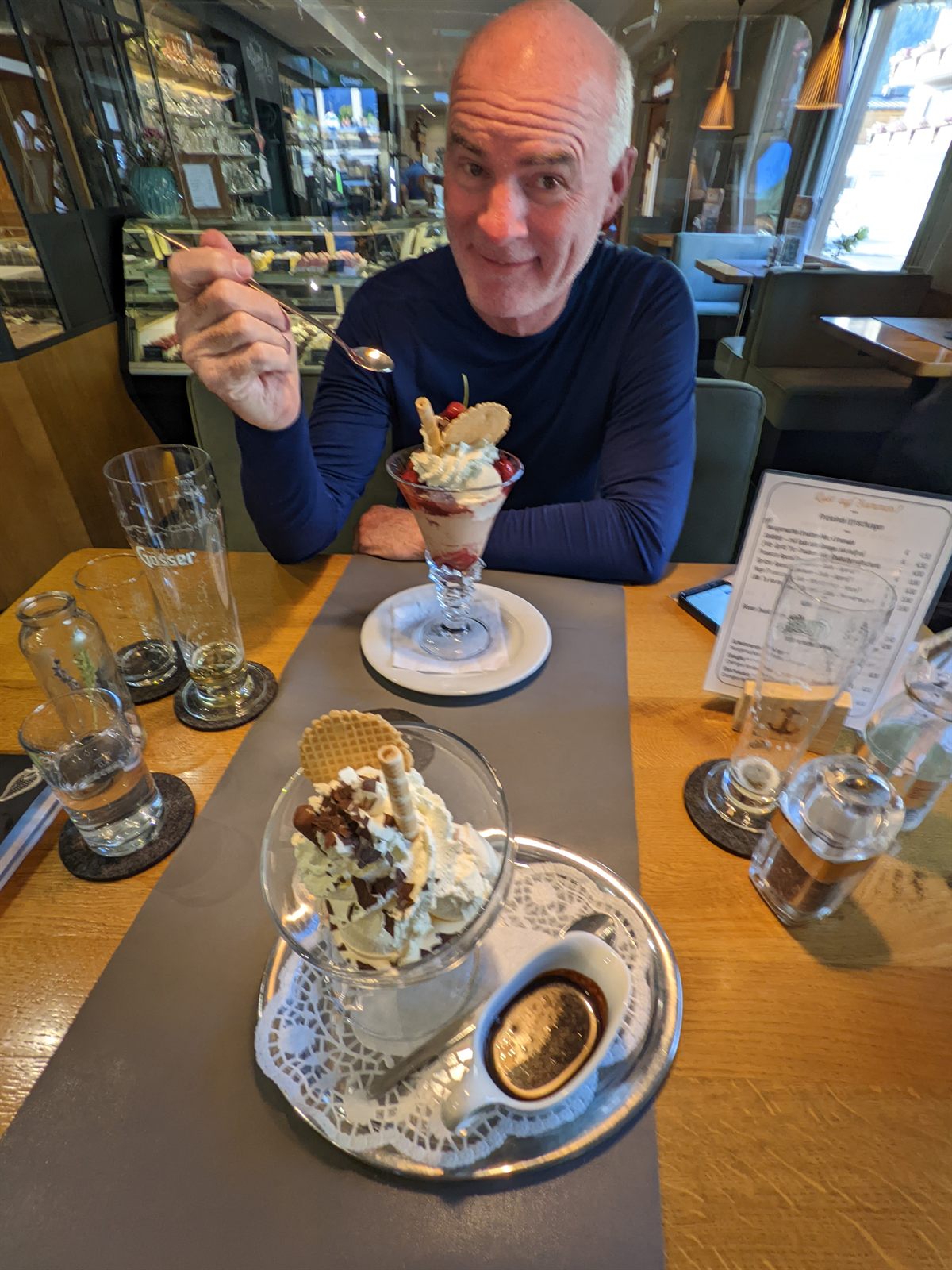
We spent the night at the Hotel Klingler in Maurach, at the south end of the lake. The restaurant sat across the street — connected to the hotel by a cool little pedestrian tunnel that ran under the road, so you could get from your room to dinner without ever stepping outside. Handy in a snowy Tyrolean winter, I'm sure. Dinner was excellent — a couple of beers with the meal — and we were in no mood to skip dessert.
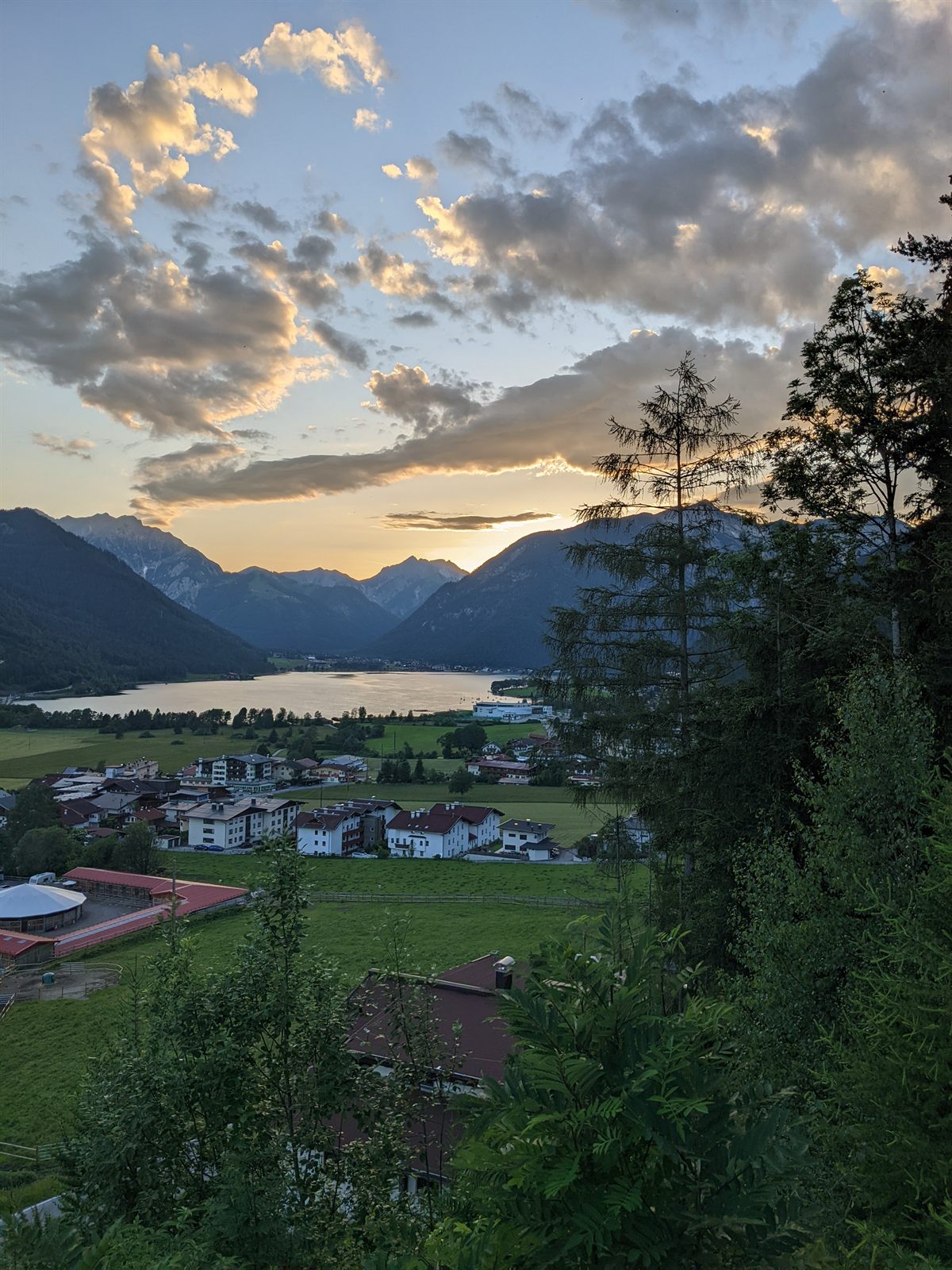
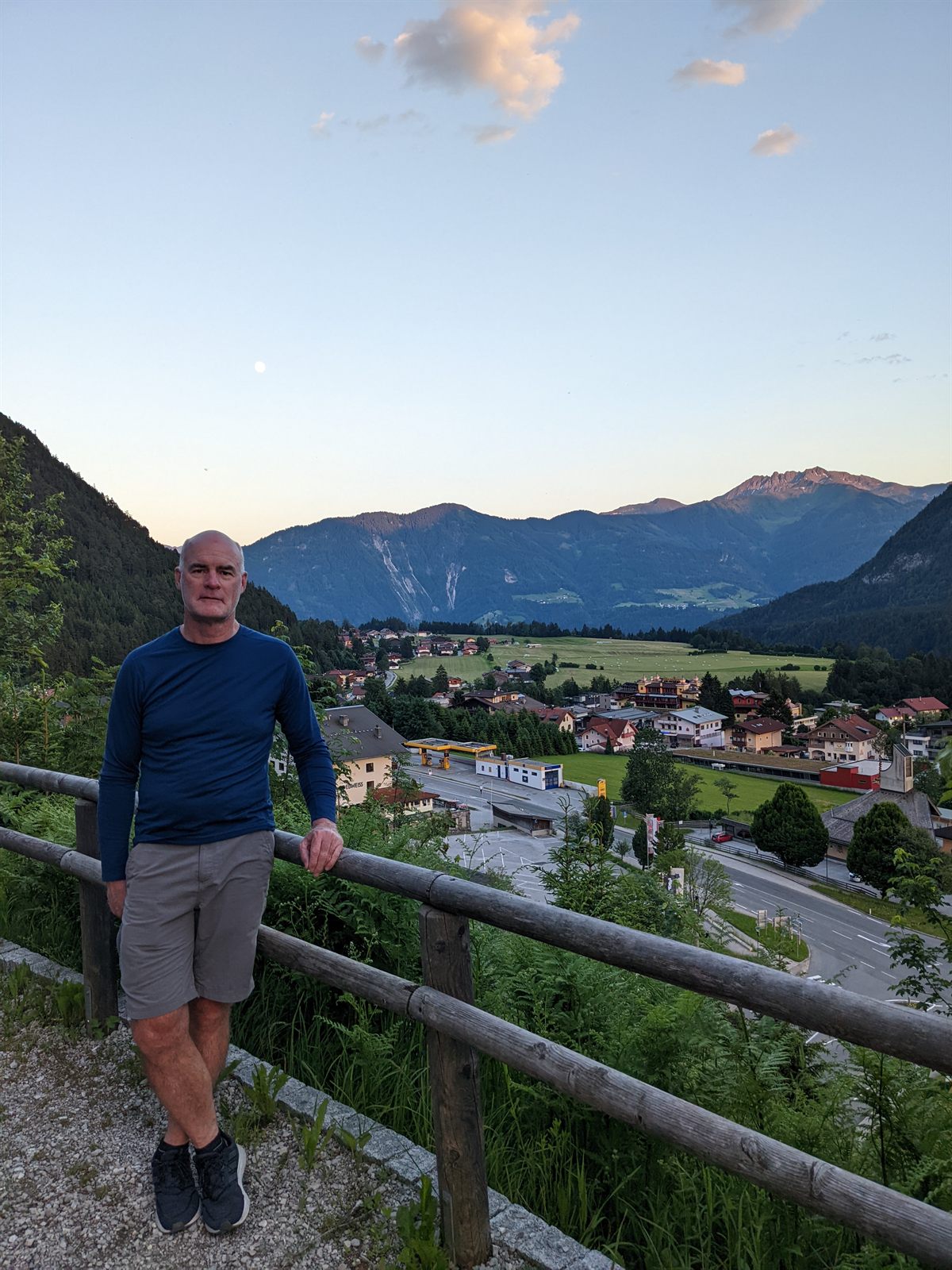
In the evening we walked up to the Häuserer-Bichl Kapelle, a tiny chapel on a wooded knoll above town. It was built in 1949 by a soldier returning home from the war, and someone still keeps it up — there are even a couple of wooden loungers set beside it, an invitation to sit a while. And what a spot to sit: a beautiful stretch of the Achensee below, the town at our feet, the sun sinking behind the peaks, and a near-full moon climbing over the valley on the other side.
≈30 miles ridden to Innsbruck · 2,510 ft down / 1,270 ft up · then the train over the Brenner · Austria → Italy
We woke in Maurach, at the south end of the Achensee, to a very different Tyrol than the one we'd fallen asleep to — low cloud, damp air, none of yesterday's blue. We had a great breakfast at the same restaurant we'd eaten in the night before, packed everything back onto the bikes, and set off. We didn't even make it out of town before it started to rain and the temperature dropped. We ducked under someone's carport to stay dry long enough to dig out and pull on our rain gear, then rolled on into it.
The ride out of town dropped off the shelf the Achensee sits on and descended an amazing gravel path with a run of switchbacks, threading down alongside the old Achenseebahn — the historic cog railway that still climbs up from the valley. I would have loved to do this section in the dry, but even soaked it was a treat, and we enjoyed the descent regardless. Mostly what we kept saying to each other was how glad we were not to be going the other way — grinding up this steep, long hill in the rain would have been a very different kind of morning.
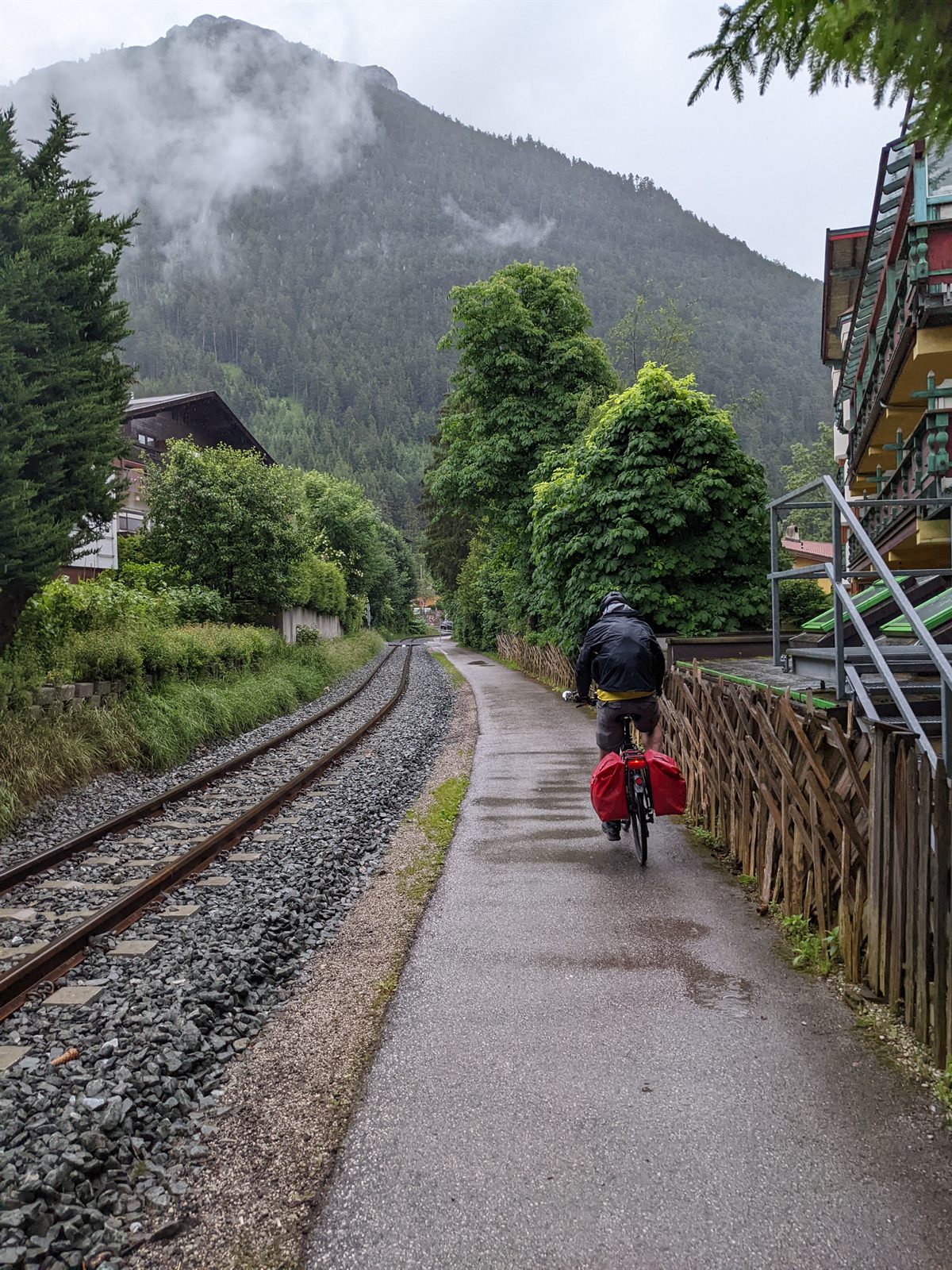
As we came out of the gravel we rolled through a pretty town on the floor of the Inn valley — Jenbach, if I'm reading the map right — with the rain stopping and starting as we went. From there we picked up the path and loosely followed the Inn river upstream toward Innsbruck. It was flat and easy, a welcome change after the morning's descent, and eventually the rain gave way to some sunshine and we got to actually enjoy the valley and the mountains standing over it.
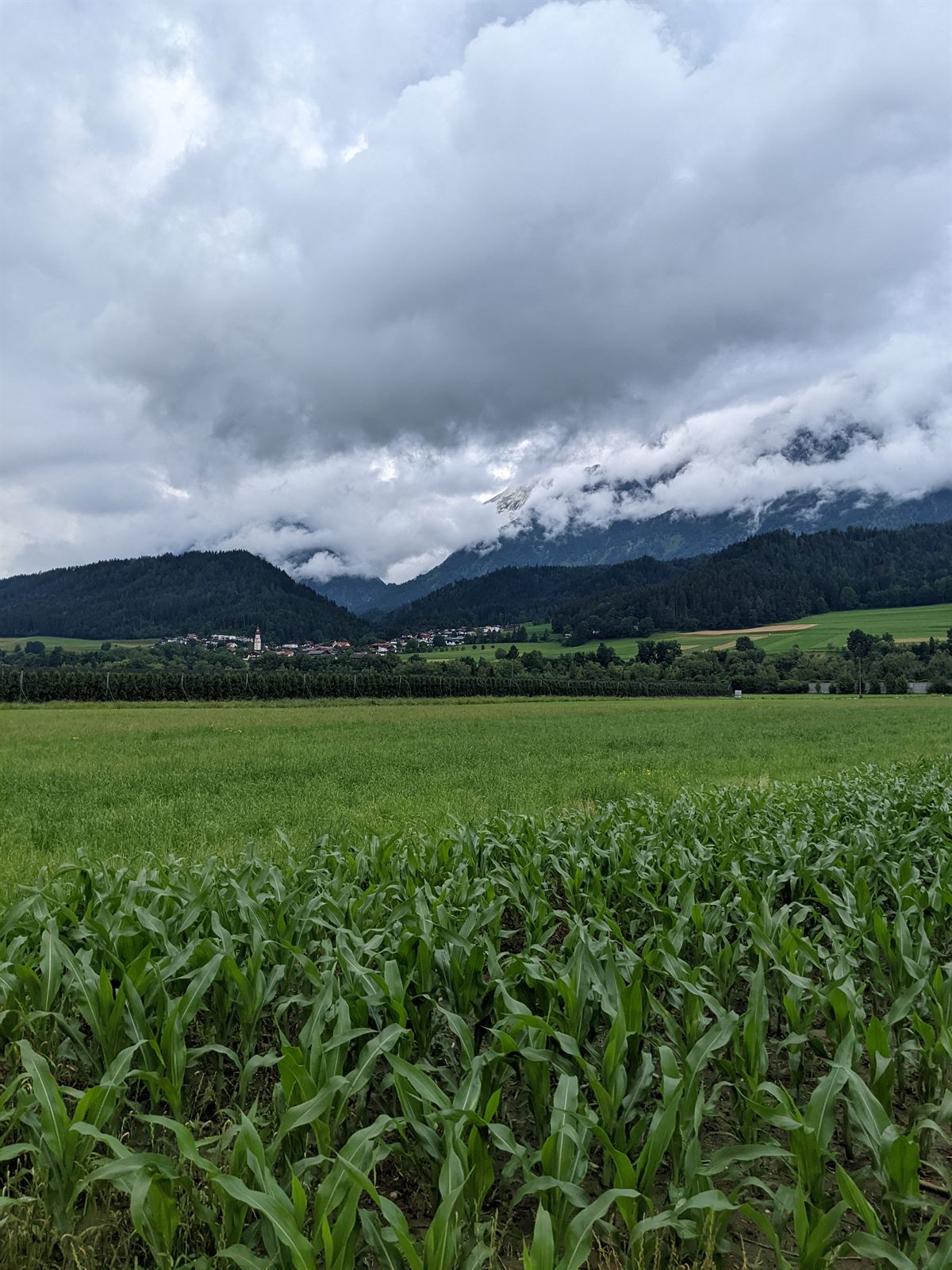
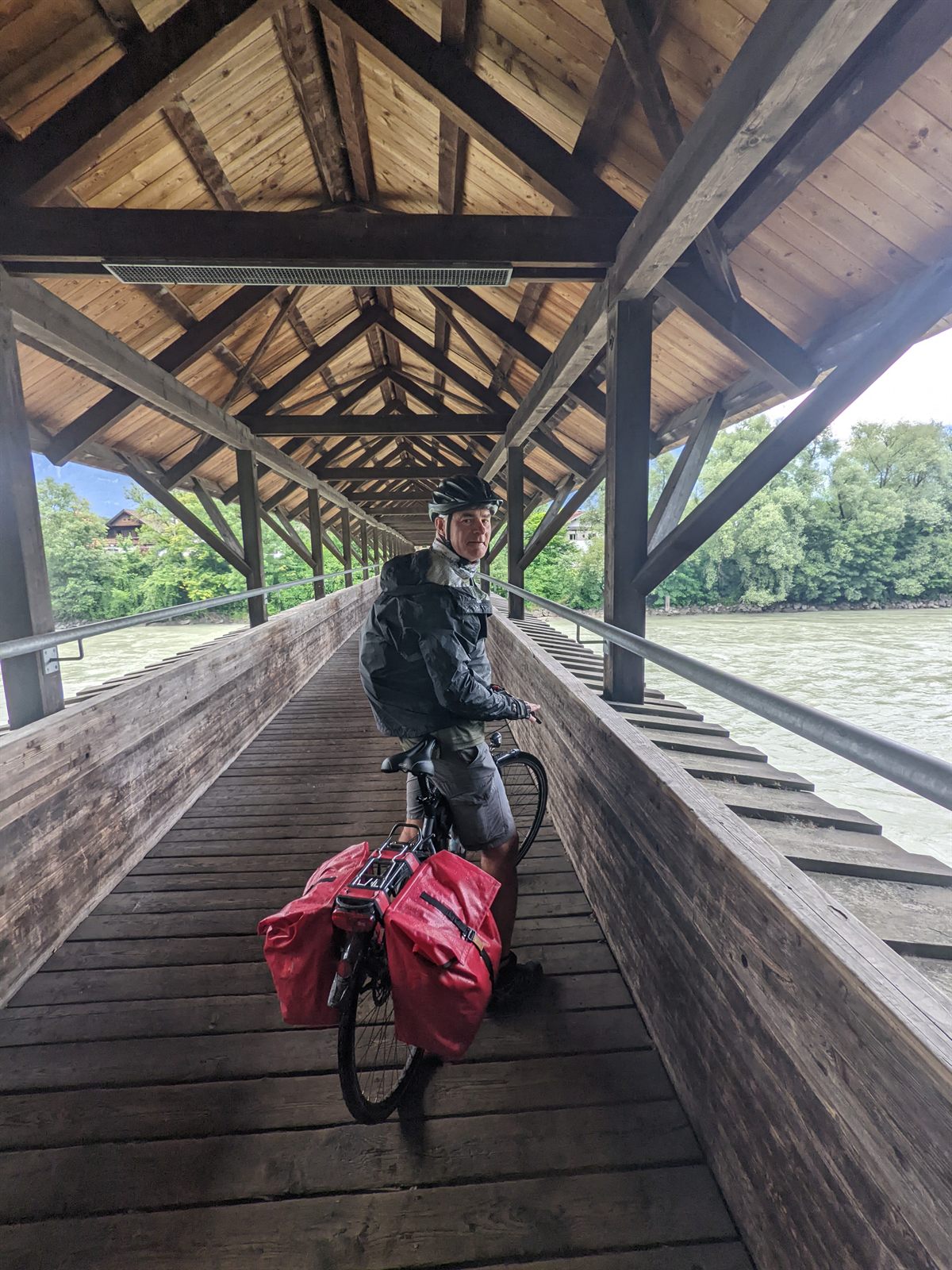
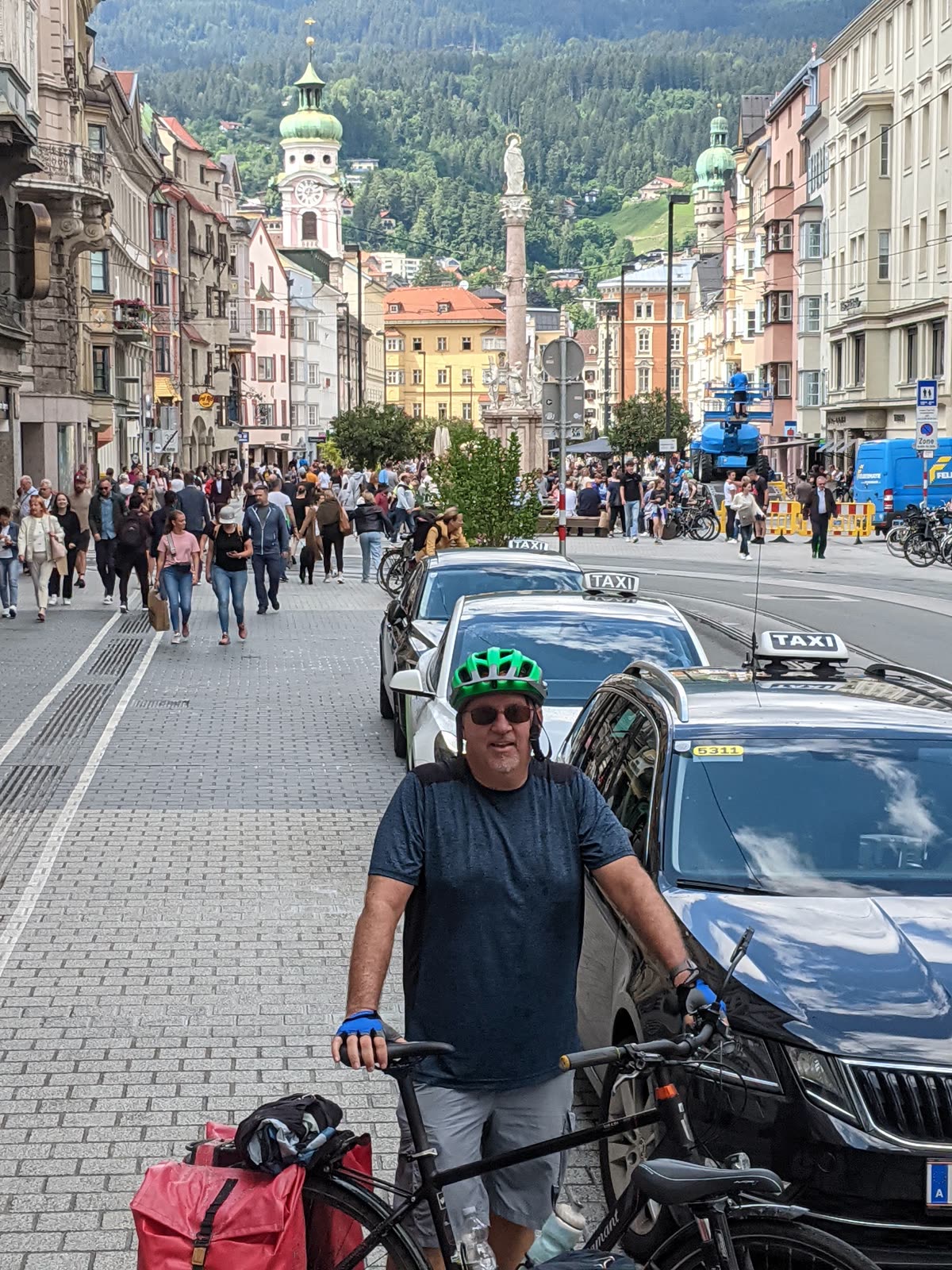
We entered Innsbruck and enjoyed the way the path wound itself into the city. Riding through the Tyrolean capital was pretty painless — there are some genuinely decent bike paths here. It's no Amsterdam, but it's better than most cities in the US for getting around on two wheels. We rolled through the old town, past the tall painted facades and the arcades, and made our way to the train station.
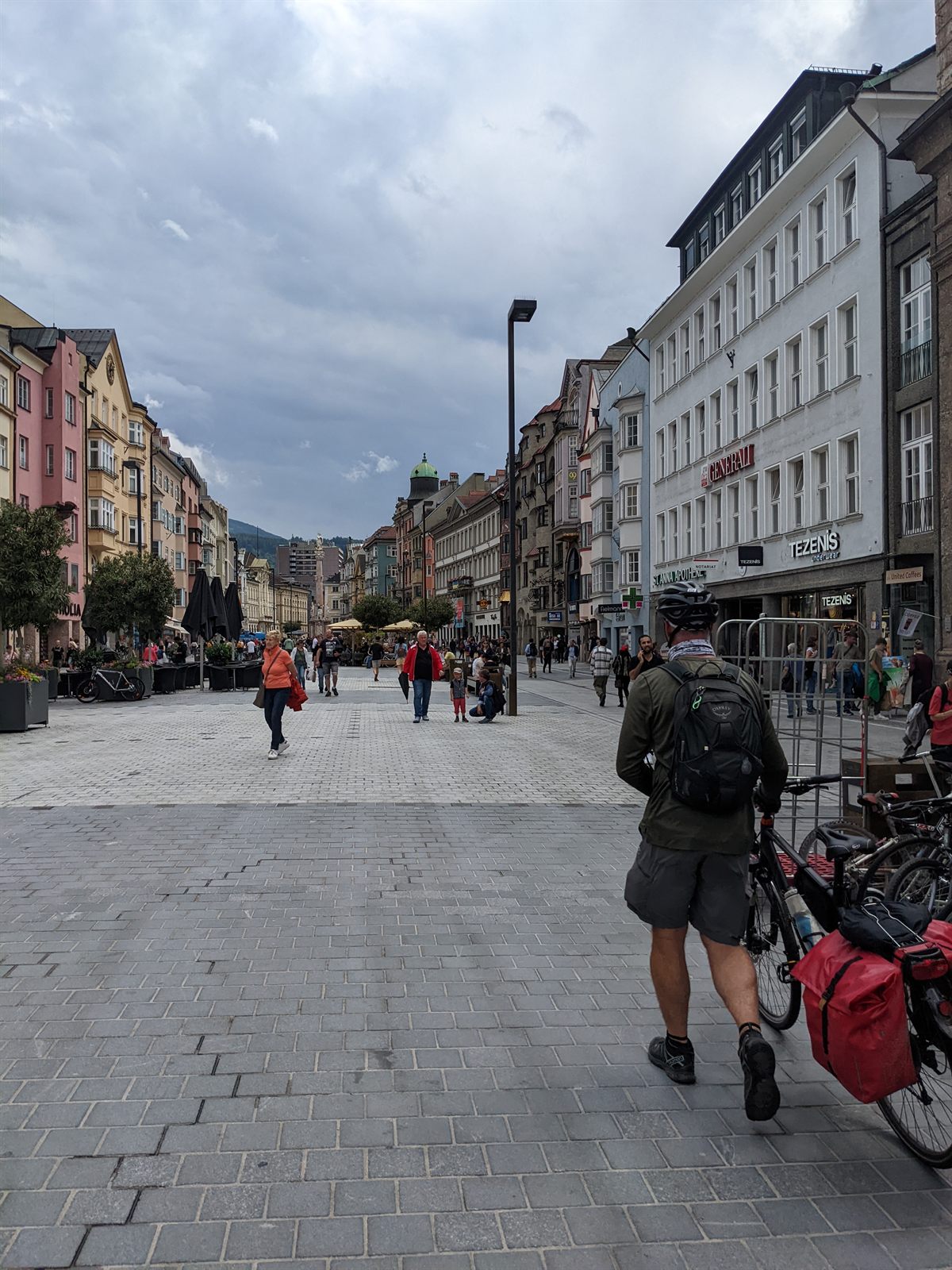
Most tour groups take the train from Innsbruck up to the Brenner Pass — partly to skip the climb, but mostly to avoid the busy highway and roads that grind up to the Austria–Italy border — and we decided to do the same. It was the right call: the train had great views, and it was a genuine pleasure to be whisked up to the top of the pass instead of fighting traffic for it. We poked around Brenner a little, and then rode the bike path down into Italy from the top.
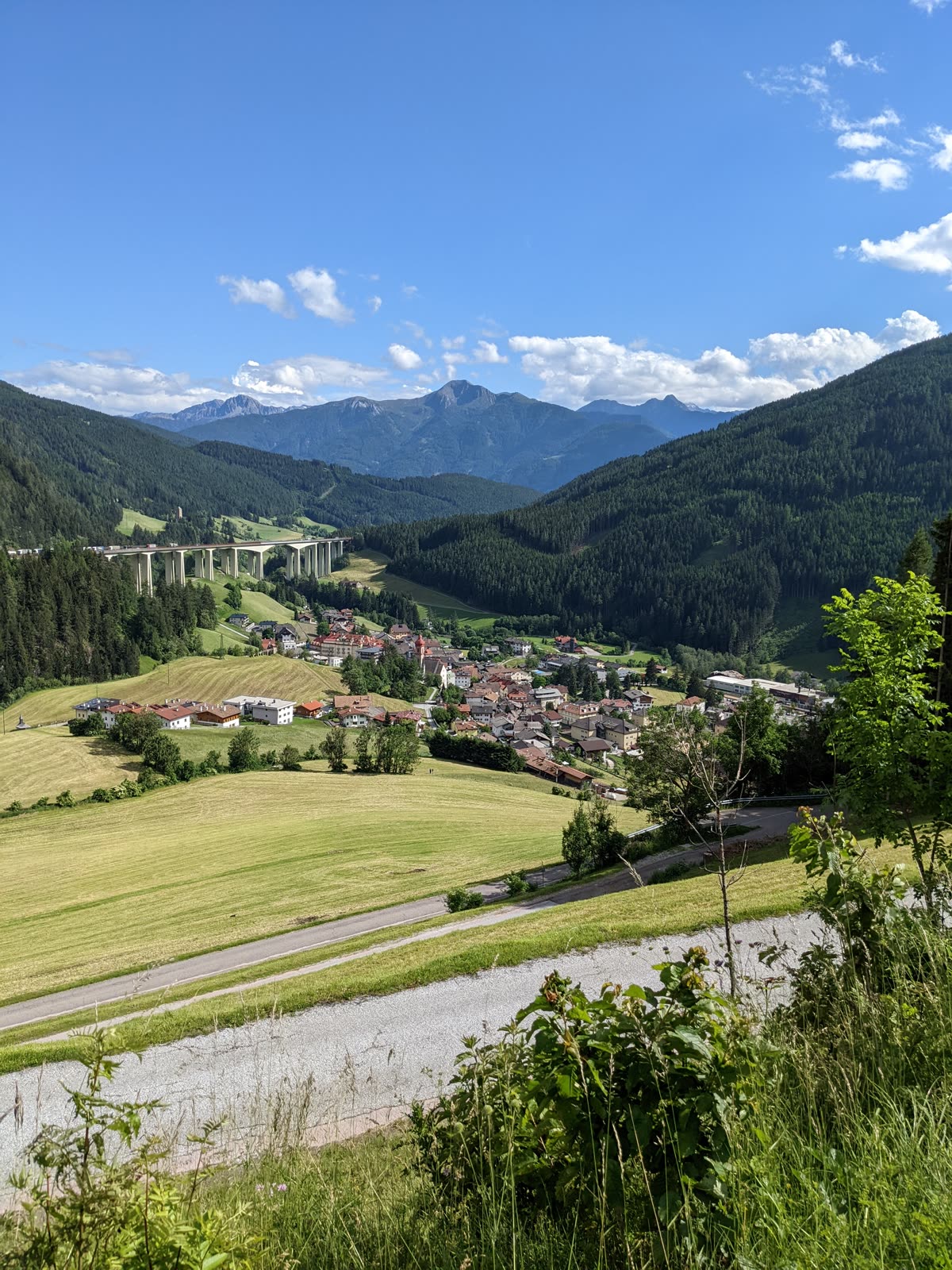
That descent turned out to be one of the many highlights of the day. The path follows the grade of the old Brenner railway down the Eisack (Isarco) valley — a gentle, steady drop with the modern Brenner autobahn striding across the valley on its enormous viaducts overhead. We'd crossed into South Tyrol — Alto Adige — Italian since the end of the First World War, but German-speaking to its core, so every town now had two names at once.
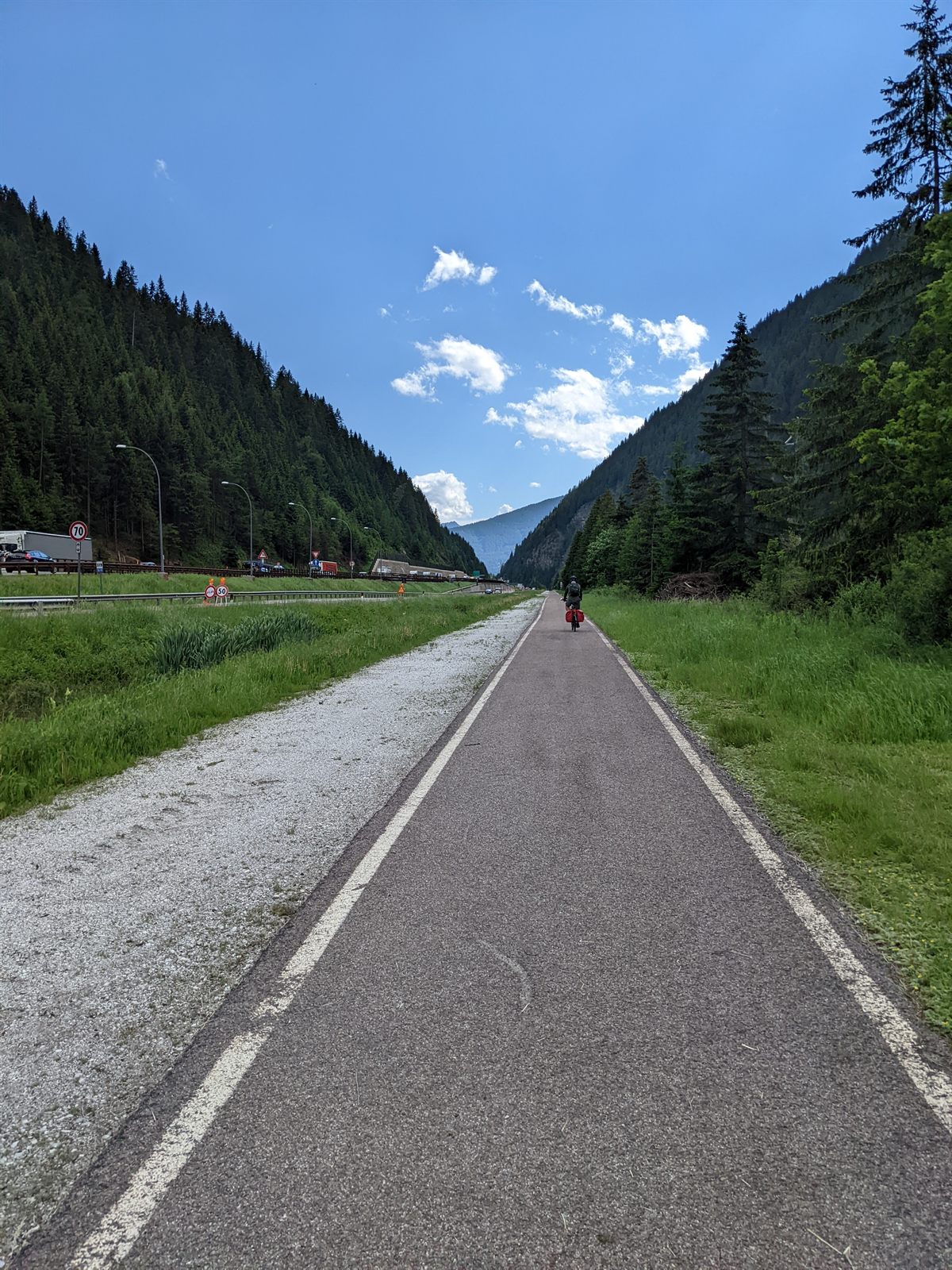
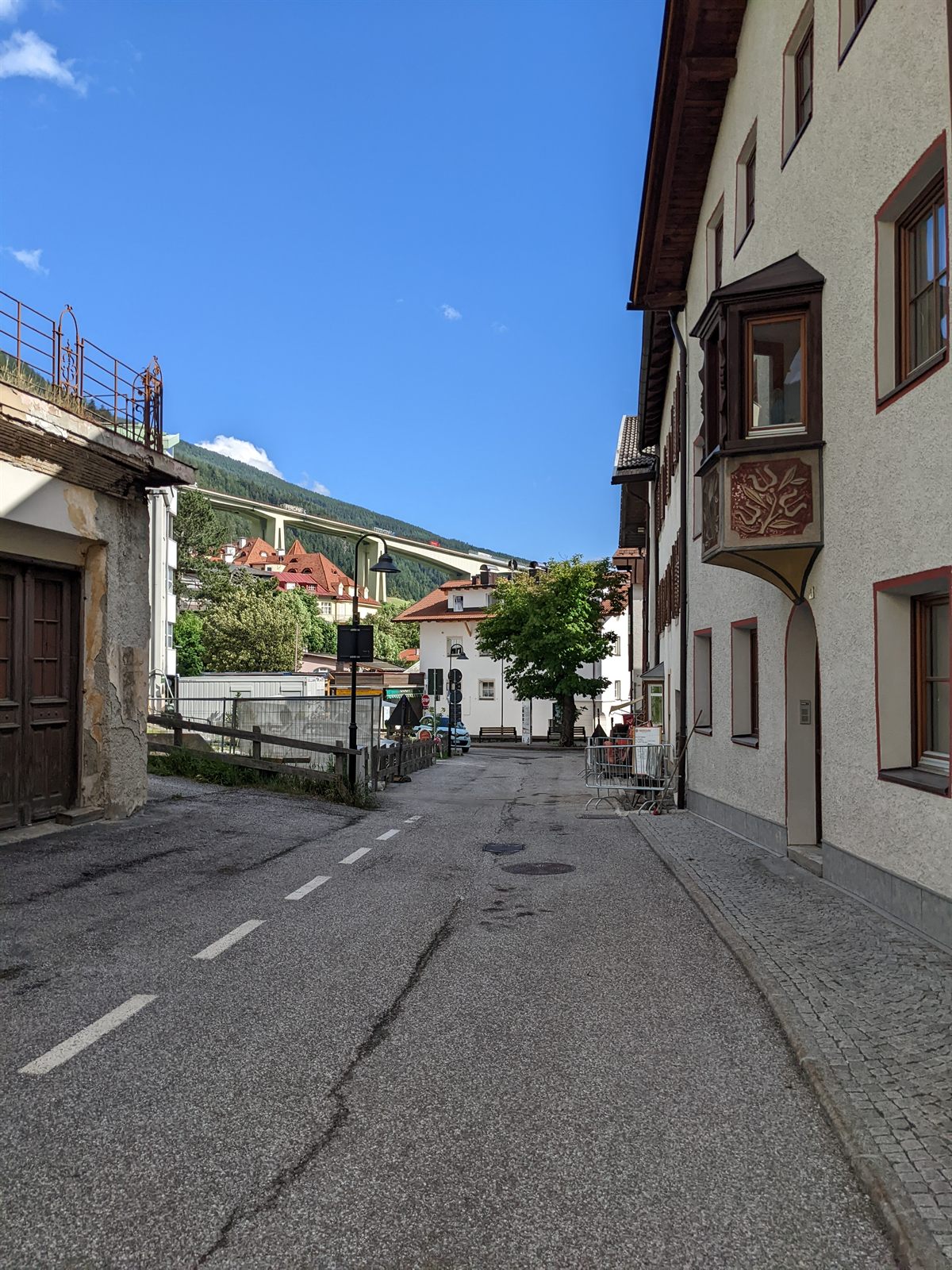
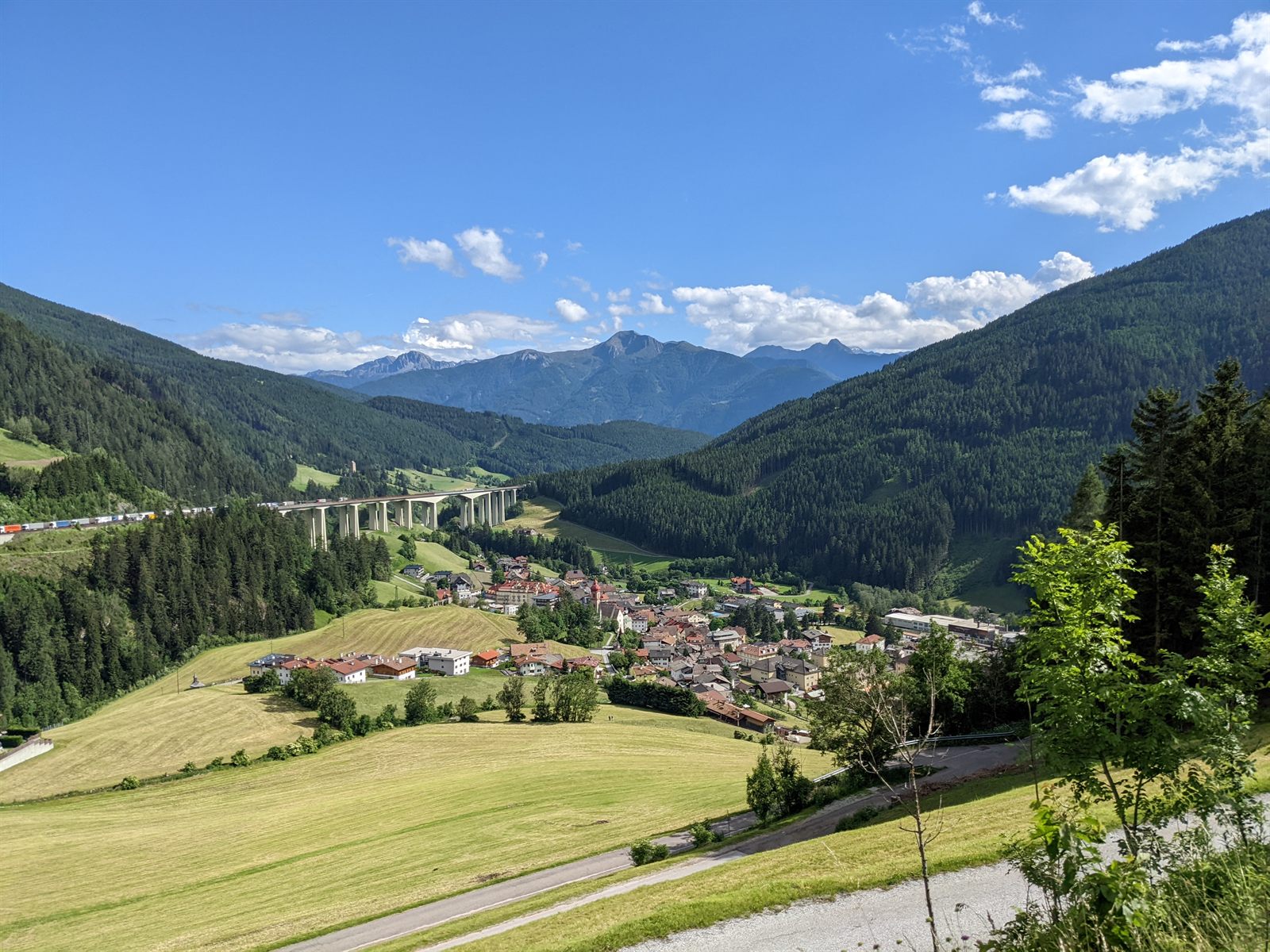
🎥 Two quick clips off the bike on the descent from the Brenner — through a tunnel, then out past the farmland.
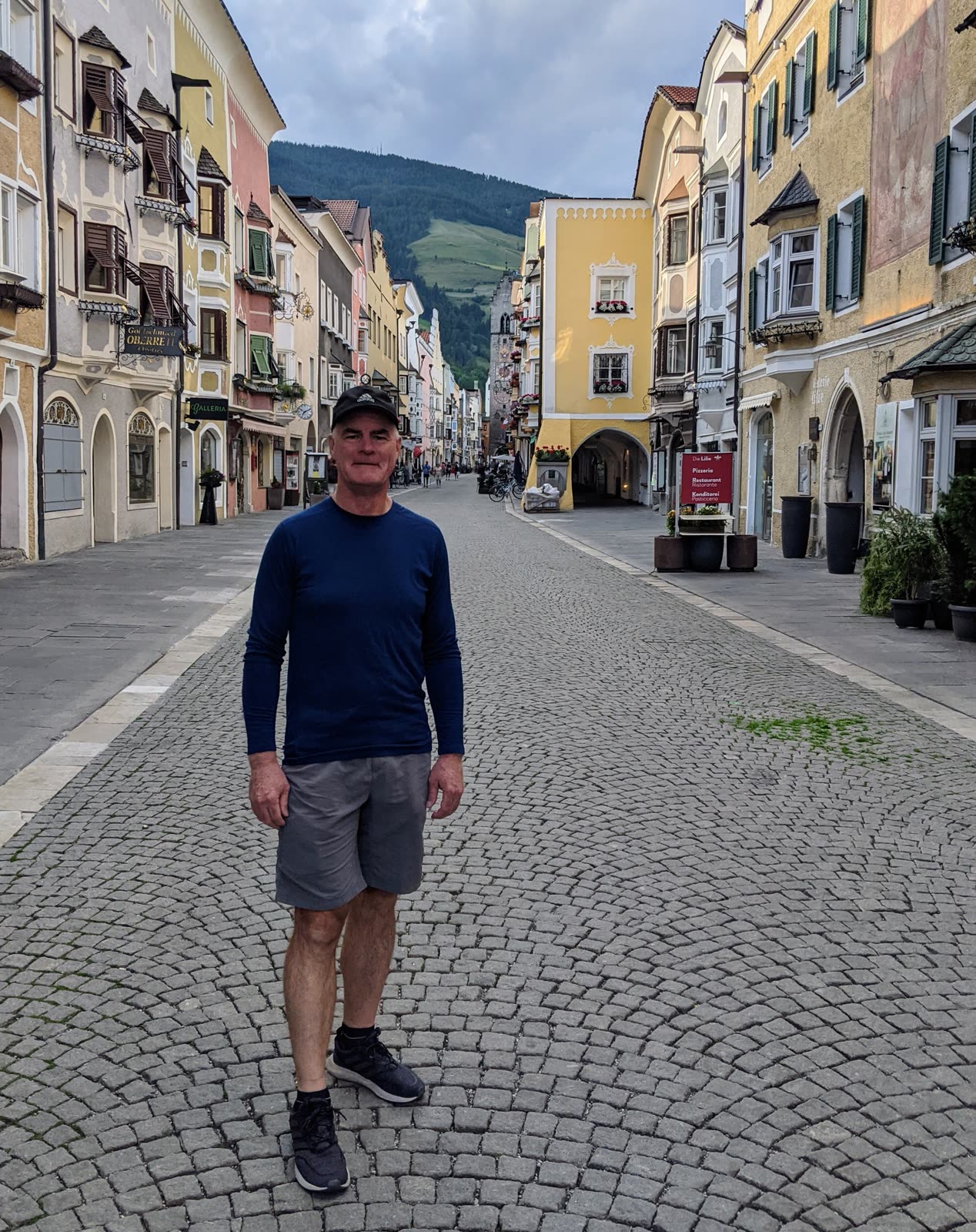
We made our way down into Vipiteno — Sterzing in German — and our hotel for the night, the Hotel Mondschein. It's a colorful town with a rich history, and we had a fine evening of it: a few drinks and a great dinner, our waiter sliding effortlessly between Italian, German, and English, one language flowing into the next without a hitch. Around here both German and Italian are simply part of daily life, a legacy of the region's back-and-forth past. We were glad to have earned some better weather by the end, and gladder still to spread our soaked gear out to dry at the hotel. Another great day, and great scenery — the roll down from the Brenner into Italy the pick of it.
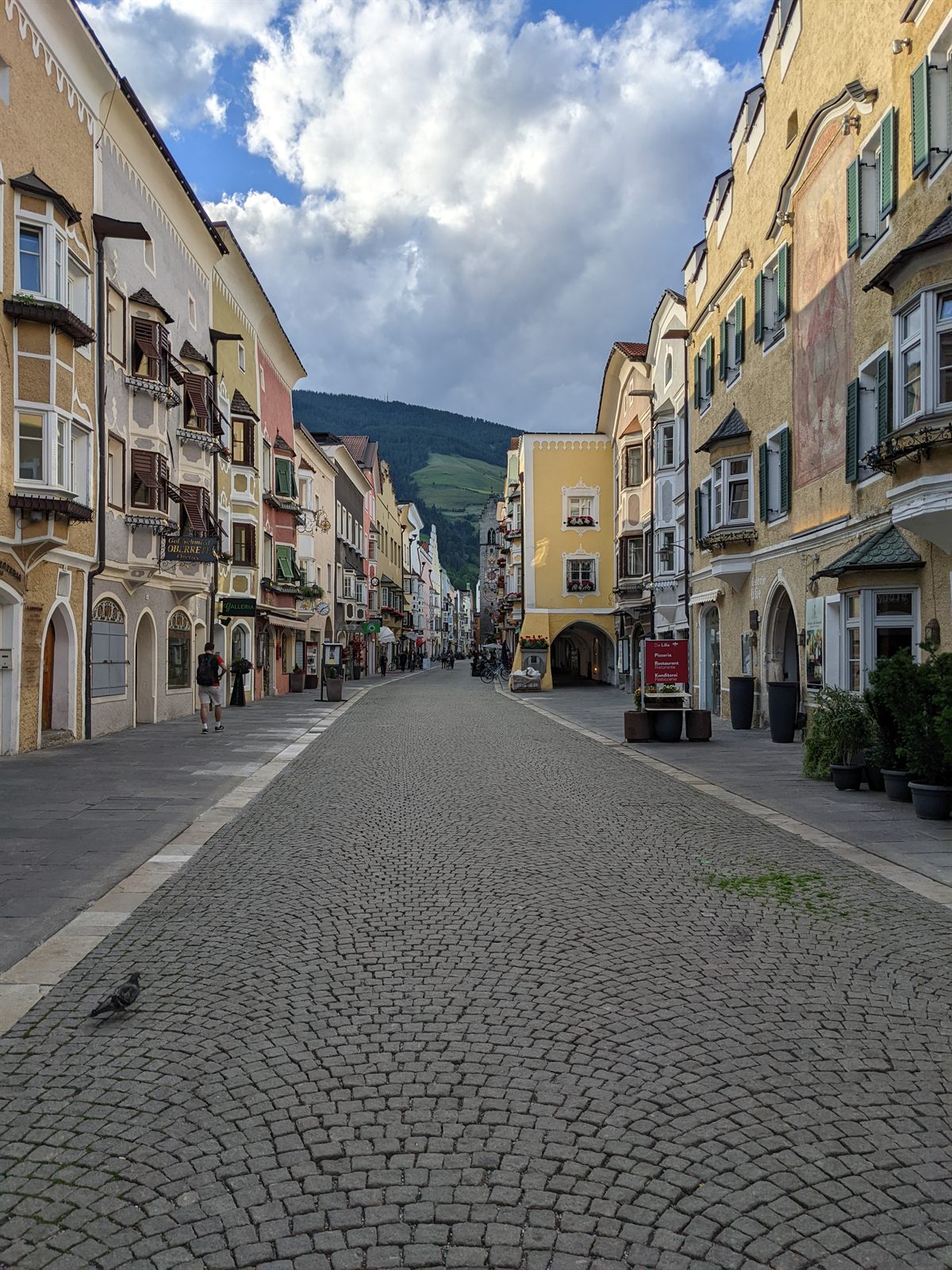
Click any photo to enlarge it and read its caption.
≈42 miles · ~2,610 ft climbed · Italy · east into the Puster valley
The Hotel Mondschein in Vipiteno had treated us well — dry gear, a good night's sleep, and a breakfast worth lingering over before we rolled out. The first part of the day was the kind of riding you'd wish on anyone: downhill, loosely shadowing the main road down the valley, sometimes running alongside the railway, and every so often peeling off the valley floor for a little detour through a village or a cluster of farms. The Wipptal — the valley running down from the Brenner — was wide and green, the sun was already up over the ridgelines, and the sky stayed a deep, cloudless blue the entire day.
Not far out of town, up on the hillside, a castle came into view — a square keep with a steep pointed roof standing over a battlemented curtain wall, half-swallowed by the forest behind it. It stopped us both.
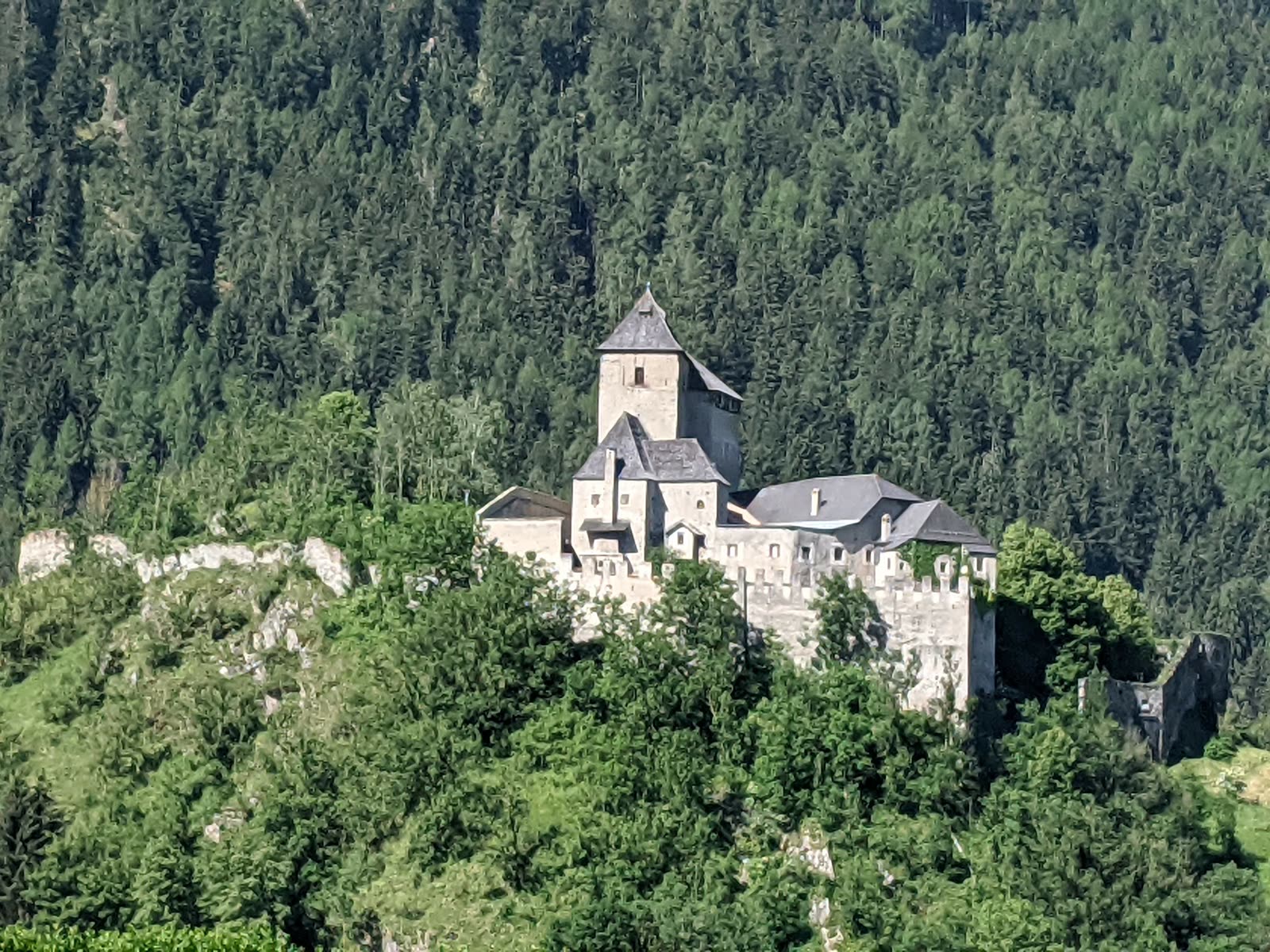
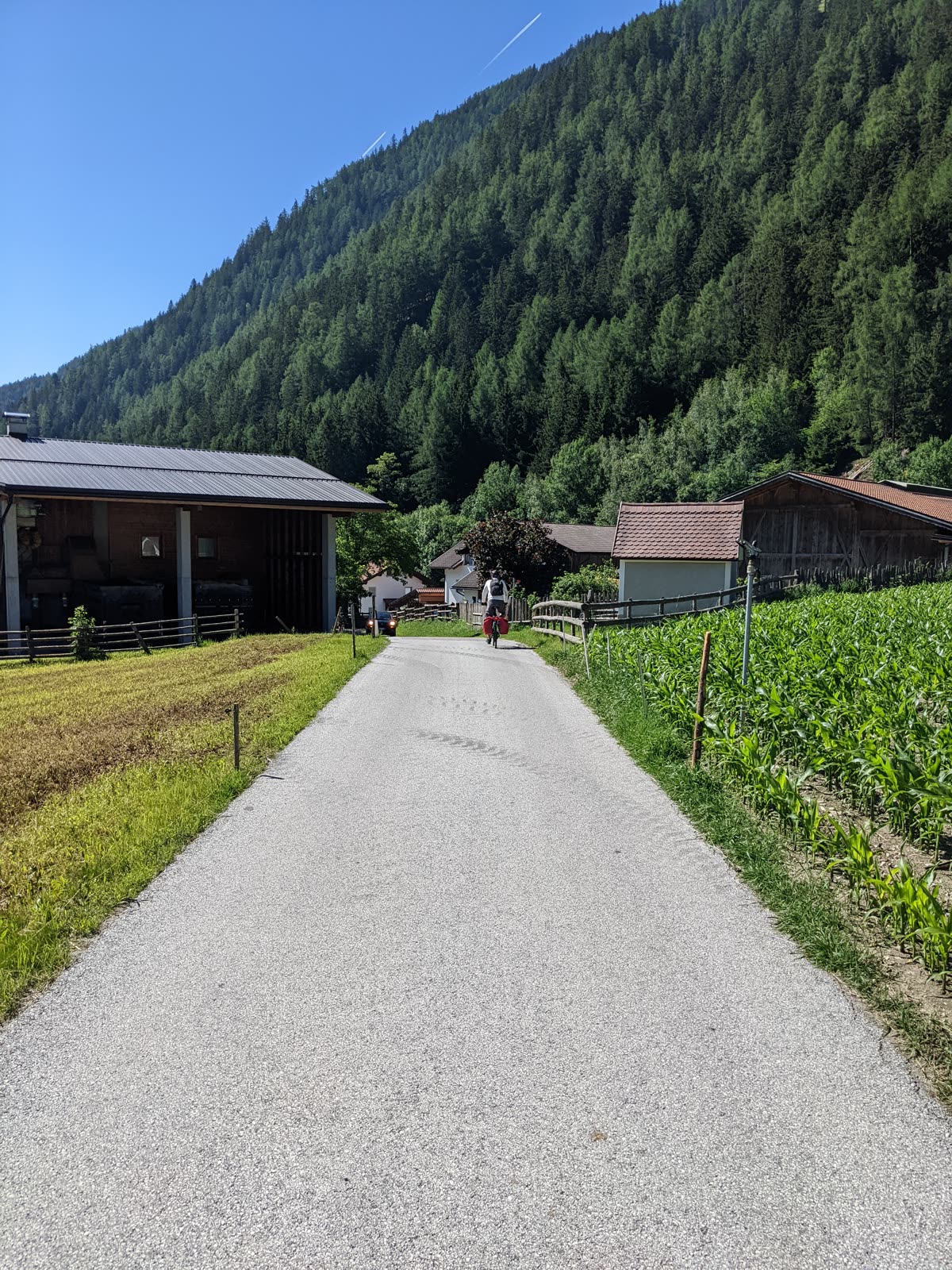
Somewhere in there, Doug took the lead — and at one of the junctions where our route splits away from the long-distance line that carries on south toward Bolzano and Verona, he turned right and kept going. We should have gone straight. Little did we know that Verona would go on to make us some very "interesting" memories of its own just a few days later.
Route-finding was like that all day. Signs kept appearing for our route and for other bike routes, sometimes at the same post, sometimes contradicting each other. I had a map that was doing most of the work of keeping us honest, but the trail had been re-diverted here and there onto newer or better alignments, so the map and the ground didn't always agree. When Doug disappeared up the wrong road, I decided I'd rather wait a few minutes than climb hills I didn't need to climb — and eventually he came back down looking for me. For a moment there I did think I might be finishing this tour solo, in which case I'd have a lot more stories to tell and nobody to check them against.
Our loose plan for the day had been to reach Dobbiaco. That's how Doug and I were running this trip: the first two nights were booked, and everything after that we made up as we went. The riding kept changing character — road through small towns, a stretch beside the highway, then long sections next to a fast, cold, milky-green river, or crossing over it on wooden bridges. It was warmer than it had been, so we stopped for water, picked up sandwiches that looked far too good to ride past, and grabbed some snacks. Set for the day, no need to stop again for lunch.
Where the Eisack valley ends, the Puster valley begins, and the entrance is guarded — properly guarded — by a wall of river stone with two round towers that runs down the wooded ridge and stops just short of the road and the cycle path. You ride right past it.
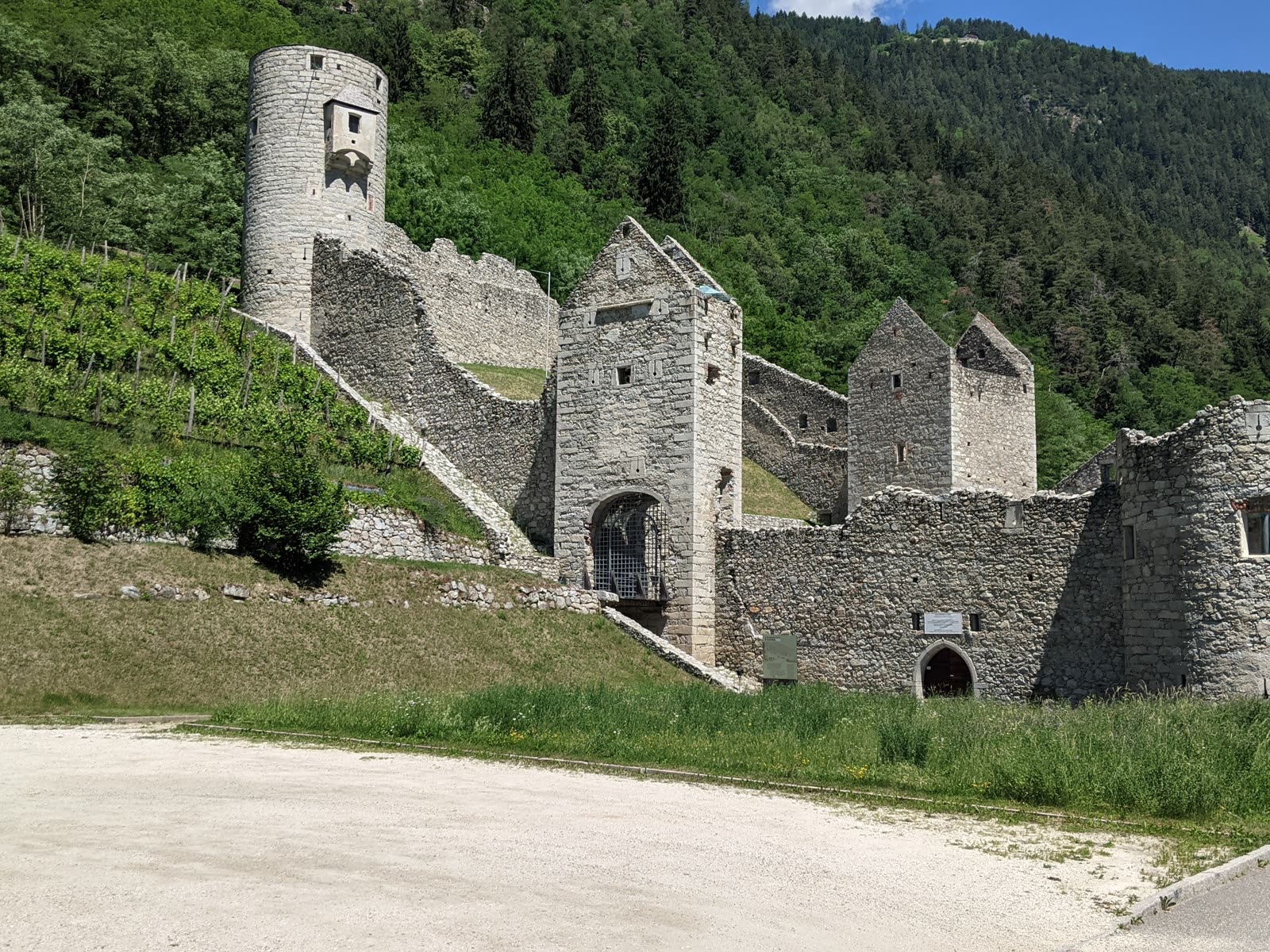
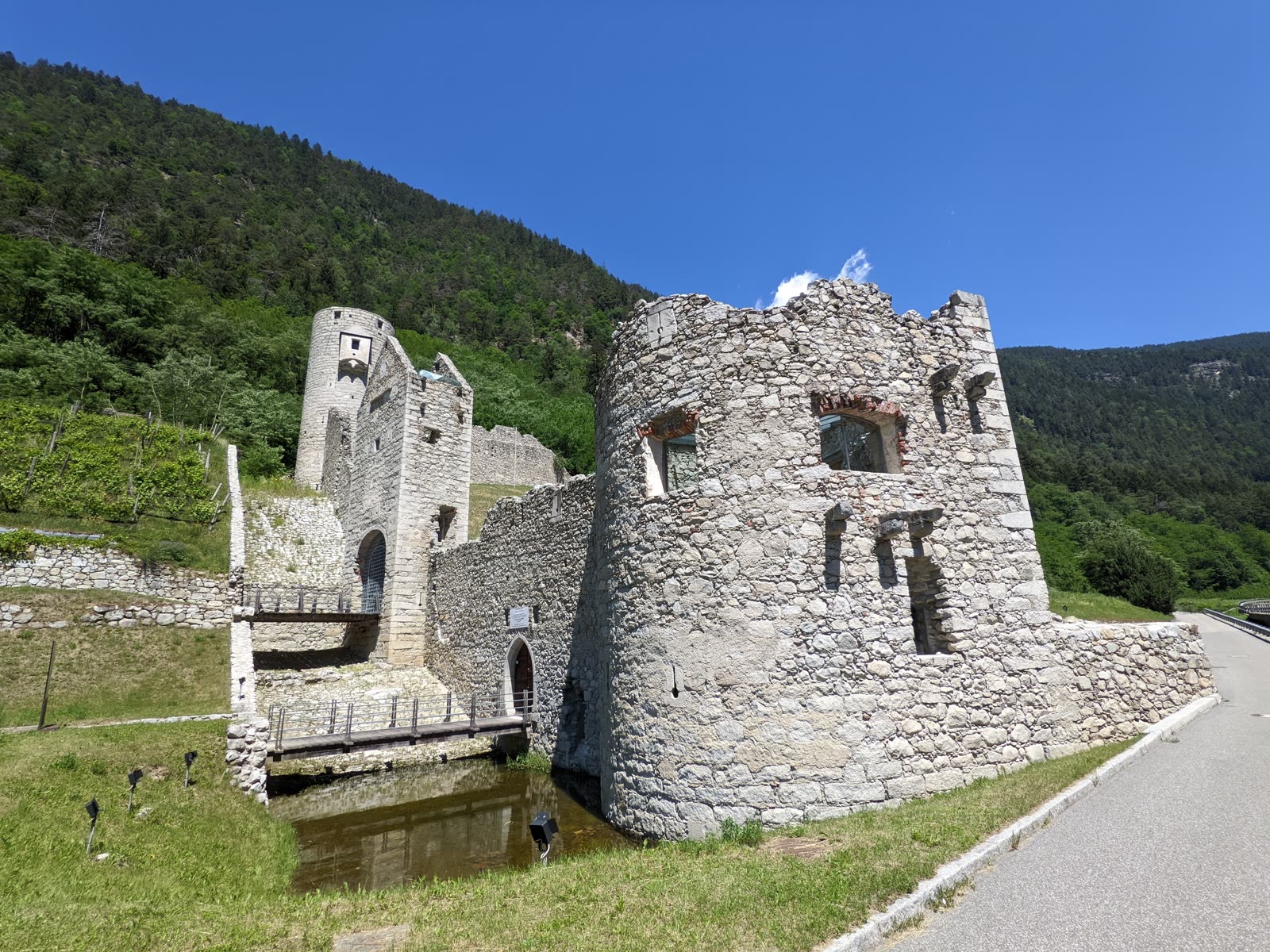
A little further on we crossed the river on a covered wooden bridge, and there on one of the posts was a yellow scallop shell on a blue field, pointing the way. The Way of St. James runs through here too — the Jakobsweg, feeding all the way west across Europe to Santiago. Four years earlier Doug and I had followed that same shell across Galicia on our own Camino — not this route, and not the famous walk into Santiago either, but the quieter continuation beyond it, out from Santiago de Compostela to Muxía and Finisterre on the Atlantic coast. Finding the shell again on a bridge in the Puster valley, on bikes, heading the opposite direction entirely, was one of those small quiet jolts a long trip hands you now and then.
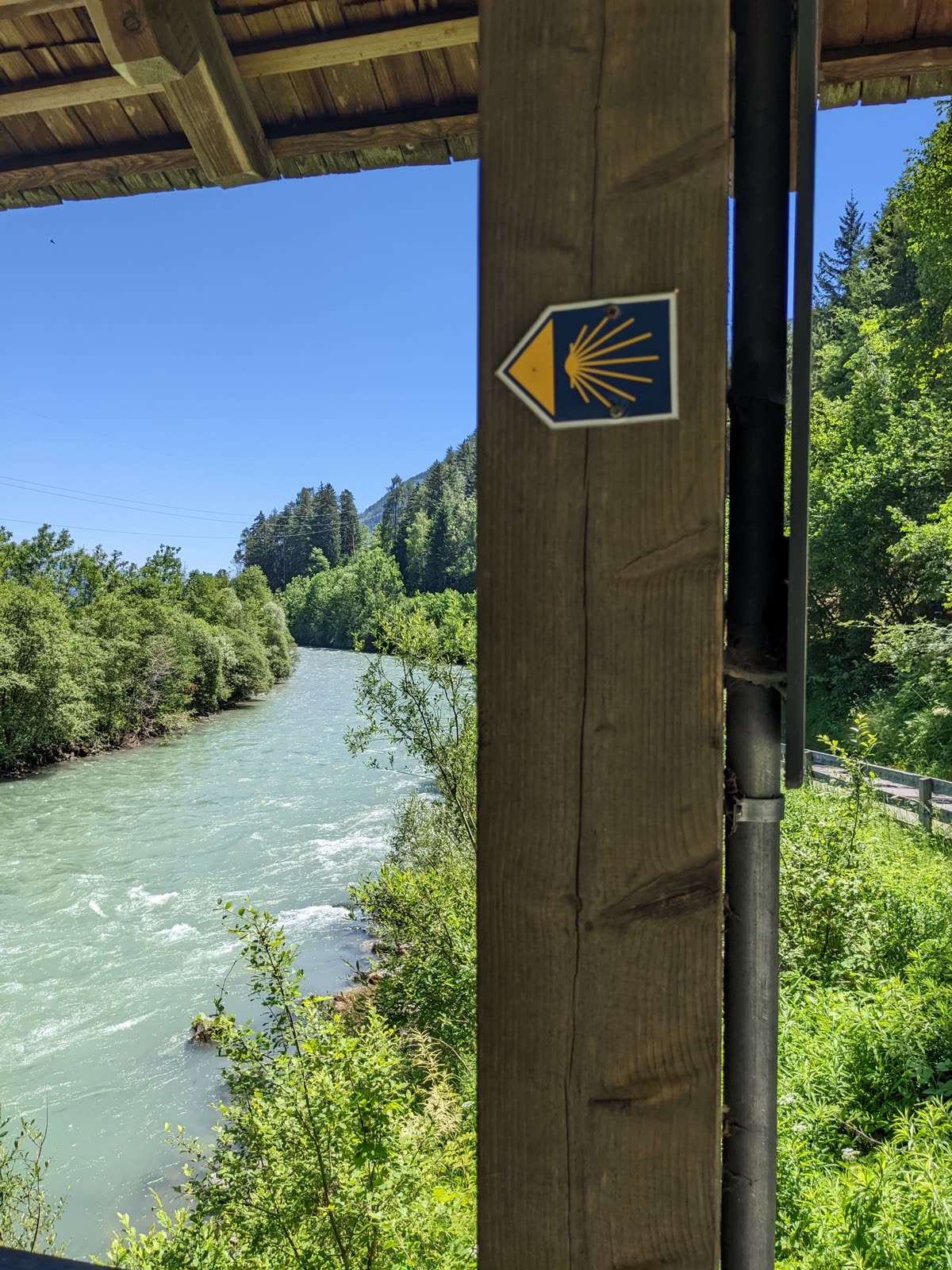
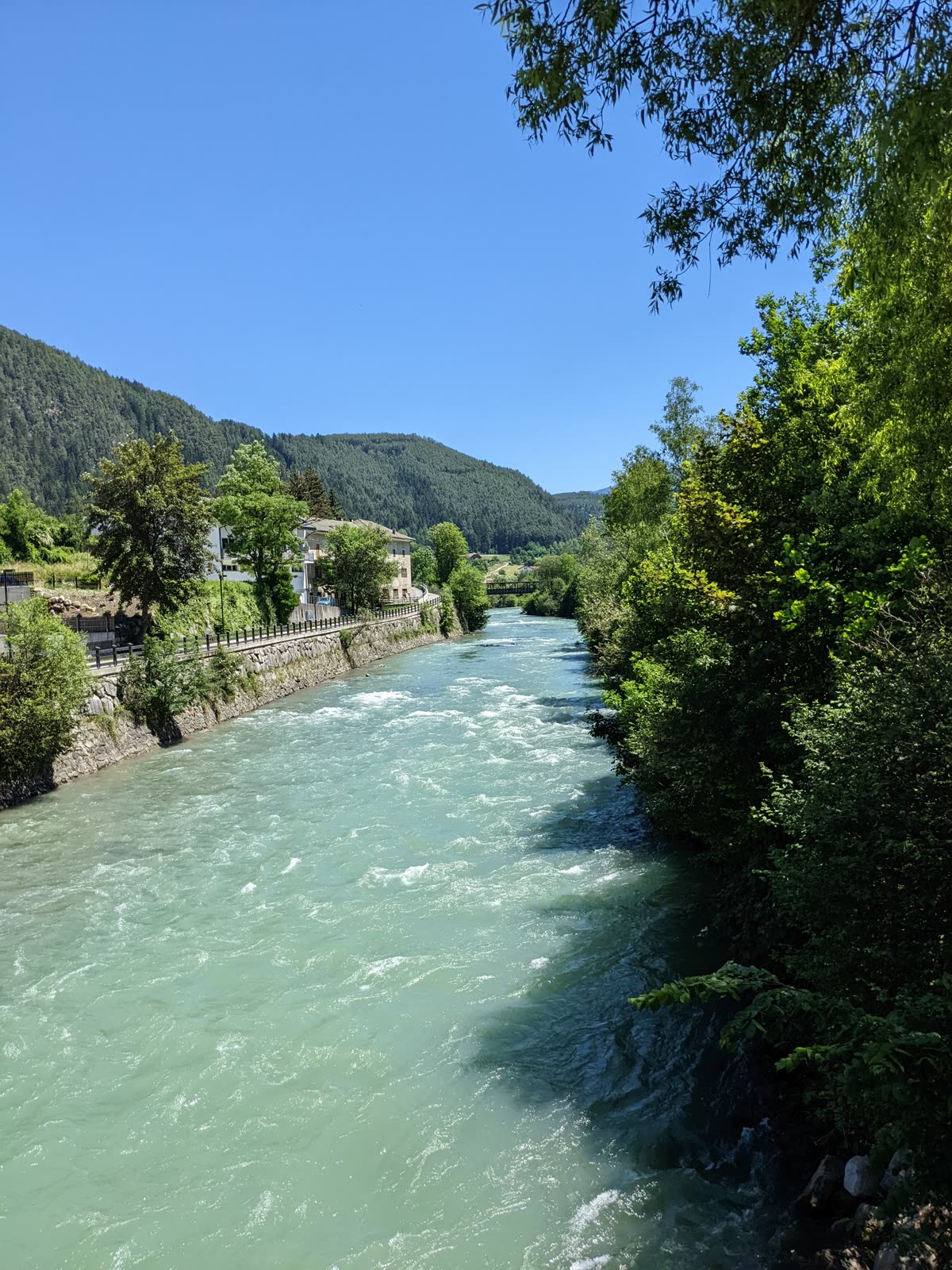
East of there the Puster valley does something the Wipptal never quite did: it opens out. Wide flat-bottomed sections of green pasture with mountains standing up on both sides, and the Rienza running through it fast and cold and that unmistakable glacier-fed blue-green. It was gradually uphill nearly the whole way now, with steeper pitches thrown in, and the views got better with every mile. We were riding into the Dolomites, and we knew it.
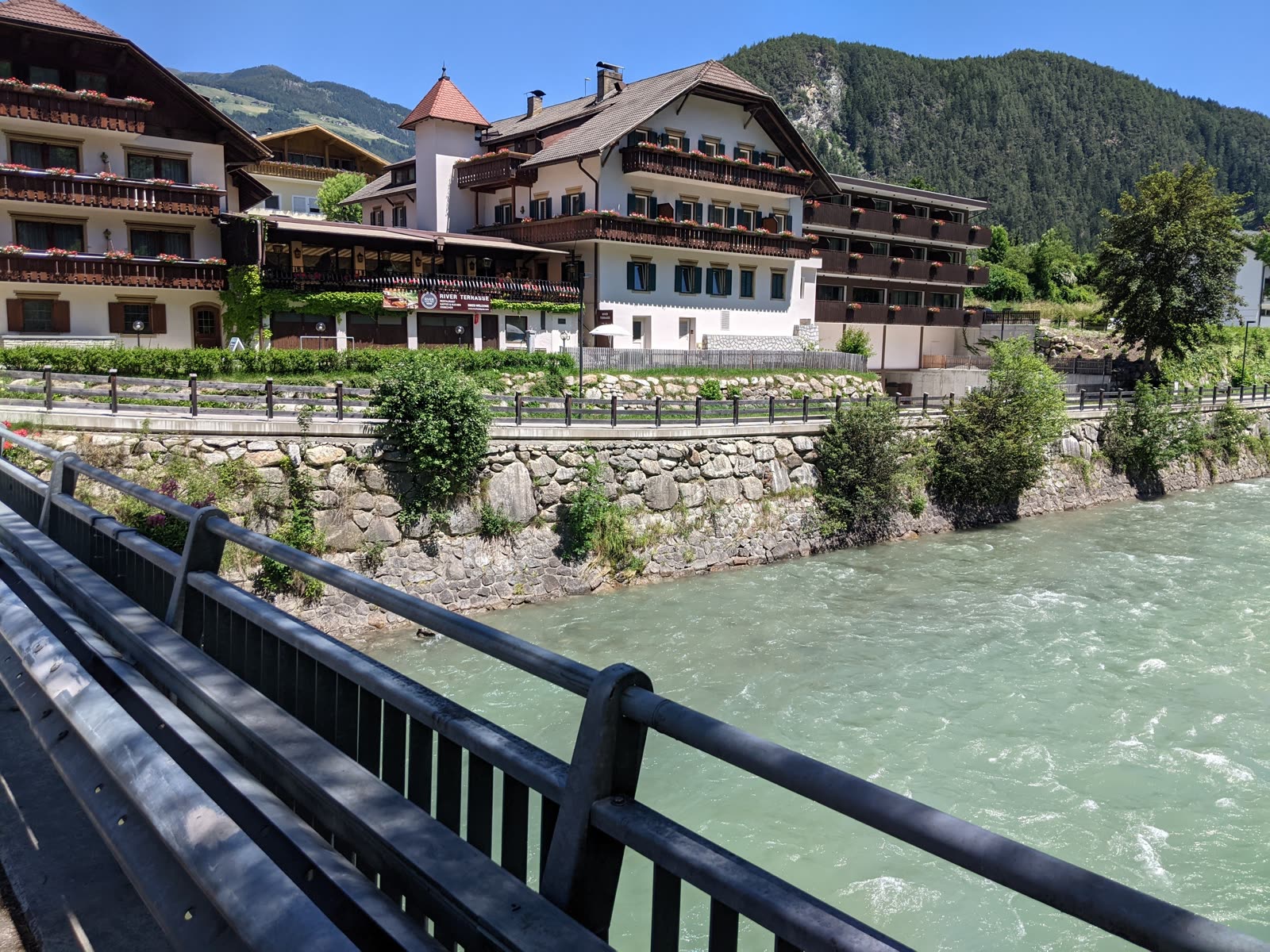
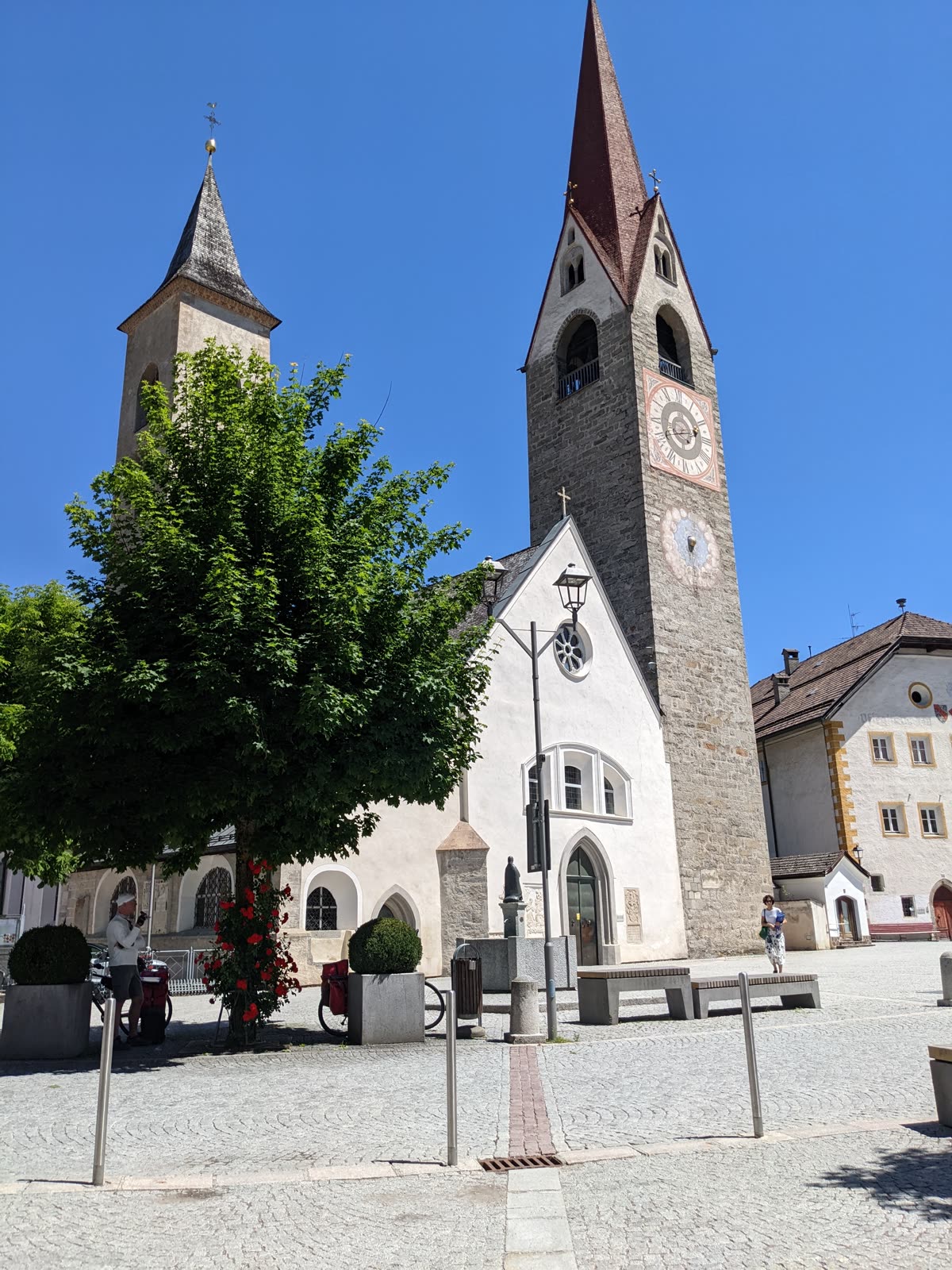
The best thing that happened all day wasn't planned at all. Mid-afternoon we rode into San Lorenzo di Sebato — St. Lorenzen — a quiet, beautiful little town, right as school let out. The streets filled with parents walking home with their young kids, the whole unhurried ordinary business of a weekday afternoon. The square had benches all the way around it, so we leaned the bikes against the flowers and sat down to watch the world go by. I spotted a shop, went in for extra drinks for the two of us, and came back out with ice cream Doug hadn't asked for. He didn't mind.
It's rare to recognize a moment while you're still inside it — usually you only work out later which ones stuck. But sitting on that bench in the sun, I said it out loud to Doug: this one's going to stay with us. He agreed. And it has.
Standing over all of it was the parish church, with two entirely mismatched bell towers shoulder to shoulder.
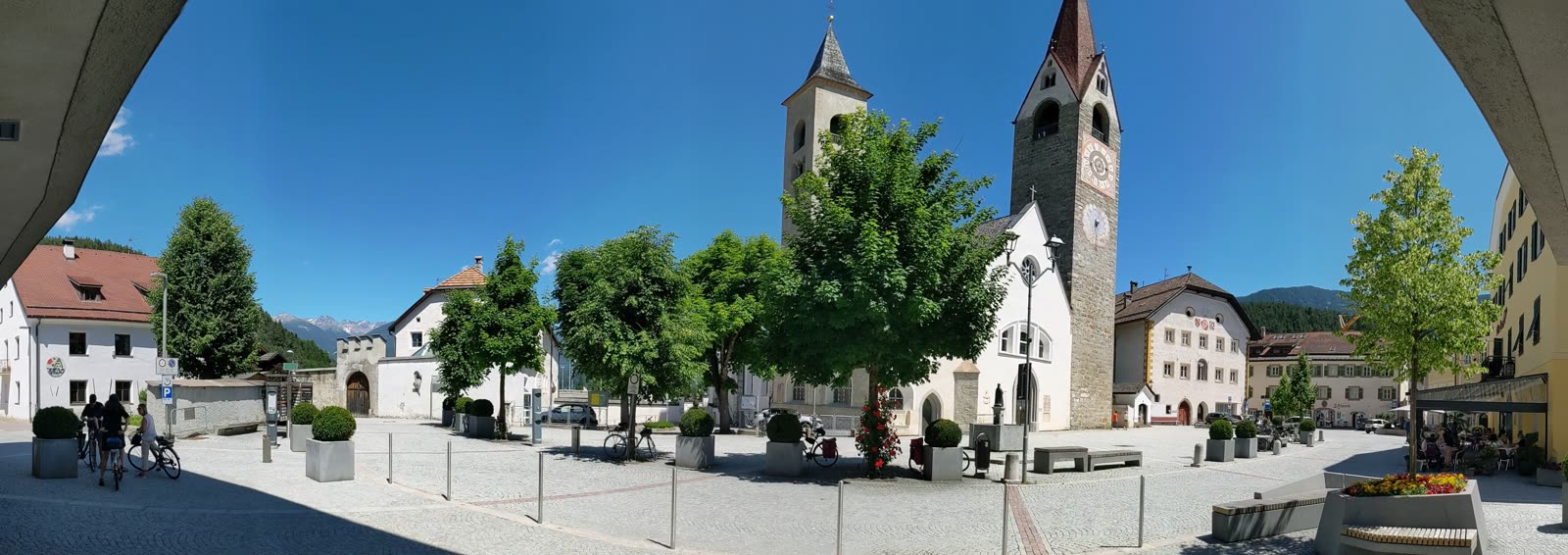
Later in the day the route put us on back roads through farmland, with some steep and genuinely long climbs. By the time we rolled into Olang — Valdaora — we'd both had enough climbing for one day and were more mentally tired than physically. Under the new plan we knew we'd reach Cortina easily tomorrow with most of the afternoon free to explore it, so there was no reason to push on. And we just had a feeling about this quiet town under the Kronplatz, the big broad-shouldered mountain that stands over the valley here and turns into one of Italy's best-known ski areas each winter.
Entirely on a whim we found a place to stay, and it turned out to be one of the best calls of the trip. The room had air conditioning — not a given up here — and, better still, the hotel had a washing machine. Four days in, we'd worked through most of what we'd packed, so getting everything clean at once felt like a genuine luxury. Dinner took some hunting; a lot of places were closed. But we found one that was open, ate well, and spent the rest of the evening doing absolutely nothing, which was exactly what the day called for.
≈30 miles · ~1,930 ft climbed · Italy · up into the Dolomites
We'd had a great night in Olang — that whim of a hotel had paid off, and we woke up rested and, honestly, a little excited. Today was the day we'd officially reach the Dolomites and ride into Cortina d'Ampezzo. I'd been to this corner of the mountains before, so I already knew what was coming: it's one of the most beautiful places I've ever set eyes on, and I couldn't wait for Doug to see it for the first time.
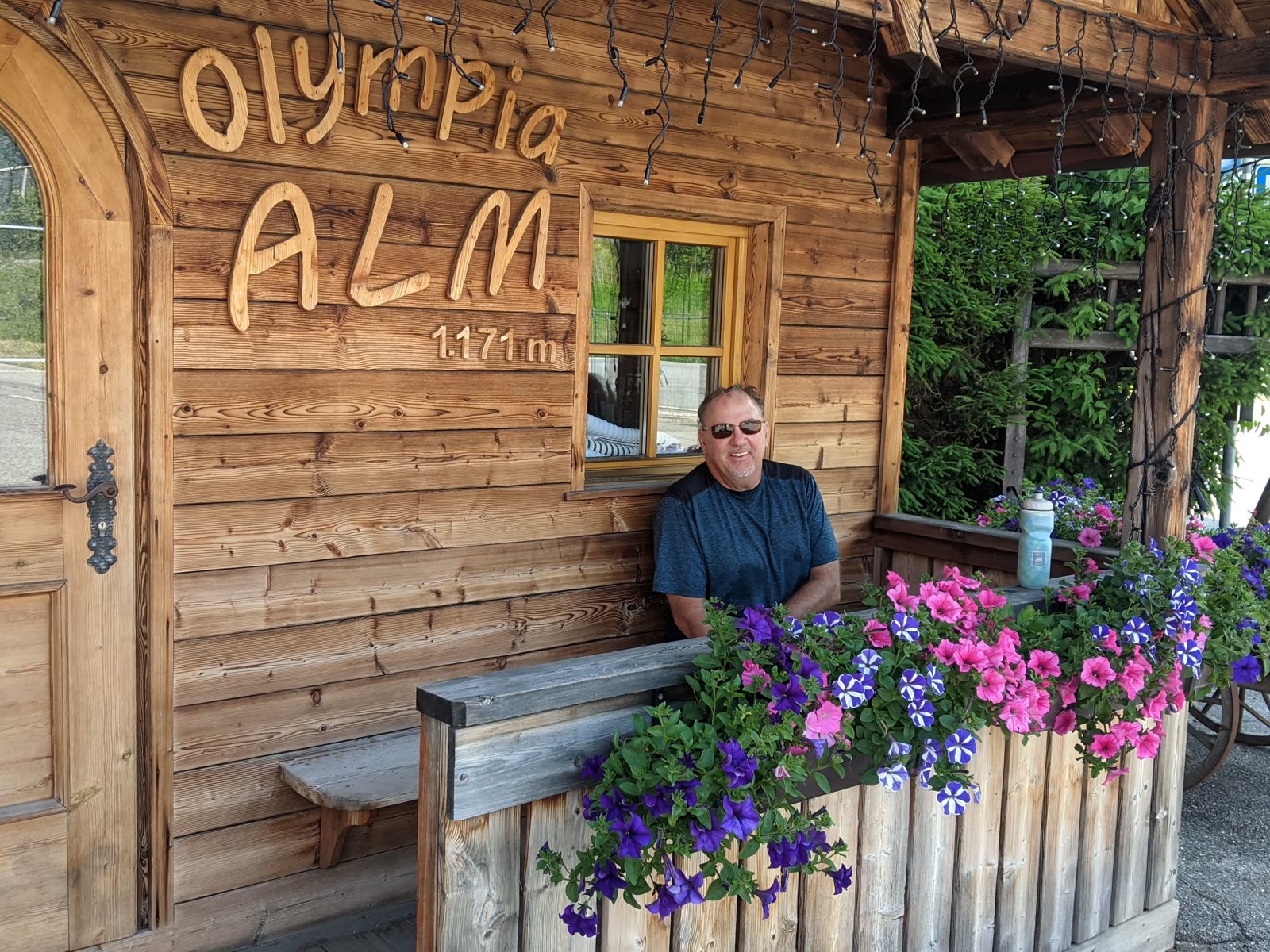
We rode out through a bit of the town and then picked up a gravel path running alongside a lake, and almost at once there were more people around — this is a popular touring route, and plenty of riders were on it, most of them headed somewhere other than where we were going. The signage got tricky. Twice we took wrong turns and had to backtrack, and on top of that there was trail work going on, with detours that added their own little puzzles. All part of the adventure. And the scenery kept changing enough that we never minded — the views of the Dolomite peaks, the lakes, and the green mountainsides make the pedaling so much easier, even though we were climbing for most of the day.
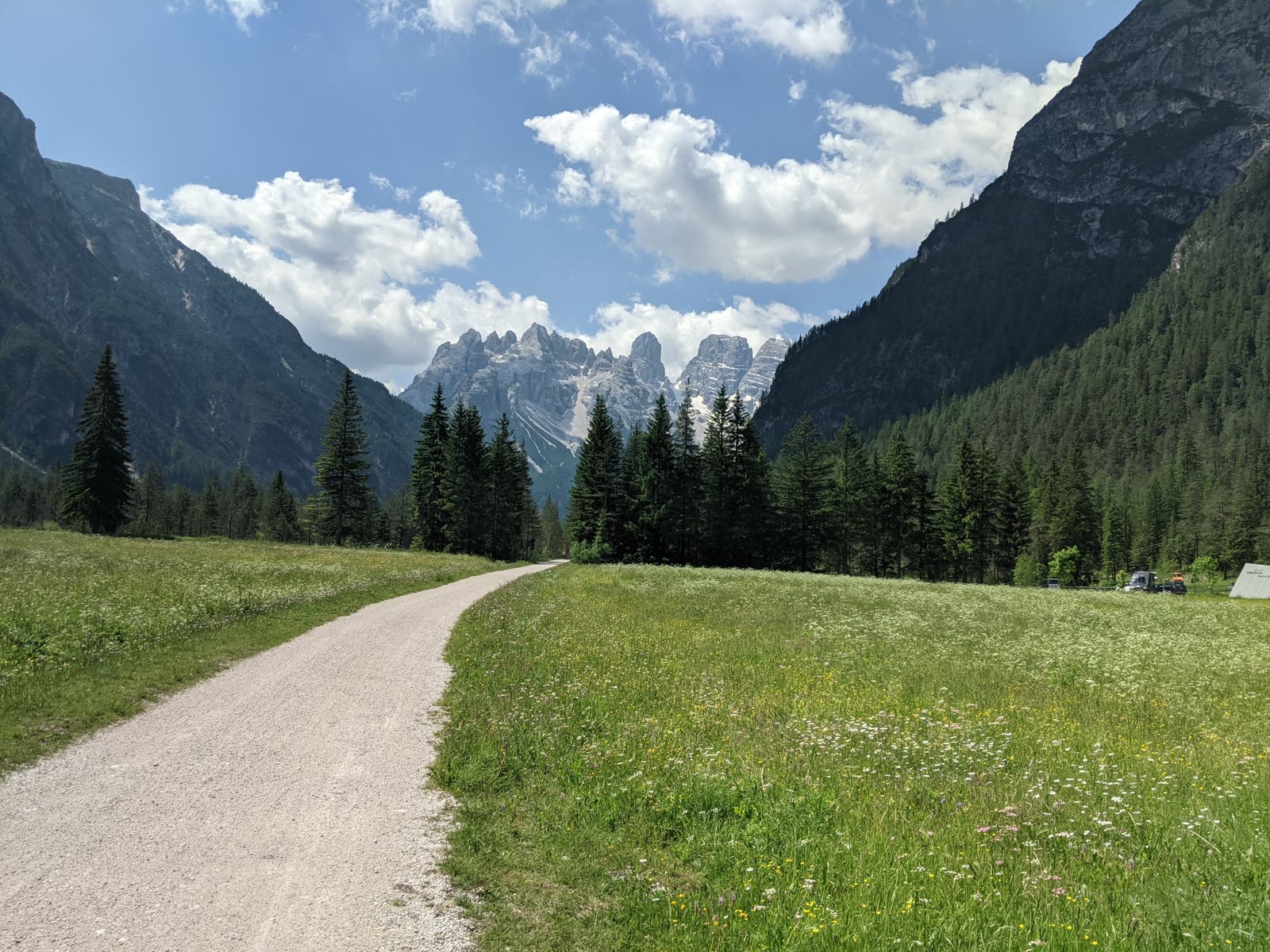
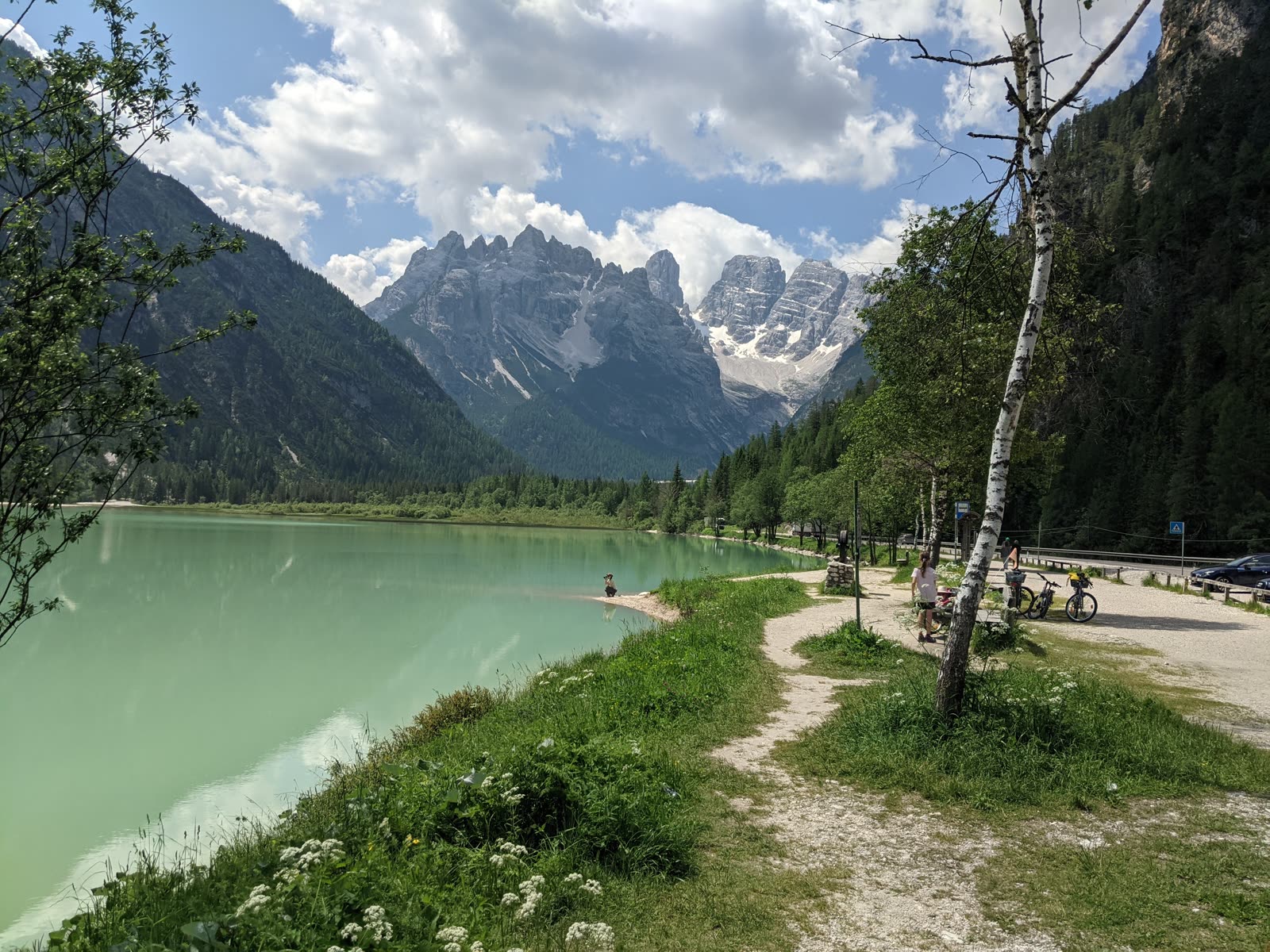
For long stretches we were riding an old railroad bed — a mix of gravel and paved sections that we'd stay on, on and off, for the rest of the day. It climbs gently and steadily toward a saddle called Cimabanche, and when we finally reached the Cortina sign we knew we were nearly there — with an epic downhill still to come. We'd be stopping in the town for the night, but this same rail trail carries on south out the other side, and we'd pick it right back up the next morning.
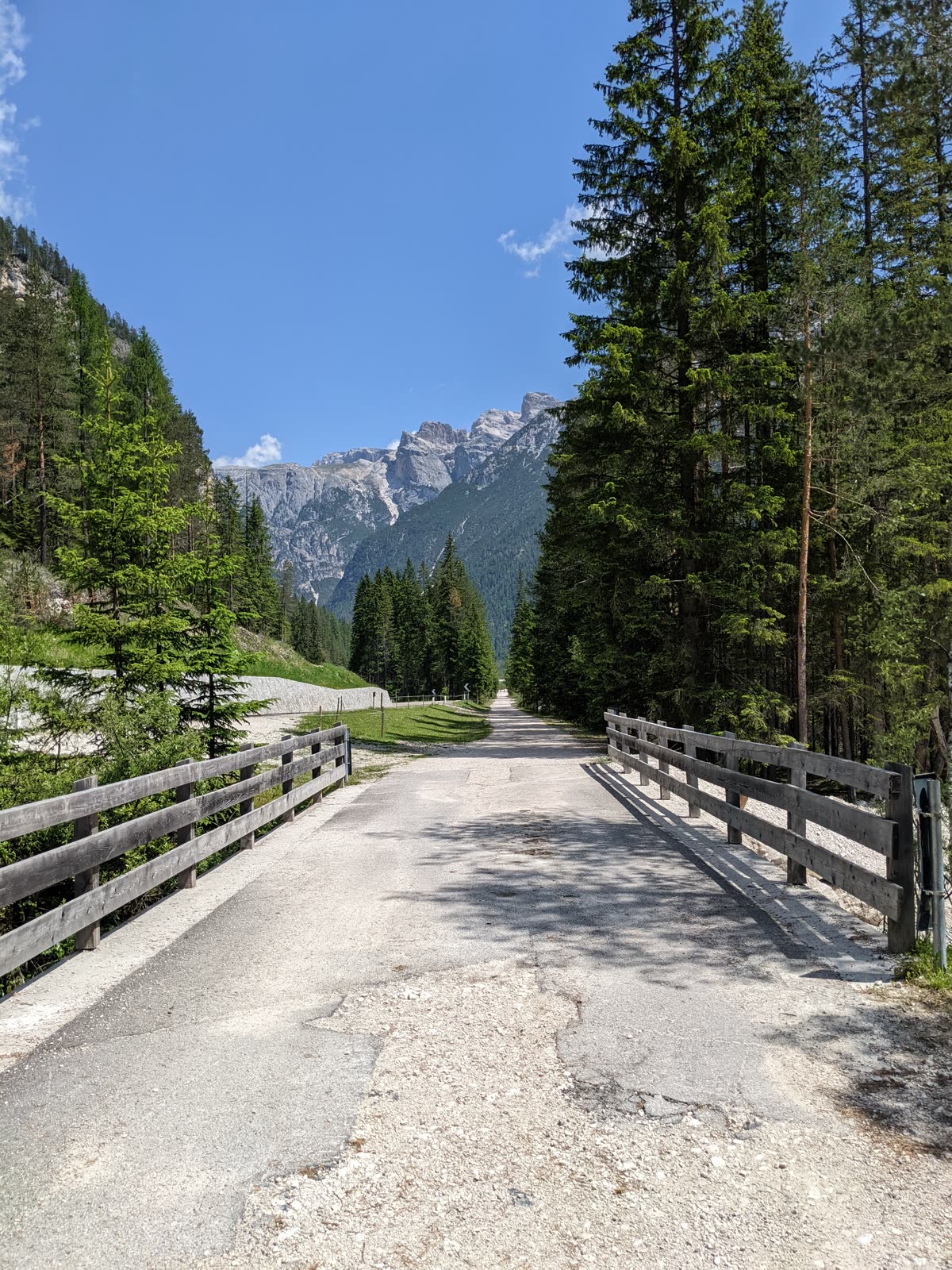
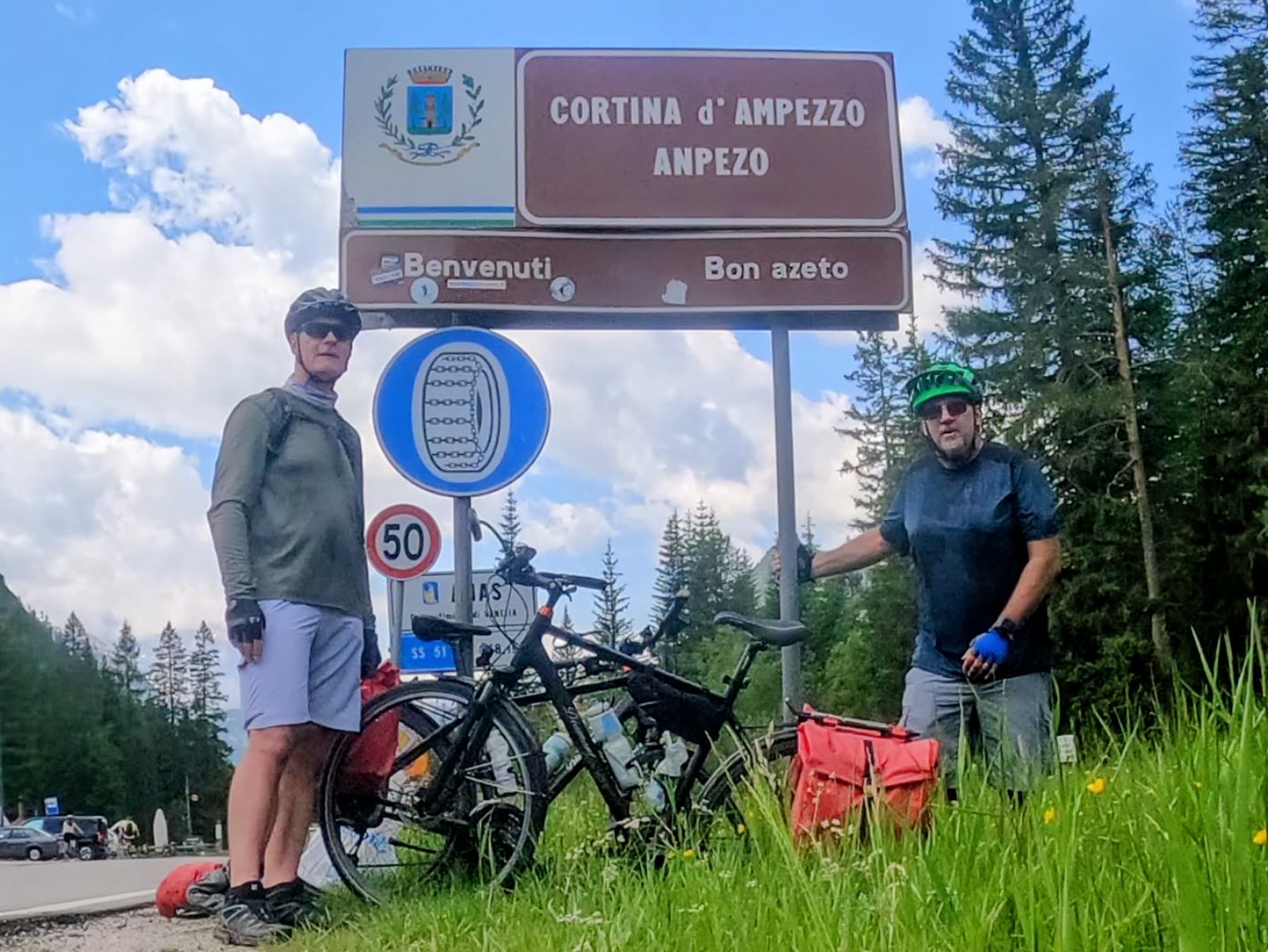
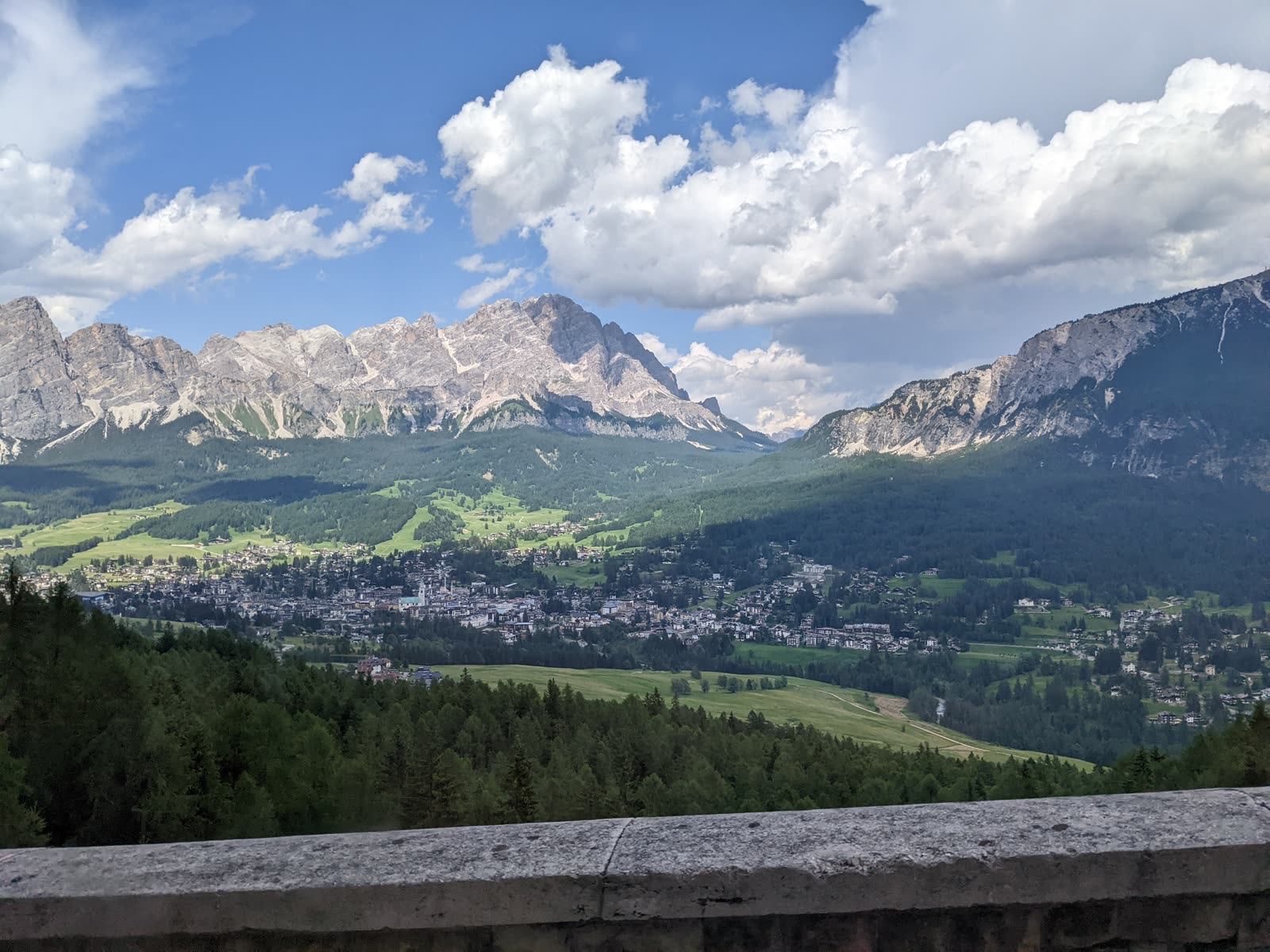
The closer we dropped toward town, the more the valley opened up and gave itself away. Ski slopes stood there green and grassy in the June sun, waiting for a snow that was months off; beautiful mountain homes and old Ampezzo buildings came into view, and the sweeping views of the whole basin kept widening — all of it our reward for the day's climbing. We stopped for lunch along the bike path right in town, then rolled over to our hotel — the Hotel Montana, right in the middle of Cortina — to drop off our bags, with the whole afternoon still ahead of us.
From the hotel we headed straight for the bus station. There was a place up above town I'd been to years earlier with my wife, and it had held great memories for me ever since — I wanted to go back, and I wanted Doug to see it. So we caught a bus that wound its way up the switchbacks out of the valley, climbing the whole time, the town falling away below us.
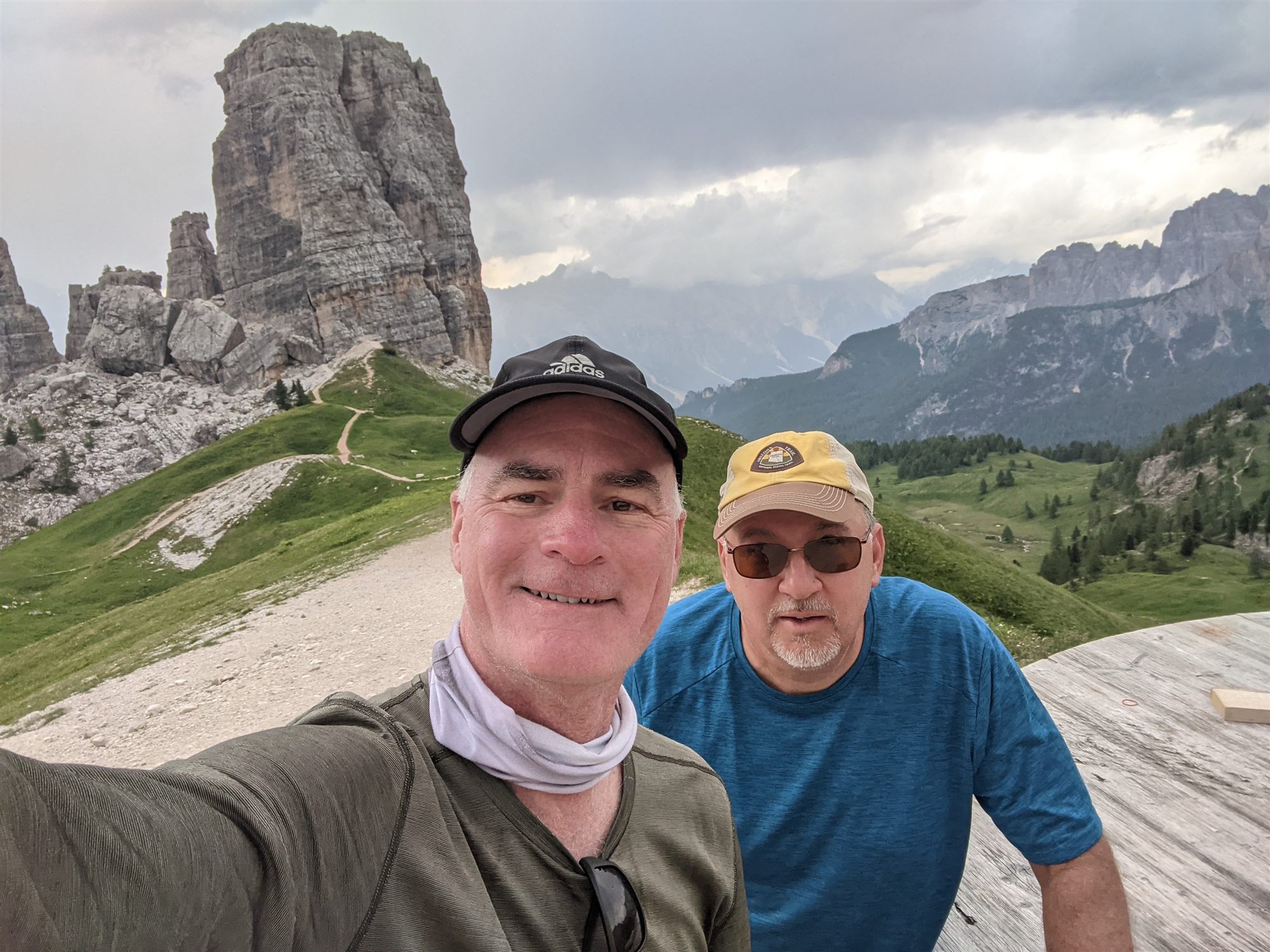
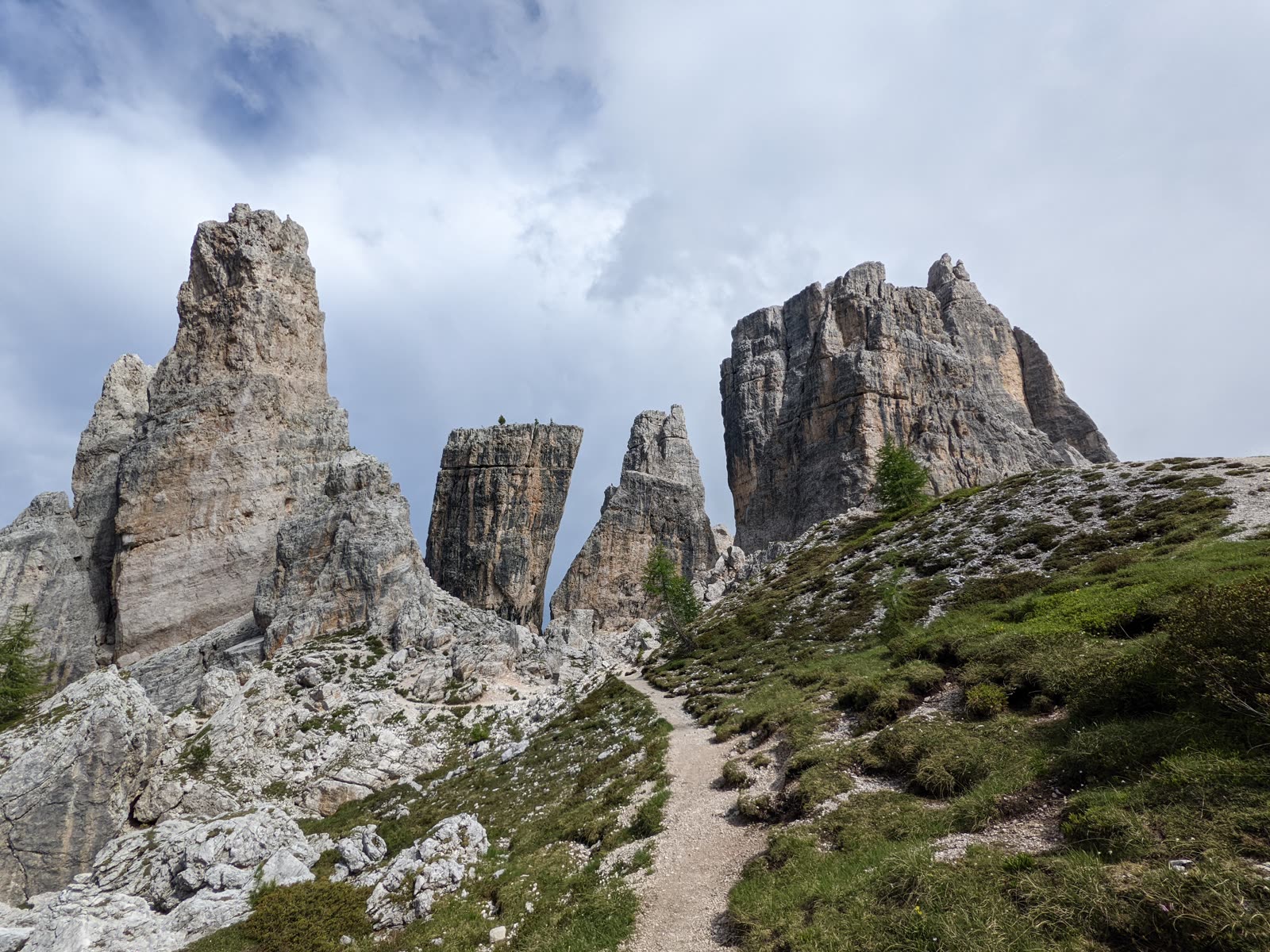
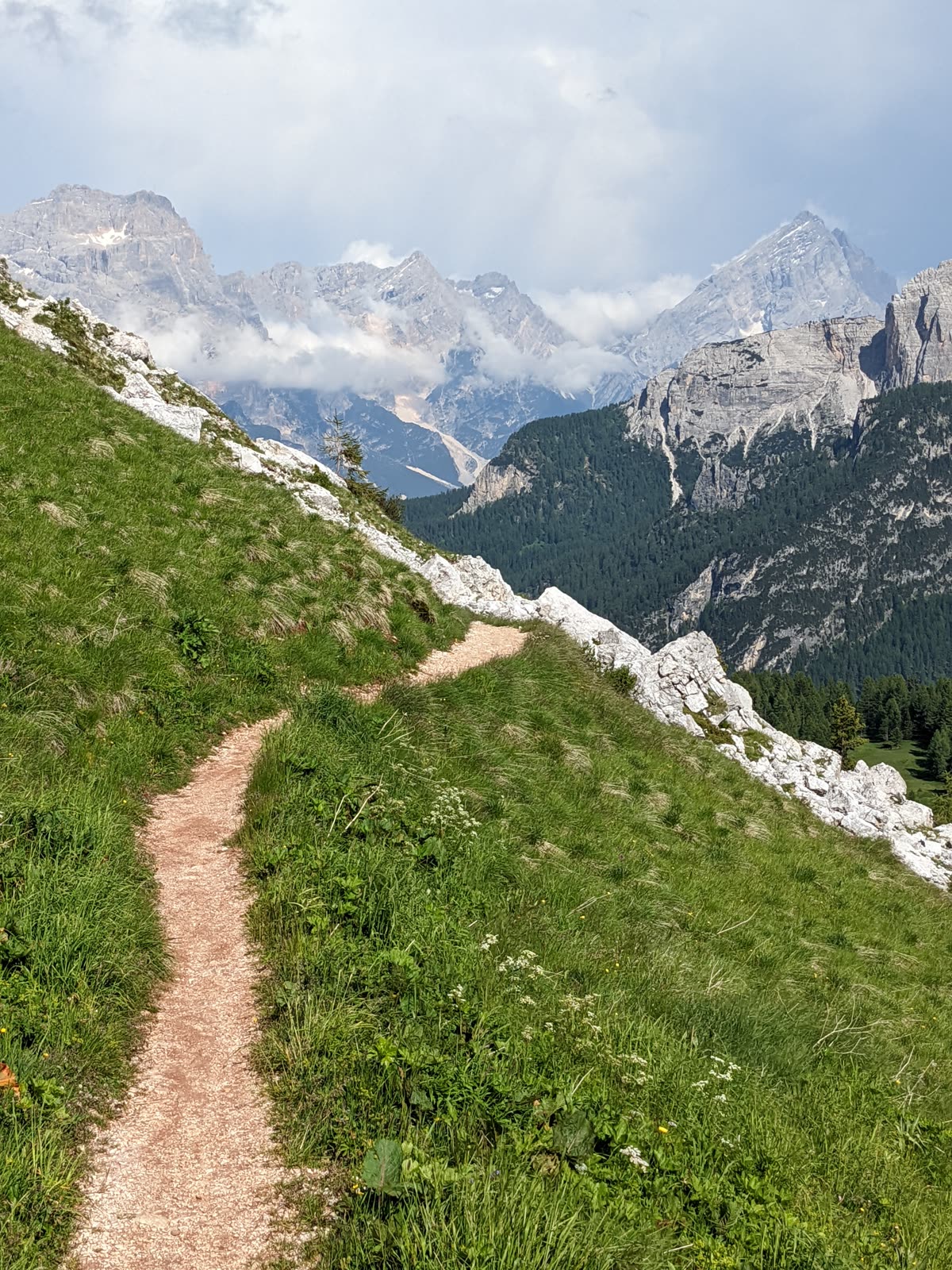
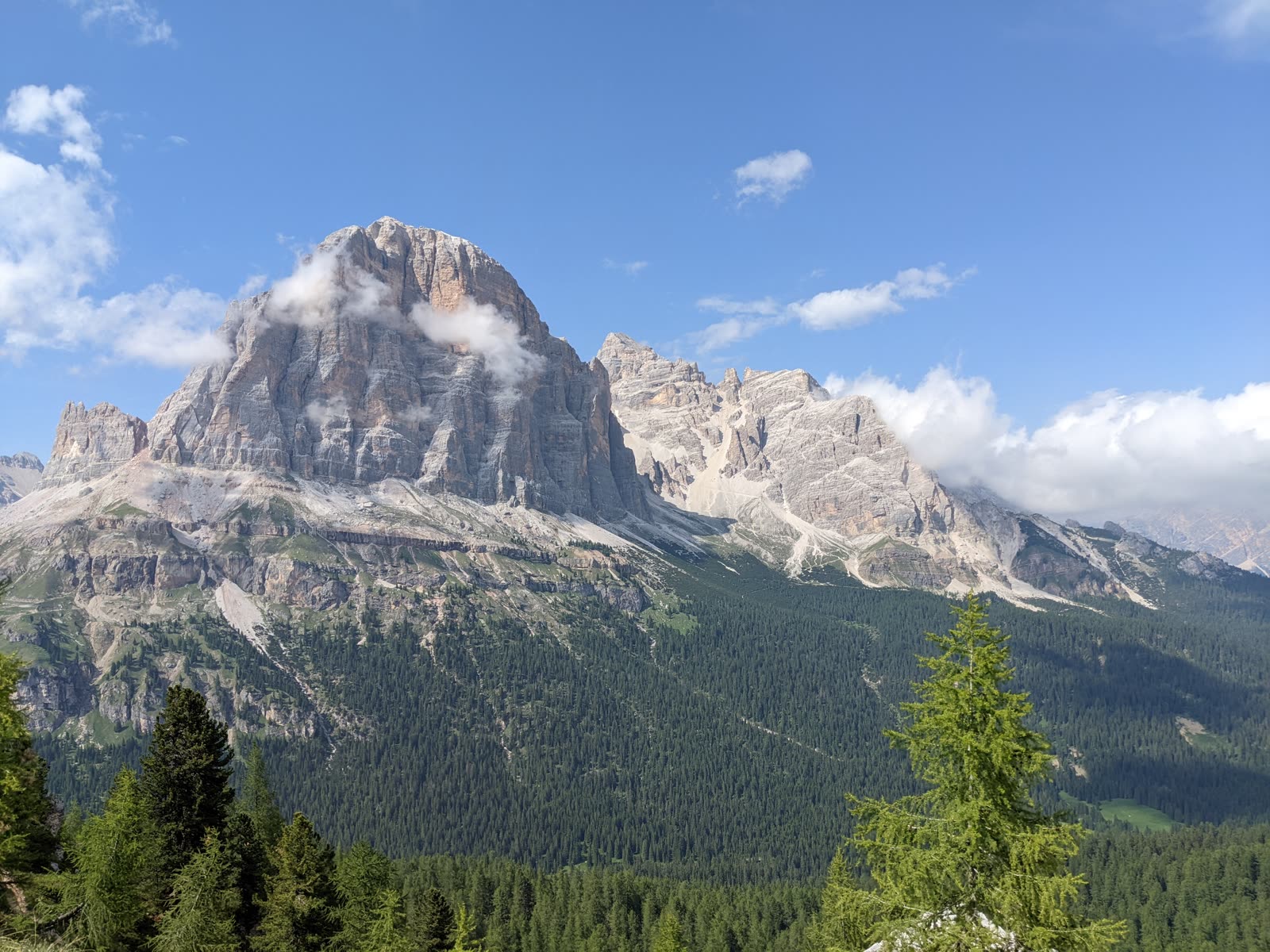
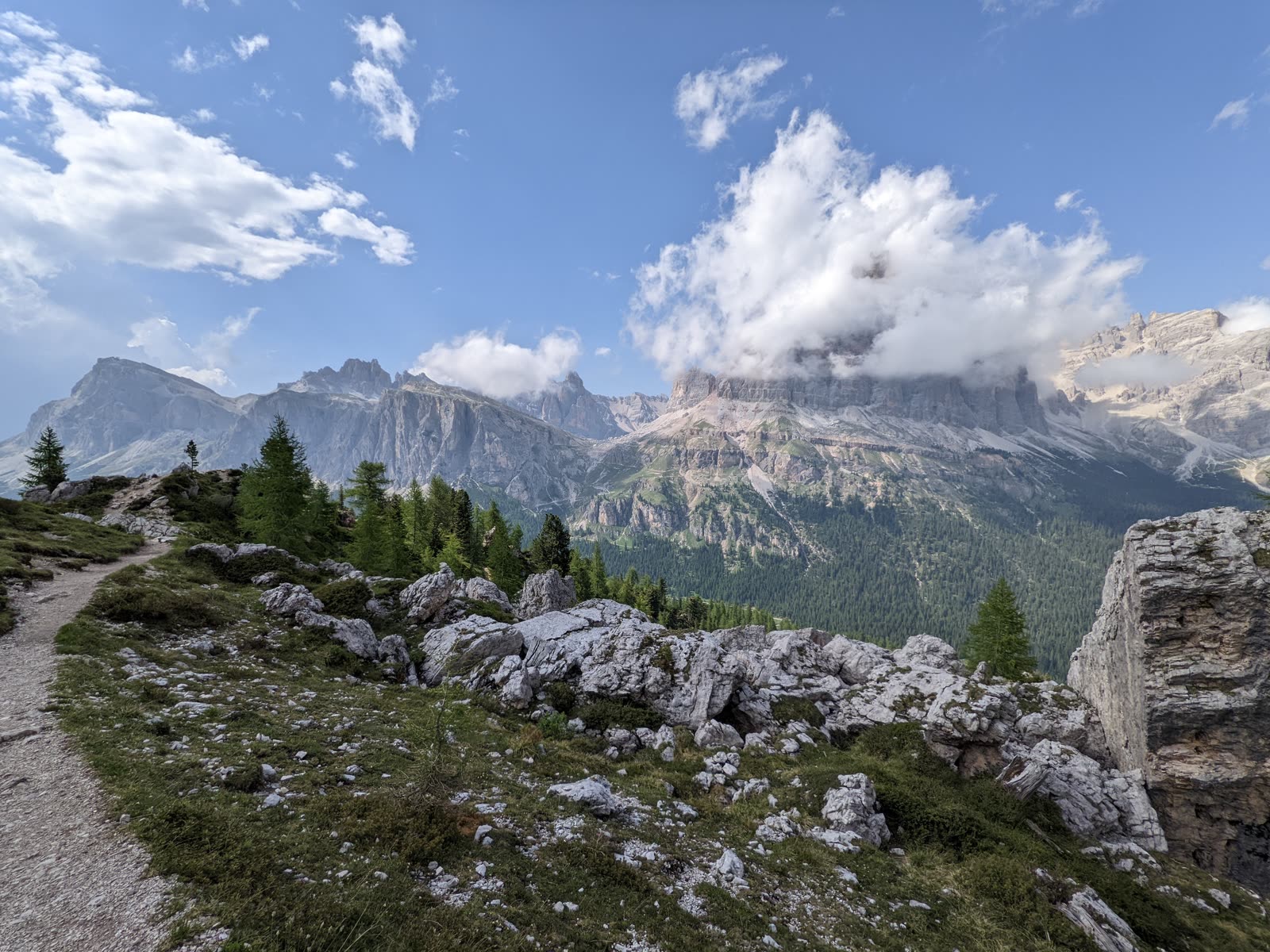
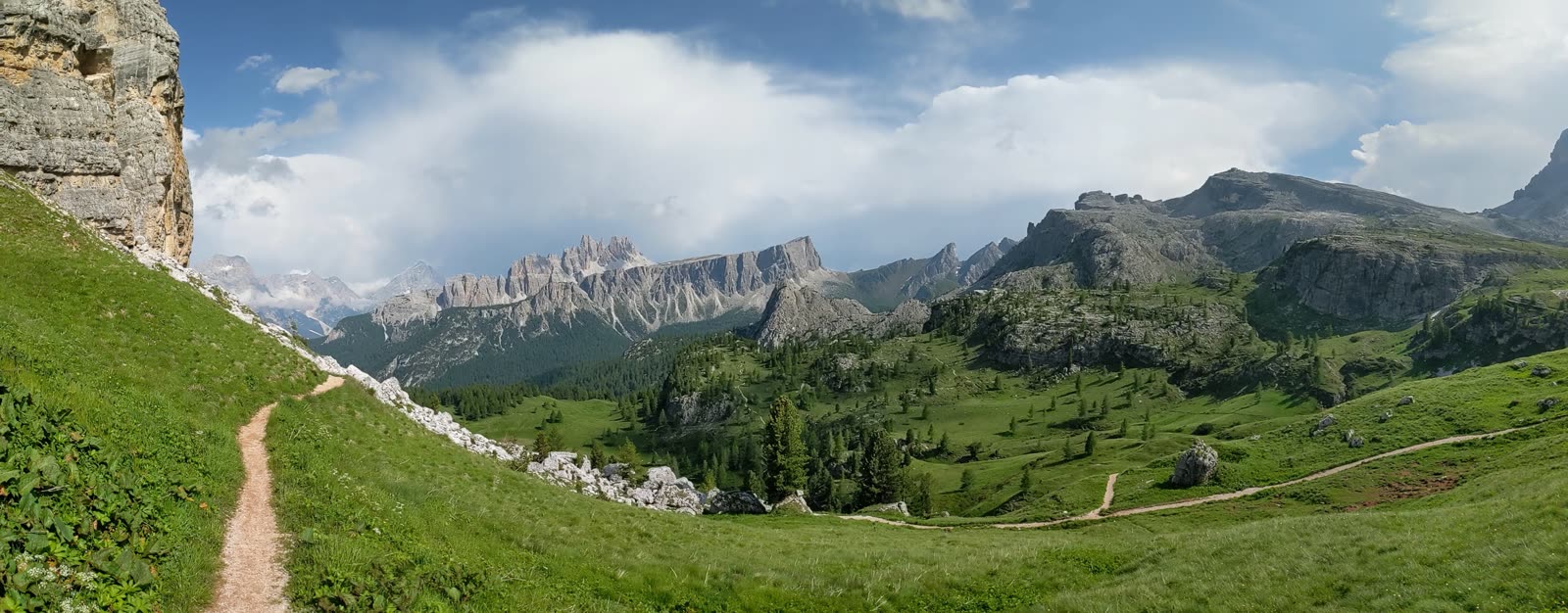
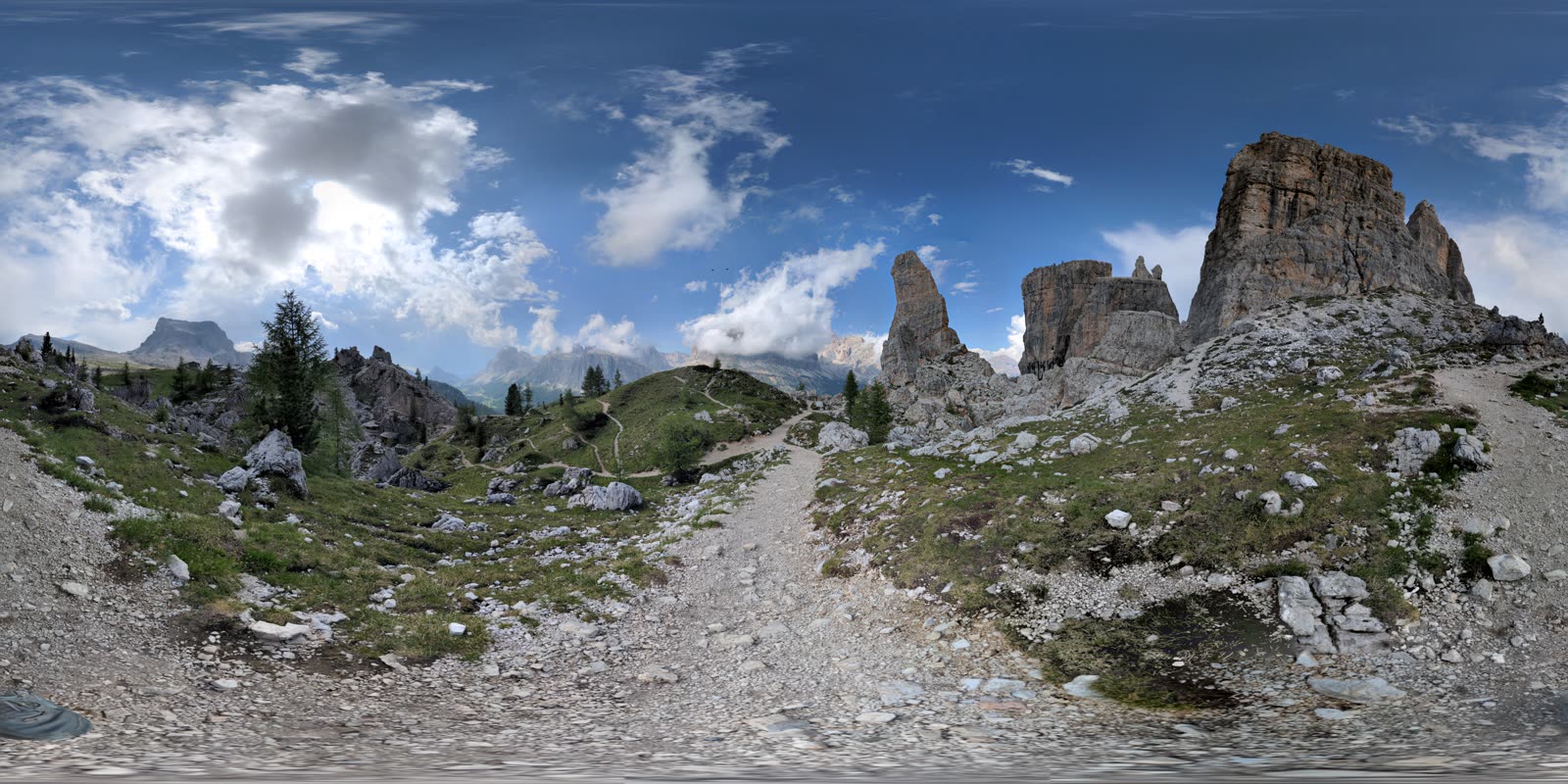
The place is the Cinque Torri — the "Five Towers," a cluster of pale rock spires standing on their own out on a high green shoulder of the mountains. The First World War history up here is deep. This was a front line, and we spent a good while wandering through old bunkers and trenches and reading the historic signs about what had happened on this exact ground a little over a hundred years before. We also just sat with it a while, taking in the views. We passed some firefighters hiking the slopes in full gear as part of a training exercise — we think local crews running a joint drill with US troops stationed in Europe — and a few tourists here and there, but it was never crowded — we had plenty of open space to ourselves. We rode the gondola up to the refuge and restaurant at the top, and when the lift was closing for the day we were among the very last down, in no hurry at all, with nothing to do but wait at the bottom for the bus back to Cortina. I think we had that bus entirely to ourselves for the winding ride down.
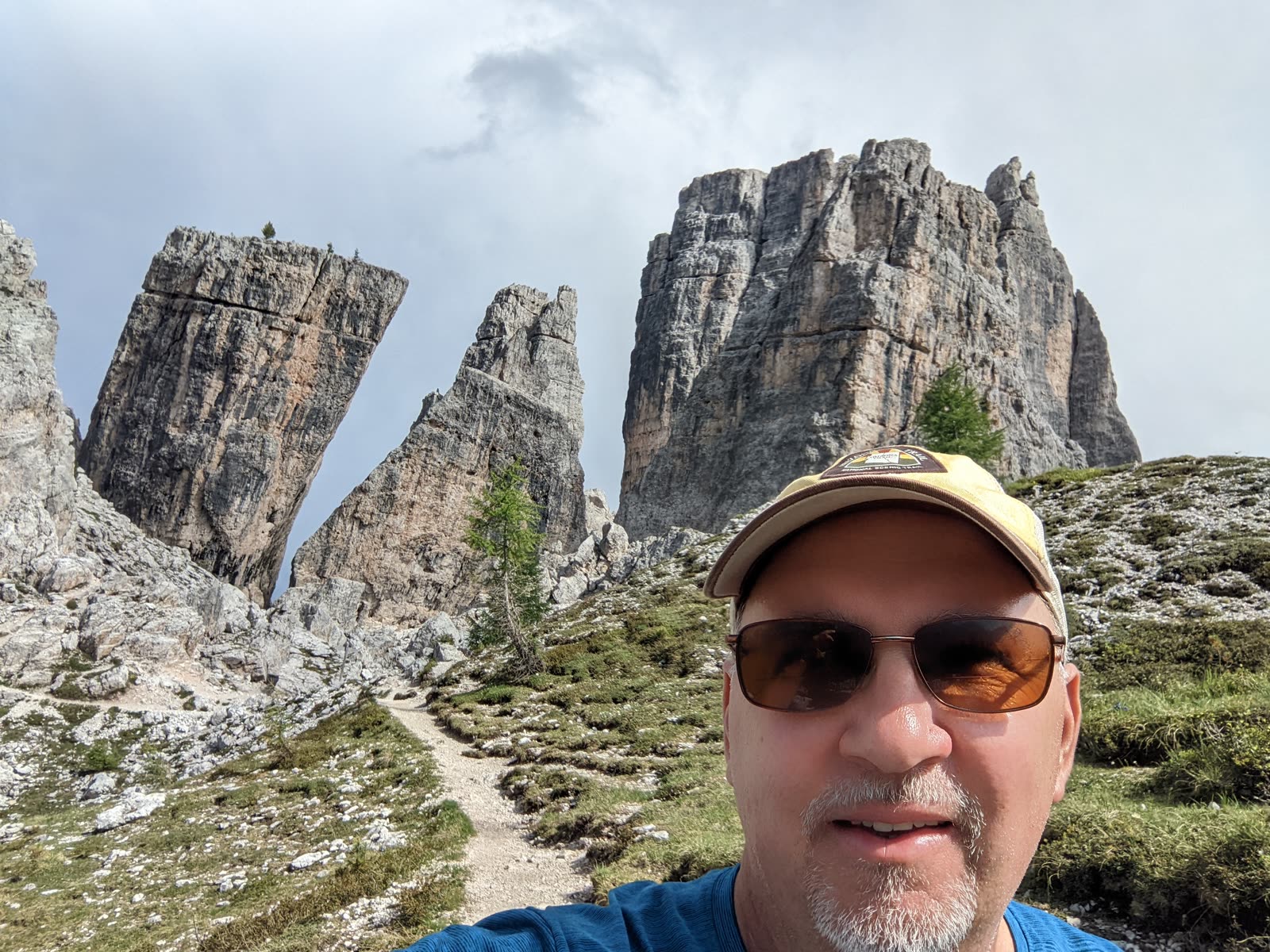
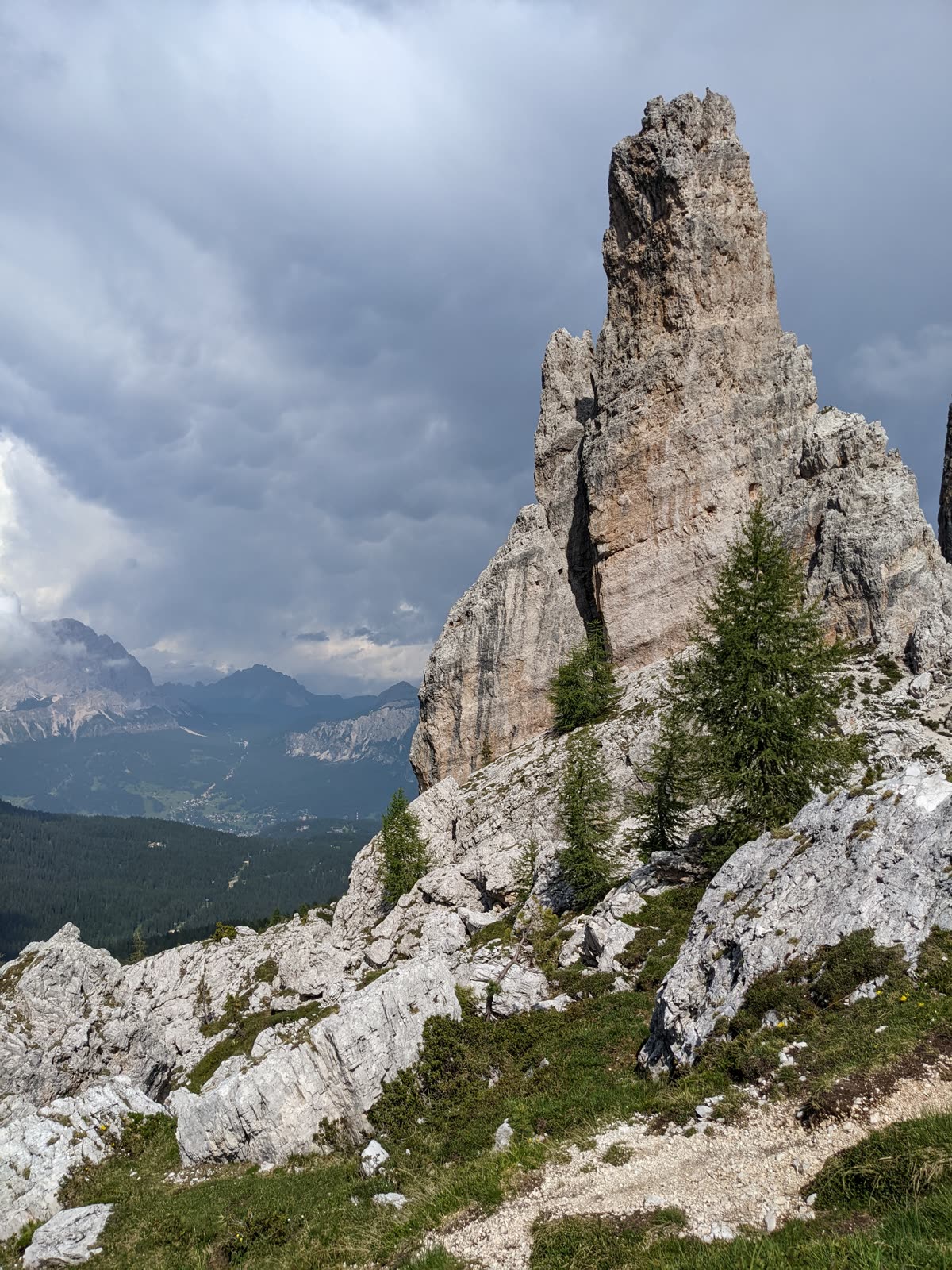
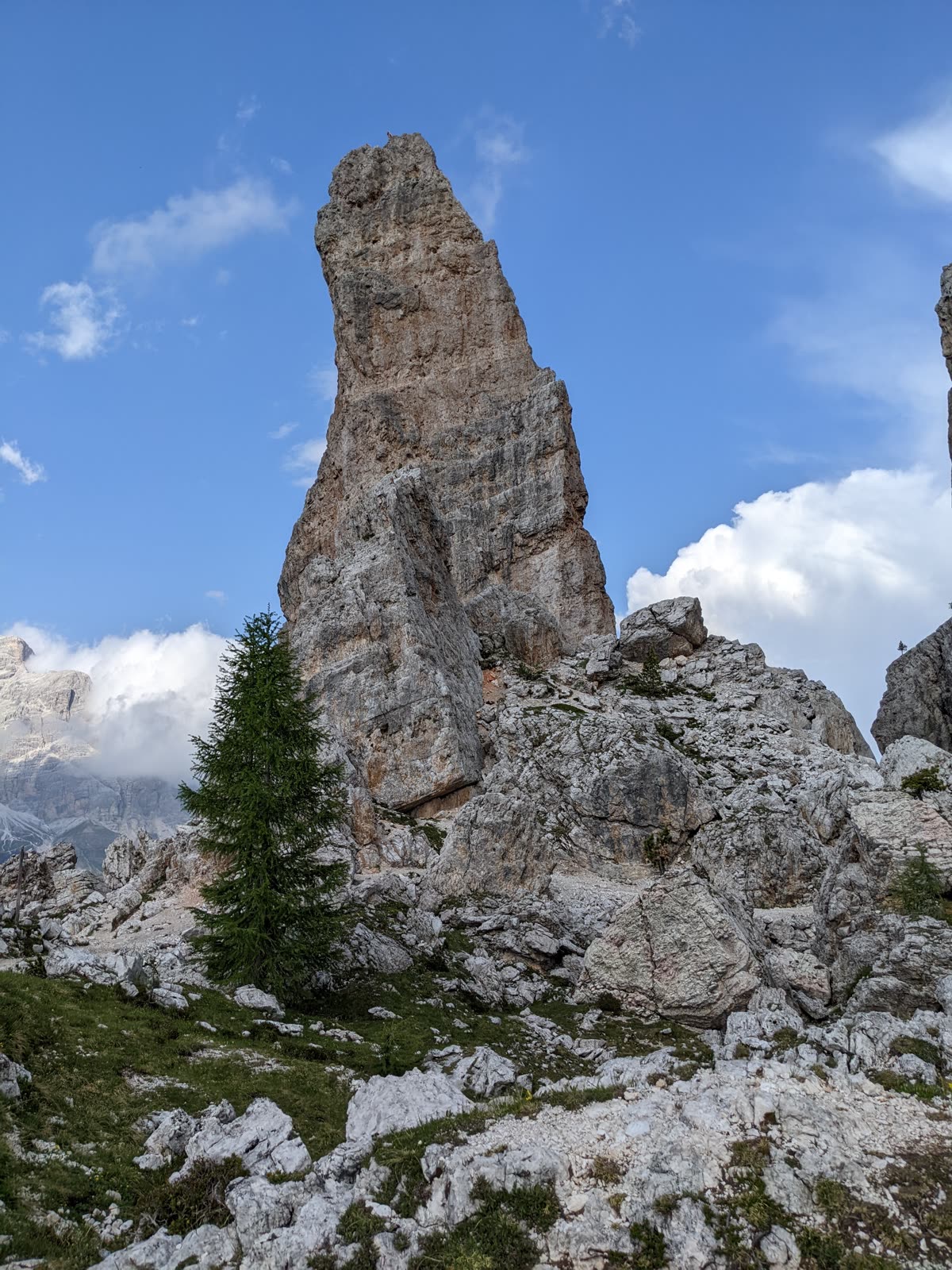
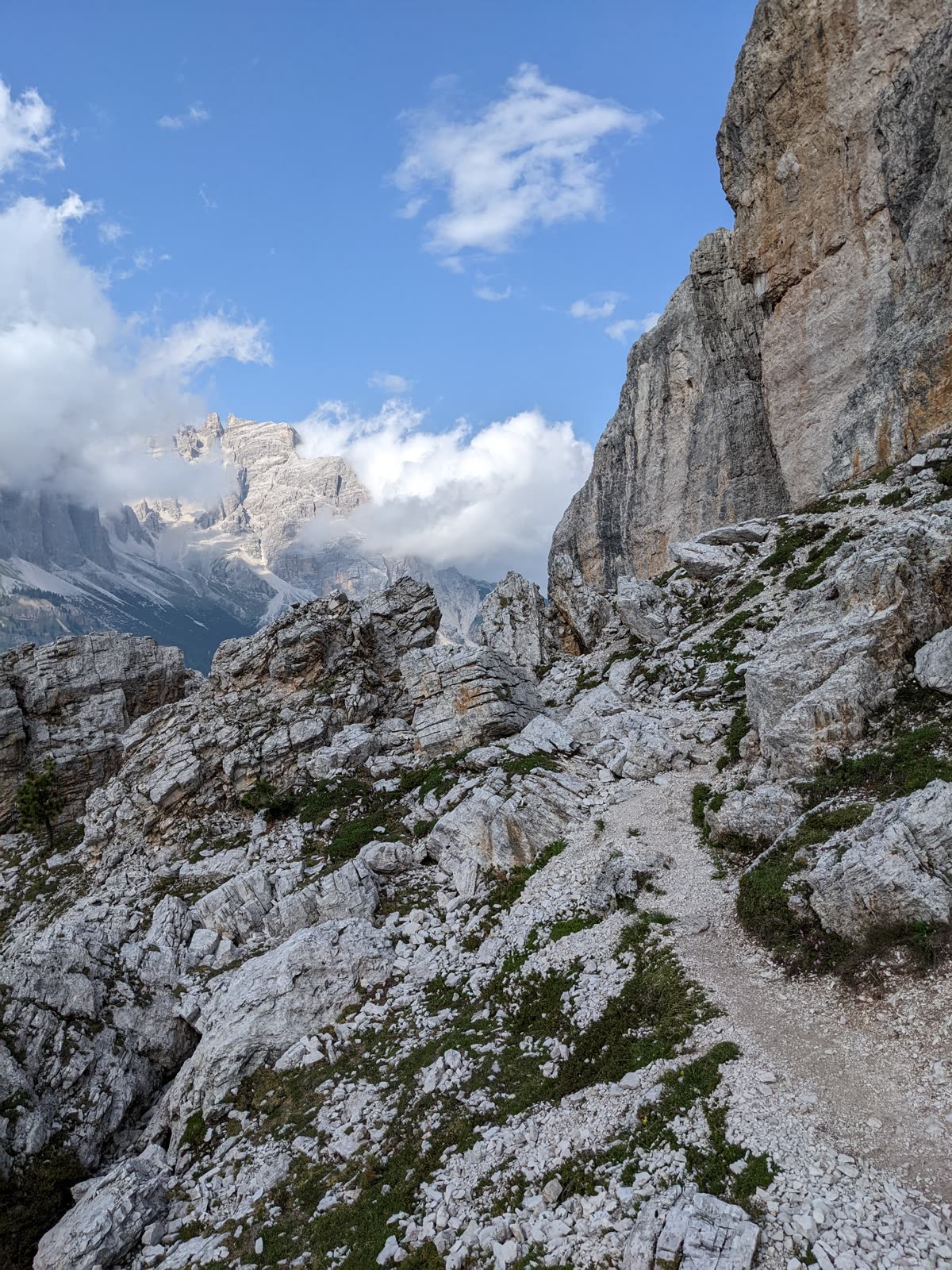

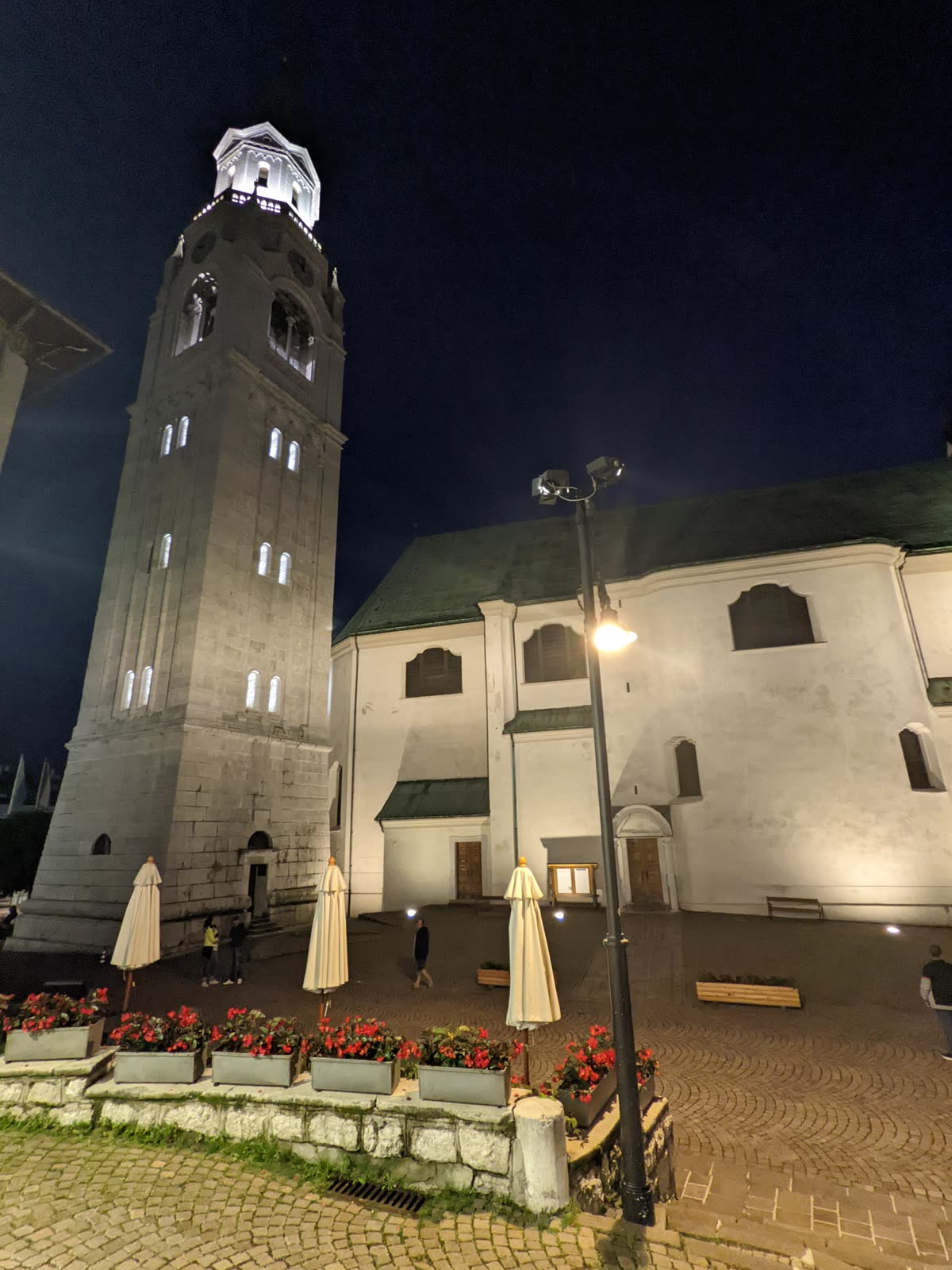
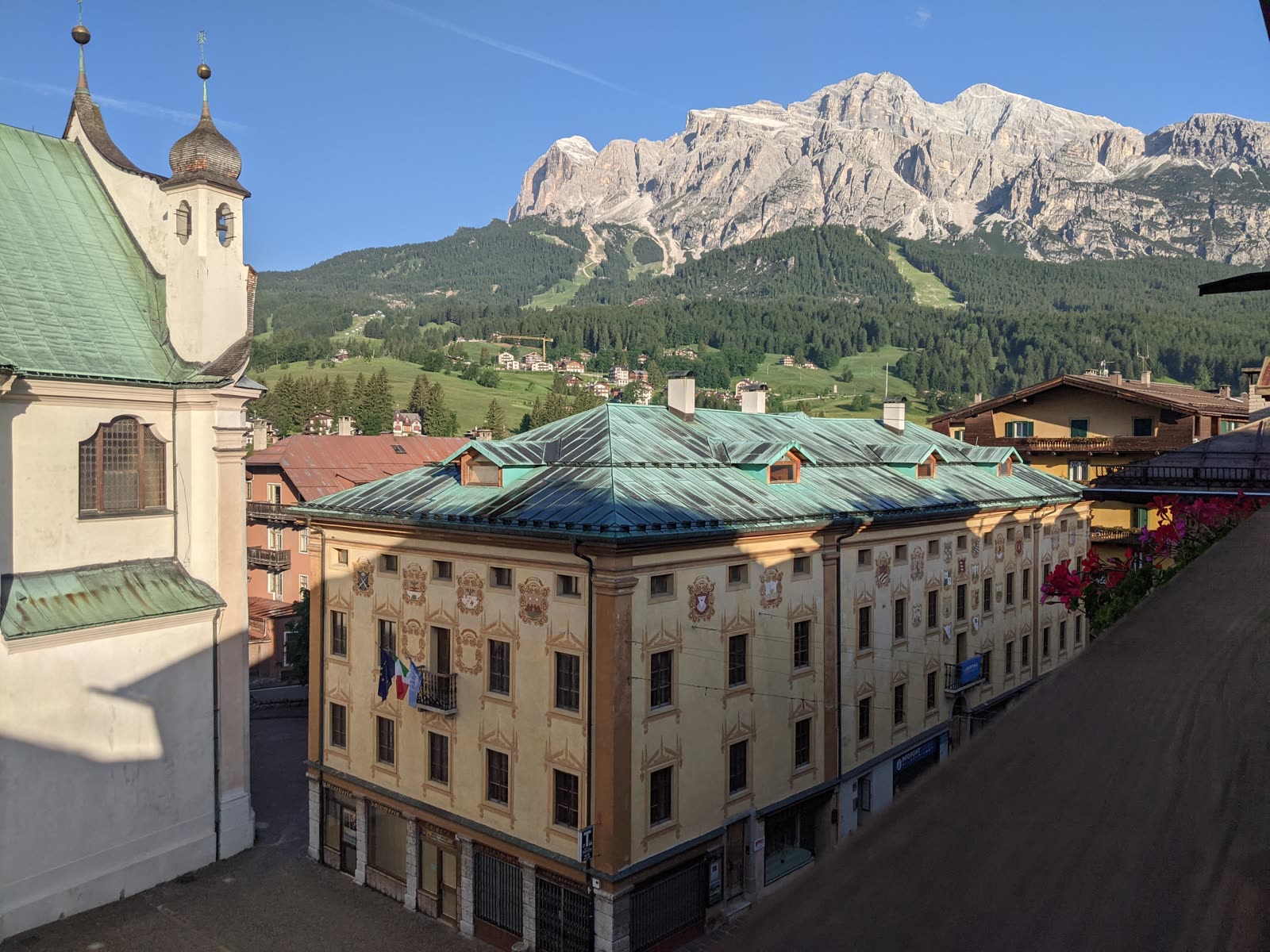
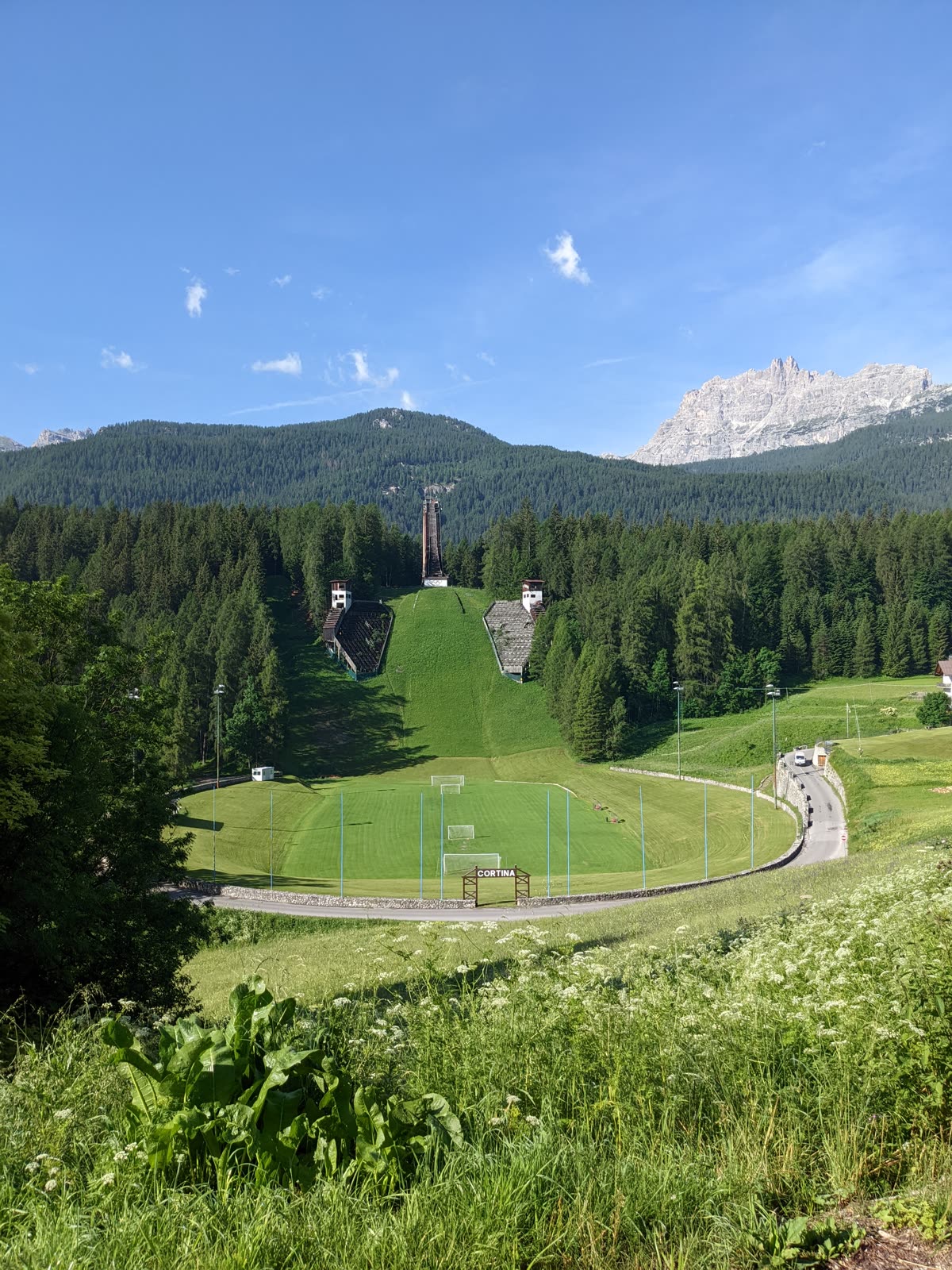
Back down in town we had dinner in Cortina and walked the beautiful old center a while afterward. It was hard not to picture the place in winter — this was June 2022, everything green and summery, and yet you could feel that this town truly comes into its own under snow. We already knew that some events of the 2026 Winter Olympics would be held here, and that Cortina had hosted the Games once before. Standing in the middle of it, that was easy to believe.
≈101 miles · ~6,160 ft descended · Italy · down out of the Dolomites to the Veneto plain
We left Cortina knowing we had a long ride ahead of us. The good news was that a lot of it would be downhill — with a few steep uphills thrown in to keep us honest. Where exactly we'd end up that night, we didn't know yet. The plan for the days after was set: reach Venice, spend a few hours there, then jump on a train and start making our way back toward the bike shop in Garmisch. So today the idea was simply to get as close to Venice as we reasonably could, to leave ourselves a short, easy final day.
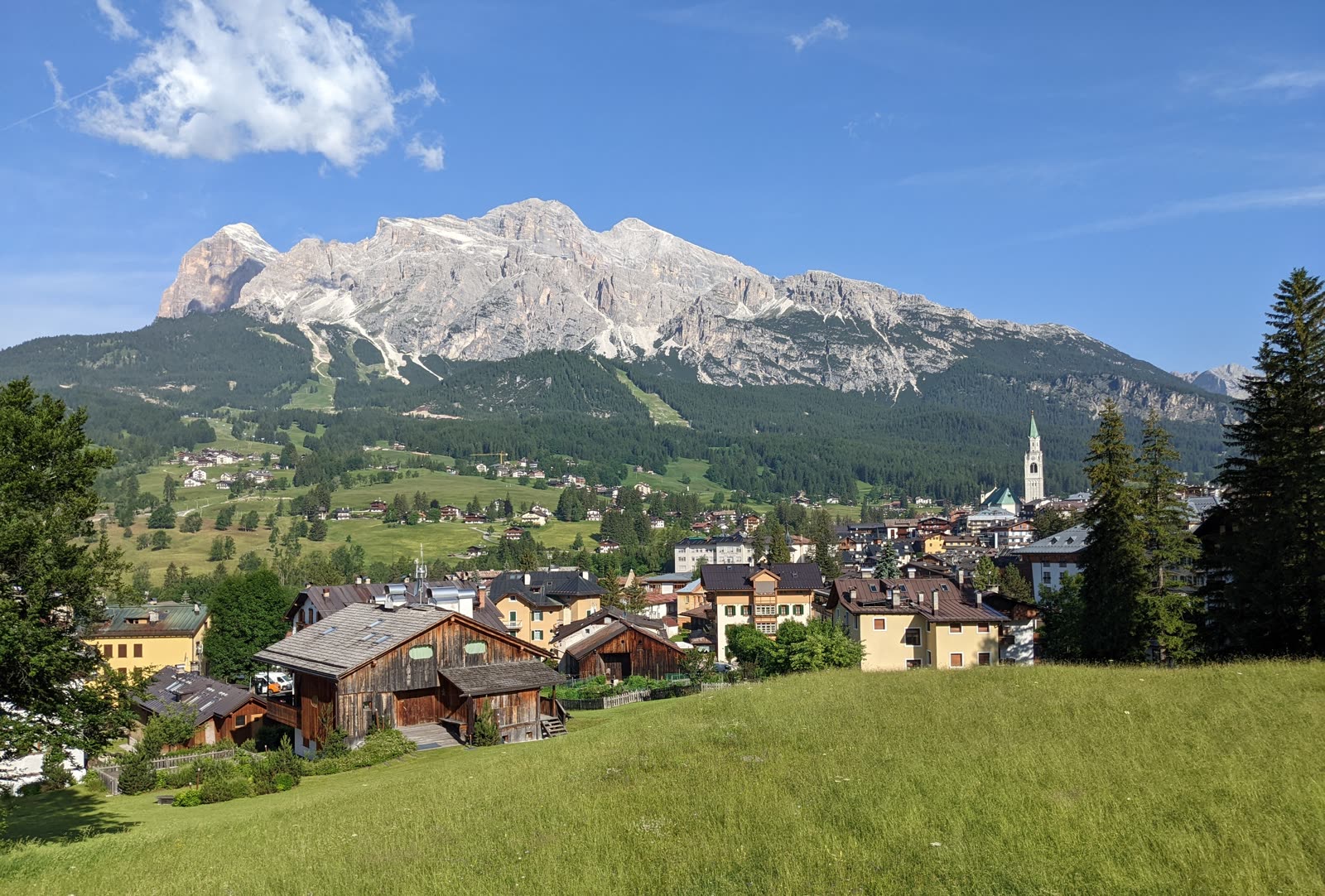
We picked up the same old railway bed we'd ridden into town on the day before, and turned south on it, continuing toward Venice. We took one last look back at the picture-perfect town and its ring of mountains. If all went to plan, we'd be in Venice the very next day.
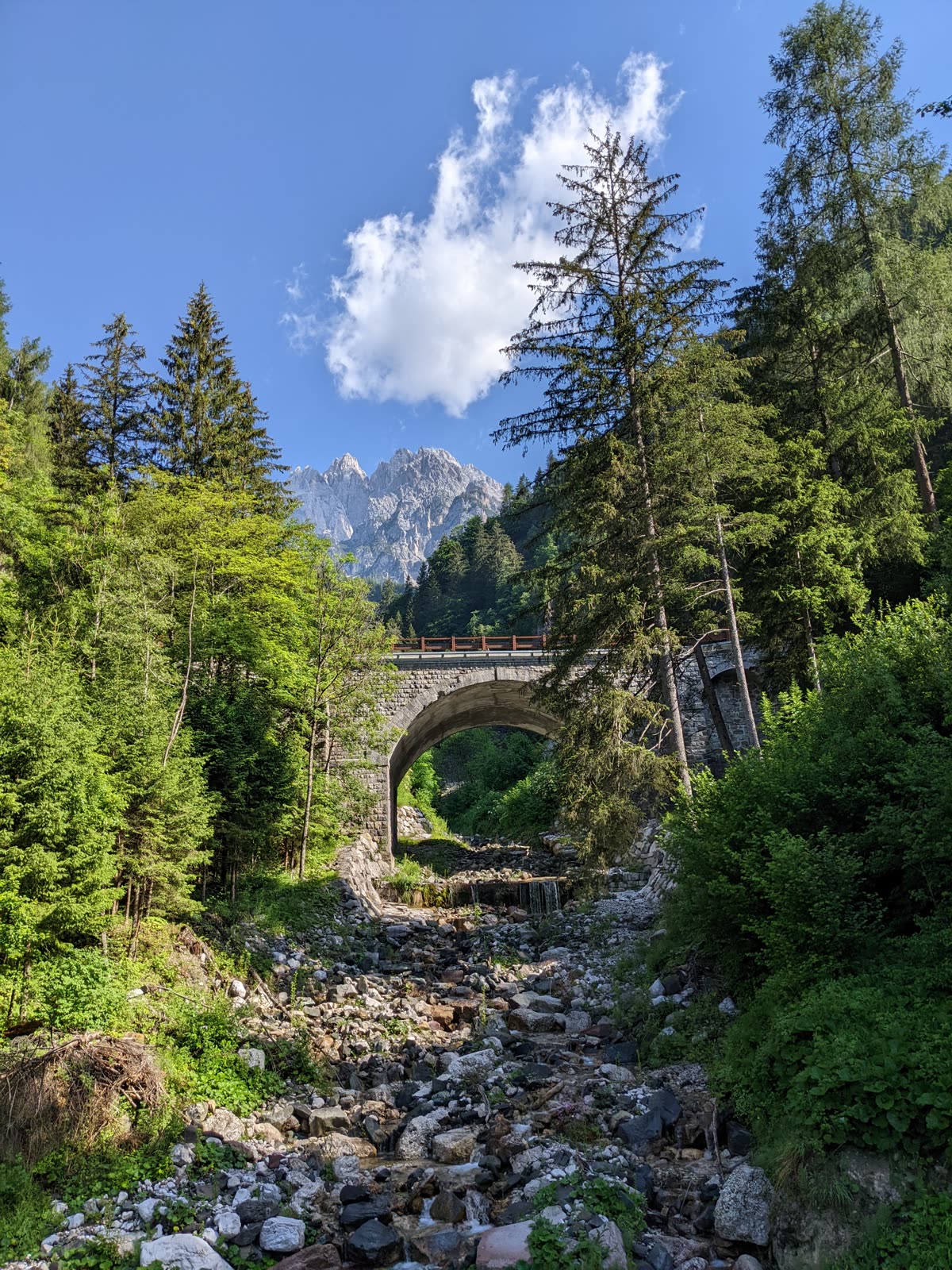
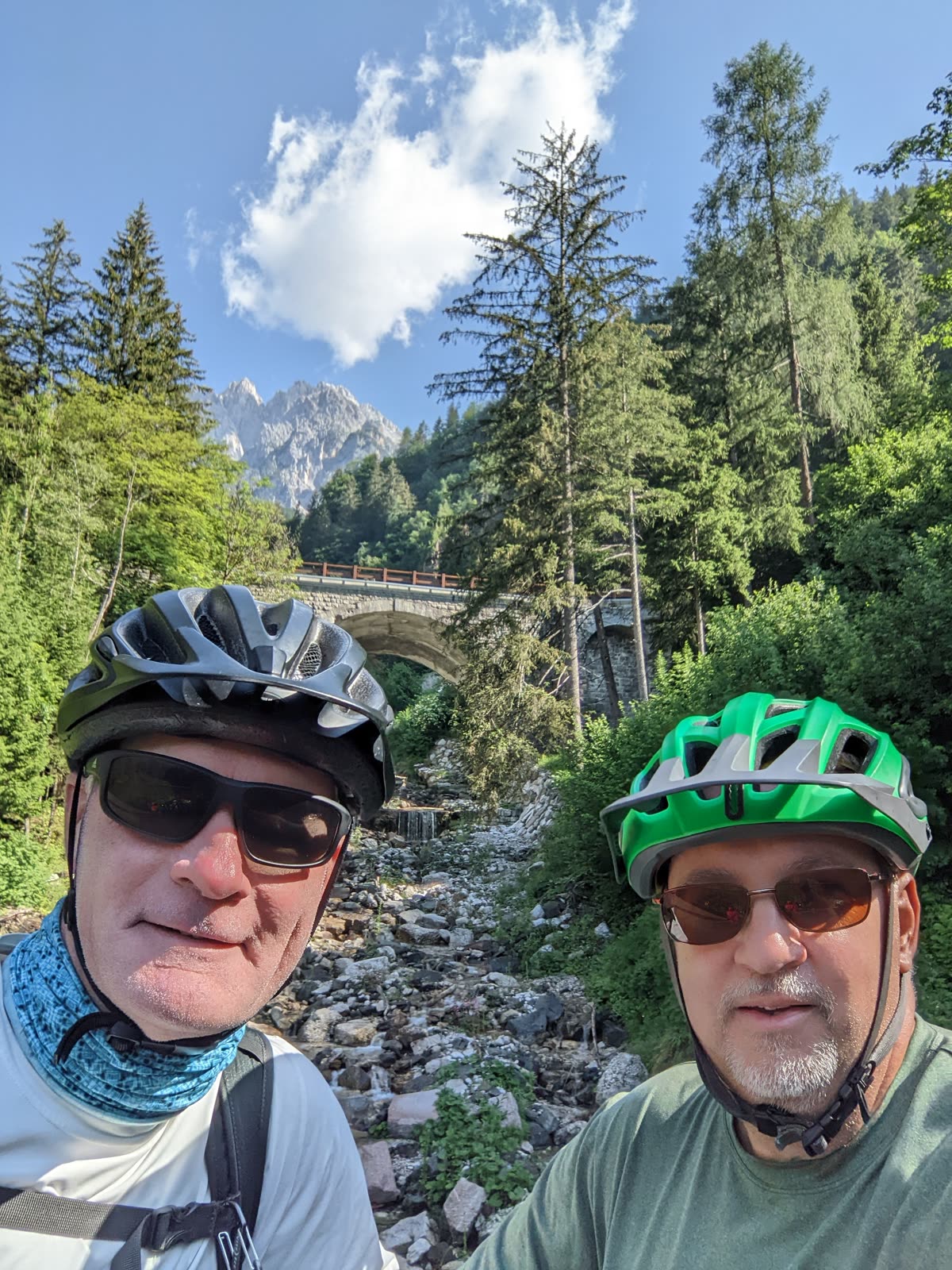
It was an enjoyable day, but it had its share of route-finding puzzles. In places the signage was thin, and in others the map I was carrying didn't quite agree with the path under our wheels. We took a couple of wrong turns and had to double back — but we always made it right in the end. There were a few genuinely huge downhills, the kind you feel in your hands as much as your legs, and the terrain kept changing the farther we went. The old railbed followed the Boite, the river that runs through Cortina, down toward where it joins the bigger Piave, and for much of the day we were riding down a long valley, the Dolomites slowly giving way behind us to lower, softer, greener country.
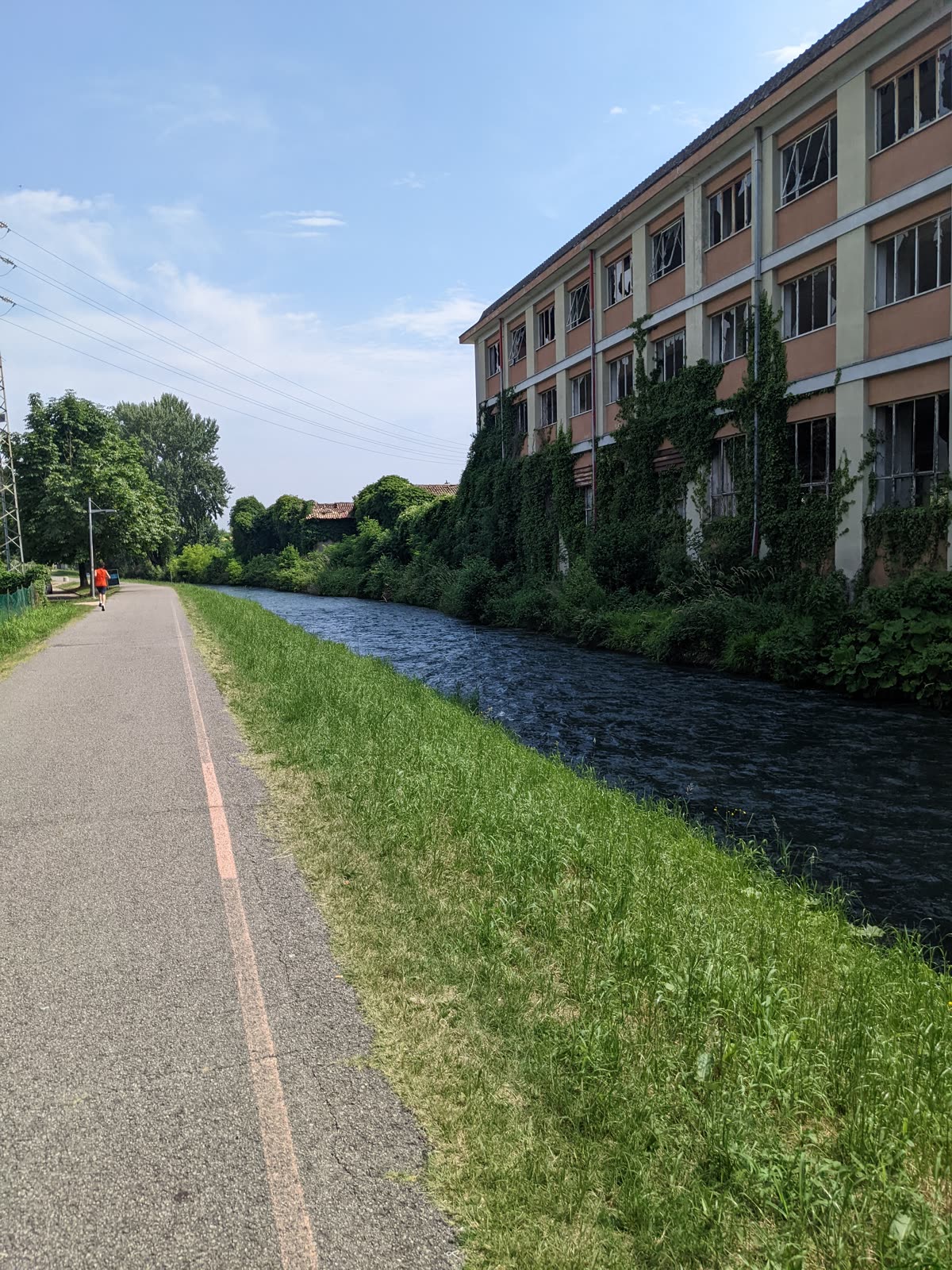
The mountains finally let go of us for good around Vittorio Veneto, the town where the hills give out and the plain begins. We came through it on a flat path beside the Meschio, the river that runs down through the town, past a big old ivy-swallowed factory — this valley was mill country for generations, and you could feel the history in the brick. From here on it was the wide, flat, farmed country of the Veneto plain, and with the change came heat: it was noticeably warmer and more humid down here than it had been up in the Dolomites that morning. Long flat stretches on cycle paths and quiet lanes, the kind of easy, rolling-along riding that lets you cover a lot of ground. Somewhere in that long afternoon we stopped for lunch at Pizzeria Pino in Roncade — a pizza each and a salad each, exactly the fuel a day this long calls for.
A few times through the day we crossed paths with a guided tour group — one of those outfits where a leader rides out front and a van carries everyone's bags from hotel to hotel. We'd pass them, then they'd pass us, and so on. Later in the afternoon, after our lunch stop, we pulled over for water and a snack — and they rolled by us yet again, only for us to catch right back up to them, this time at the entrance to their hotel for the night, their van already parked out front with all their luggage waiting for them.
We thought about it for a moment. We could have called it a day right there too. But we still had daylight left and the terrain ahead was flat, so we decided it made more sense to push on and get closer to Venice, keeping the next day short. So we waved them off to their fresh sheets and carried on down the road.
We settled on Treviso as our home for the night, and Doug turned up a really cool spot to stay — a shared house-and-apartment called Little Garden, where we had the entire top floor to ourselves — sectioned off, grandly, by nothing more than a single velvet rope. We loved the town straight away. Dinner was fresh fish, and afterward we wandered the old center, which turned out to be laced with canals and quiet water, and started reading up on the place — its long history and its deep connection to Venice, just down the road.
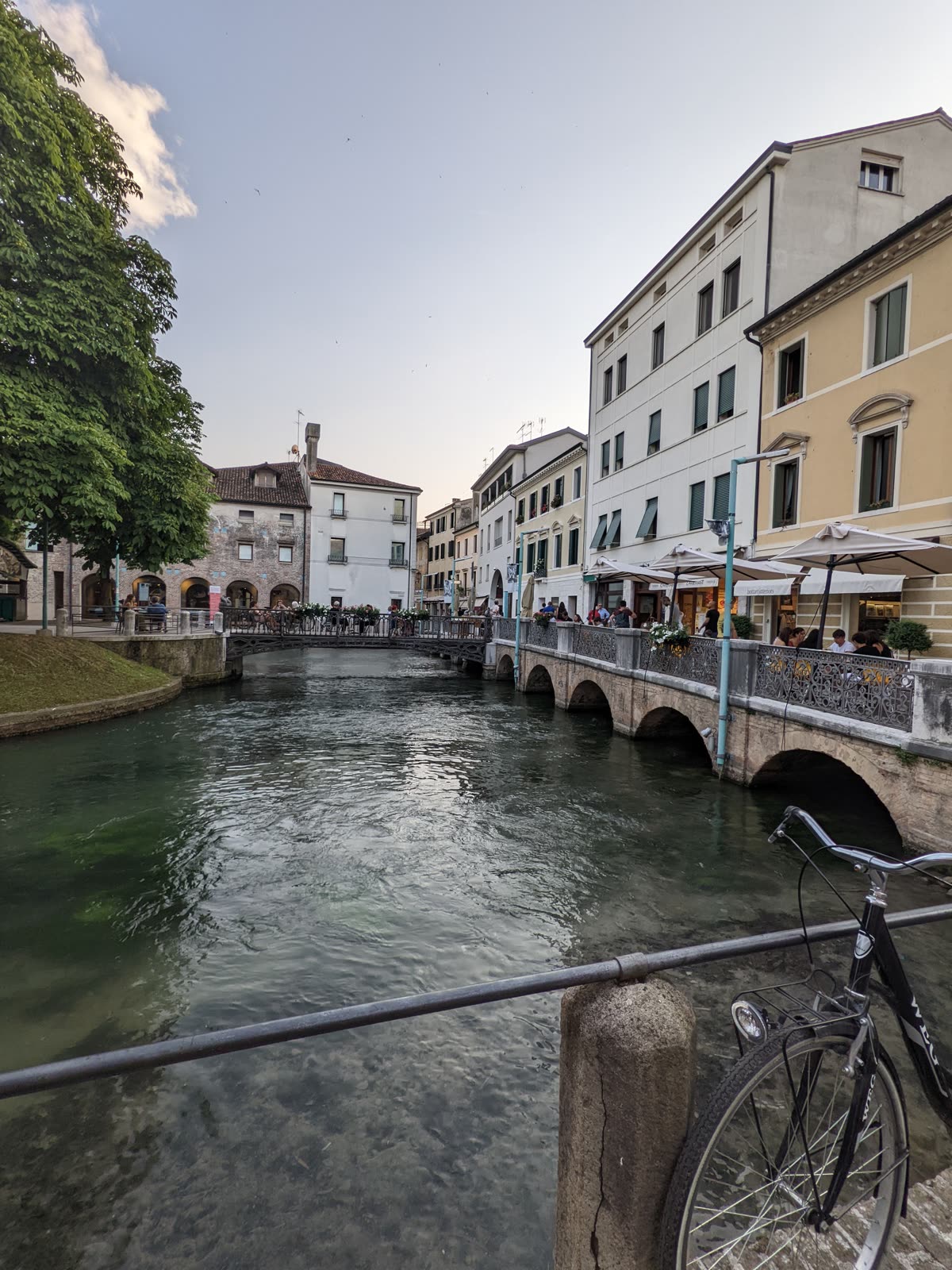
It was warm and humid enough that we were genuinely thankful our rooms had air conditioning, and after a day like this one we slept well. Because this had been a 100-mile day — a full century, ridden end to end, no trains, no shortcuts. It was Doug's first hundred-mile ride, a real milestone, and a great one to notch on a trip like this. My own longest is somewhere north of 120 miles, out on the coast and in Oregon back when I was a lot younger, with a handful of century rides scattered across the years since. But there's nothing quite like watching your riding partner roll past a hundred miles for the very first time — down out of the Dolomites and onto the plains of the Veneto, with Venice waiting just over the horizon.
≈35 miles · flat & fast · Italy · across the plain to the lagoon
We'd fallen so hard for Treviso that we couldn't quite bring ourselves to leave without one more look. So on Friday morning we wandered the town all over again — in through the Cathedral of St Peter the Apostle, and up and down the main streets, which are lined with shops and restaurants and threaded through with those quiet canals. We both agreed we could happily have given the place another whole day. But the clock was against us: we needed to start our travels toward Venice, and beyond that, toward home.
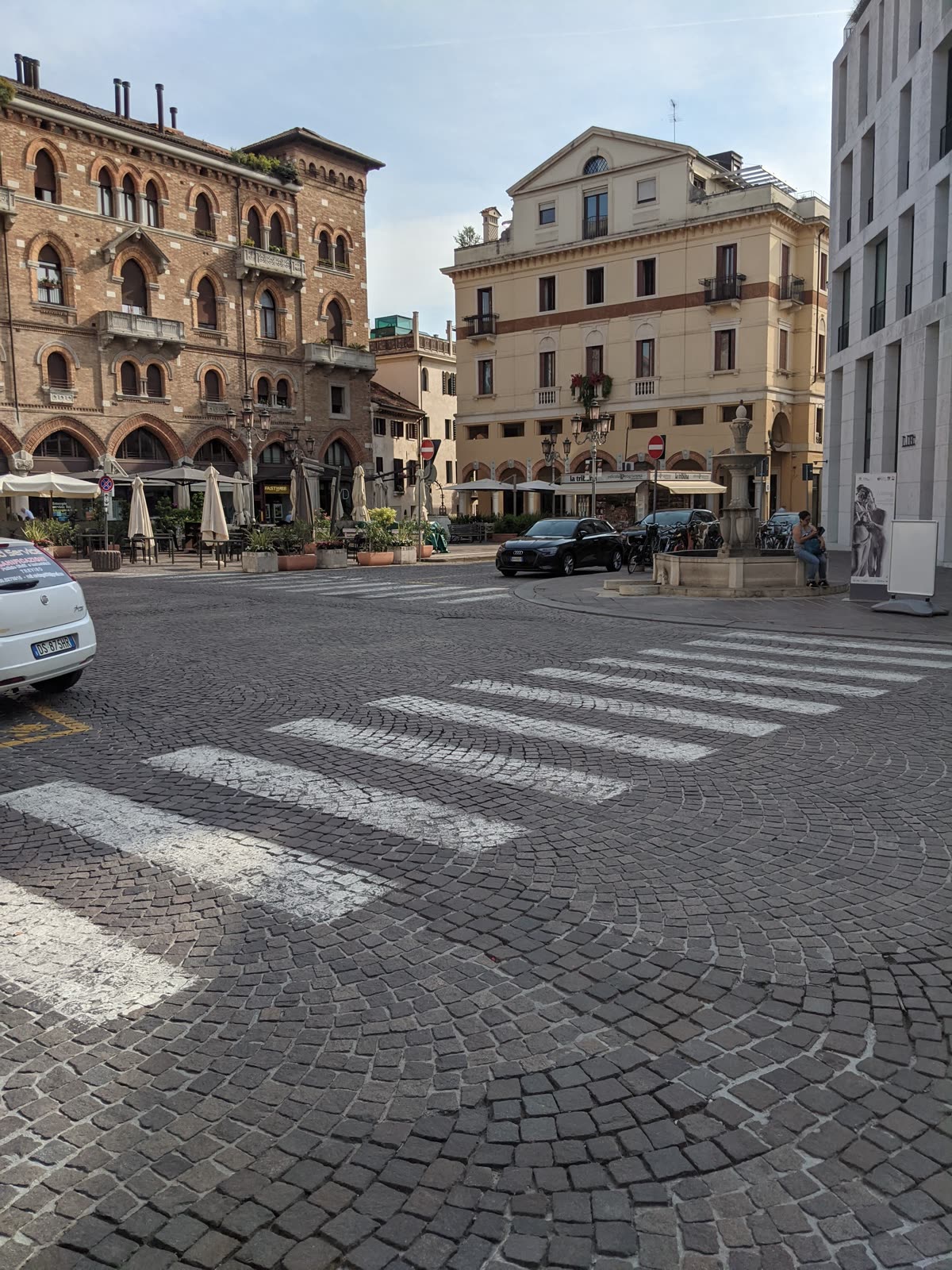
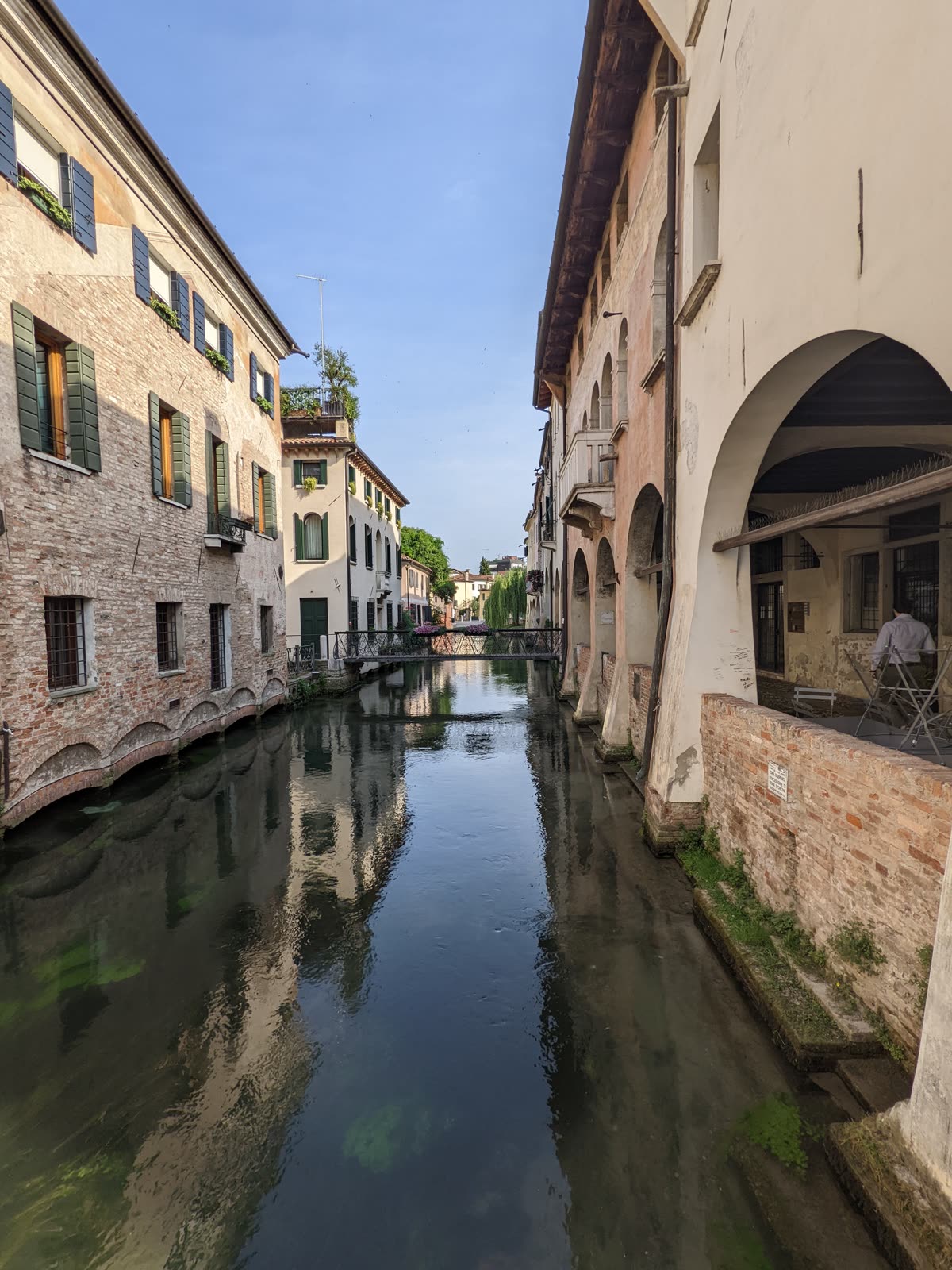
The ride out of town was a relaxed one, mostly away from cars for a good while. Coming out of Treviso we followed a canal for a stretch — I shot a nice, chill little video of the two of us rolling along beside the water, which I'm fairly sure was pointing us toward Venice.
Every so often, though, the route dropped us back onto an ordinary road for a bit before handing us to the next trail.
It was on one of those hand-offs — road back onto bike path — that Doug went down. There's often a pair of posts set into these paths to keep cars off them, and coming into a set of them Doug caught some gravel and fell, right between the two posts. I didn't actually see it happen; I only heard it. What I saw was the faces of two Italian cyclists coming the other way, who had watched the whole thing — eyes wide and full of sympathy for the epic crash they'd just witnessed. They were kind enough to stop and make sure Doug was OK, which, thankfully, he was. We dusted him off and carried on. In more than a week of riding across the Bavarian Alps, the Tyrol, and the Dolomites, that was the only crash of the entire trip — and it came here, on the flat, with Venice almost in sight.
I'll be honest — compared with the mountain riding of the days before, up in Germany, Austria, and the Dolomites, this stretch was less interesting. But it was incredibly easy going, flat and quick. As we got closer to Mestre, the mainland town across the water from Venice, a lot of it turned industrial — not all of it, but big stretches. This is where a lot of businesses keep the warehouses and infrastructure that keep Venice running — and it's where a lot of the workers live, too. The people who commute onto the island every day to work in the tourist trade, because Venice itself has become too expensive for ordinary Italians to actually live on. There's something a little sad about that.
We were riding through Mestre in the afternoon, when most of the shops and restaurants were closed, and we struggled to find any water or sports drinks to deal with the warmer, more humid weather down here on the coast. The route also threw a lot of turns at us, and either we missed one or the signage let us down, because we got a bit lost. At one point the path we were on was under construction and simply dead-ended. In the end we jumped a guardrail onto the main road toward Venice, rode that for a while, then hopped a fence a bit later to get back onto the bike path. Just one of the many little adventures of bike touring.
Honestly, the approach to Venice and the arrival itself were a bit of a letdown. Apart from those canals leaving Treviso, the ride had been fairly anticlimactic — and so was rolling into the city. You can't take your bikes into any of the pretty, touristy parts of Venice for a triumphant finish-line photo. Where the bike path finally spat us out, it was busy with trucks and cars coming and going off the island. But we found our way across, and riding over the long bridge onto Venice was, at least, a more interesting way to arrive than most people manage.
Shortly after crossing, we found the Bicipark Venezia and parked the bikes. I've used the big bike-parking garages in the Netherlands before, and while those are great, this one used a very secure bike box that let us stow our bags right along with the bikes. I even used it to change out of my riding clothes — though I suspect I broke a few Italian rules doing so, and I'm fairly sure that wasn't quite what they had in mind. Then again, how bad can a jail in Venice really be...
With the bikes safely stowed, we made our way over toward the Grand Canal, near the train station. Doug and I had both been to Venice before, and while we'd looked forward to finishing our tour here, we also knew we couldn't linger — we still had a long way to go to get ourselves, and the bikes, back toward Garmisch. So we decided to split up, each do our own thing for a couple of hours, and then meet back at the bikes.
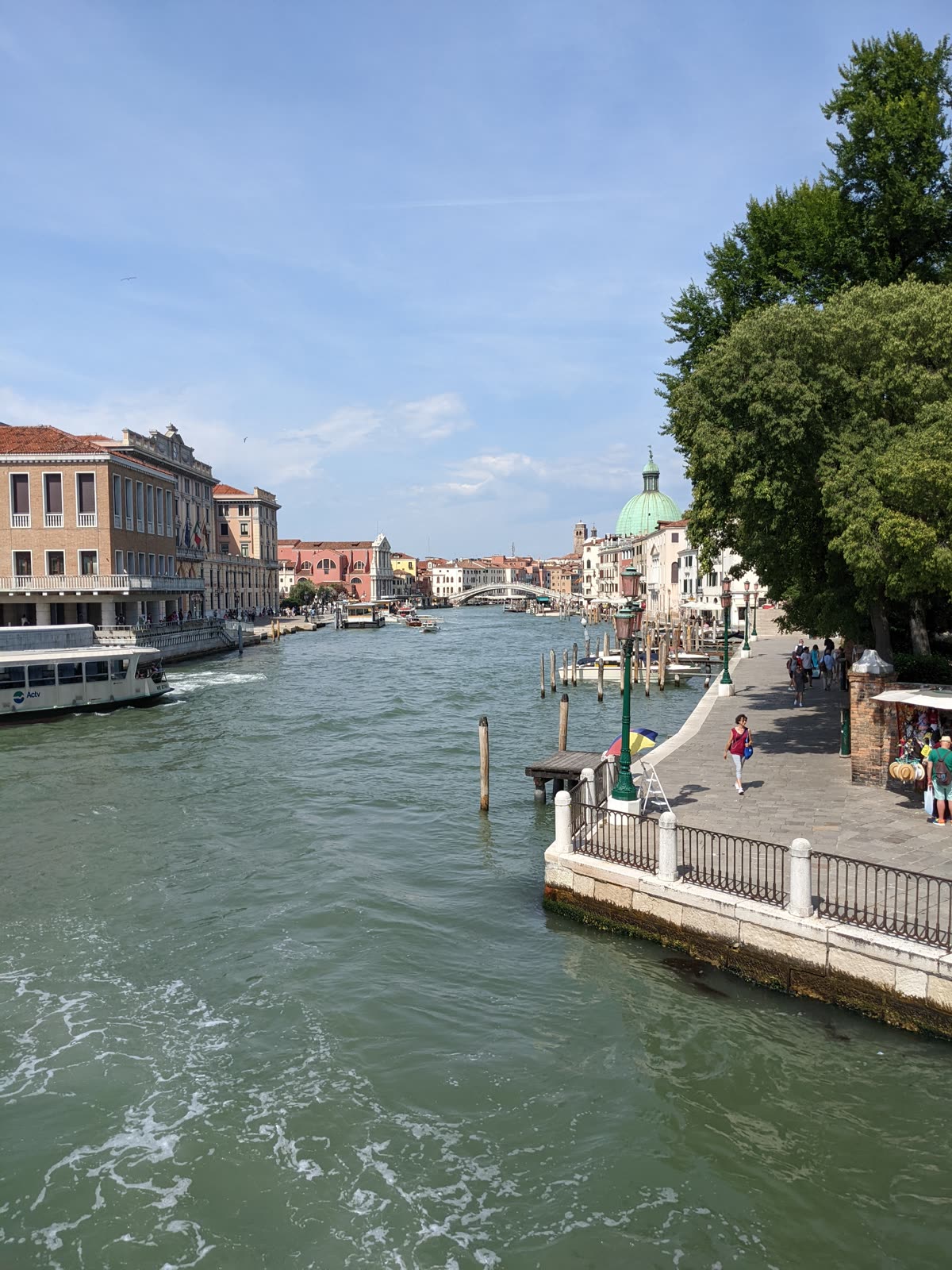
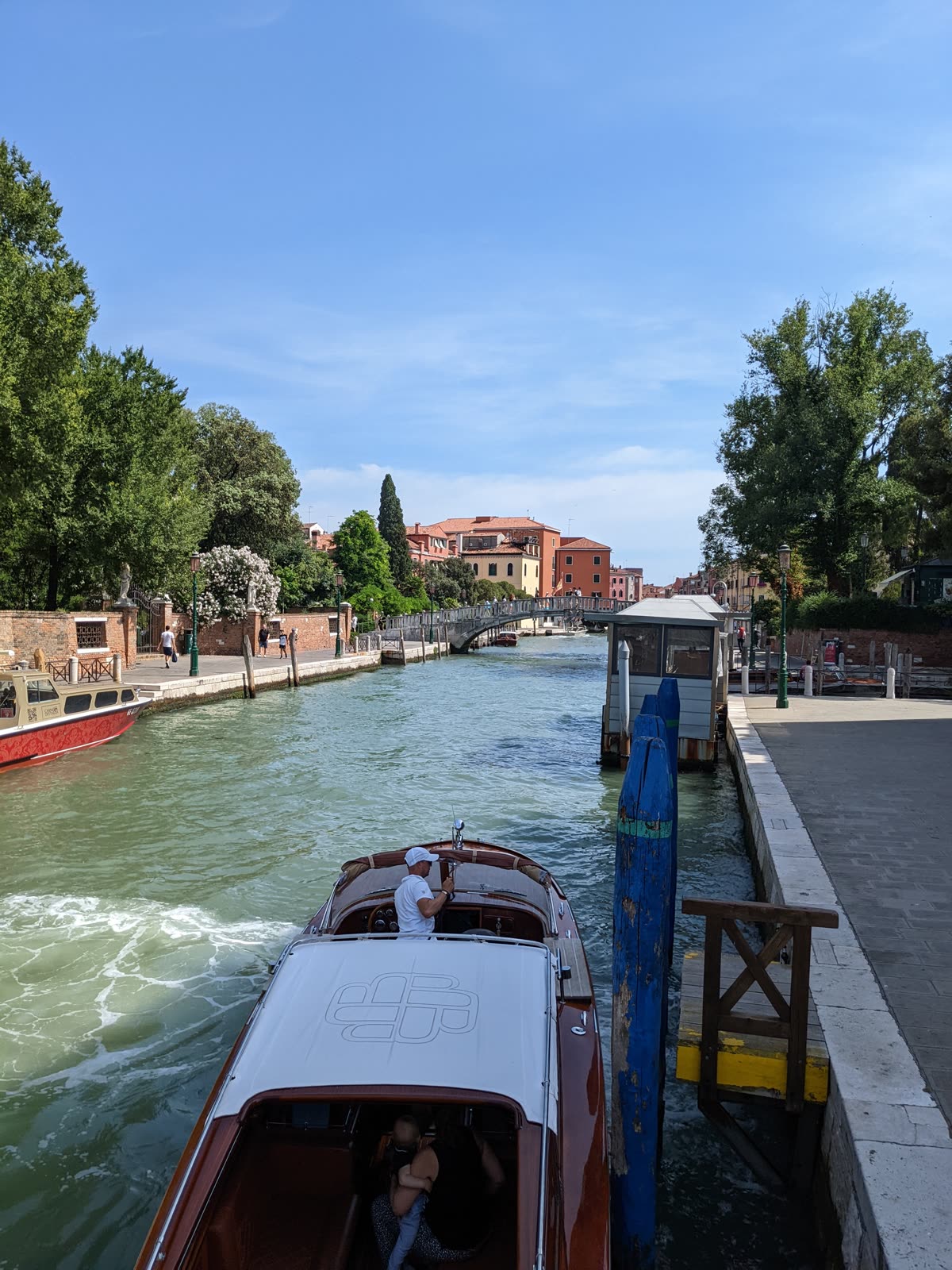
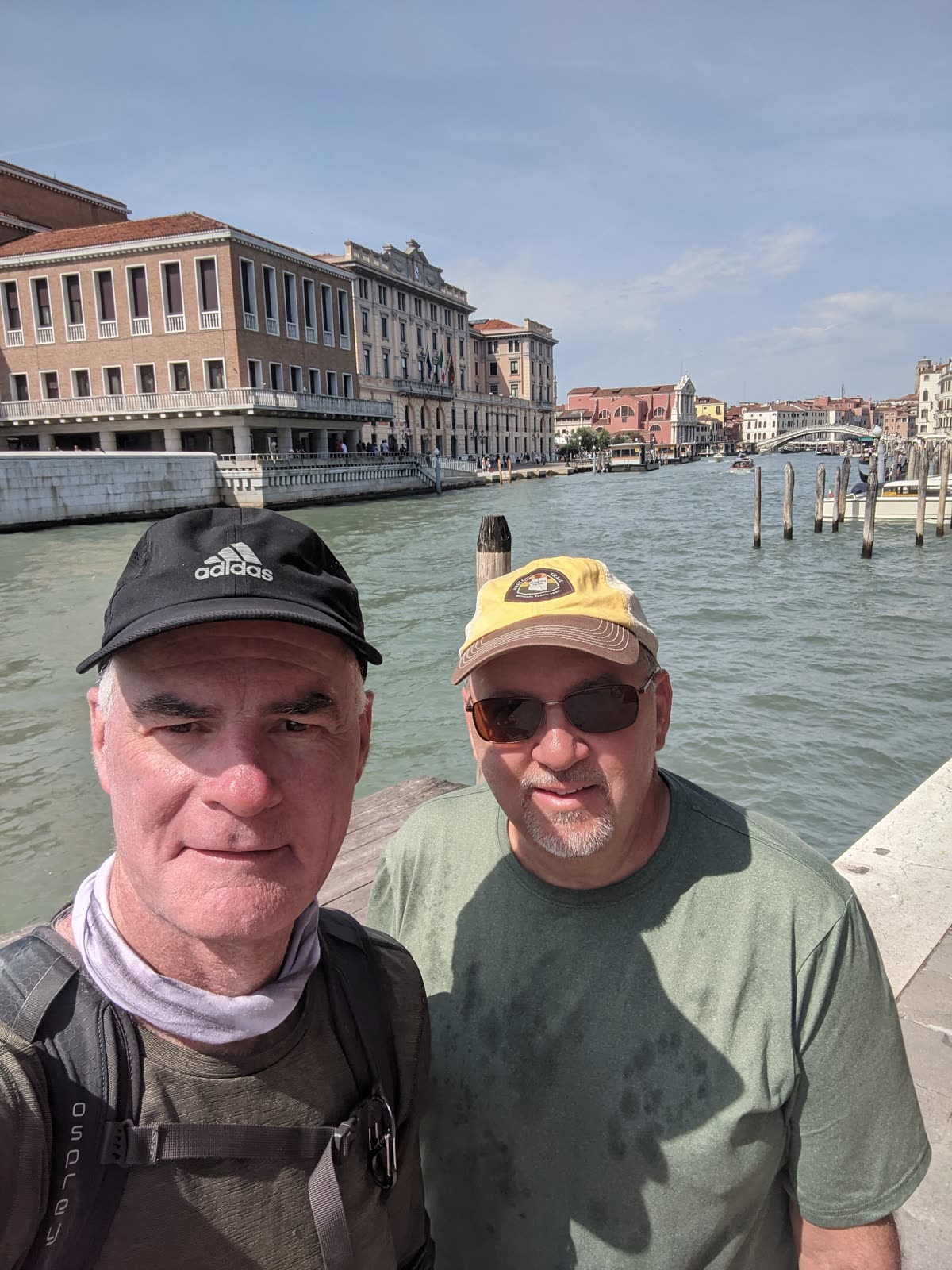
With a couple of hours to fill, I just wandered — over the bridges and along the little side canals, the ones tucked a street or two back from the crowds, where the gondolas are moored and the everyday business of the city goes on by boat.
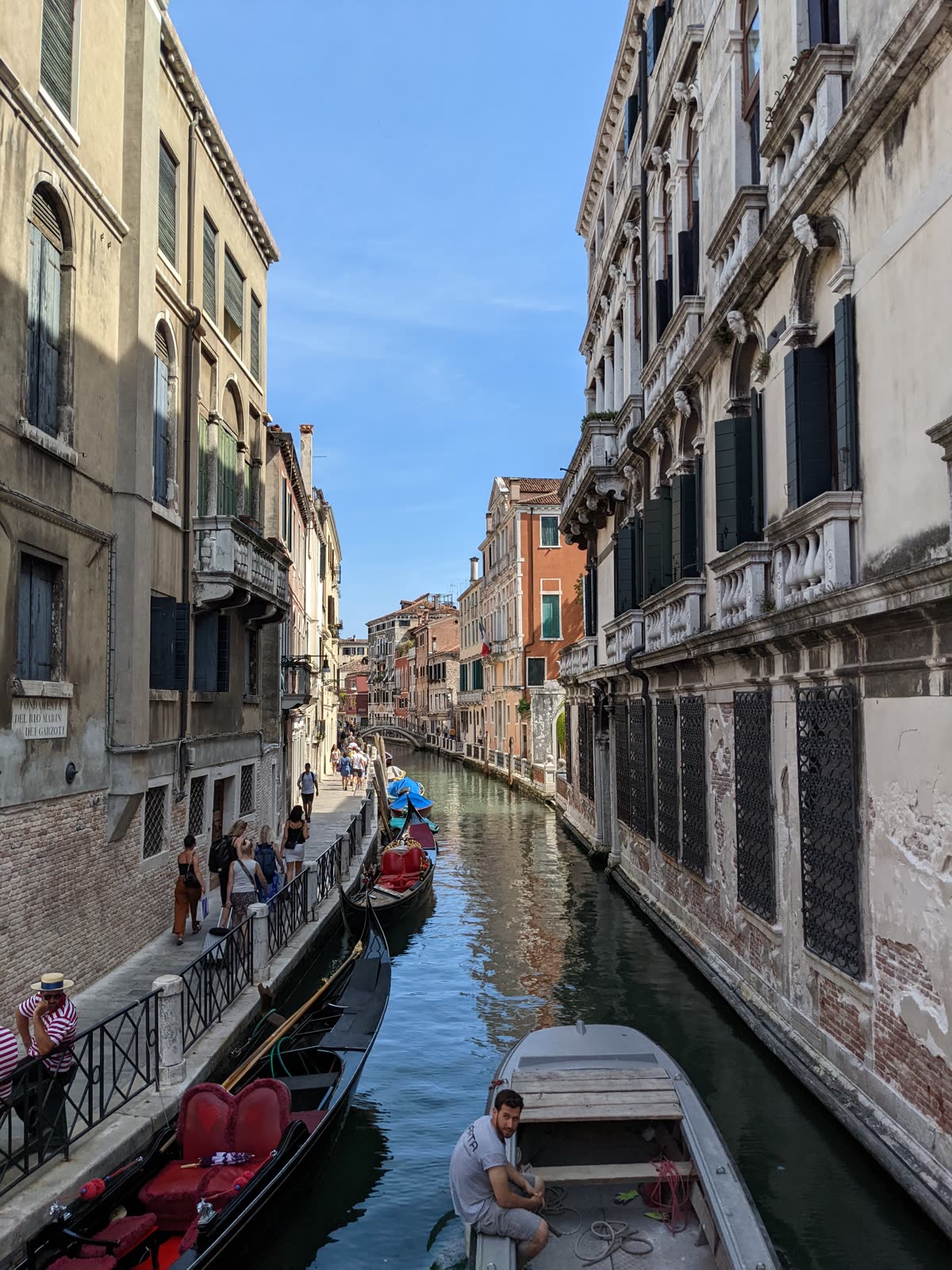
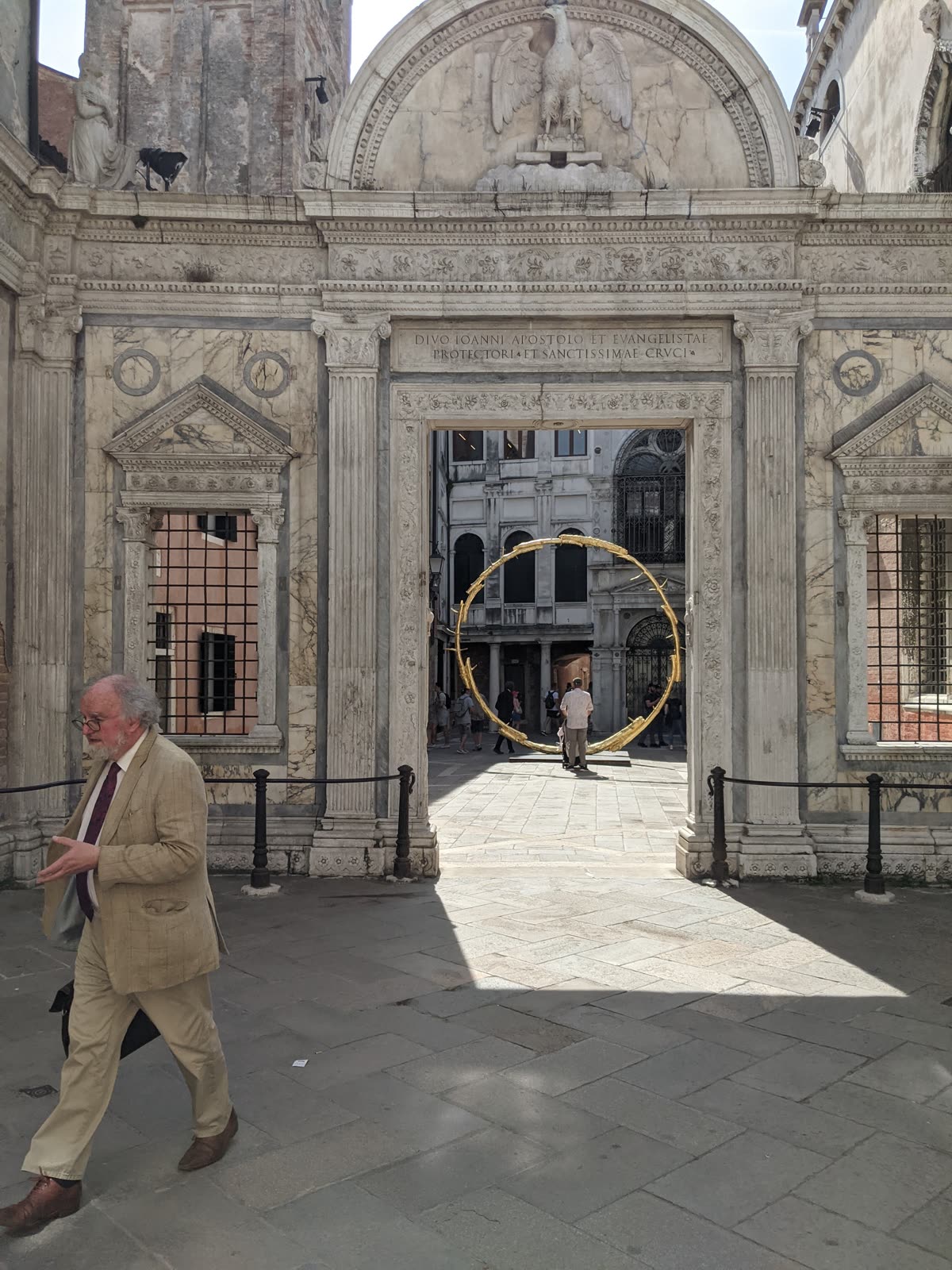
We both enjoyed our short time in Venice — but by the end of it we'd landed on the same conclusion: Treviso would have made a more fitting end to the ride, and spending that extra day there would have been the right call. Venice is Venice, and it's remarkable, but arriving by bike strips away most of the magic. The finish we'll actually remember isn't the causeway and the parking garage — it's the canals and the fresh fish of Treviso the night before.
And this was where the bike tour really ended — Germany to Venice, done. We'd still turn the pedals here and there over the next couple of days — around Verona, and across Innsbruck to reach our hotel and the bus — but the tour itself was finished. The trip, though, was far from over. We still had to get ourselves and our two rental bikes all the way back to the shop near Garmisch, and then down to Florence by Sunday, where our partners were due to meet us. Even if every train and bus connected perfectly, that journey was going to take a full day and then some.
So we grabbed the bikes and jumped on a train heading north toward the Brenner Pass, where we'd change trains for Innsbruck. It was early evening when we boarded, and we had no idea how far we'd get or where we'd sleep. We both started scanning for options — somewhere with a place to stay near a station, good onward trains the next morning, and ideally a few restaurants nearby. After what we jokingly called an "intense search" — really just the two of us hunched over our phones, debating whether to push on farther that night — Doug turned up a spot in Verona that seemed to tick the boxes. With darkness coming on, Verona it was. He booked a place called Chez Martha. We'd have a "tenda" for the night... whatever that turned out to be.
We arrived in Verona and took the short ride to our accommodations — a house in an ordinary neighborhood. We rang the front door, and our host came out and had us wheel the bikes through a gate into the side yard. We figured we'd leave them there and then be shown to a room. Instead, as we came around to the back of the yard, she pointed to where we'd be sleeping: a tent. Doug looked at me and asked, "Are you OK with this?" At that point, all we could really do was smile and think — when in Rome... er, Verona — you go with the flow.
Our host, a wonderfully eccentric little Italian woman, led us inside to show us the bathroom and shower. That meant walking through a very messy kitchen — where, she informed us, breakfast would be served — and stepping over a large, elderly German Shepherd sprawled across the floor. She showed us how the shower worked, ran through a few more "house rules," and that was that. Home for the night.
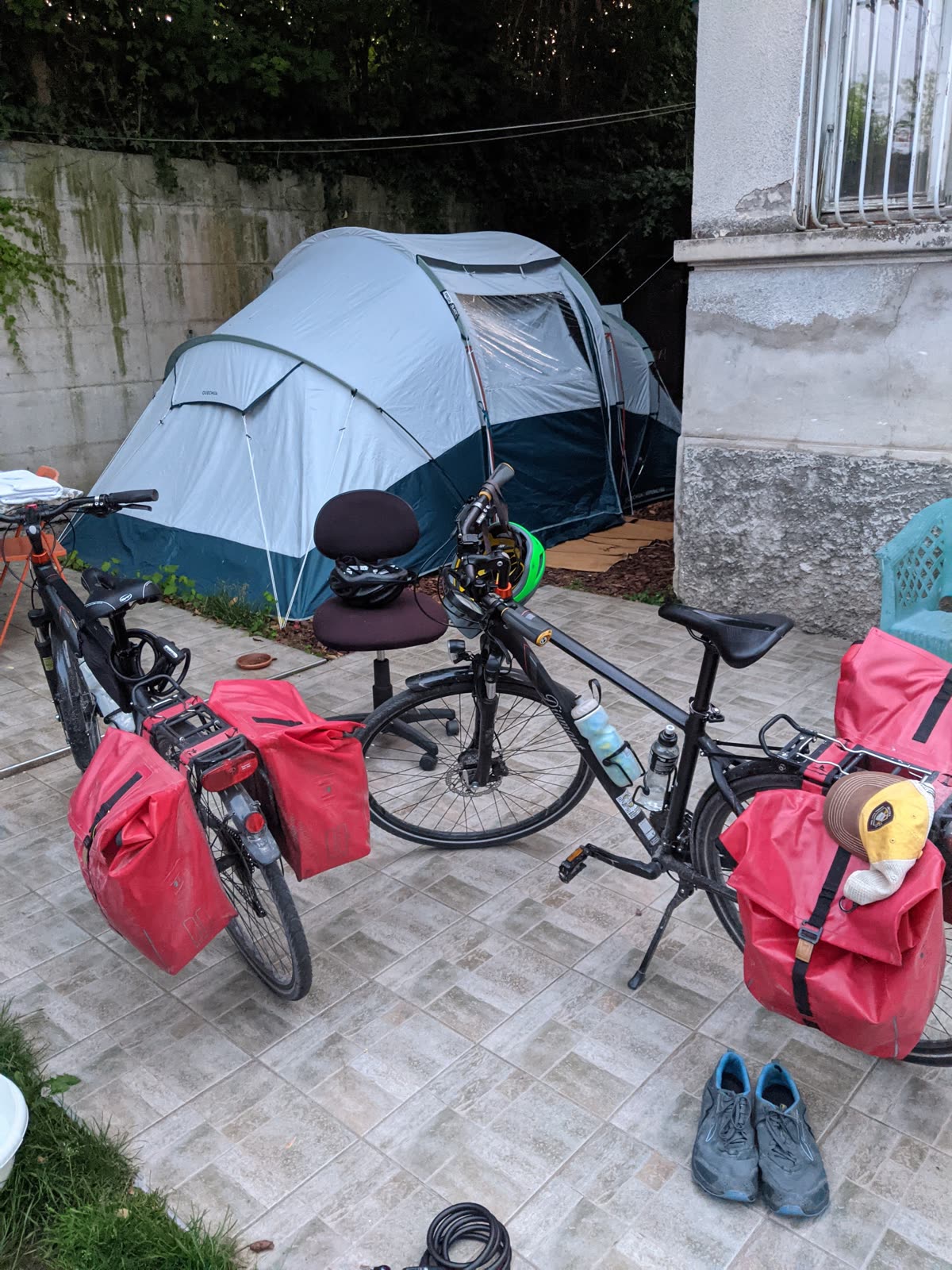
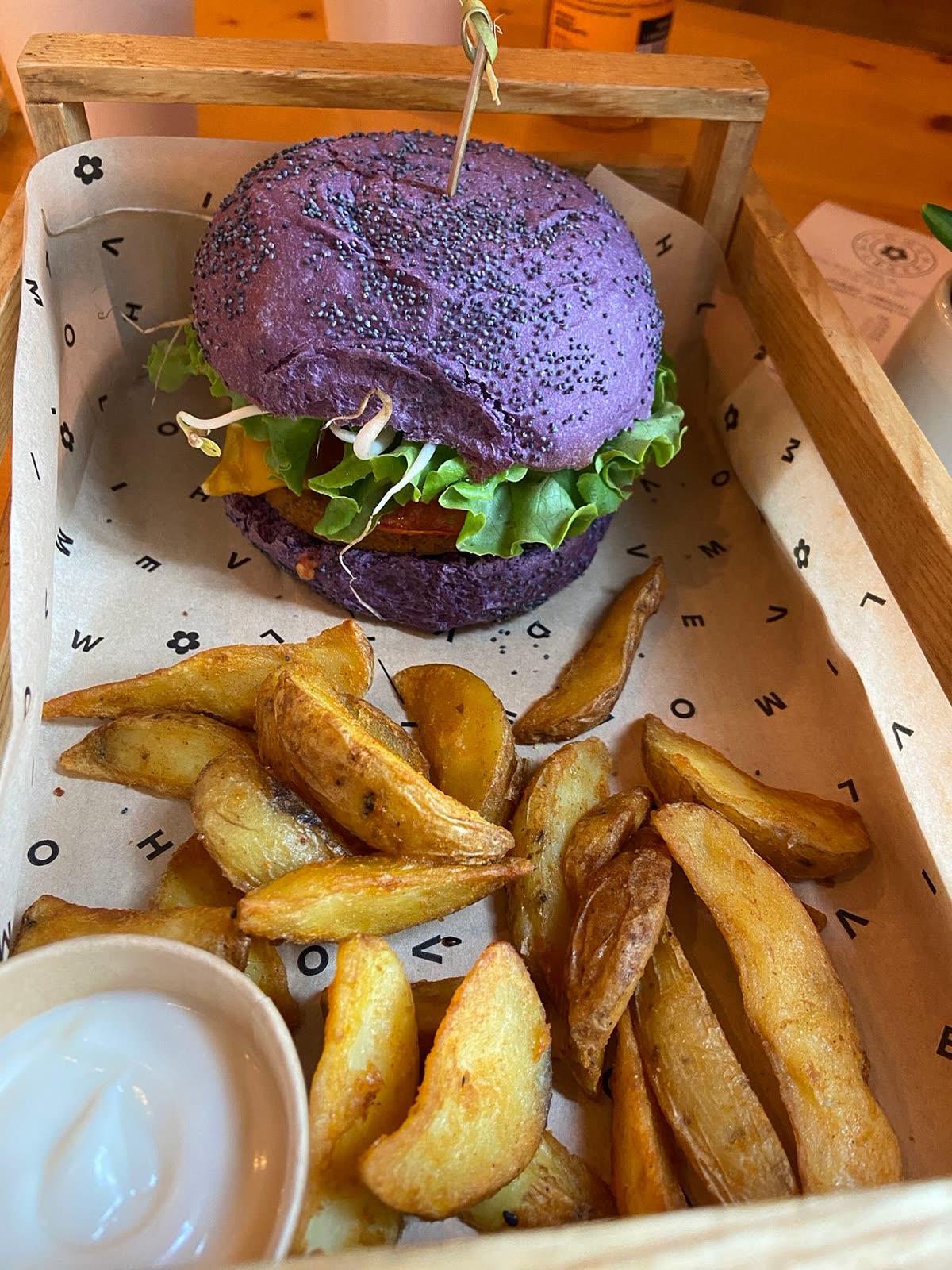
The tent actually had two cots and even electricity, and it turned out to be surprisingly comfortable. Having to go into the house to use the bathroom — stepping over the dog each time — was an experience, but at that point we were just grateful to have a roof, or at least a rainfly, over our heads. We settled in and headed out for dinner — at a spot called Flower Burger, where the burgers arrive stacked on bright purple buns (ours ran to a red-bean patty, cheesy sauce, BBQ, iceberg, and crispy pickles) — then walked around a little. When we came back and went to use the bathroom, we noticed our host had made up her own bed on the bench behind the dinner table, right next to the German Shepherd we'd been stepping over. We figured she must have rented out her own room and been left to sleep in the kitchen — though one of us floated a rumor that maybe this wasn't even her house at all, and she was just squatting in a vacant place and renting out the rooms. And the tents.
I don't remember exactly when the first train went by, but the tracks ran right behind the wall our tent was pitched against. Thankfully they didn't run all night. Tomorrow would be another adventure.
The long way home · Juliet's balcony, a cabinet door, and a battle to get the bikes on a train
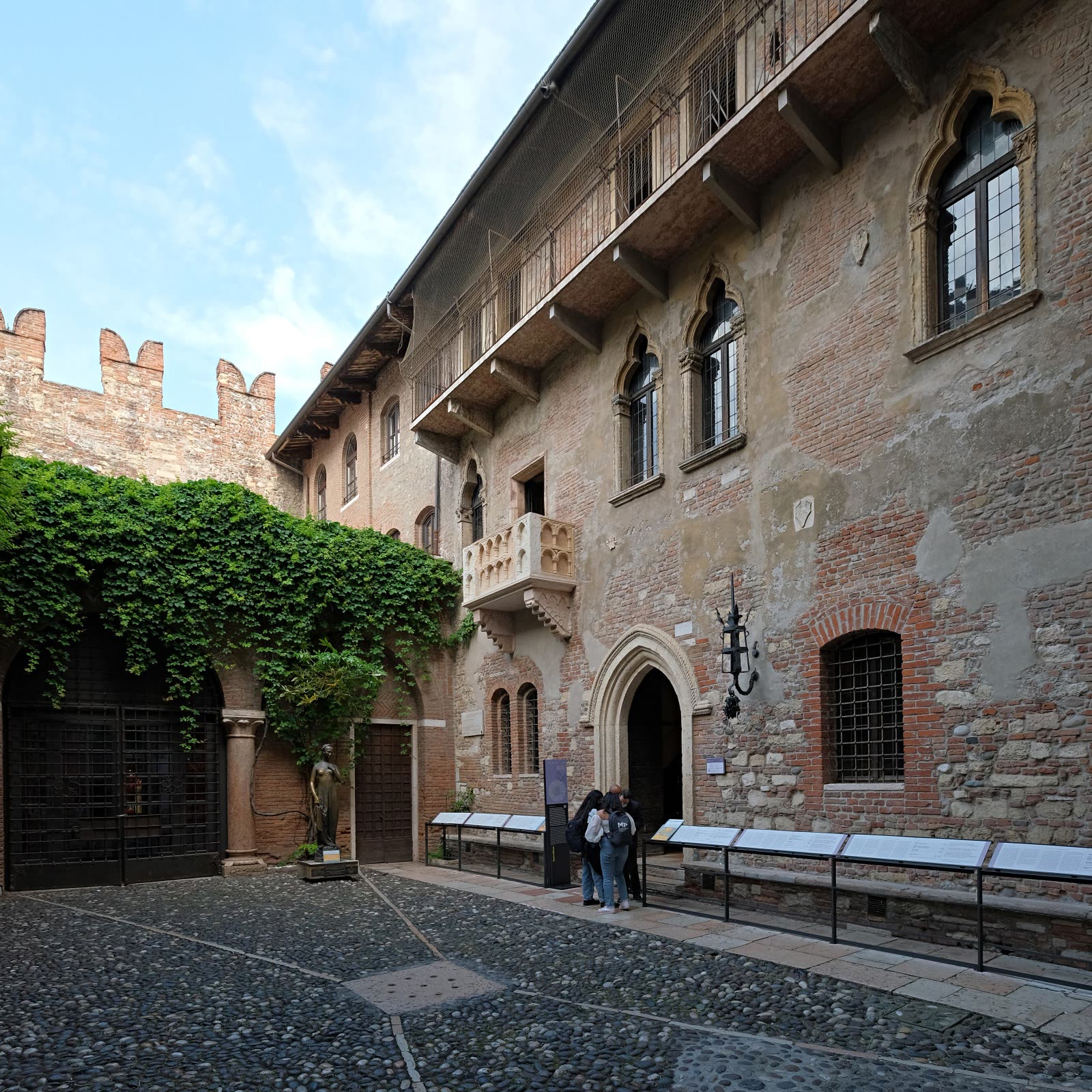
Our train tickets weren't until mid-morning, so we had a little time to enjoy Verona before we left. We rode around town a bit and went to see the famous Romeo and Juliet spot, and we treated ourselves to some great pastries and a proper breakfast out in the city. And yes — technically we were staying at a bed and breakfast, but there was no way on earth we were going to risk eating breakfast made in that kitchen. Let's just say it wouldn't have passed even the most lenient health inspection. Plus, honestly, we were just tired of stepping over the dog. We barely took any photos in Verona at all — and not a single one back at that house. Not even of the dog.
We headed back to the house to pack up and grab showers before the train. I went in first, stepped over the dog, and followed the instructions for working the shower. Doug showered next. The windows were open, so from outside I suddenly heard this awful thud — followed by some serious profanity, which is really saying something, because I'm not sure I'd heard Doug swear once on the entire trip.
Here's what happened. As Doug went to step over the dog, our host had left a cabinet door hanging wide open. Looking down at the dog, he never saw the open cabinet door — and cracked his head on it hard enough to draw blood. So there it is: after a week of riding across the Alps and the Dolomites, over gravel passes and down century descents, the single worst injury of the whole trip was delivered by a kitchen cabinet door. The one silver lining was that it was the very last time we'd have to step over that dog.
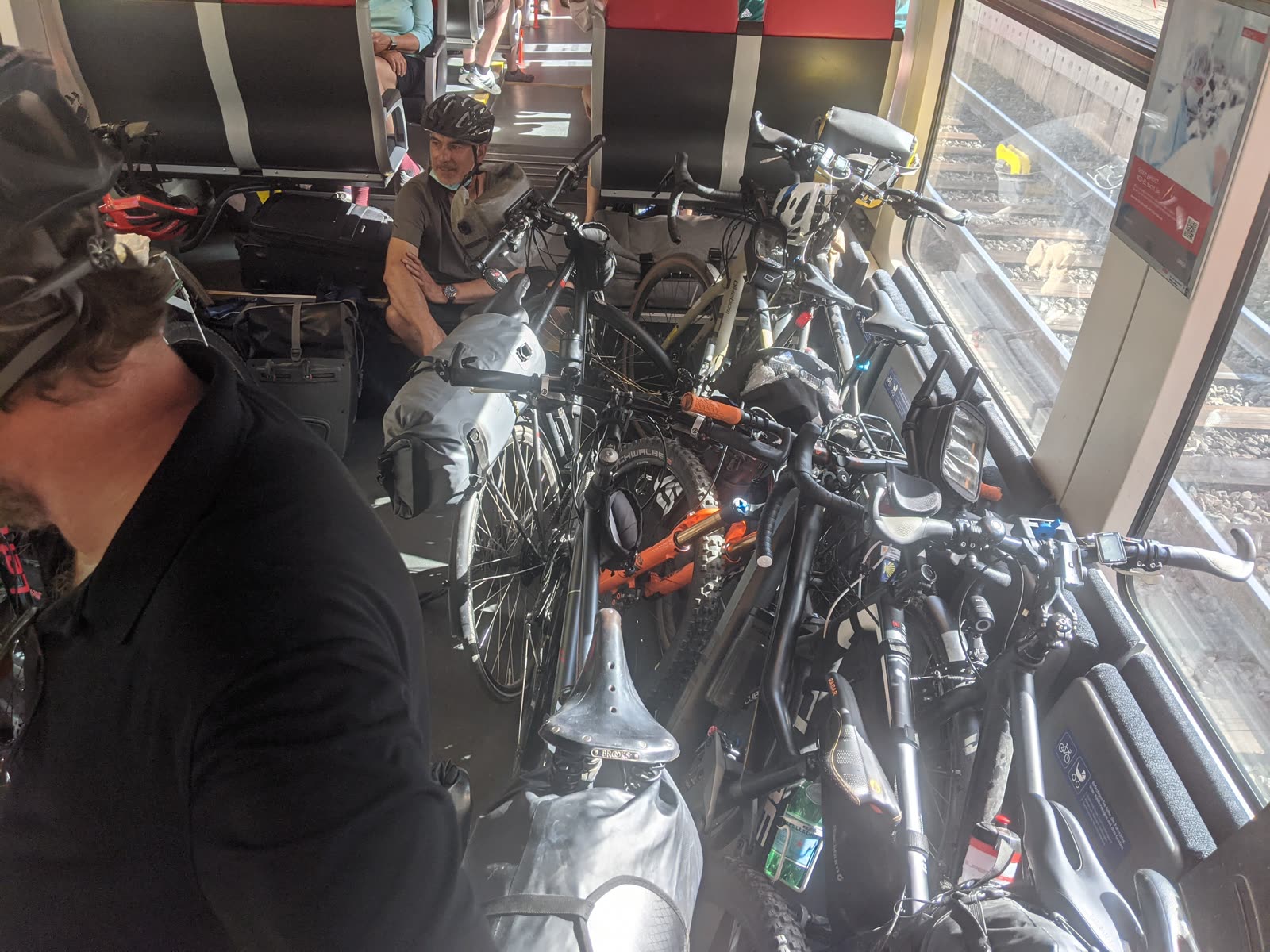
But the adventure was only just getting started. When we got to the train station, we found out there wasn't enough room for our bikes on the train — and we were far from the only ones. We tried all sorts of different train options, and none of them worked out. So we started strategizing with the other stranded cyclists, including a group from Germany with someone who'd done this before and knew the ropes of getting bikes onto Italian trains. Train after train came and went, each one taking only a few bikes, and it slowly dawned on us that we might genuinely be stuck in Verona for another night.
As it turned out, Italian regulations only allow a limited number of bikes per train, to keep the boarding areas clear for people to walk through. In the end, one of the conductors — or whoever was in charge of that particular train — took pity on us. He also stood there cursing his own bosses and the train company, saying this happens every single year and yet they still never add any capacity for bikes. It was a tight squeeze, but he let us load far more bikes than were technically allowed, so that everyone waiting could finally get aboard. Several hours later than we'd hoped, we were at last on our way toward the Brenner Pass.
For all the hassle of getting aboard, the journey itself turned out to be a beautiful one. The run north from Verona toward the Brenner follows the Adige valley up through the South Tyrol, and the views out the window were some of the prettiest of the whole trip — steep terraced vineyards climbing the hillsides, castles perched on the ridges, and tidy villages tucked in beneath the peaks.
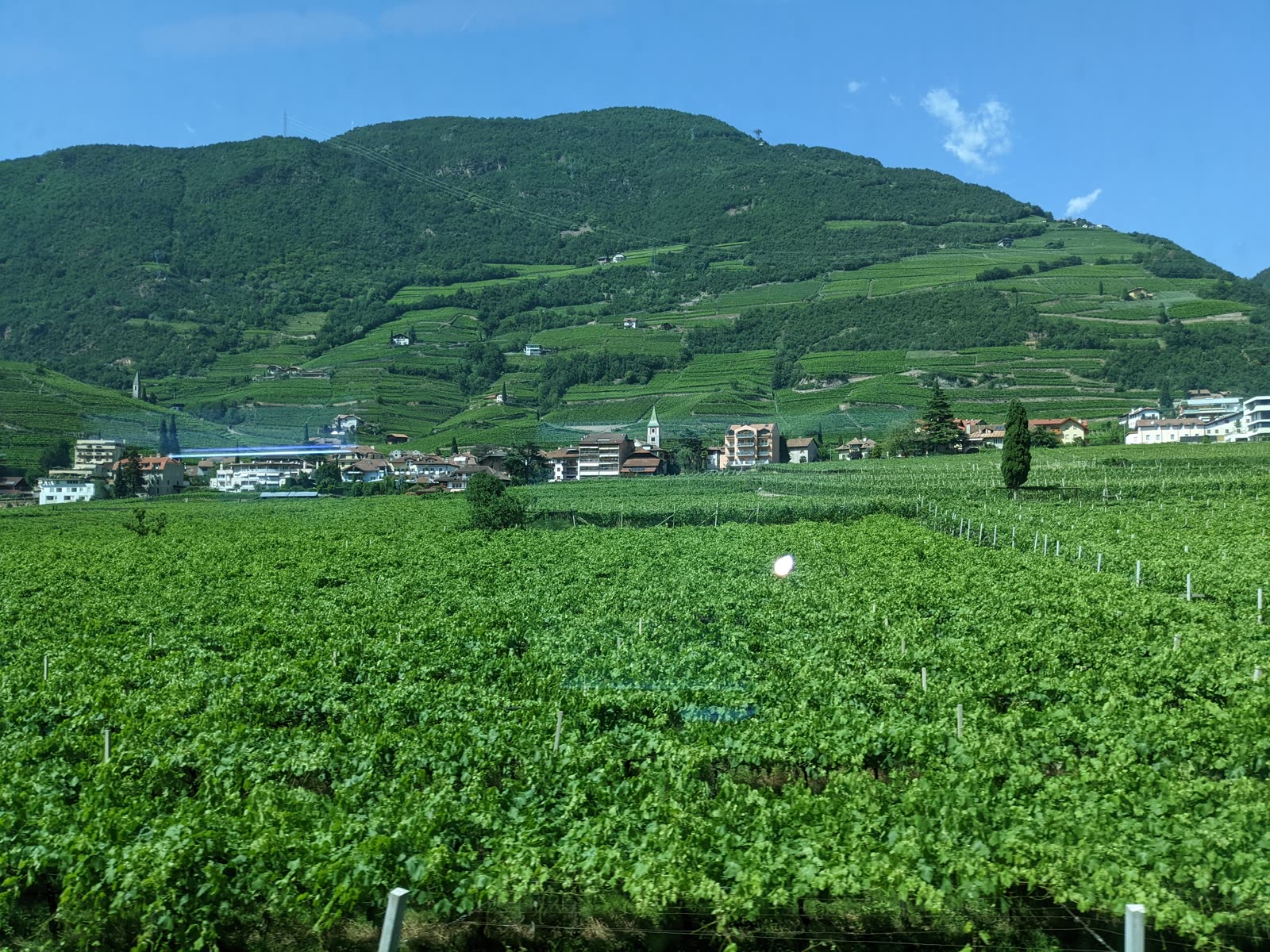
The connection at the Brenner over to Innsbruck was quick and seamless, and we had no trouble at all getting the bikes onto the Austrian train — a welcome change after Verona. And then, at last: Innsbruck. Yay! We'd made it. We had a great dinner out that evening and checked into the Hotel Neue Post. We were both taken with the innkeeper — warm, bubbly, and genuinely hospitable, and refreshingly open about how hard COVID had hit their business, and what the pandemic had been like in Austria. The room did come with one small catch, though: no air conditioning, on a very warm night, which made for a long, sweaty sleep. But we were one big step closer to home, and to getting the bikes back where they belonged.
The long way home · returning the bikes, a G7 checkpoint, and a taxi to the rescue
If everything went to plan, the day would go like this: a FlixBus from Innsbruck back to Garmisch to drop the bikes at the shop, then another bus back to Innsbruck to catch a train, and finally the long ride south — connecting through Bologna — to Florence, arriving late in the evening. A lot of moving parts, and a lot of connections that all needed to hold. Even getting that first FlixBus had been a puzzle: the night before, while I slept off the heat in that AC-less room, Doug spent a few hours working the booking — plenty of buses ran to Garmisch, but finding one with two open bike racks took real doing. One more problem to solve before we'd even set out.
The FlixBus went well enough. We loaded the bikes onto the rack on the back, climbed aboard with the other passengers, and set off for Garmisch. All was well — or so we thought — right up until the bus was pulled over at a security roadblock. It turned out the G7 summit was being held nearby in just a week's time, and the checkpoints were already going up. Every one of us had to get off the bus and show our passports before we were waved through. The whole thing took only about ten minutes, and it helped that it was early and there wasn't much traffic yet. We didn't think much of it at the time. That would change later.
We rolled into beautiful Garmisch-Partenkirchen — the town where this whole adventure had begun nine days earlier — hopped on the bikes one last time, and made the short ride over to the shop. I couldn't resist one final spin down the painted main street to grab a bit of GoPro footage before handing my bike back.
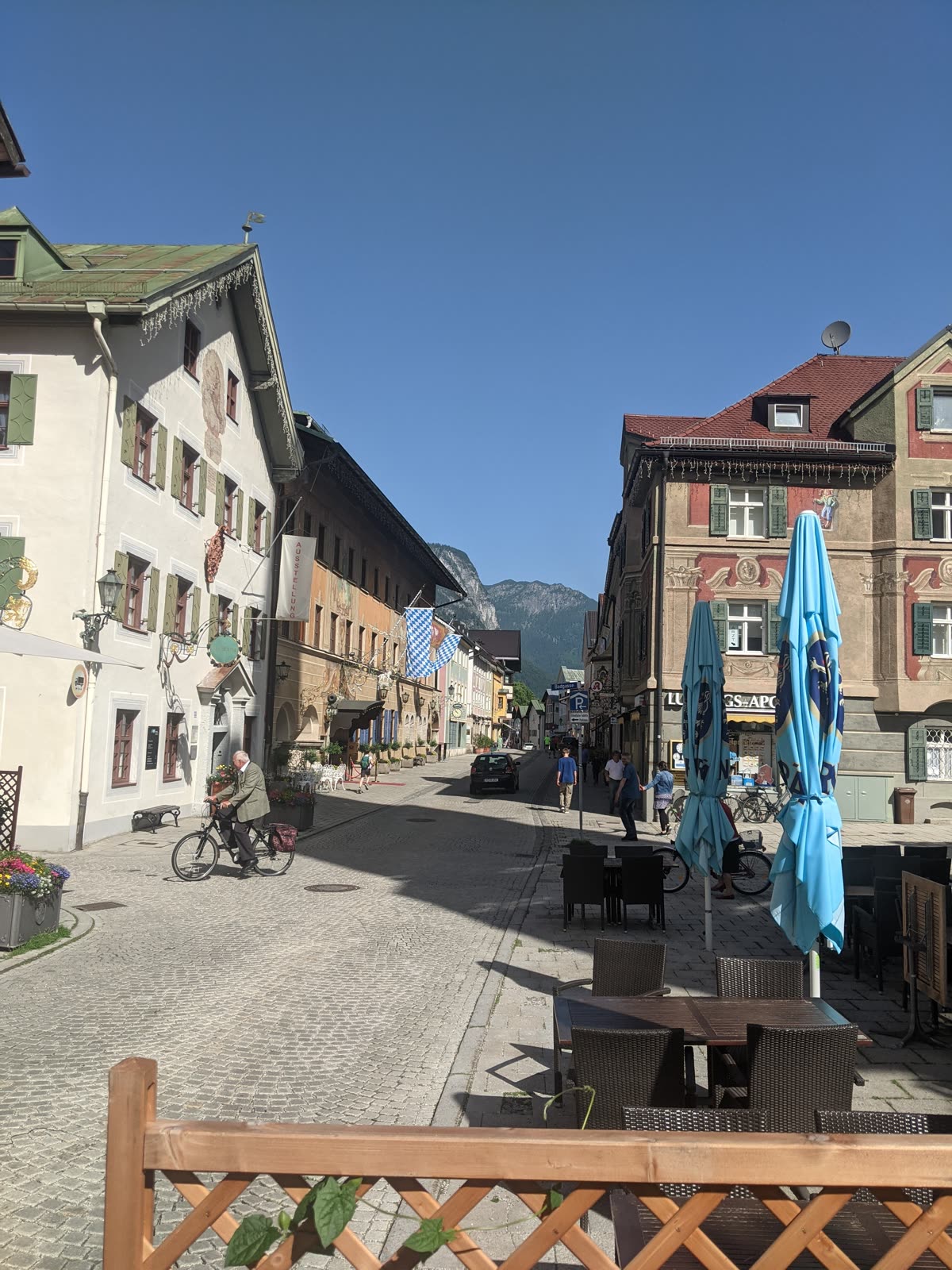
Here's that final spin down the main street — the last footage of the trip:
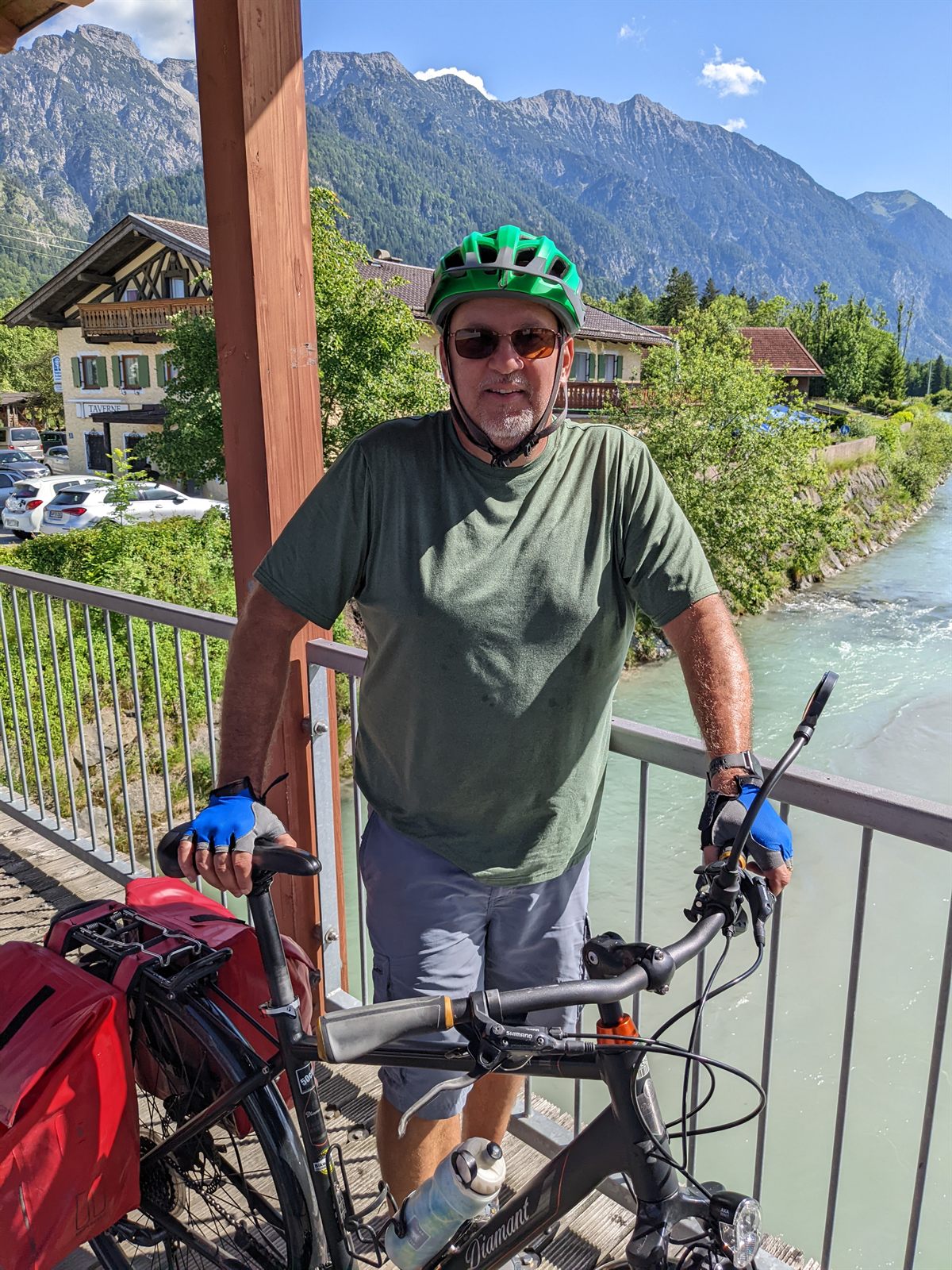
Then we returned the bikes and took a few photos out in front of the shop, the tour officially behind us. The folks at bikeverleih.de were incredibly helpful. They weren't the company we'd originally booked with — that was a different outfit, the one whose shuttle van broke down and left us scrambling before we'd even begun — but they're who came through and got us onto bikes in Garmisch when we needed them, and they looked after us right up to this final handoff.
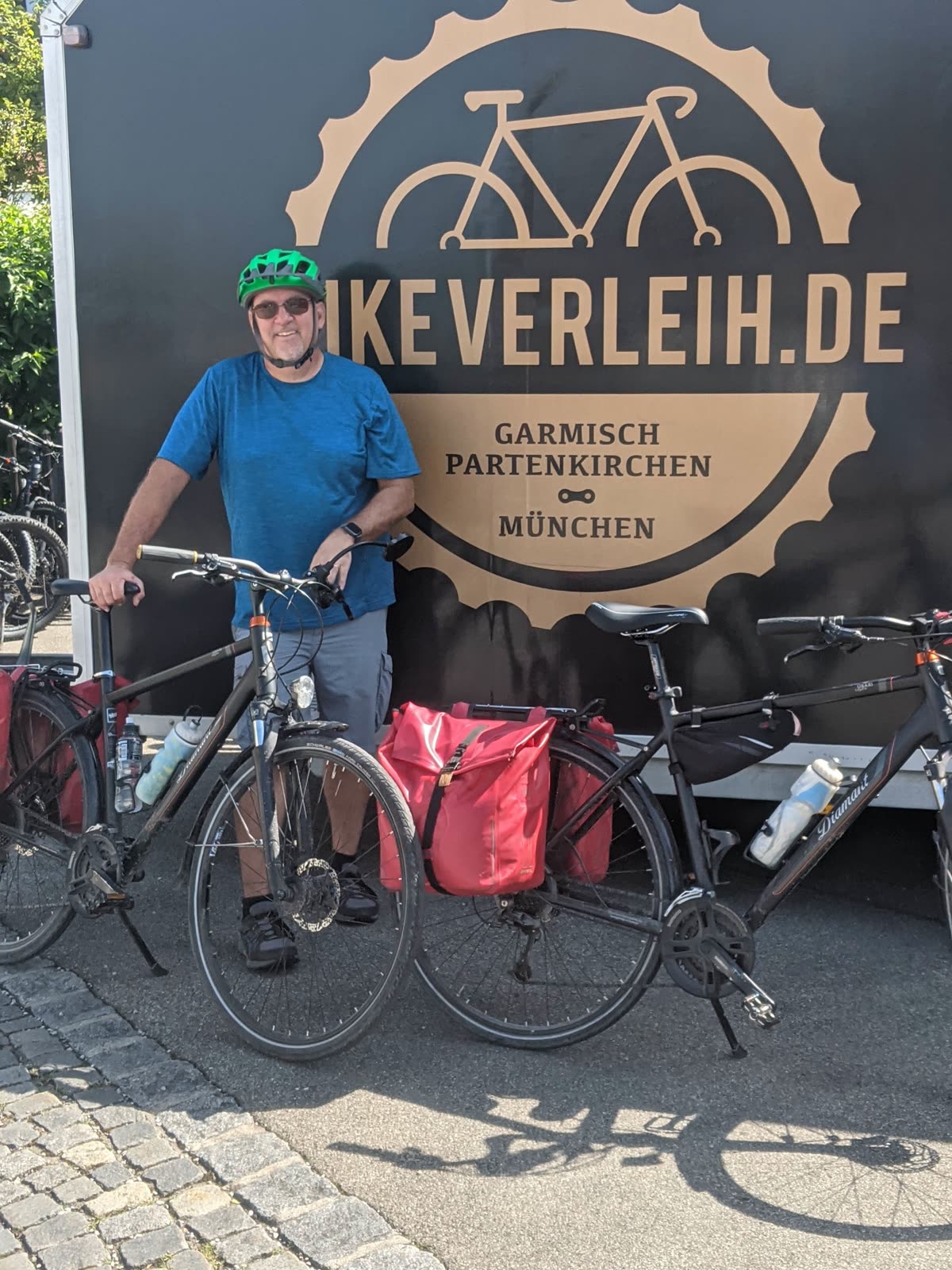
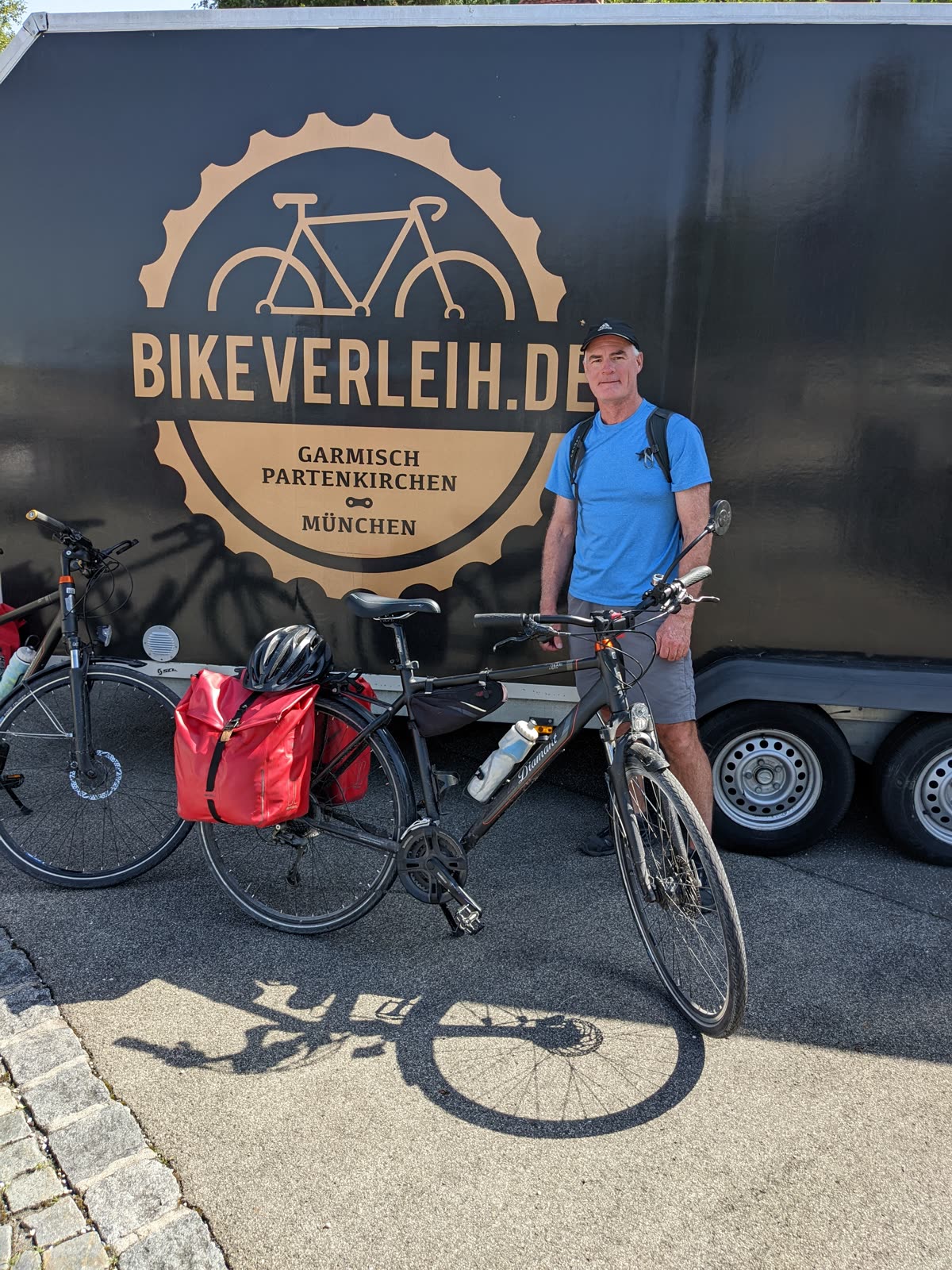
With the bikes handed back, we had around two hours before the next bus to Innsbruck, so we wandered parts of Garmisch we hadn't seen on the way out — sitting for a while first in a park, and then at a café near the bus stop. It's a genuinely gorgeous town, ringed by the Wetterstein peaks, and a fitting place to run out the clock on the trip.
And this is where things went south — well, not south, exactly, since south was the direction we actually needed to go. But you know what I mean. Because of that G7 checkpoint, the buses coming from Innsbruck were now running badly late, which meant our bus back to Innsbruck was late too. Looking at the estimates, there was simply no way we were going to make our train — and no way we'd reach Florence that day.
So we started asking around. We put the problem to a few workers sitting nearby, and for a while nobody had any good ideas — until one of them said, "You could take a taxi." Now, you have to understand: we were basically up in the mountains, and a taxi all the way to Innsbruck seemed about as likely as a passing helicopter. But when I asked where I'd even find one, he just pointed toward the park and said, "There's a taxi driver right over there." So I walked over to ask whether he'd take us, and what it would cost. We settled on 120 euros for the roughly 38-mile run — a trip that would normally take under an hour. And just like that, we were on our way.
Of course, there was still that security checkpoint to get through — and this time we hit the traffic. Our driver hadn't quite anticipated the delays, and somewhere in the queue he realized he probably should have charged us more. Heading our way the wait wasn't too bad, but he could see that his trip back to Garmisch was going to cost him at least a solid half-hour stuck in it. The rest of the drive to the station was smooth, and we pulled in with time to spare for our train. Given what he was about to face on the way home — and the fact that he'd genuinely saved our whole day — we gave him 160 euros, about 40 more than we'd agreed. He'd earned every cent. He was our savior.
The train down to Florence went off without a hitch — even the very tight connection in Bologna. We arrived to a long but scenic walk through the dark streets to our house rental, where we met up with Mo, Doug's girlfriend, who had flown in earlier that day and already checked in. My own wife had run into flight delays getting over from the States, so she wouldn't make it until the following day — a day later than we'd planned. (One small note for future travelers: the cobblestone streets of Florence are absolutely brutal on roller luggage.) But we made it. Our biking adventure — Germany to Venice, across the Alps and the Dolomites, and the long scramble home — was officially over, and we had a whole trove of great memories and stories to show for it.
The trip itself wasn't quite finished: over the next week or so we'd spend a few days in Florence, then head out to the Cinque Terre on the coast, before finally flying home out of Milan. But the ride was in the books — and what a ride it had been.
The ride ended in Venice — from there, we went home by rail (and bus, and one memorable taxi). Friday evening we backtracked west to Verona (and the infamous tent); Saturday we climbed north up the Adige valley, over the Brenner Pass into Austria, to Innsbruck. Sunday we hopped back to Garmisch to return the bikes, then rode the long train south through Bologna to Florence. A schematic of the route, following the line through the towns along the way — not an exact GPS track.