🗓️ Completed · October 2018
Camino de Santiago
A surprise reunion on one of the world's oldest pilgrimages — then onward with Doug from Santiago to the Atlantic coast at Muxía and Finisterre, the "end of the world."
A surprise reunion on one of the world's oldest pilgrimages — then onward with Doug from Santiago to the Atlantic coast at Muxía and Finisterre, the "end of the world."
In October 2018, my mom set out on one of the oldest journeys in the world: the Camino de Santiago. The name means "the Way of St. James" — most pilgrims simply call it the Camino, "the Way." For more than a thousand years, walkers have followed its paths across Spain to the cathedral of Santiago de Compostela, in the green northwest region of Galicia, said to hold the remains of the apostle St. James. I didn't do that full pilgrimage myself — but her journey became the reason for mine.
My own trip came in three parts. It began with a few days in Madrid. Then came the heart of it: my mom was nearing the end of her own Camino, and Doug and I flew over to surprise her as she walked the final miles into Santiago. And once her pilgrimage was complete, the two of us set off on a short Camino of our own — west to the Atlantic at Muxía, then down the coast to Finisterre, the rugged cape that medieval pilgrims believed was the literal end of the world.
Skip ahead to either story
A little background on the route my mom walked — for anyone new to the Camino.
The Camino de Santiago isn't one path but a web of ancient pilgrim routes, all converging on the cathedral in Santiago de Compostela. The one my mom walked — the Camino Francés, or "French Way" — is the most famous of them. It runs roughly 500 miles (about 780 km) from Saint-Jean-Pied-de-Port, on the French side of the Pyrenees, up over the mountains and west across the whole top of Spain — through Pamplona, Logroño, Burgos, and León — before dropping into the green hills of Galicia and finishing at Santiago. Pilgrims have walked it for more than a thousand years; in the Middle Ages it stood alongside Rome and Jerusalem as one of Christianity's three great pilgrimages, and today the routes are a UNESCO World Heritage Site.
Everyone walking the Camino is called a pilgrim — peregrino in Spanish — because the route began as a pilgrimage, a journey to a holy place. Here the destination is the tomb of the apostle St. James (Santiago in Spanish), believed to rest beneath the cathedral in Santiago de Compostela. For more than a thousand years people have set out on foot for faith, penance, or gratitude, and the name "pilgrim" stuck to anyone making the journey. Today people walk for all sorts of reasons — spiritual, personal, athletic, or simply the pull of the open road — but whatever draws you, the moment you start walking the Way, you're a pilgrim.
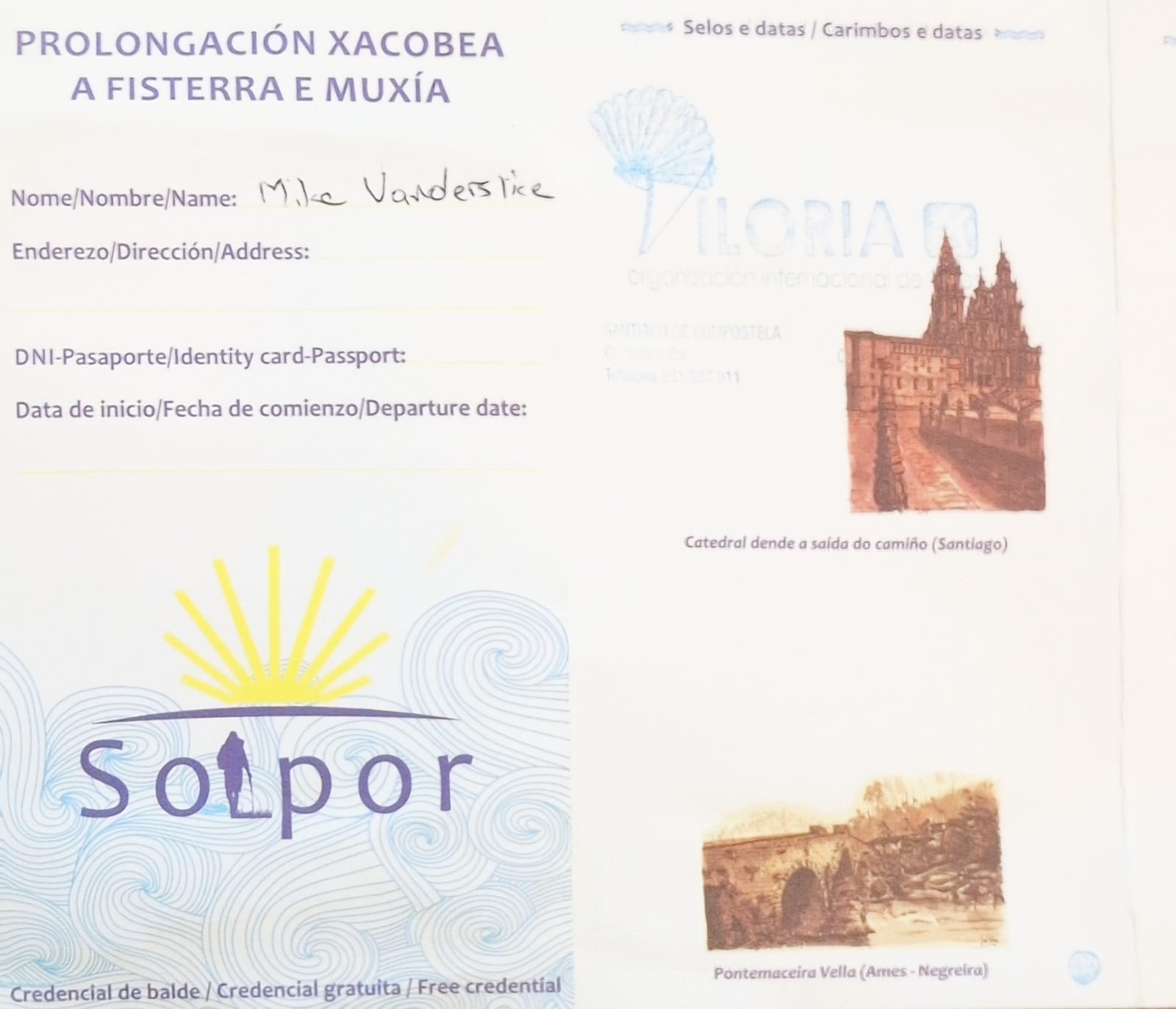
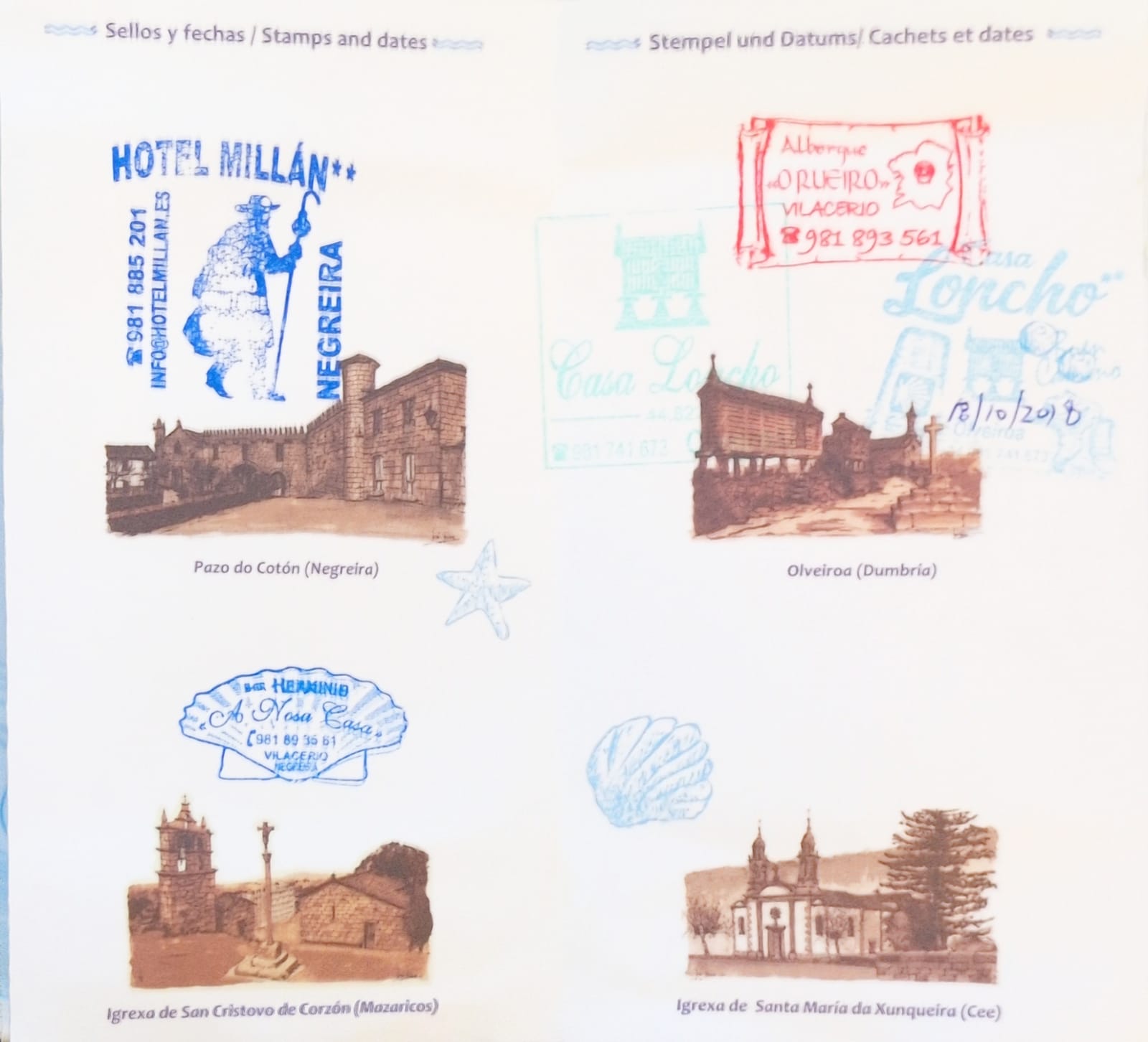
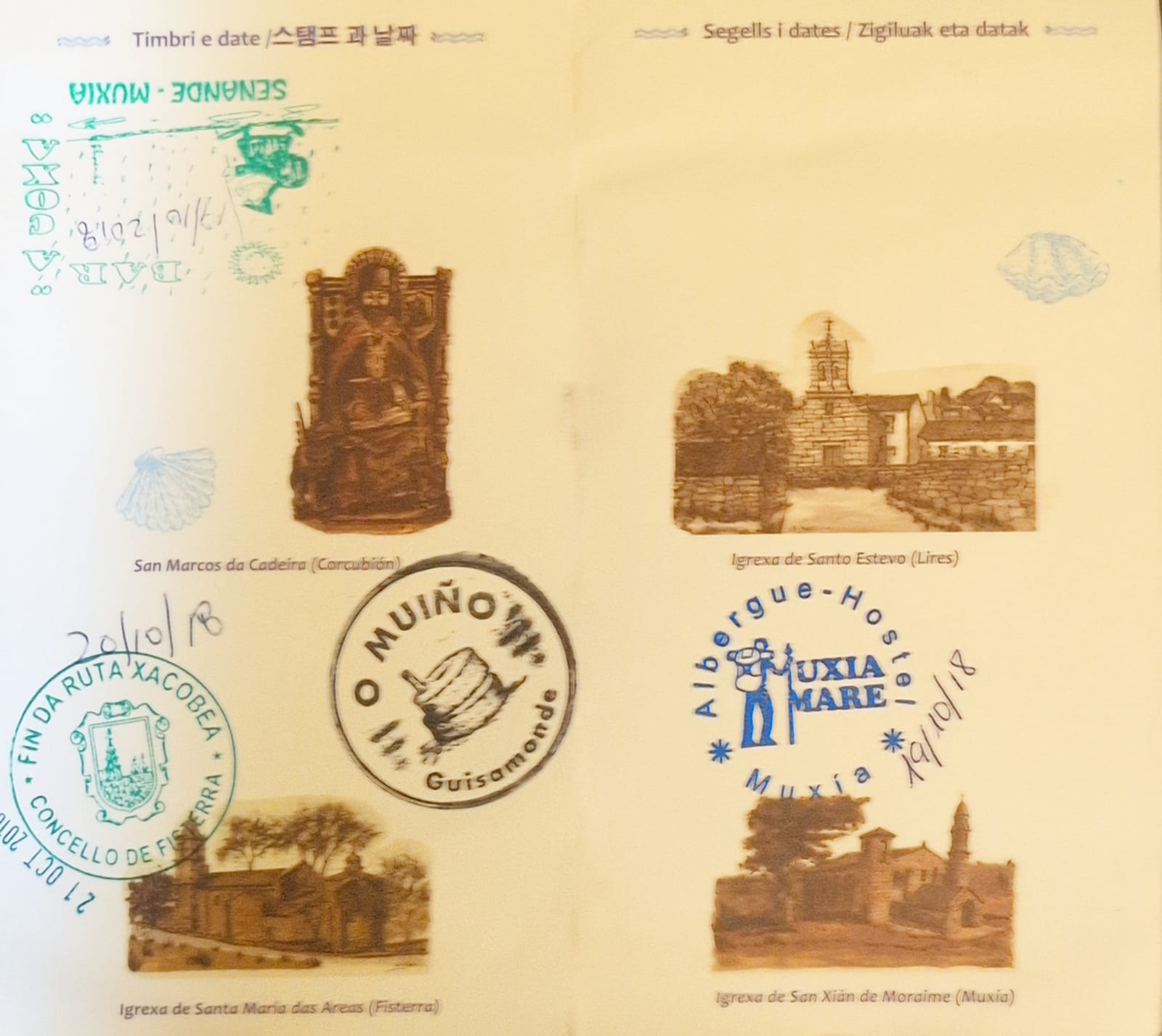
Walkers carry a credencial — a pilgrim's passport — and collect stamps at the towns, churches, and albergues (pilgrim hostels) along the way. Cover at least the final 100 kilometers on foot and you earn the Compostela, the certificate handed out in Santiago. The full French Way takes most people four to five weeks, and you'll spot it everywhere by its two symbols: the scallop shell and the yellow arrow.
If you'd like to get a feel for it, watch The Way (2010) — Emilio Estevez directed it, and his father, Martin Sheen, stars as an American father who walks the Camino Francés in honor of his son. It follows the same route my mom took, all the way to Santiago and on to the Atlantic coast, and it captures the spirit of the pilgrimage beautifully. It's a genuinely good film, and well worth a watch whether or not you ever lace up for the Camino yourself.
As it happens, The Way played a small part in how this whole trip came to be. In the fall of 2017, I had my parents over to watch it — not to nudge anyone toward a pilgrimage, just a good movie with a great story set in Europe. It did fit a loose little theme, though: around the same time, I'd invited my mom to a talk at our local REI given by a woman who'd walked the Camino several times.
My mom didn't say a word about wanting to do it herself — not after the movie, not after the talk. Then, a day or two later, the phone rang: "I'm going to do the Camino!" Really — that's freaking awesome, I told her. Hearing her so excited about it was a wonderful moment. It turned out she'd known about the Camino since earlier in her life; all of this had simply nudged her to finally act on it, and she set about planning her walk.
The reason was simple, and it mattered to me a great deal: I wanted to be there at the finish to congratulate her in person. I was so proud of her for setting out on a journey like this and seeing it all the way through — 500 miles on her own two feet. I knew how much the Camino meant to her, how long the idea had lived in her, and how much it would mean to have family there to share the moment she completed it.
Before she'd even left the US, I'd quietly decided I was going to meet her at the finish in Santiago. I let my wife and a couple of friends in on her plans and my idea to surprise her there. I didn't actually ask anyone to come along — it felt like too big an ask, with too many unknowns — but Doug, ever the one for a good adventure, eagerly wanted in. And just like that, our half of the plan came together. I was so sure she'd make it that I booked my flight before she ever set out.
Keeping it secret took some doing. Since none of us knew exactly which day my mom would reach Santiago, I had to play it coy — folding casual questions about her progress into our normal calls so I could time our arrival without giving anything away. I wanted to surprise my dad as much as my mom, so he was kept in the dark too — which got tricky the very weekend we left. My dad's sister was in town visiting Arizona, and while I'd seen her already during the visit, my dad called a few days later about joining them for dinner that Saturday night. I was already en route to Spain, so I begged off, said I was busy, and kept the secret. The plan started coming together during our layover in Minneapolis, where one more easygoing chat with my mom gave me her best guess at the day she'd walk into Santiago — enough for Doug and me to build our timing around, even if we wouldn't be able to lock in the exact day until we were on the ground in Spain.
The full story, as it happened, in two parts. Part One is the journey over and the surprise reunion at the finish of my mom's Camino. Part Two is the short Camino Doug and I walked on our own afterward — west from Santiago to the Atlantic coast. I'll add days here as I write them up.
Phoenix → Minneapolis → Amsterdam → Madrid · a first afternoon in the city
Doug and I left Phoenix on an overnight flight, connecting through Minneapolis and then on to Amsterdam — our gateway into Europe before the final hop down to Spain.
Amsterdam handed us the trip's first two laughs. Going through customs, Doug and I happened to step up to the booths at the very same moment, in separate lines. Maybe it was the Dutch last name, but I was waved through in about 30 seconds flat — while Doug stood there for several long minutes. We still joke that the officers must have known something about him that warranted a closer look. Hmm.
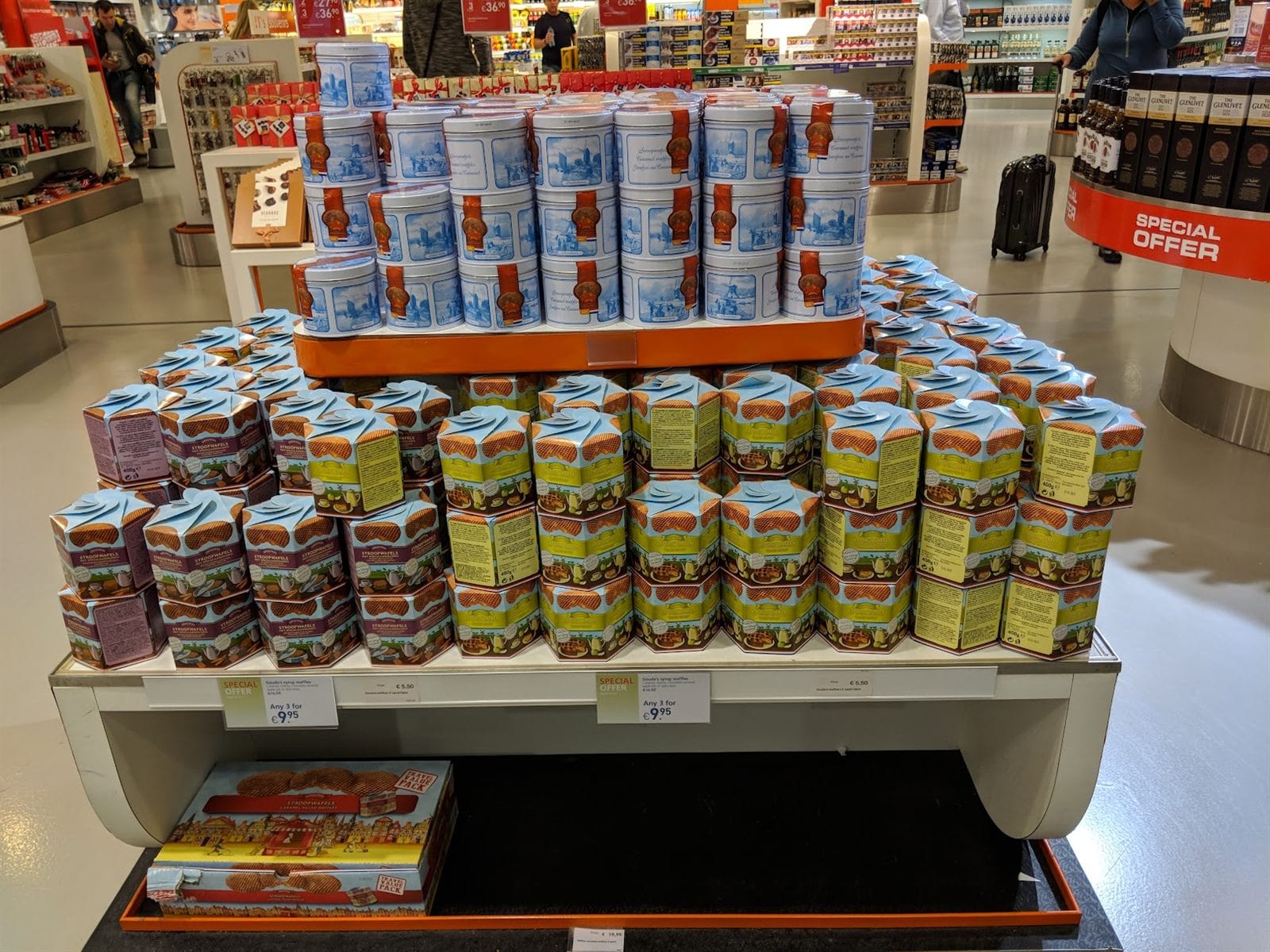
The second laugh came courtesy of the stroopwafel. On the flight over I'd been telling Doug all about them — those thin, caramel-filled waffle cookies the Netherlands is famous for — since he'd never heard of one. Then we rounded a corner in the airport and walked straight into an enormous display of them. Perfect timing.
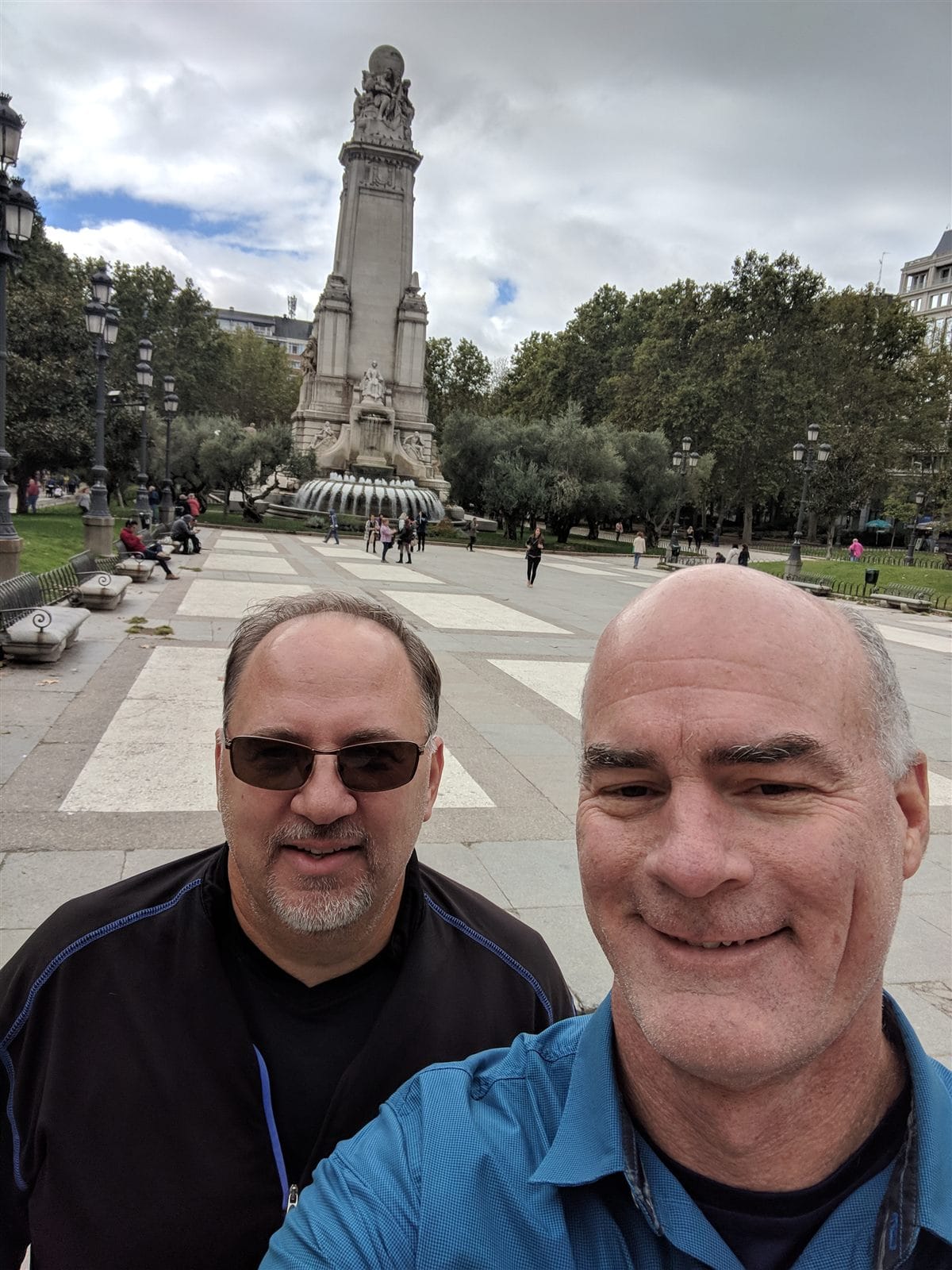
We finally touched down in Madrid on Sunday, October 14th. From the airport, the Madrid Metro carried us almost to the door — dropping us within a few blocks of our Airbnb rental.
It was mid-afternoon by the time we'd settled in, and the jet lag was hitting hard. We gave in to a brief nap at first — but knowing the best way to beat the jet lag was to stay awake until a normal bedtime, we dragged ourselves back up, headed out, and walked the city for a while. Wandering Madrid on foot turned out to be the best antidote — a first taste of the plazas and the easy energy of the Spanish capital.
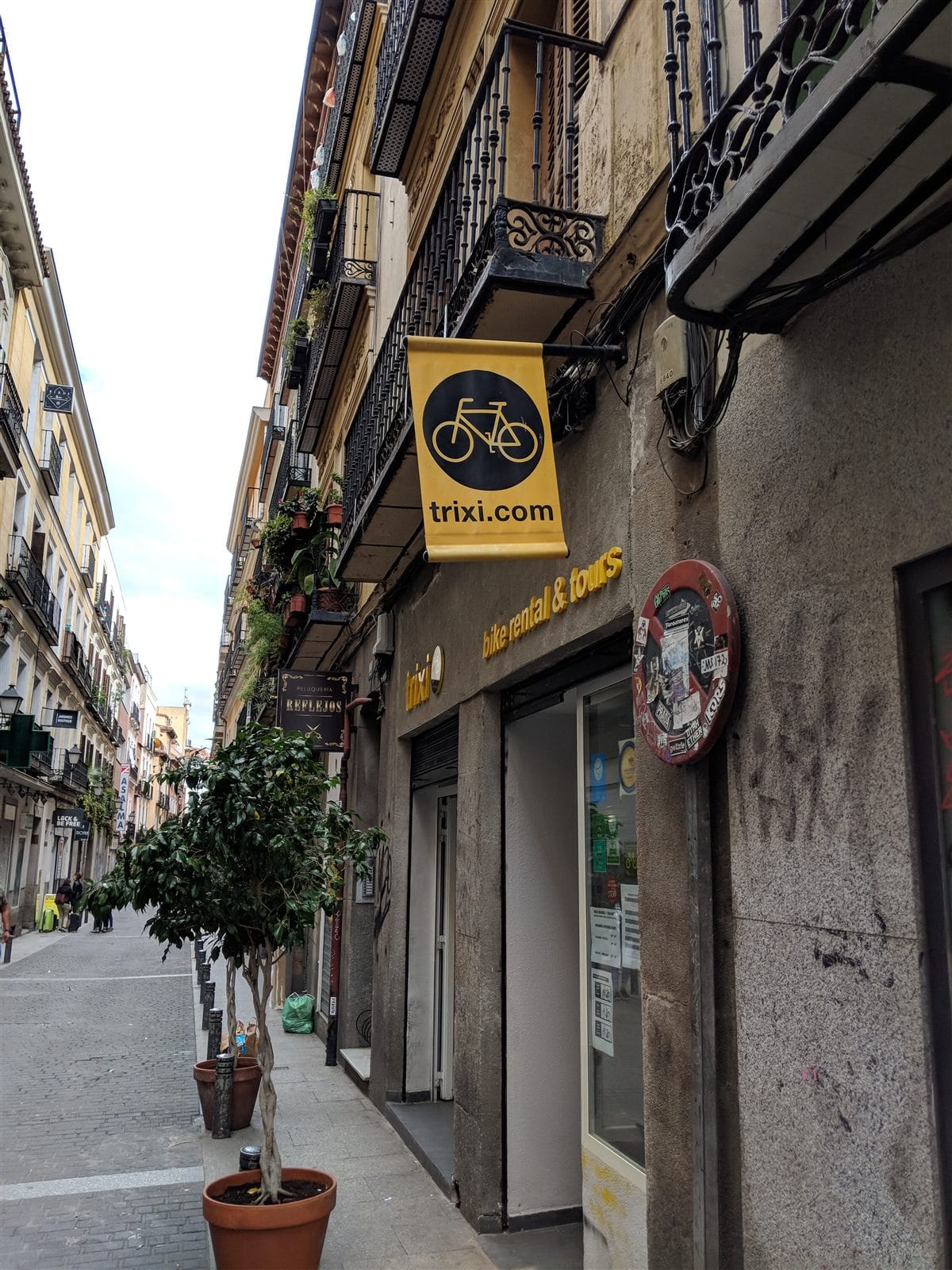
Doug had floated the idea of booking a guided bike tour of Madrid — a fun way to cover more ground and pick up some history of the city along the way. As luck would have it, we walked right past a shop called Trixi bike rentals while we were out exploring. Doug stepped in, sorted out the details, and just like that the next morning's tour was planned.
A guided ride through the heart of Madrid · evening flight to Santiago de Compostela
Our second day opened with the bike tour we'd booked the evening before. It was run in English, so we could follow every word — and what a way to see a city. Over a few easy hours we covered far more ground than we ever could have on foot, with history and stories at every stop. If you're ever in Madrid, I can't recommend this kind of introduction to the city highly enough.
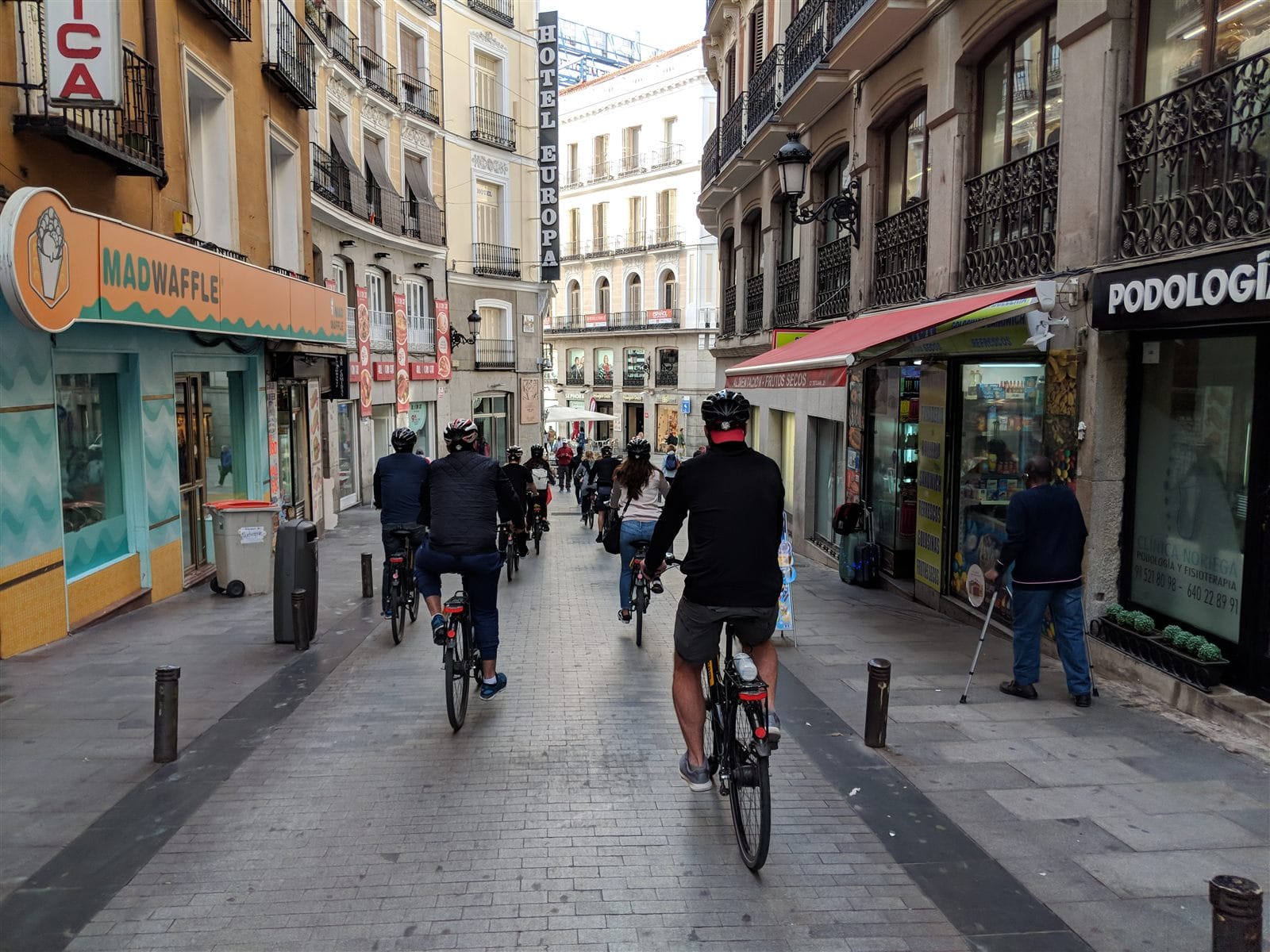
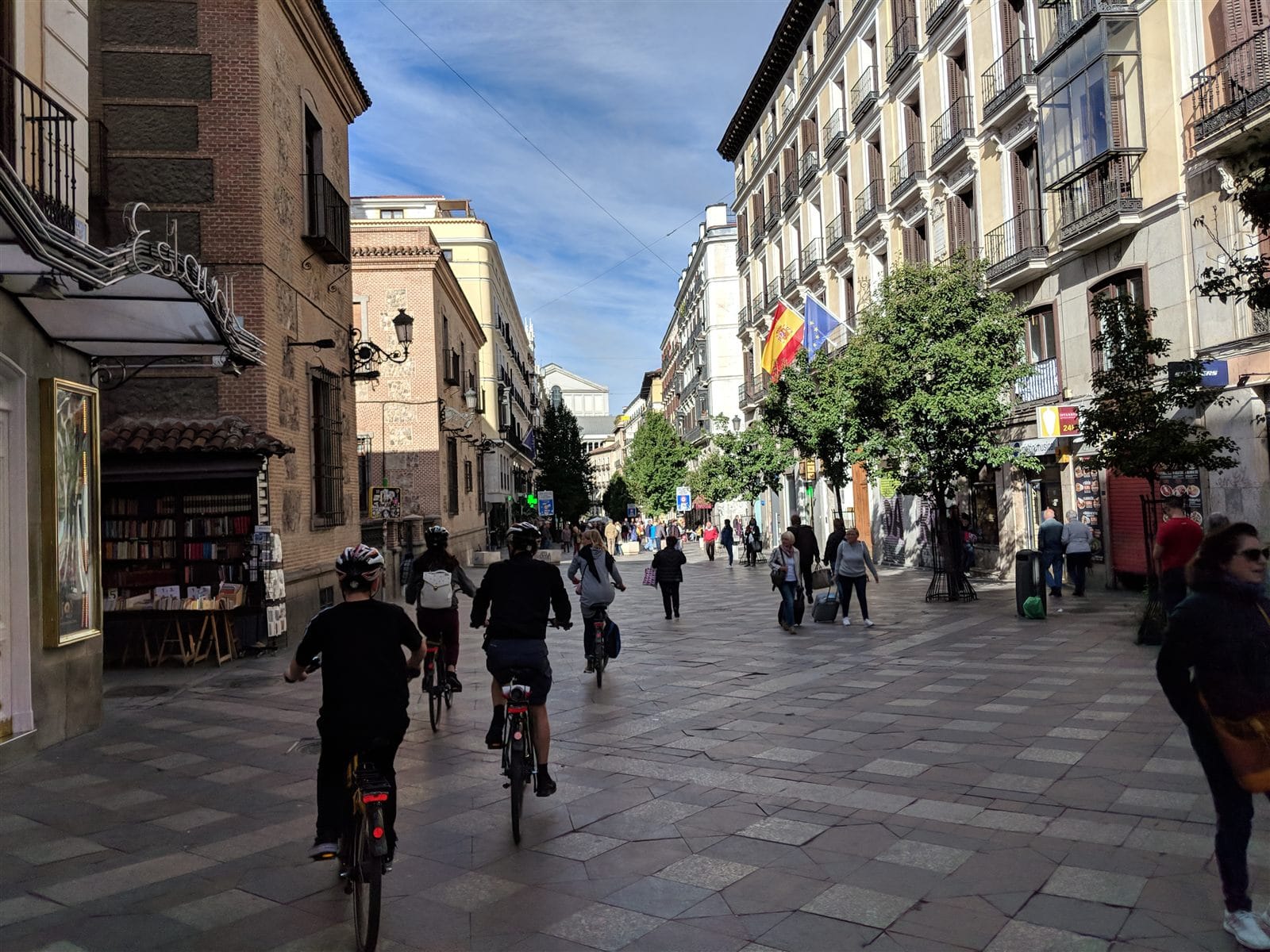
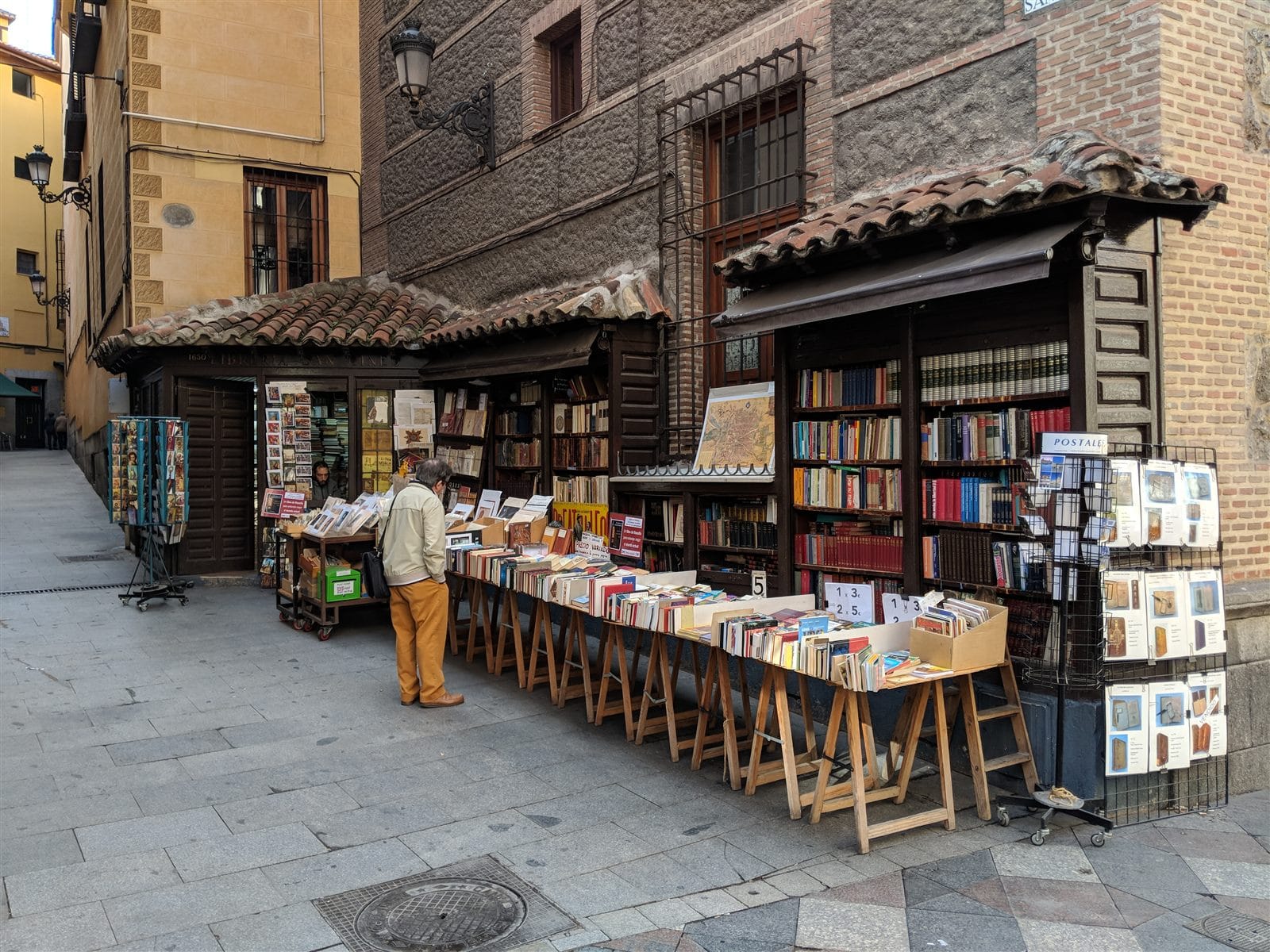
The route strung the city's landmarks together one after another. We rode toward the vast Royal Palace — once home to Spanish royalty and still used for state occasions — and pulled up beside the Almudena Cathedral next door, a building begun in the 1880s that wasn't finished and consecrated until 1993, more than a century later. Somewhere in the old town, church bells were ringing out over the rooftops as we rode past.
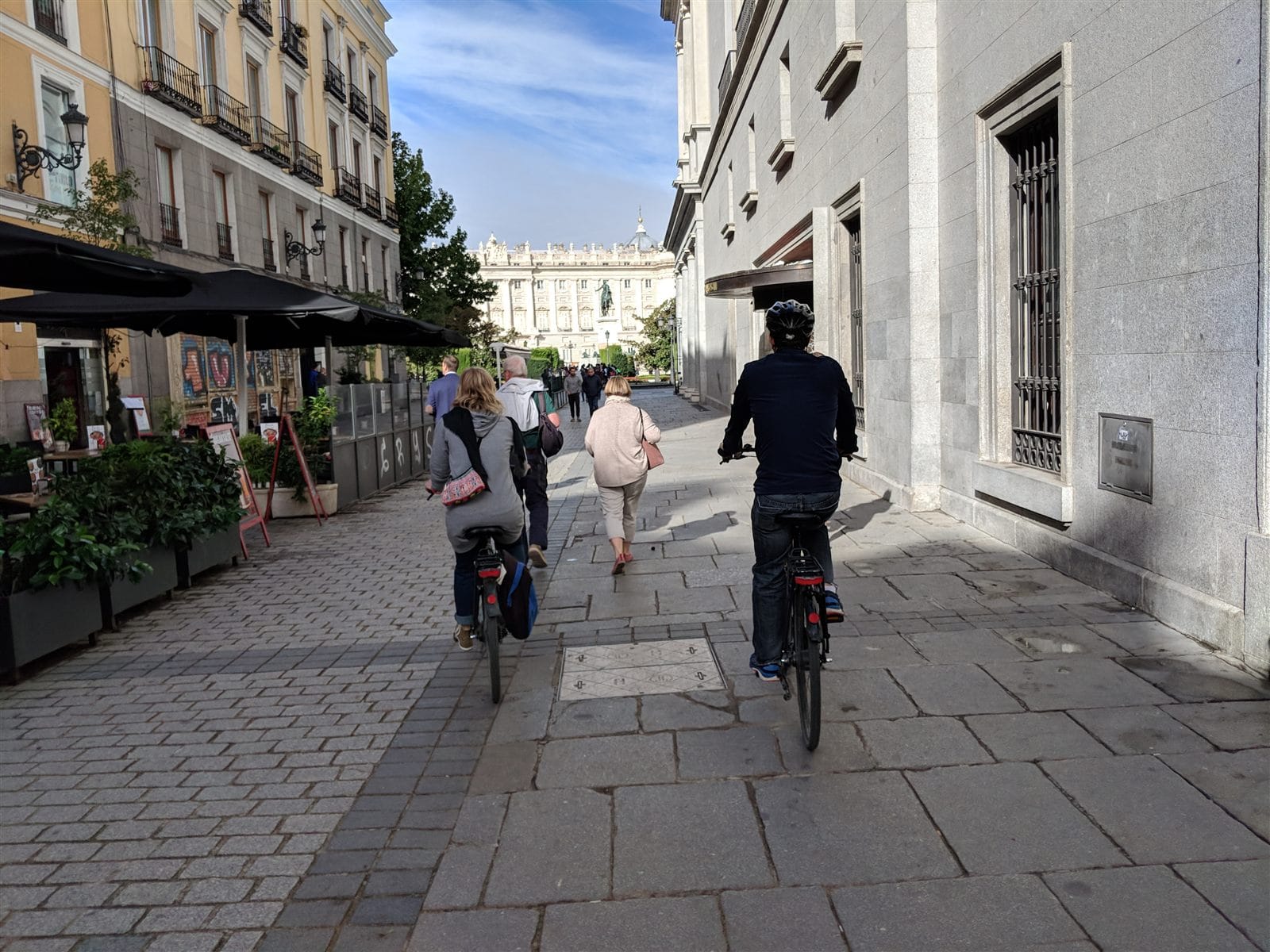
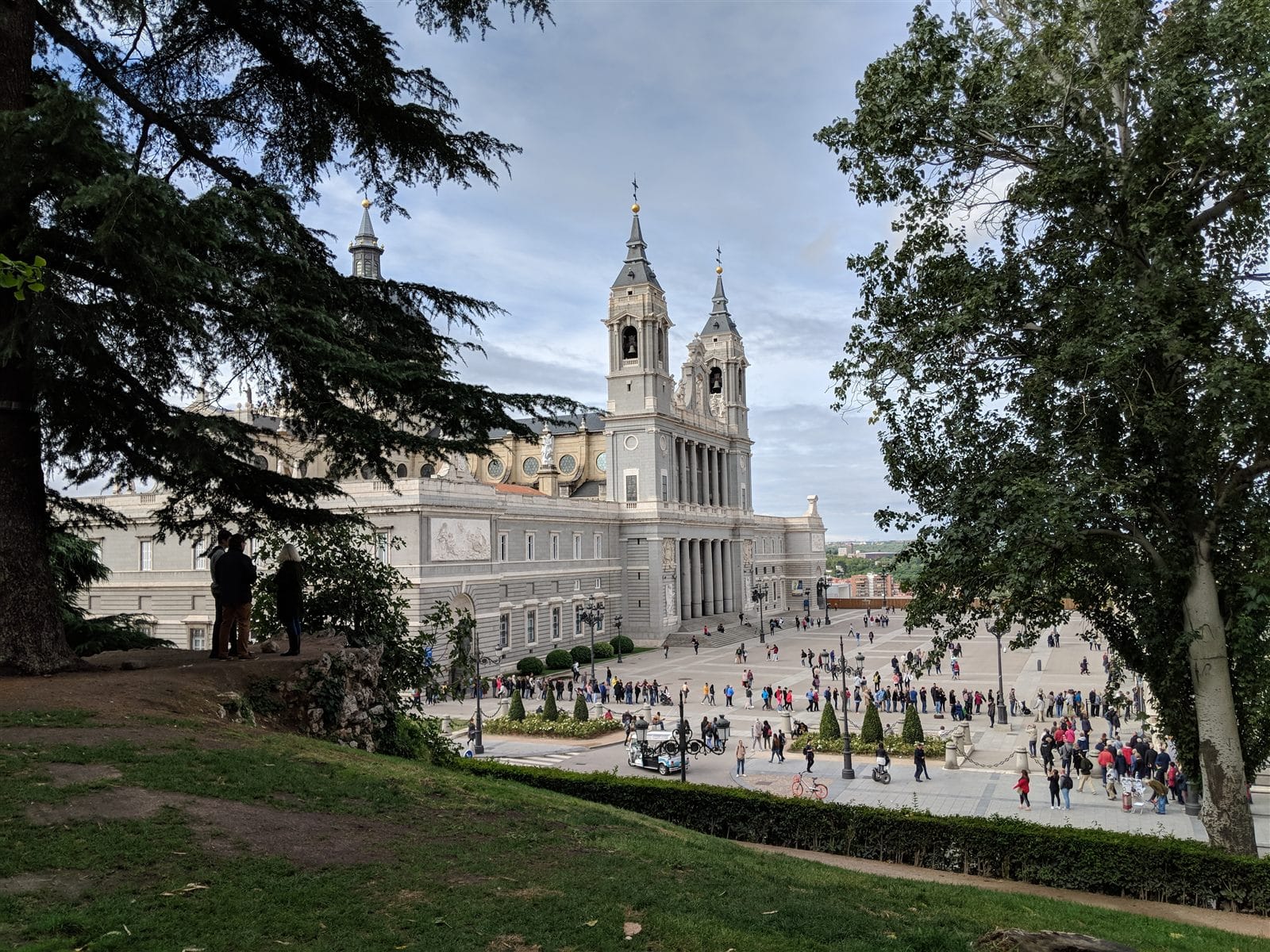
From there it was on to Plaza Mayor, the grand arcaded square laid out in the early 1600s under King Philip III, whose bronze statue still rides at its center. We parked the bikes along the edge and soaked it in.
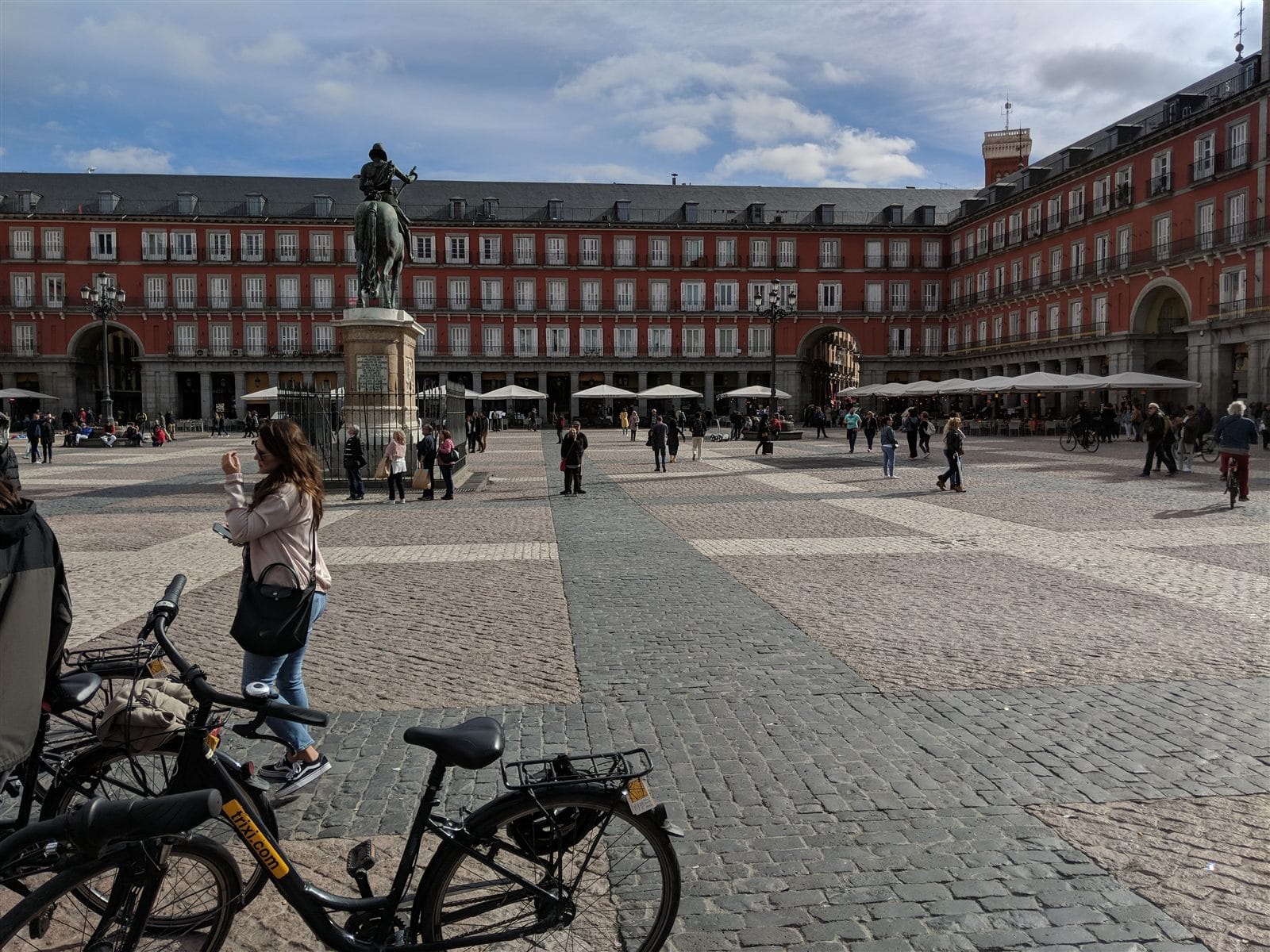
We pedaled east into El Retiro, the enormous park that was once royal grounds and is now the city's green heart, and rolled through its formal gardens of clipped hedges and fountains.
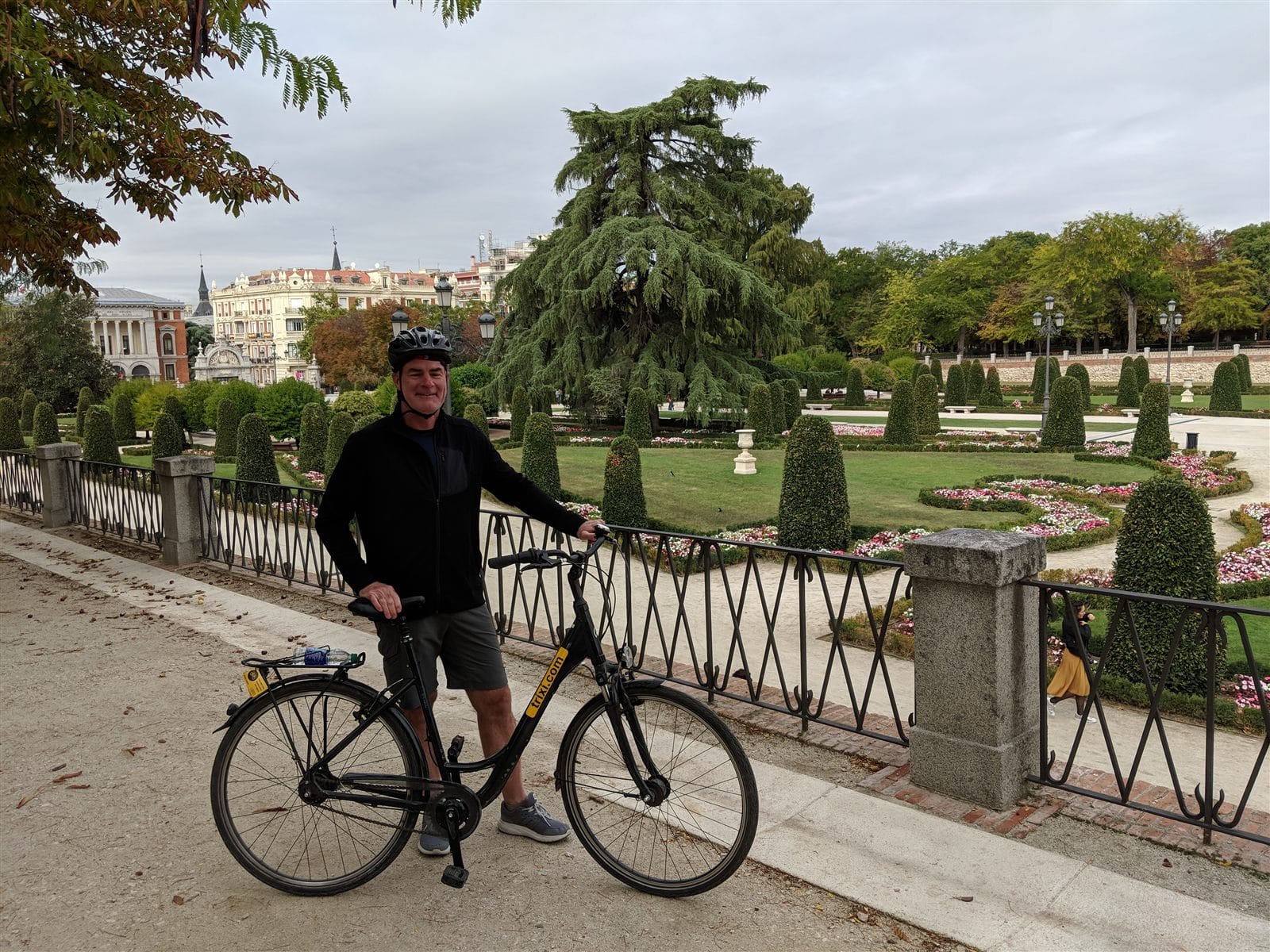
Just beyond stood the Puerta de Alcalá, the neoclassical stone gateway finished in 1778 for King Charles III — one of Madrid's defining monuments, and older than the Arc de Triomphe in Paris.
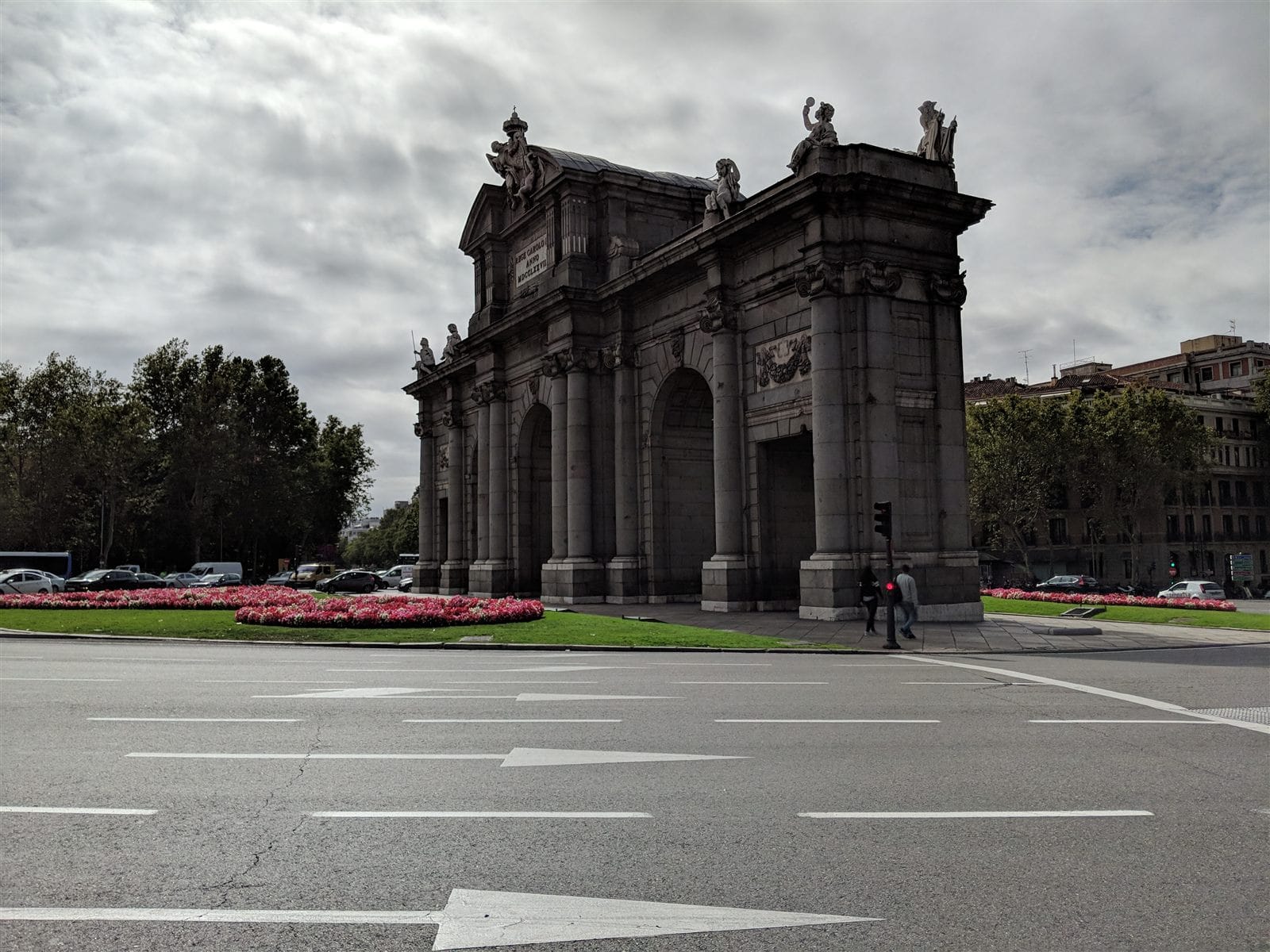
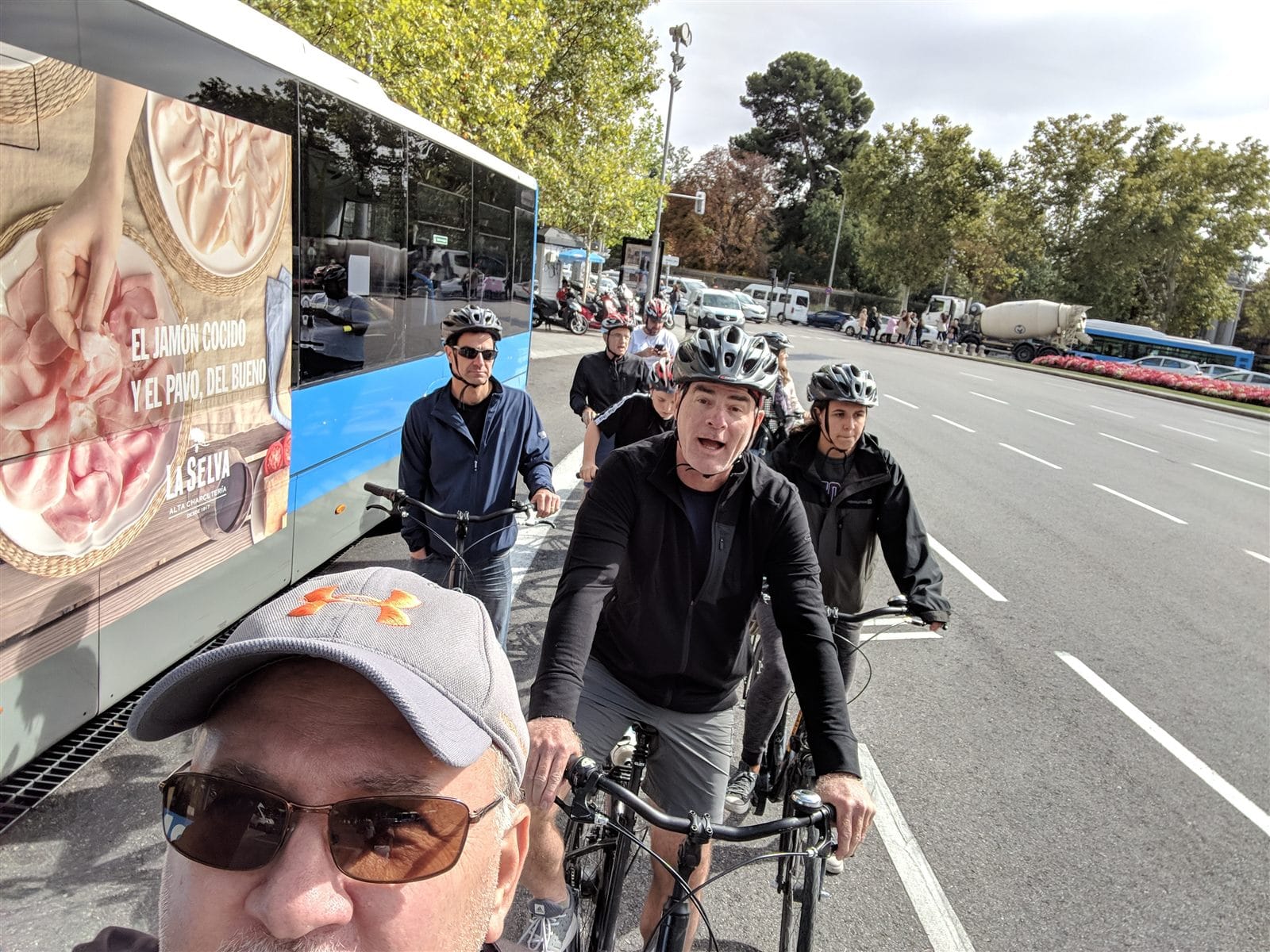
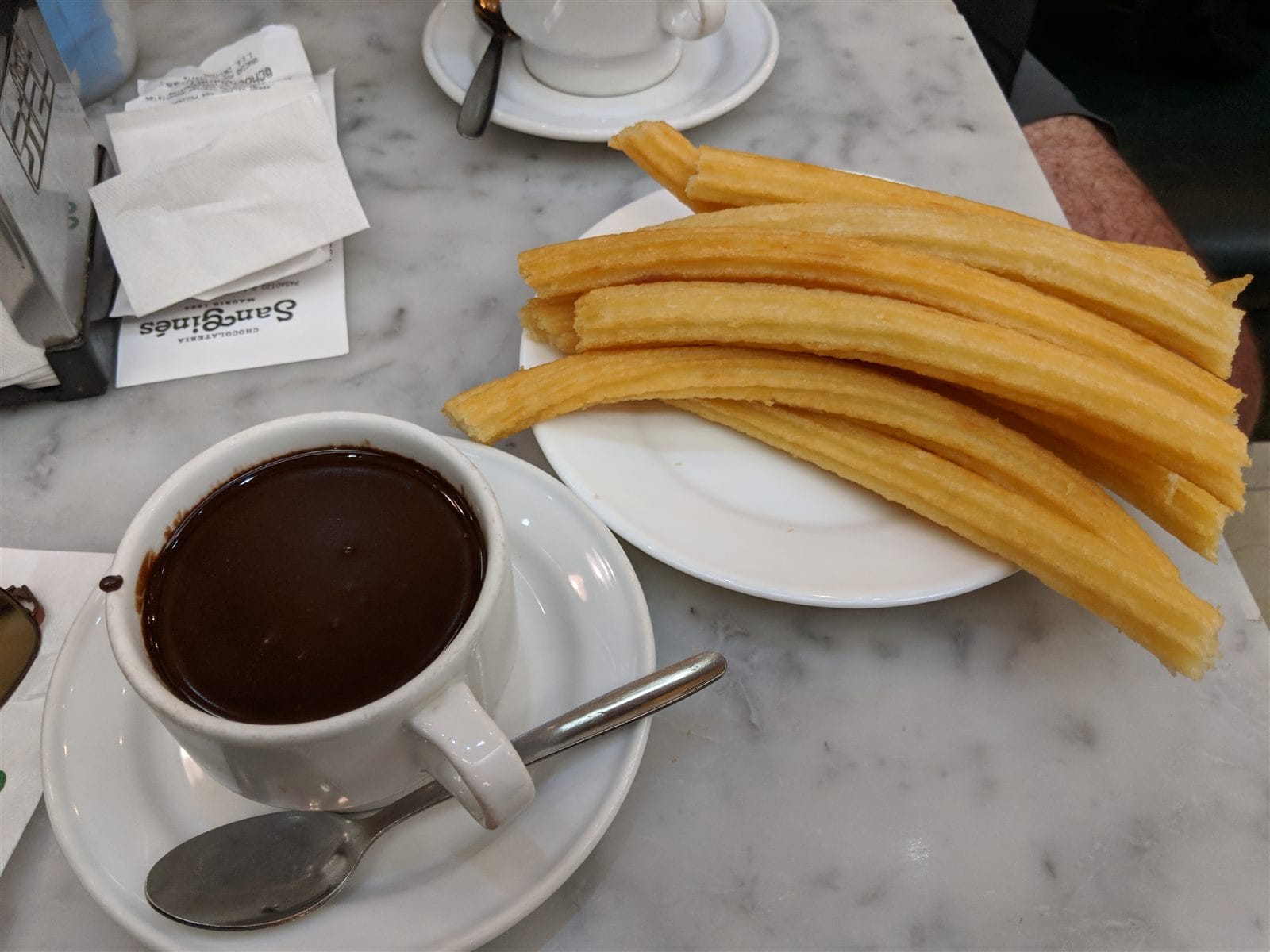
The tour wound down with churros con chocolate at Chocolatería San Ginés, a Madrid institution that's been frying churros and pouring thick, pudding-like hot chocolate since 1894. It's a beloved Spanish ritual — part breakfast, part late-night treat — and San Ginés is one of the most famous places in the country to have it, so when in Rome… er, Madrid: Doug and I shared a plate. I'll confess I didn't enjoy them quite as much as I'd expected — and I do like chocolate — but it was worth trying the classic at such a storied spot. (We split this one evenly, for the record — how Doug handles a snack "meant to be shared" becomes its own story later, on the train back to Madrid.)
With the tour done, we made our way to the airport for the short Ryanair hop up to Santiago. The check-in process was… less than efficient — it dragged on roughly five times longer than it had any right to, and by the time we were through, we were genuinely running for the gate. We made it, breathless, just in time.
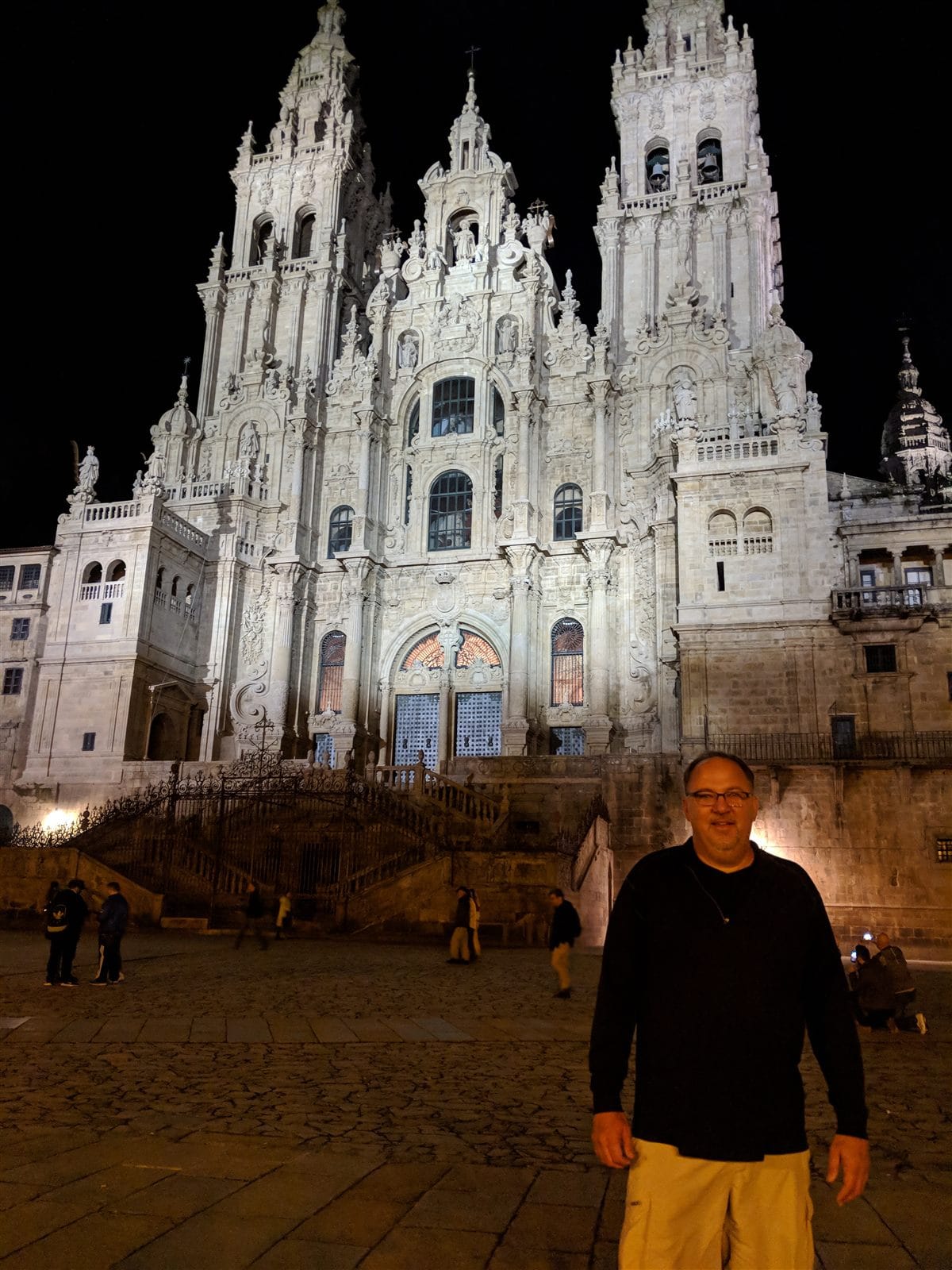
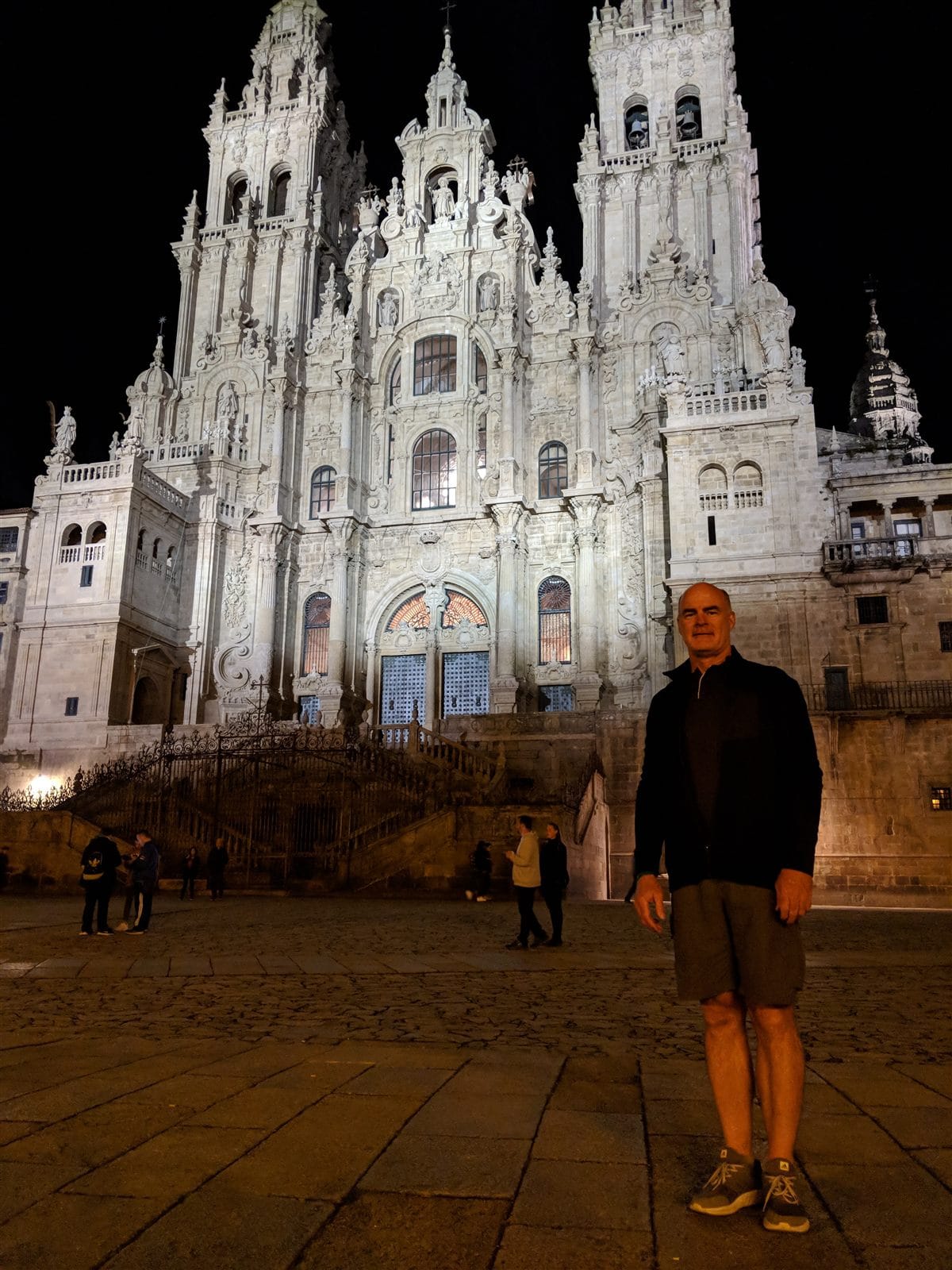
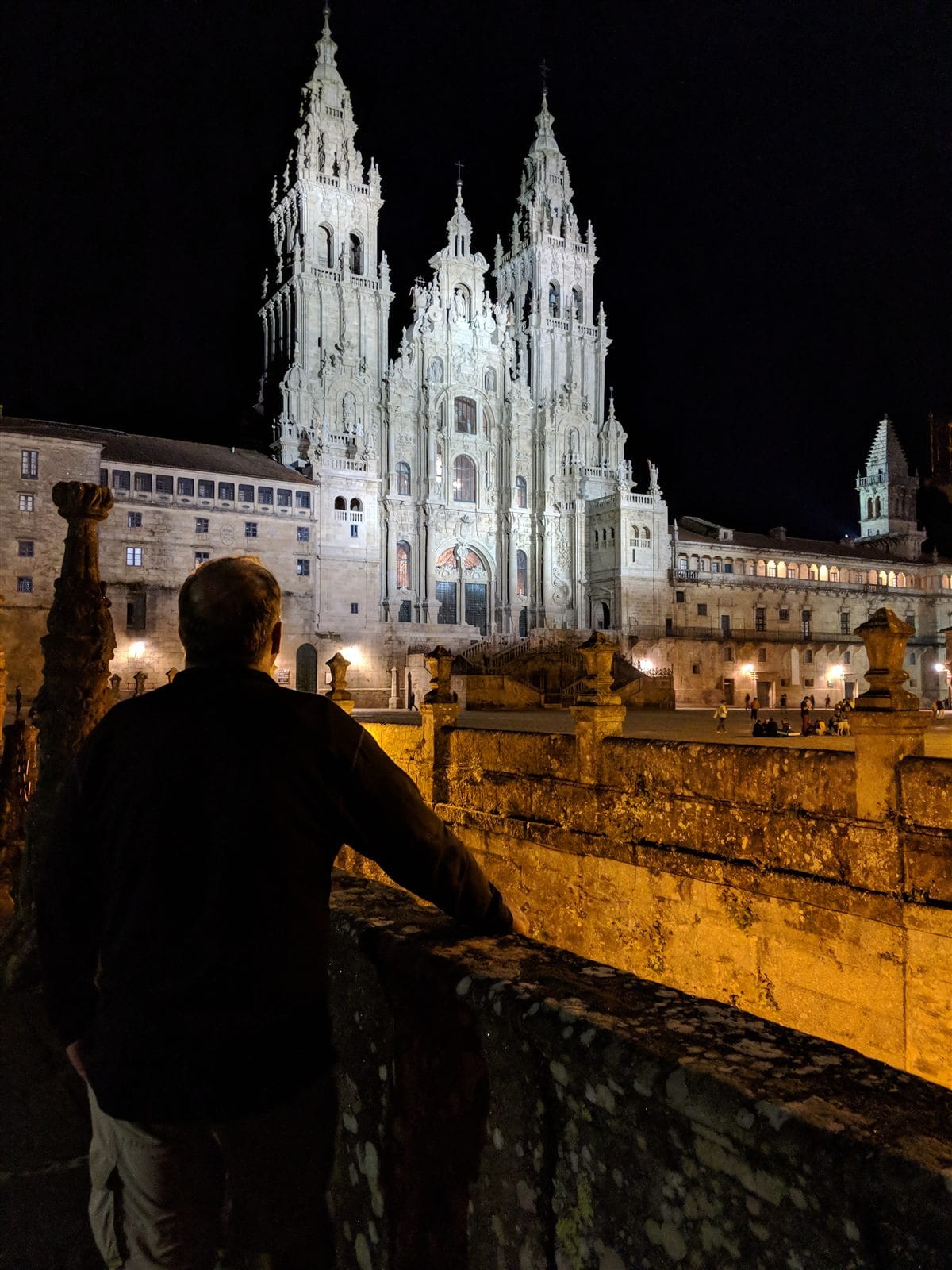
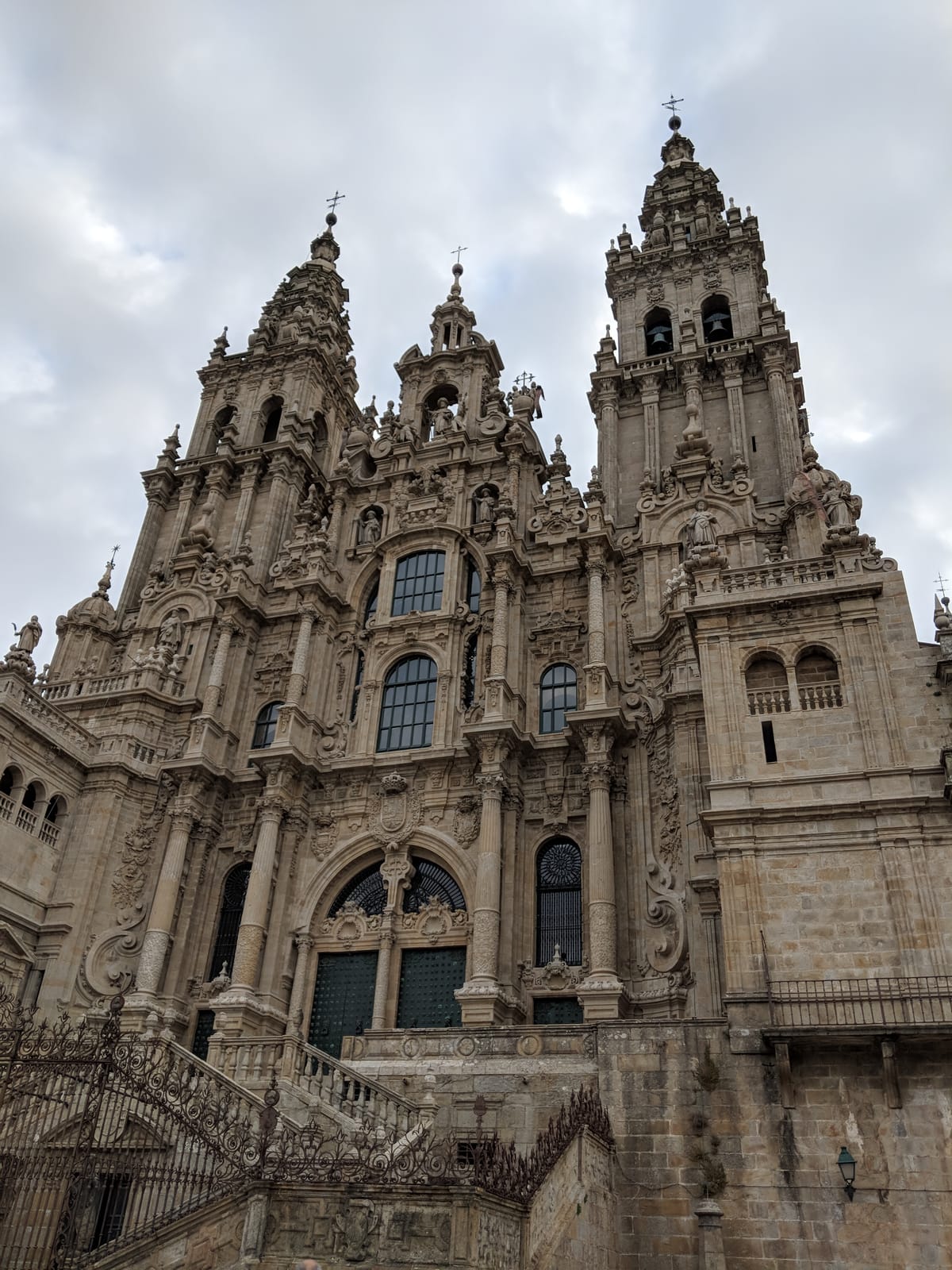
We landed in Santiago de Compostela that evening and went straight out to wander the city. The old town was nearly empty, its stone streets quiet under the lamplight, and the hush made the whole place feel magical. We found our way to the great cathedral — the very spot where, the next day, my mom would walk in and finish her Camino. Seeing it lit up against the night sky, knowing what tomorrow held, gave me chills.
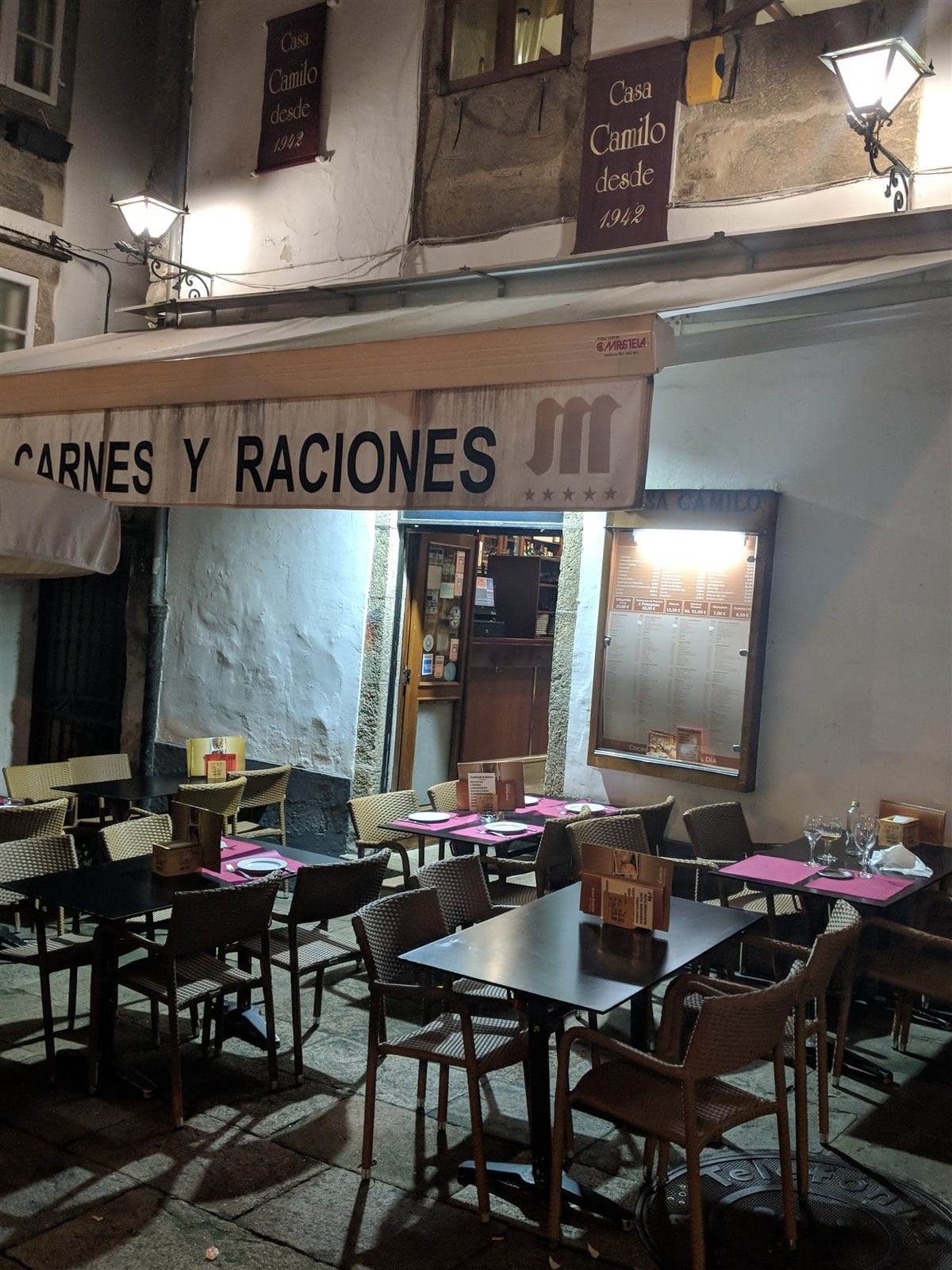
Dinner was unforgettable — an incredible fresh-fish feast at Casa Camilo, a Santiago institution since 1942. This corner of Galicia is famous for its seafood, and the restaurants here turn it into an art form, their windows lined with gleaming displays of fish and octopus on ice, almost too beautiful to eat. We ate well and walked it off through the silent streets.
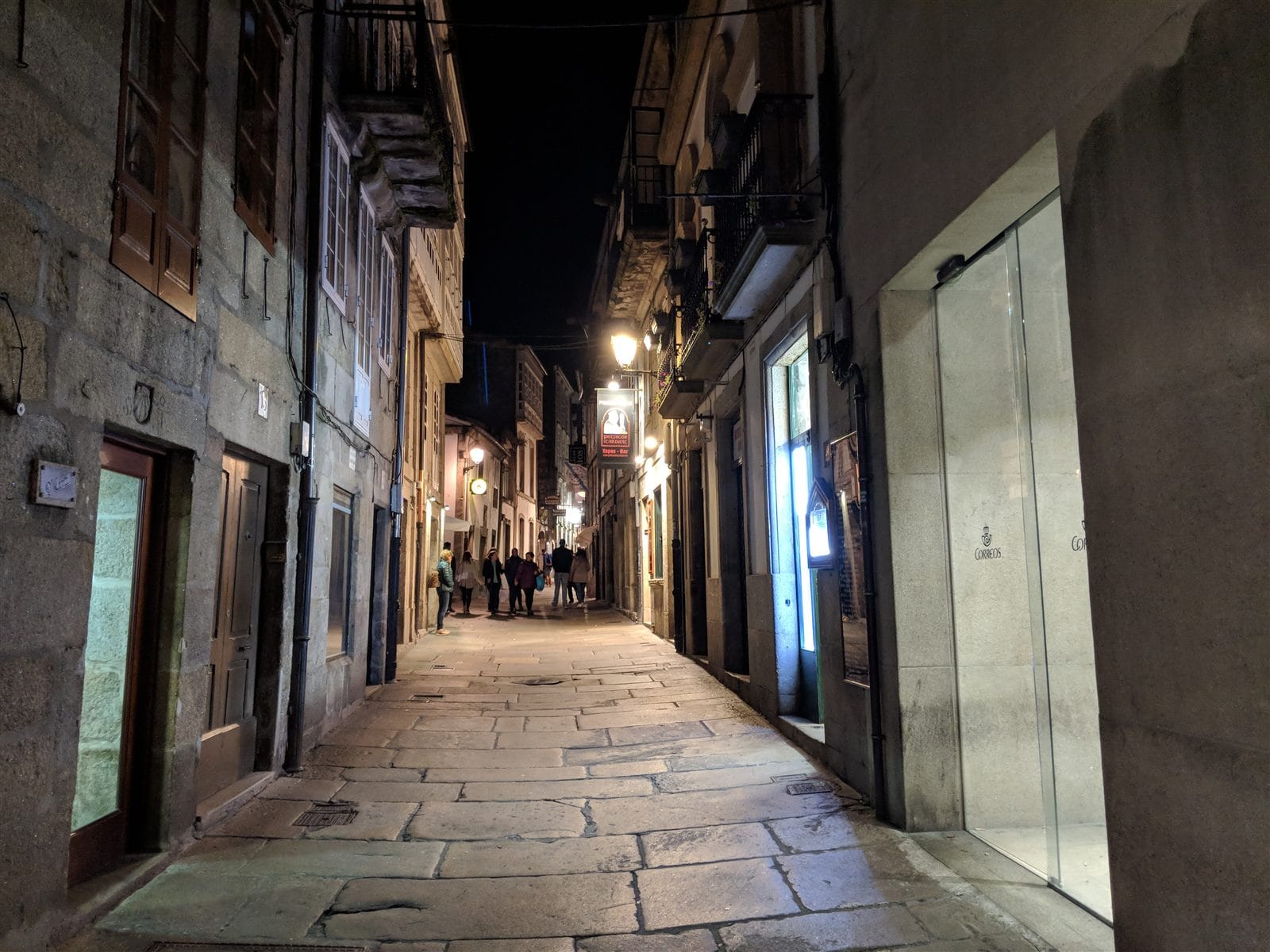
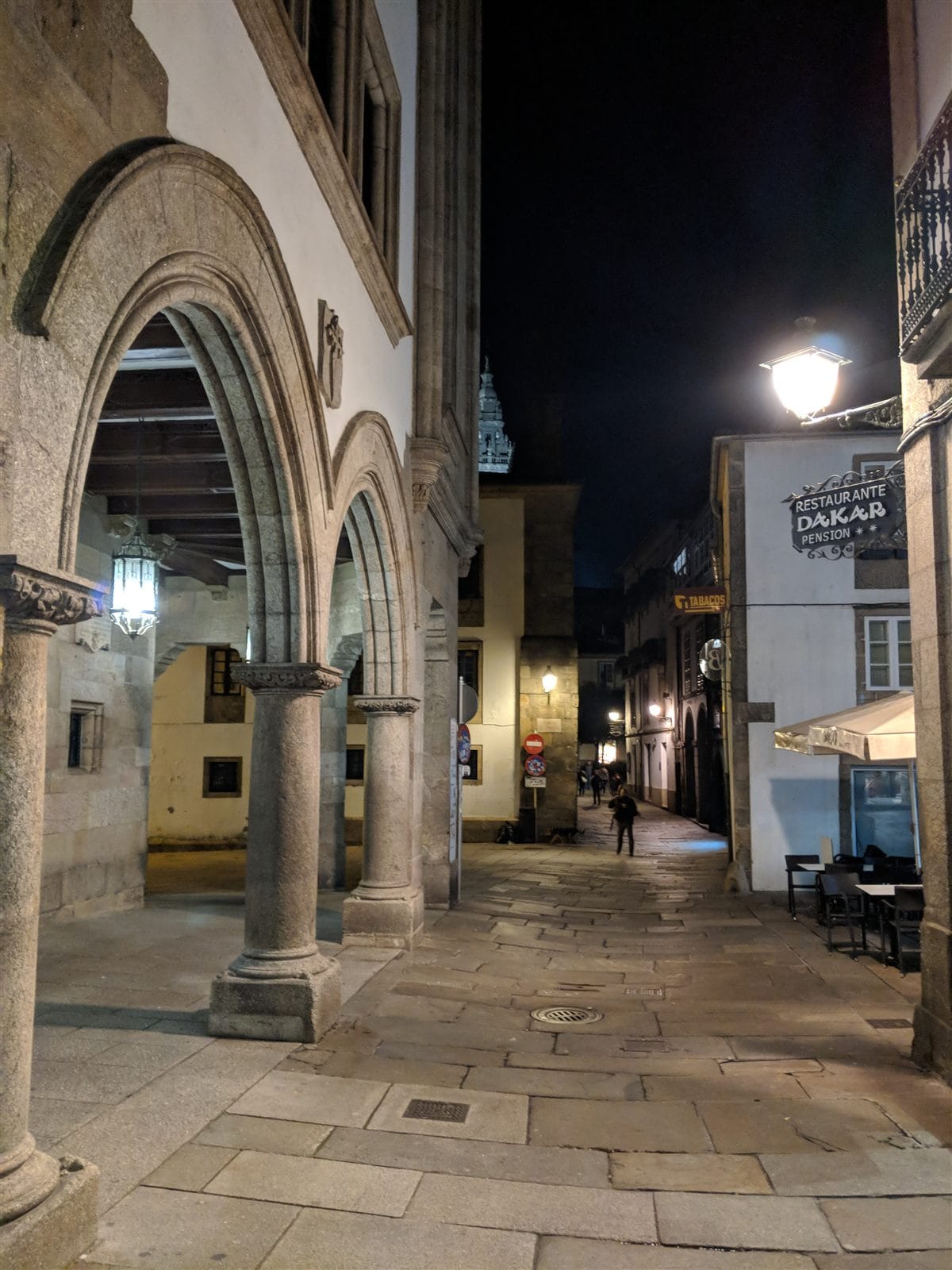
Before we turned in, I had one last check-in with my mom — and this time she could finally confirm it: she'd reach the cathedral the very next day, right on the timing she'd guessed back when we spoke during my layover. I asked her to call me the moment she arrived so I could congratulate her — which, of course, was all part of keeping the surprise: as far as she knew, I was back home waiting for that call. But now we knew exactly how it would play out. The next morning, we'd be walking out of Santiago just as she was walking toward it — and somewhere along the Camino, our paths would cross.
Walking out of Santiago to meet my mom at the end of her Camino — then back into the city together
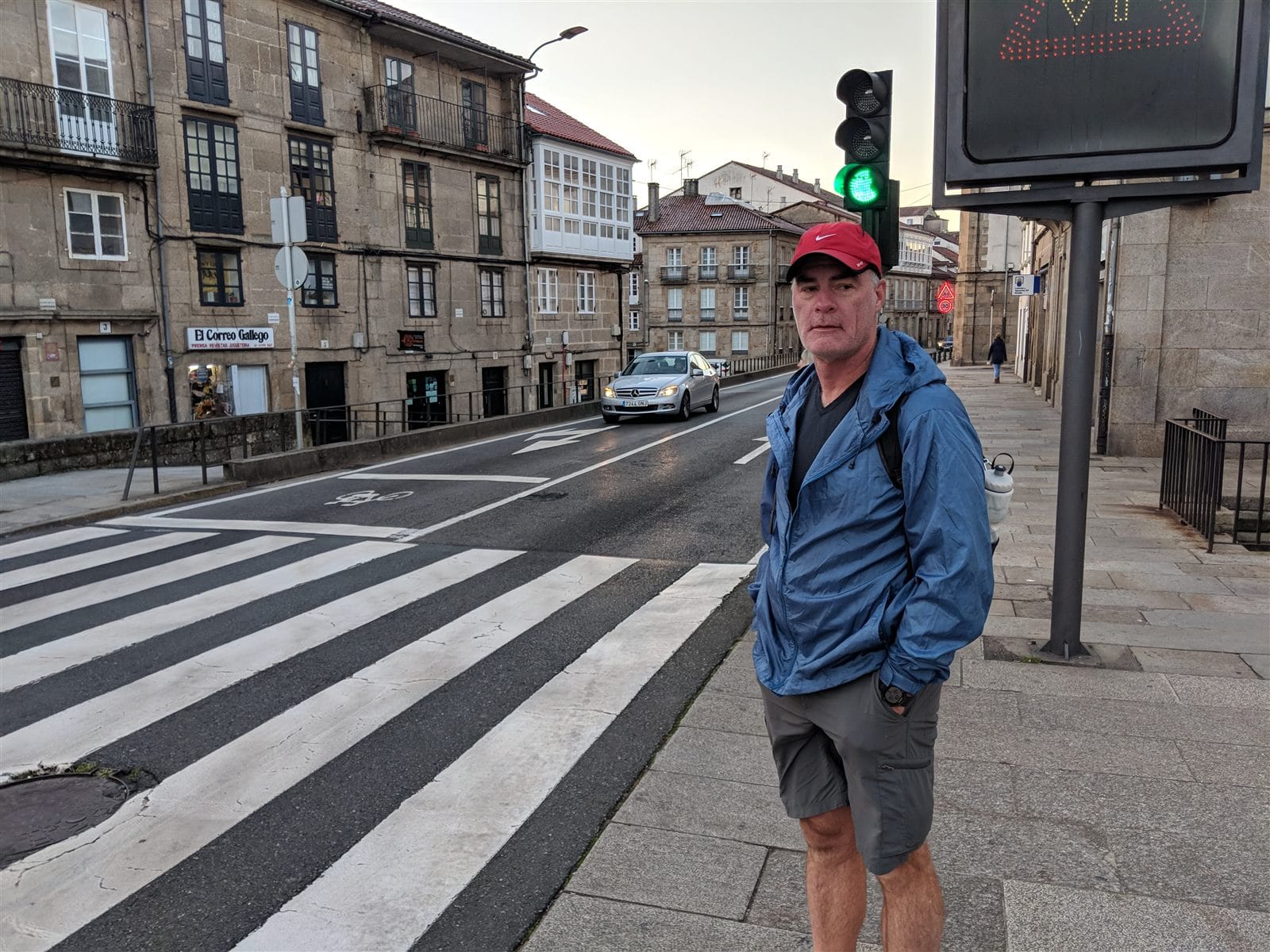
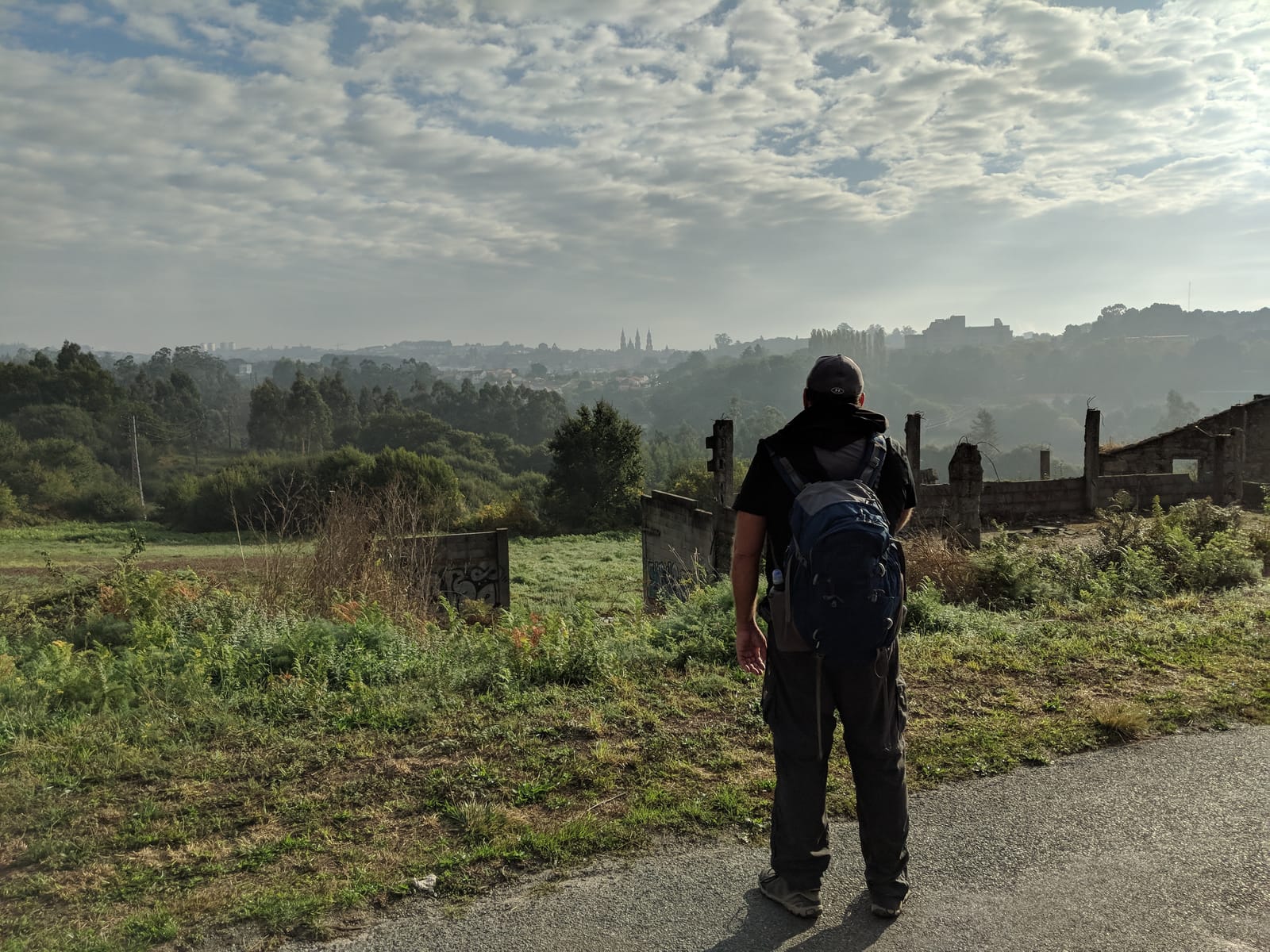
After breakfast at our hotel, Doug and I shouldered our packs and walked out of Santiago — away from the cathedral and back along the Camino. The plan was simple: walk the route in reverse until we ran into my mom coming the other way.
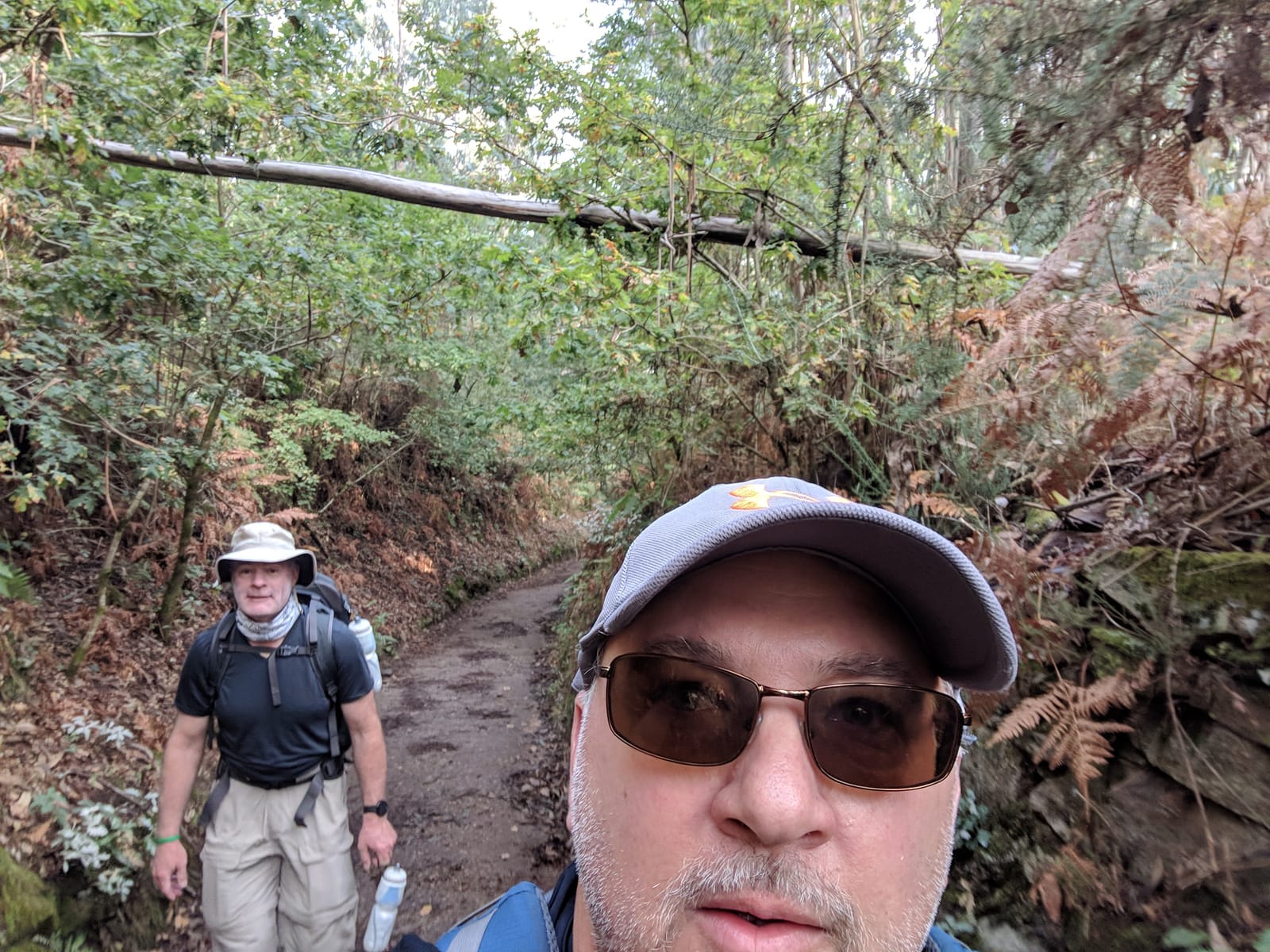
The farther we went, the more pilgrims we passed, all of them streaming toward the city at the end of their long journeys. We heard a dozen languages in the morning air, snippets of conversation from every corner of the world. And because we were the only two walking the wrong way, we drew some puzzled looks. More than a few people called out, helpfully, "You're going the wrong way!" At first we just answered, "We know." Later we started telling them we'd already walked the whole thing and were heading back to the start — which earned plenty of laughs, and maybe even impressed a few of them. 😄
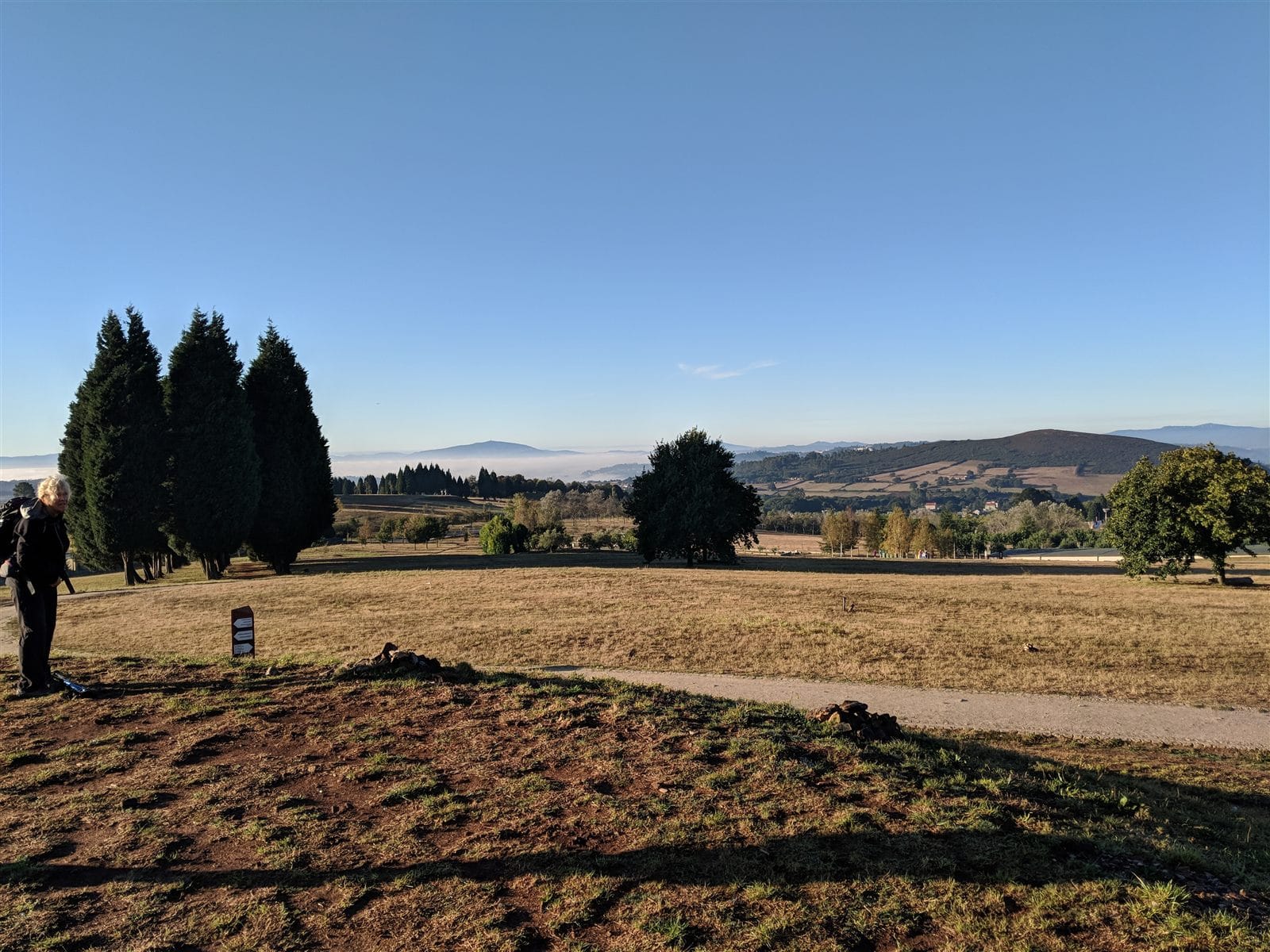
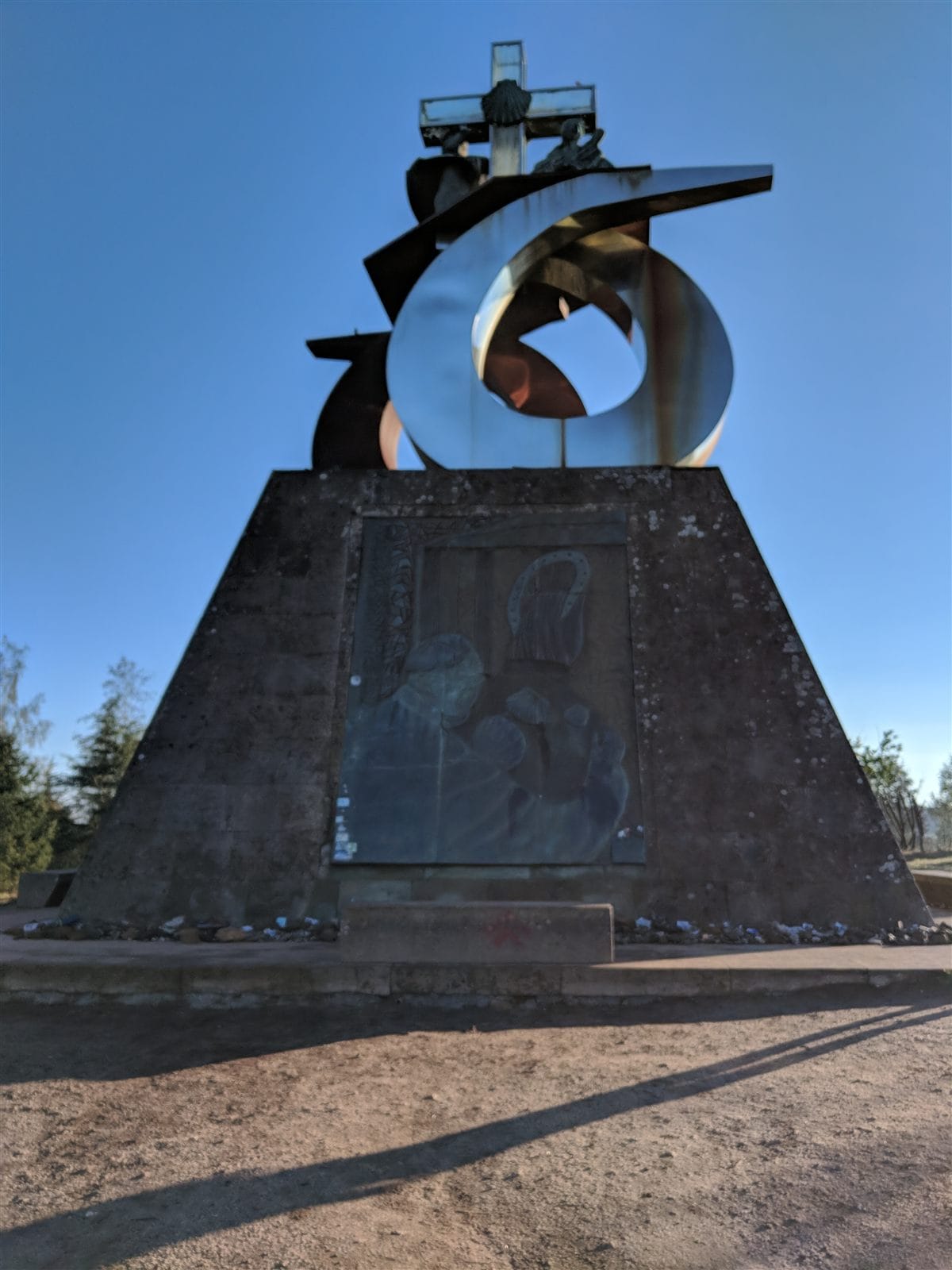
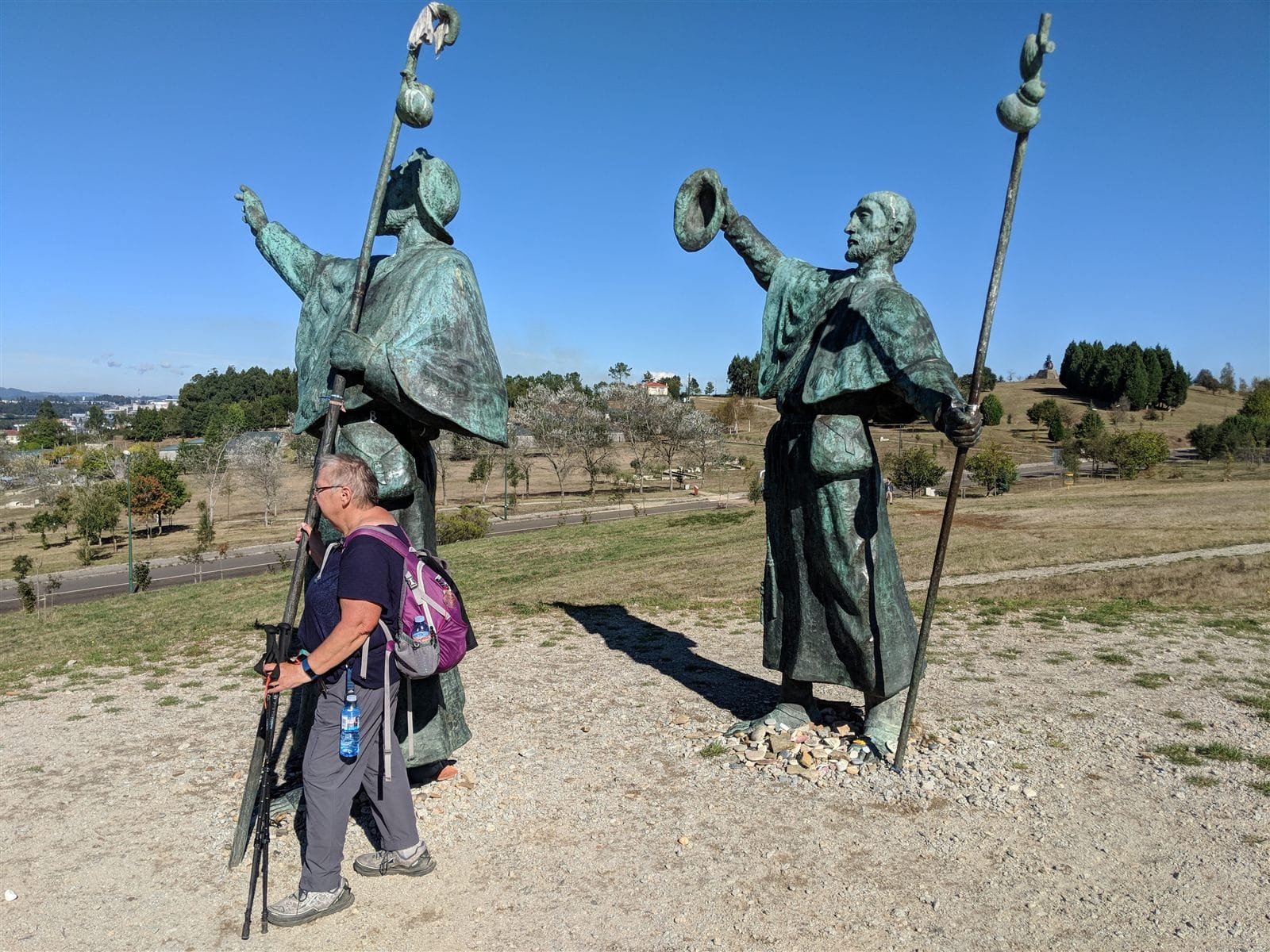
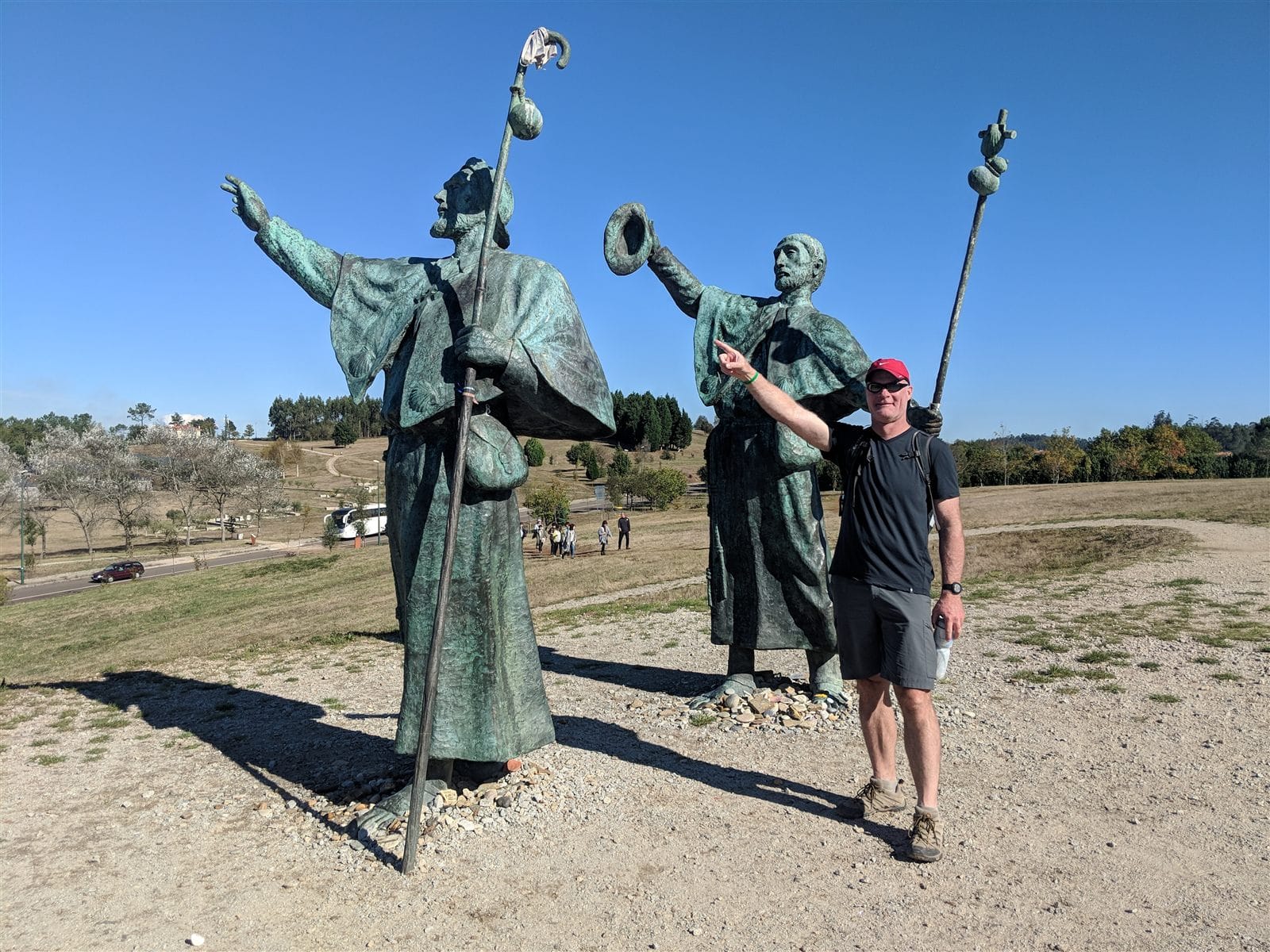
Not far out we passed the great monument at Monte do Gozo — the "Mount of Joy," the rise where pilgrims have traditionally caught their first glimpse of the cathedral spires. This one was built for Pope John Paul II's visit in 1989.
About five miles out of town, I ducked off the path for a bathroom break. As I did, Doug had a small panic: he'd met my mom once before, but didn't remember exactly what she looked like anymore. So I pulled up a photo on my phone, showed him, and — fingers crossed she hadn't already slipped by — we got back on the path.
We started walking again, came around a bend no more than two minutes later, and there she was. My mom looked up, startled, and said, "What are you doing here?!" I played it as cool as I could — "Oh, we were just out for a walk… crazy running into you out here" — as if bumping into your mother on a path in northwestern Spain were the most ordinary thing in the world.
Then we hugged, and the act fell away. She told me how, just moments before, she'd been walking with a fellow pilgrim — a fellow walker on the Camino — and talking about me. She'd been saying how much her son would love all of this, never imagining I was about to come around the next corner.
Doug had offered to video the whole thing, but the moment happened so fast and with so much genuine excitement that we didn't hit record. By the time we realized we should be filming, the initial embrace and first reactions were already over. And as we started walking back toward Santiago together, my phone had ended up buried in my pocket. That's when Doug thought the camera was off — but actually hit record. So we ended up with audio only, no video. In some ways, though, those initial reactions are worth way more than any staged re-enactment of the meeting would have been. I'm so glad we have them: the excitement in my mom's voice about her Camino journey, the joy of meeting her, and her stories about the fellow pilgrims she'd met along the way.
Mike: "Well, you remember Doug, right?"
Mom: "Yeah. Uh, yep."
Doug: "How you doing? Buen Camino." (Good Way)
Mom: "What a surprise. It was just like... Yeah, I was just talking about you because I just took some pictures with a guy from Canada and a guy from, uh, Chile, or, uh, no Brazil. And I've been walking on the route, and I haven't seen them and they both have shin splints. So I said, 'Oh, my son would love this,' and they just parted, and here you are. Well, uh, it's been an amazing journey."
Mike: "Yeah?"
Mom: "Let me tell you."
Mike: "Oh. I've always been enjoying your pictures. I... So I've had this planned since before you, when you... I booked my trip before you left."
Mom: "Really?"
Mike: "Oh. Yeah, I said something to Doug."
Mom: "And he dragged you along?"
Doug: "I wouldn't say dragged. I volunteered."
Mike: "Oh, he volunteered. He's like, 'Can I come? That sounds so cool.'"
Doug: "I'll be your cameraman."
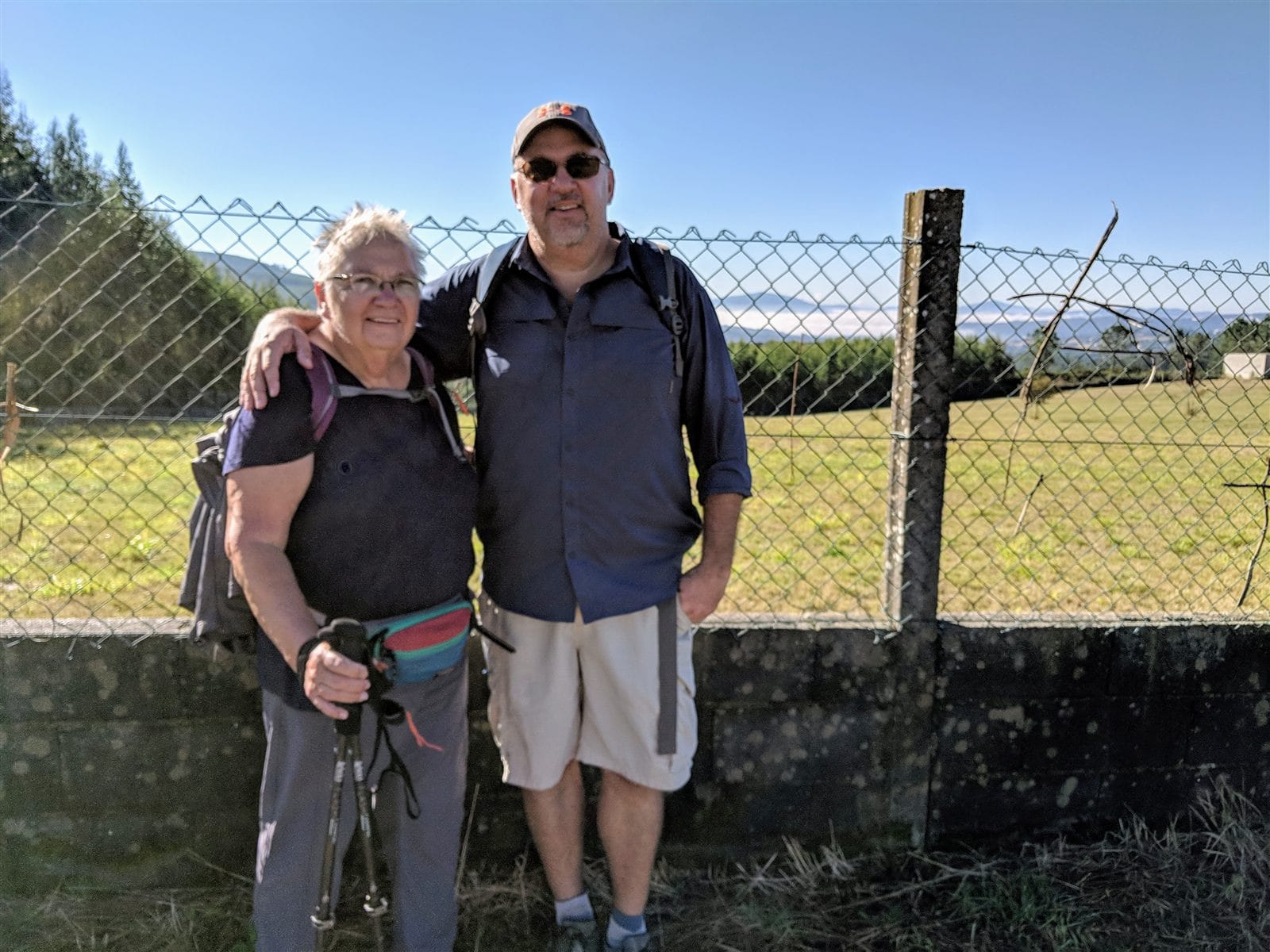
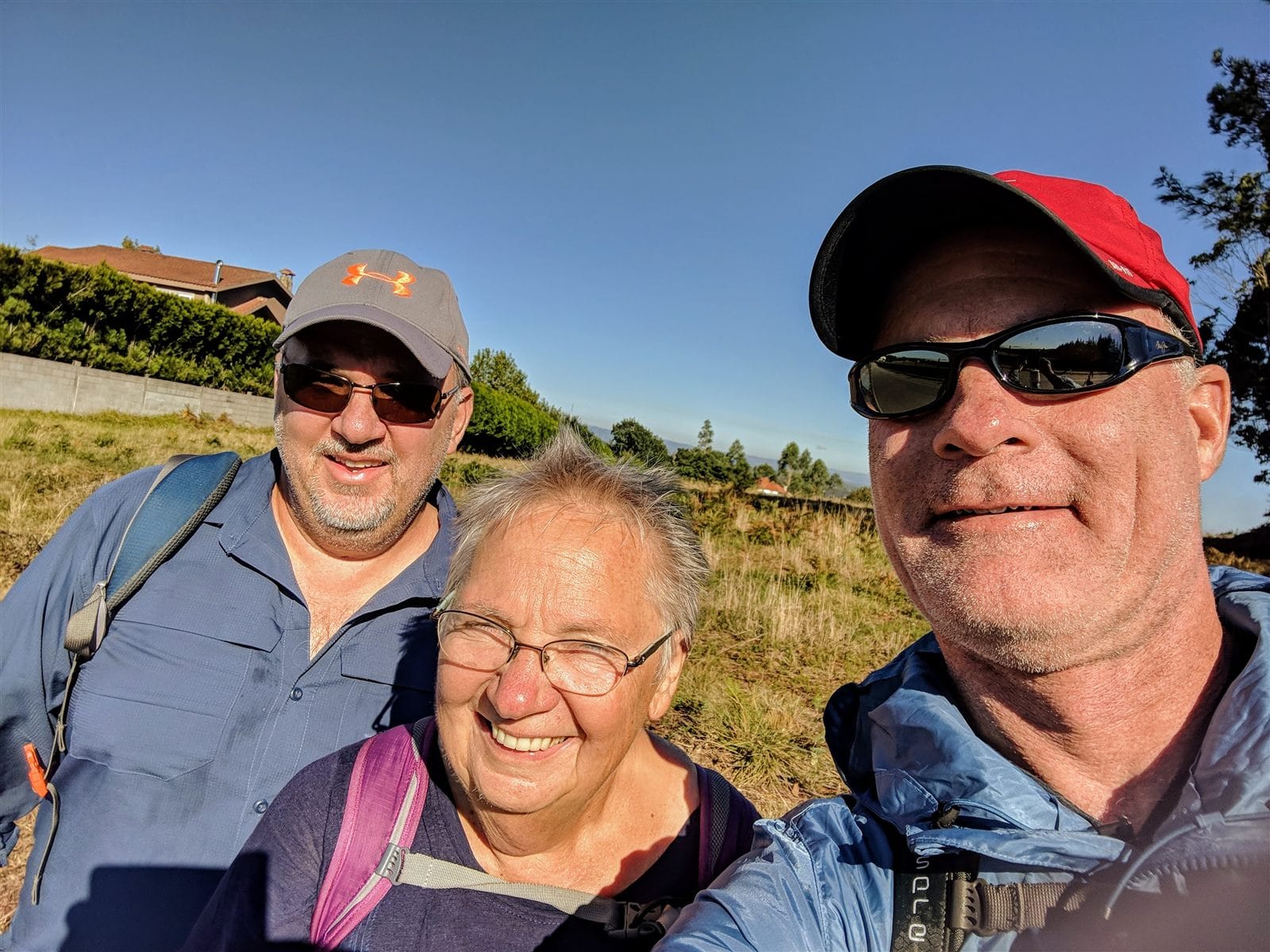
We turned around and walked back toward Santiago, the three of us side by side, stopping for photos as we went.
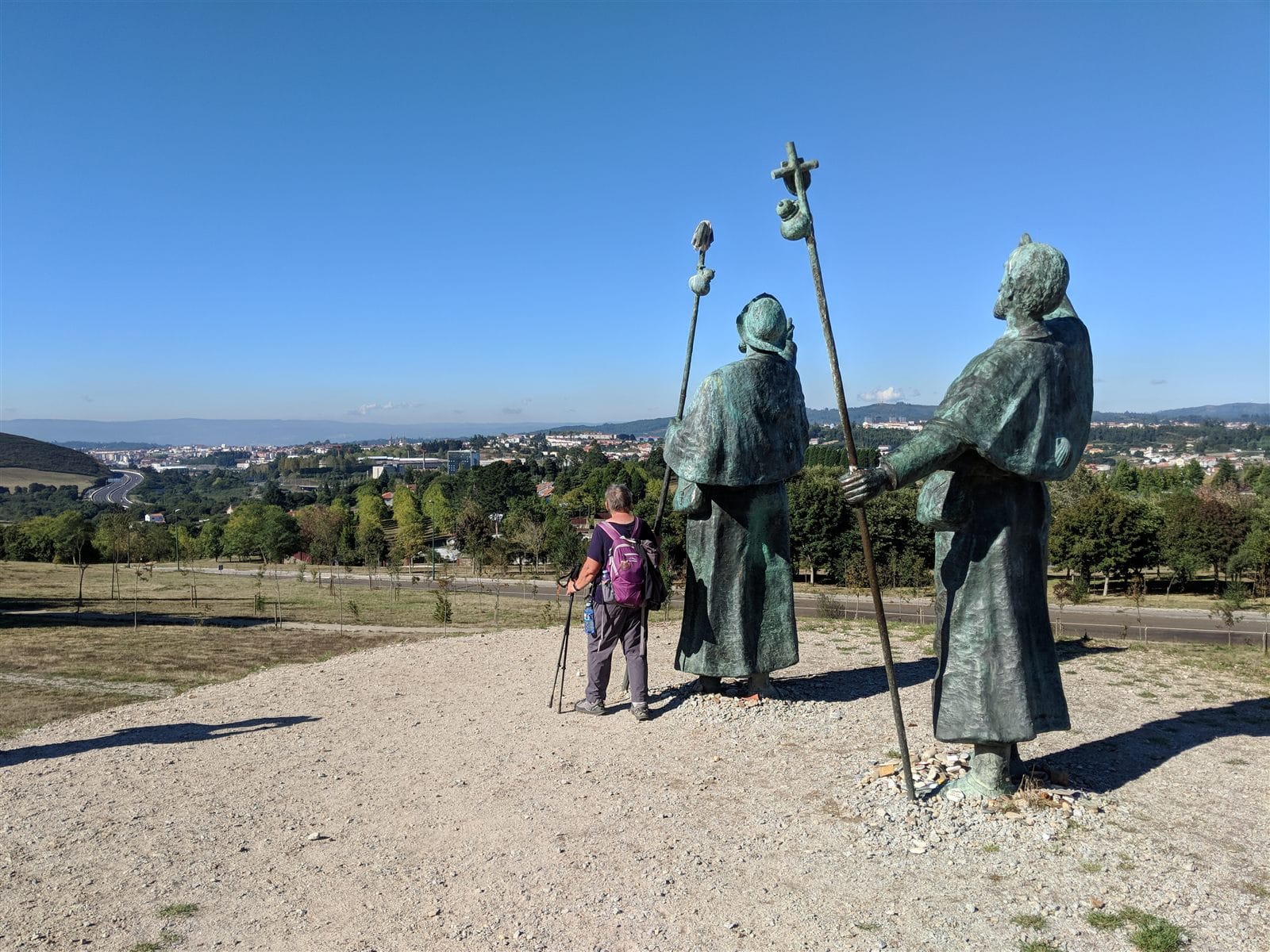
Back at Monte do Gozo, we stopped at the spot where two towering bronze pilgrims stand with their arms raised toward the distant cathedral — the very place where, for centuries, weary walkers have pointed and known they'd nearly made it.
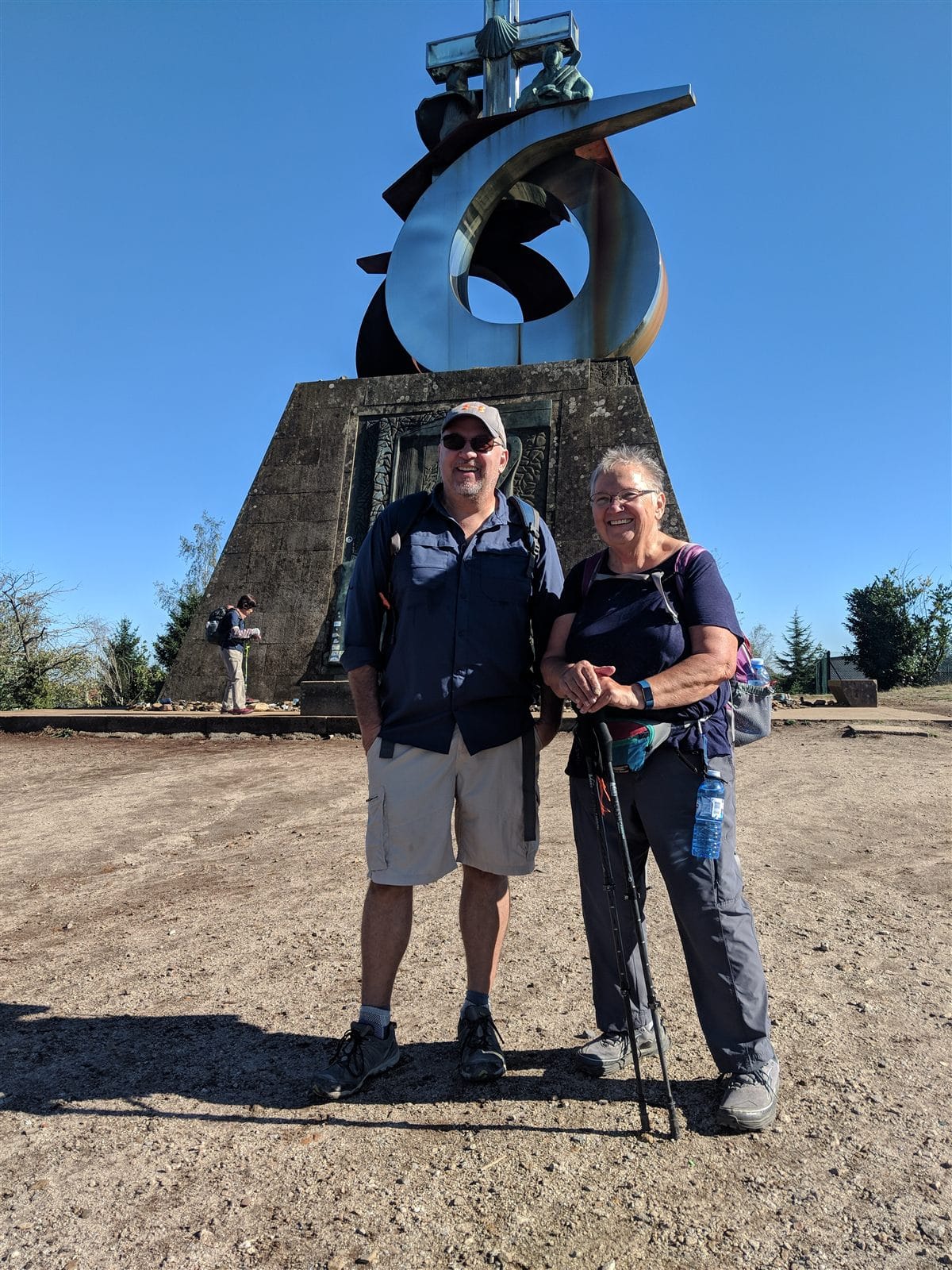
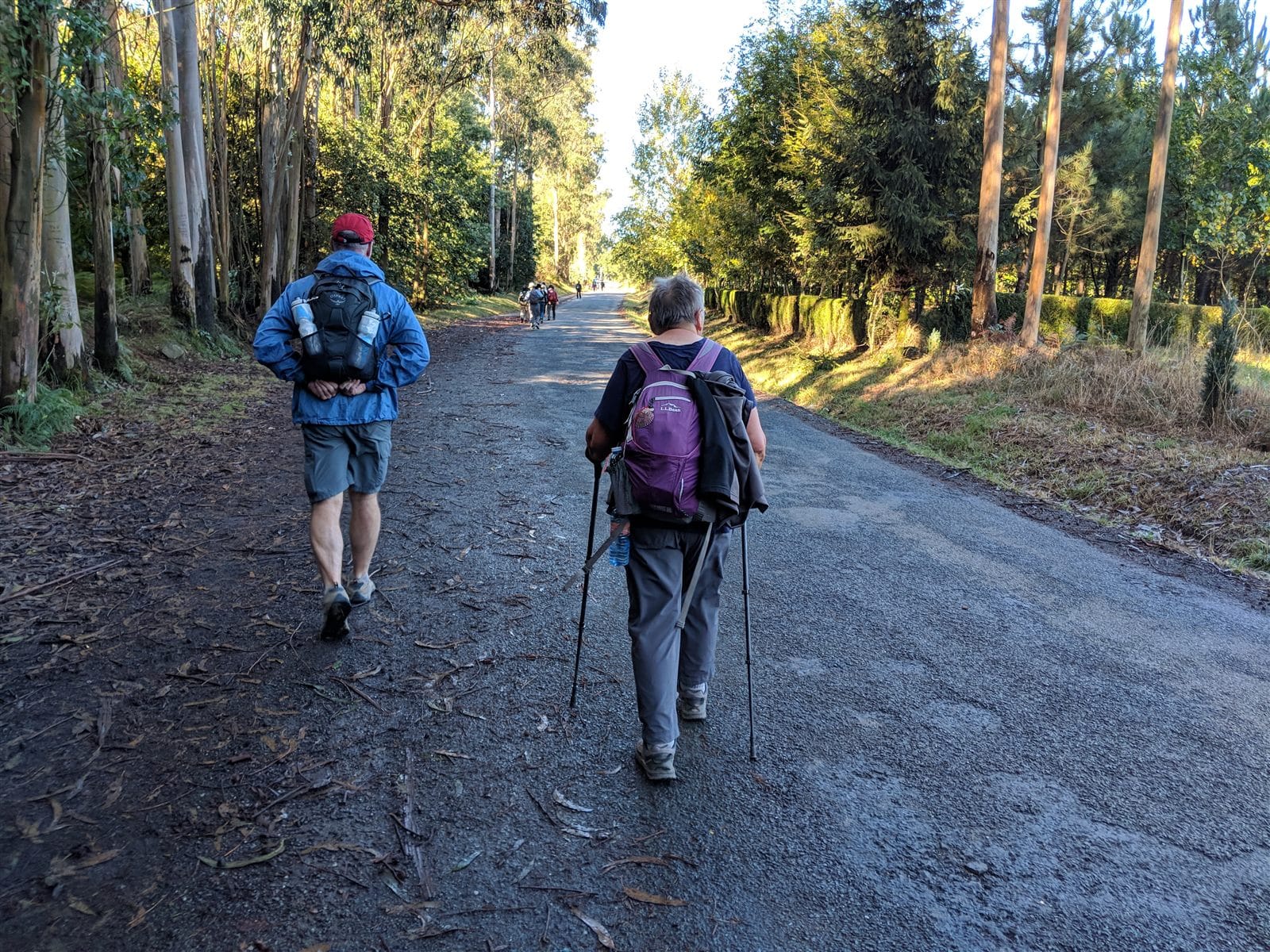
Somewhere along the way back, we crossed paths again with a fellow pilgrim my mom had befriended on her journey. She turned to him and said, in so many words, "Remember how I kept telling you my son would love this? Well — here he is." It was an emotional moment for all of us, that pilgrim included.
Together we walked the last stretch into the city, retracing the final yards of her Camino. I filmed her as she came into the Praza do Obradoiro — the great square in front of the cathedral — the moment she'd walked some 500 miles to reach.
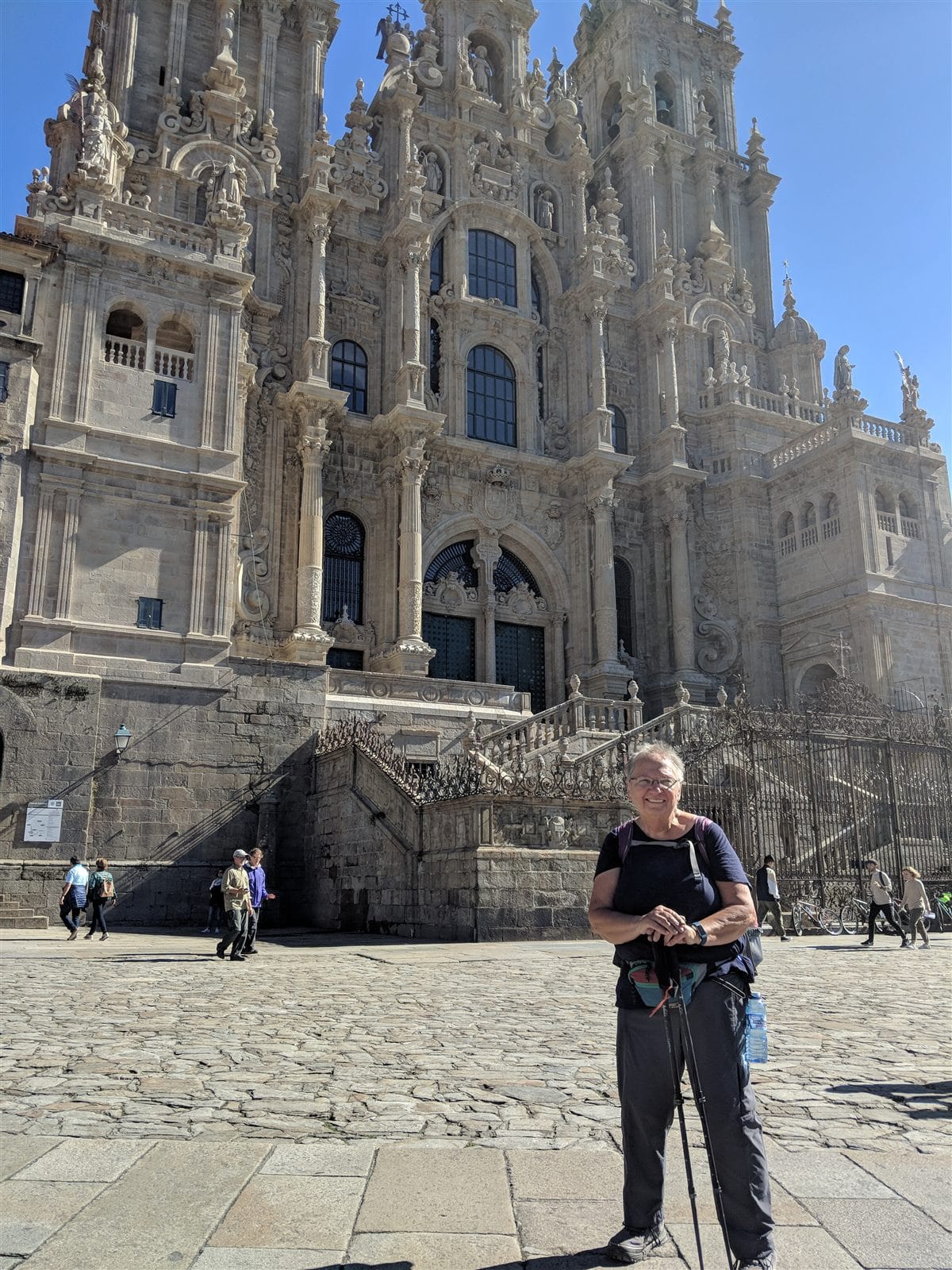
From there we went to the Pilgrim's Office (the Oficina del Peregrino), where my mom would receive her Compostela — the official certificate of completion. While she waited in line, Doug and I noticed a tourist information office right next door and ducked in to figure out what to do with the rest of our time in Spain. That's where the idea took hold: we'd keep walking — all the way to the coast, to the "end of the world," by way of Muxía.
Out and back from Santiago — about 12 miles round trip. Interactive map powered by OpenStreetMap.
That afternoon, with her Camino behind her, my mom hopped on a video call with my dad back home. They talked for a moment, and then she casually turned the phone — "look who's here" — and there I was, sitting right beside her in Santiago. It took him a few seconds to register what he was seeing, and then it clicked. We had a great chat, all three of us together across the miles. And it was right about then that my dad finally understood why I'd been too "busy" to make that family dinner the weekend I left — I'd been on my way to Spain the whole time.
That night we had a wonderful dinner with my mom and a friend who'd walked part of the Camino alongside her. What a day it had been. I was so proud of my mom — 500 miles, on her own two feet — and prouder still of who she'd become along the way. The Camino changed her, in so many good ways. What an accomplishment.
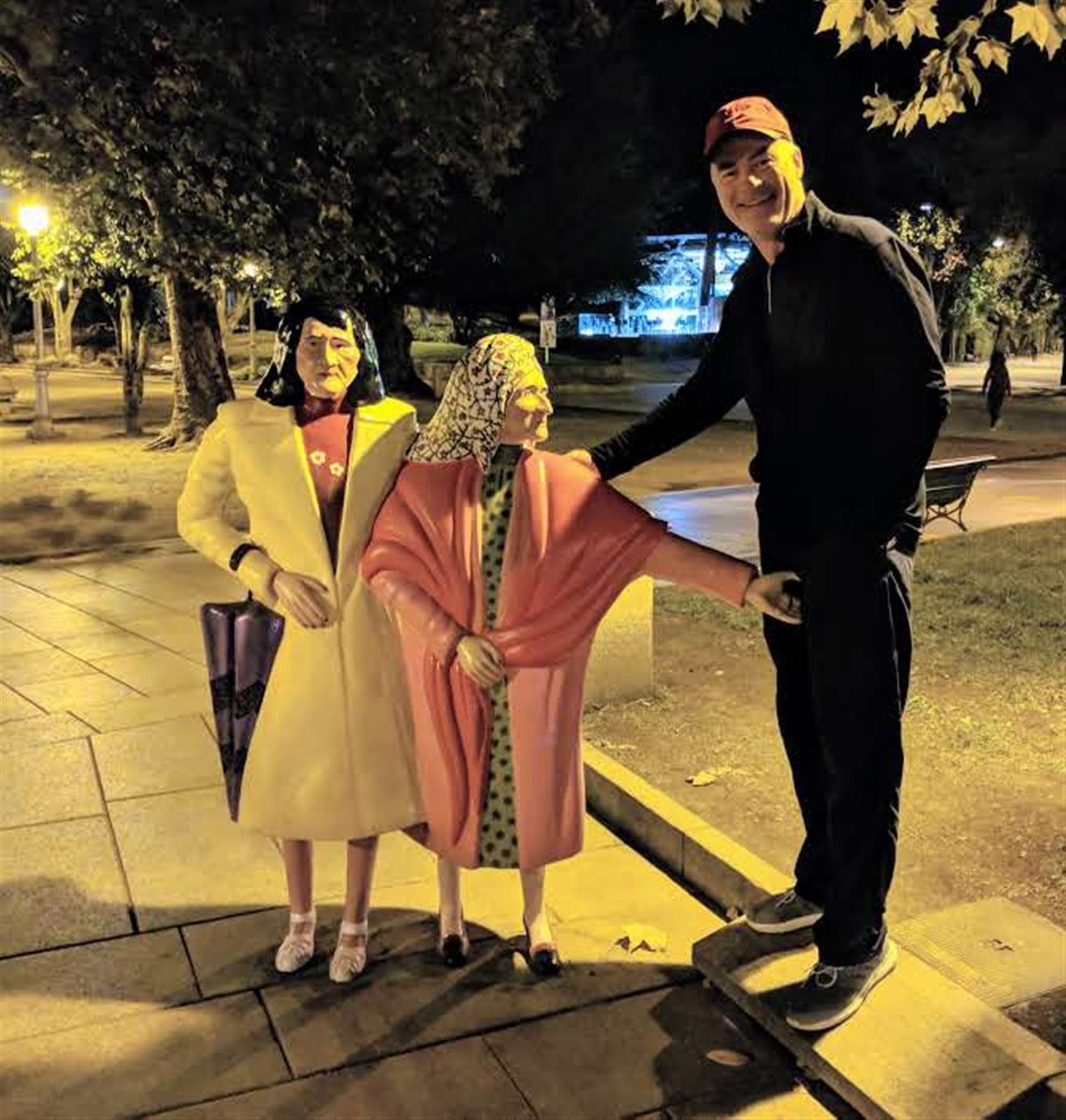
After dinner, Doug and I walked around Santiago and bumped into some local ladies who got to know Doug a bit better. LOL
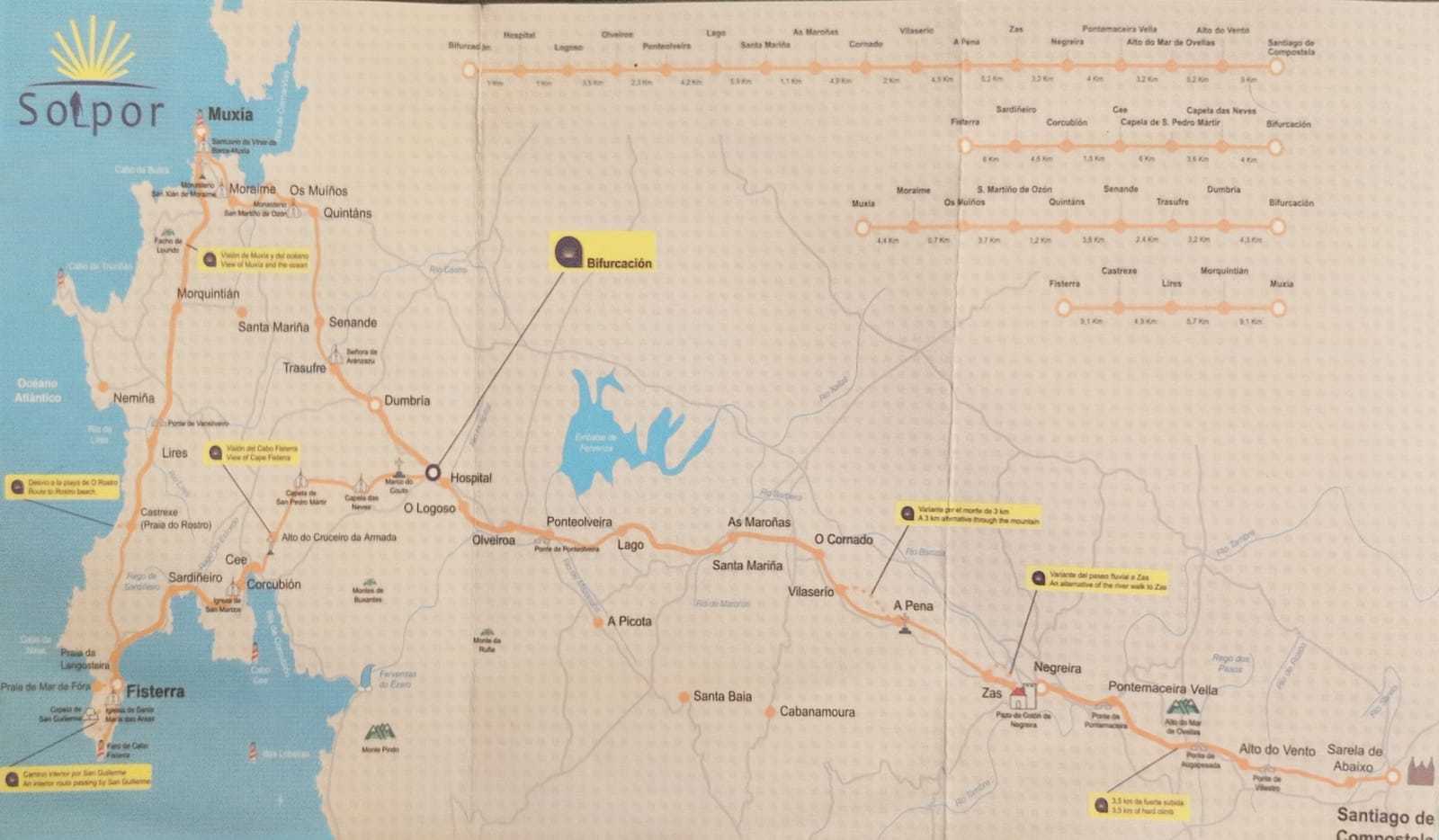
Each stage of our walk west from Santiago, one color per day — all the way out to Km 0 at Cabo Fisterra, the end of the world.
Out of Santiago on the Camino Finisterre · hórreos, Ponte Maceira & a light Galician drizzle · 13.37 mi
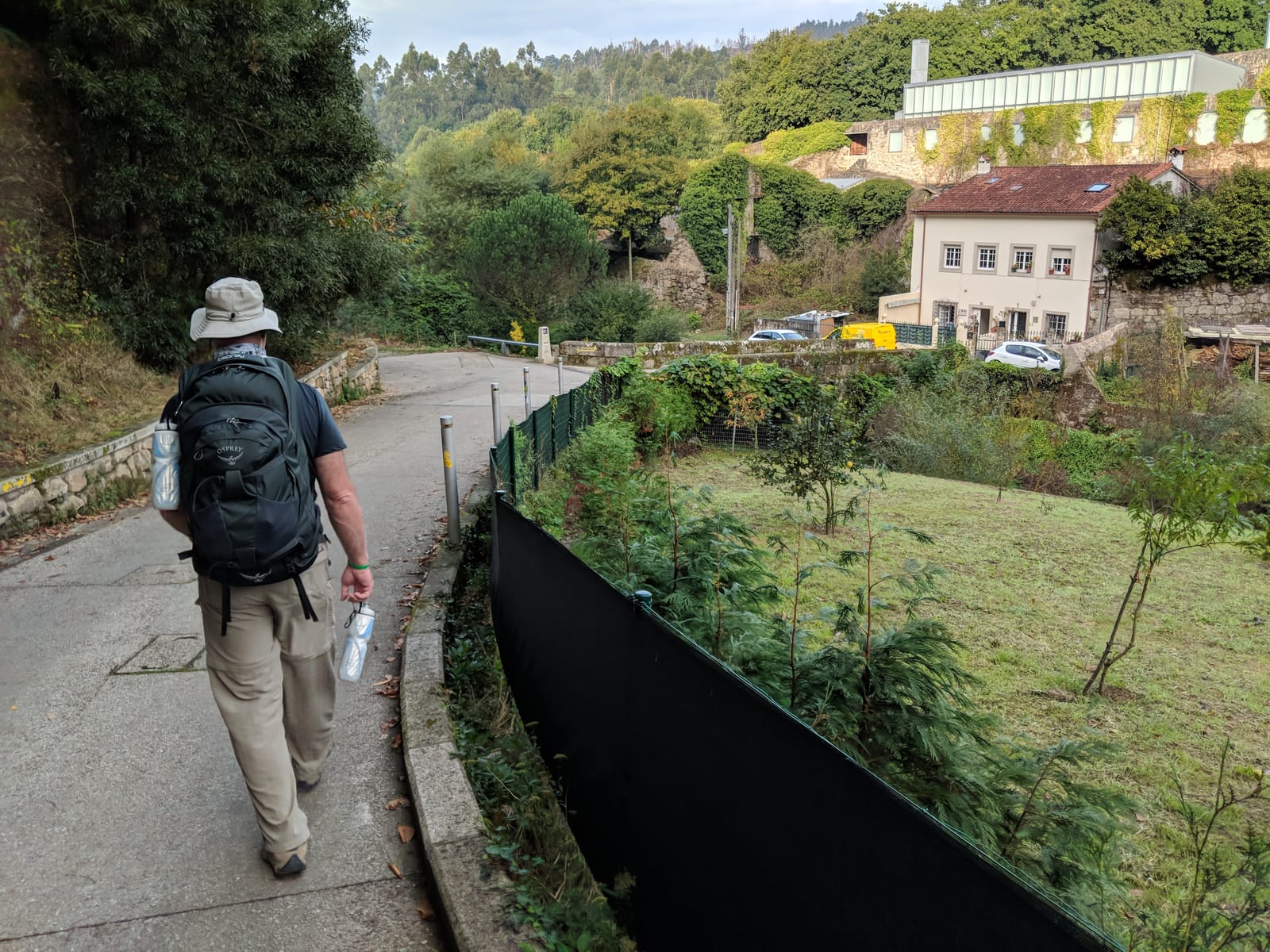
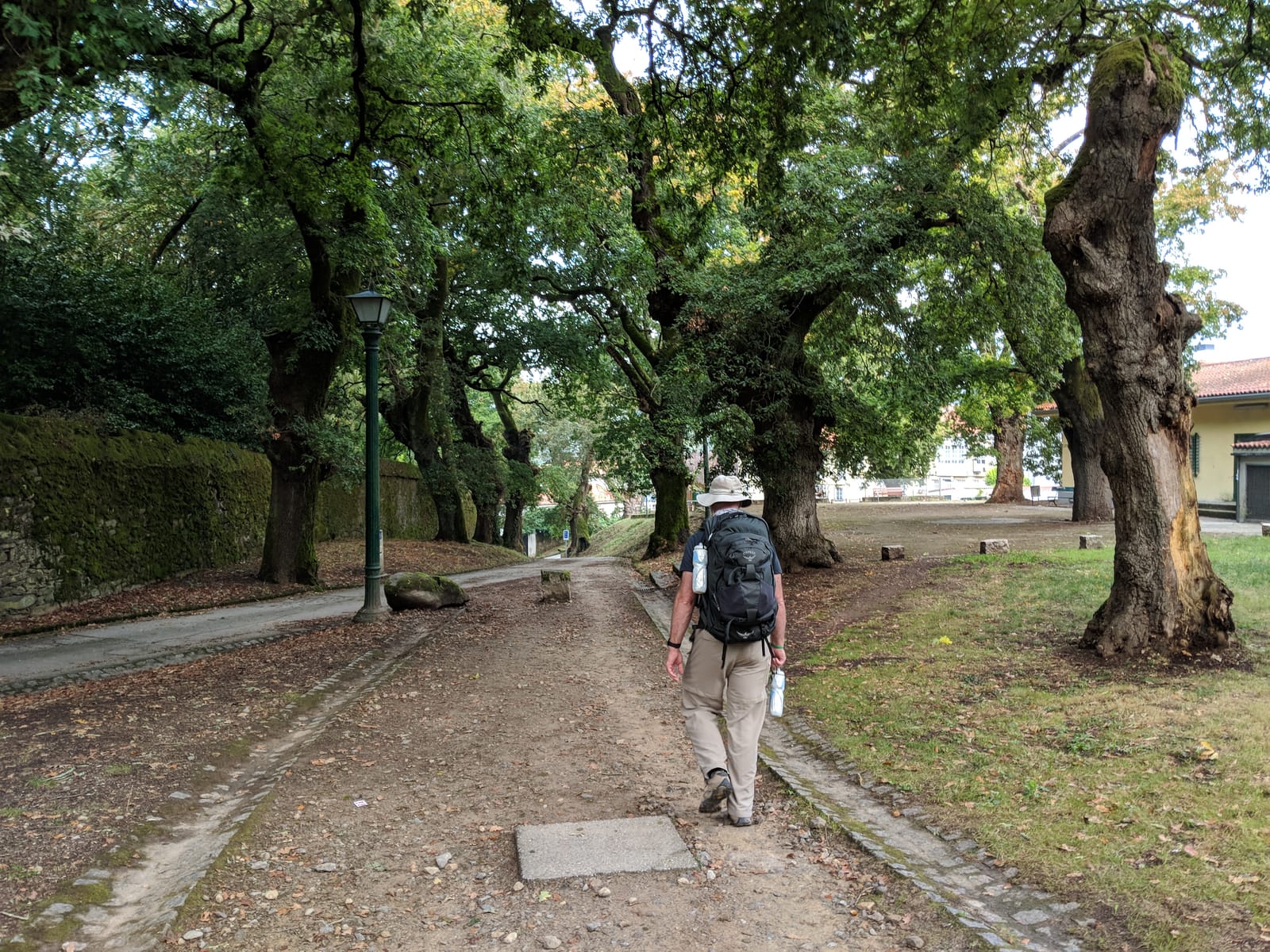
We started our Camino under some threatening skies, but we were excited about the journey ahead. First we had to walk out of town on sidewalks. Leaving the church where my mom had just finished her pilgrimage the day before felt special — Doug and I were a little anxious about doing our own journey, but ready to see where it would take us.
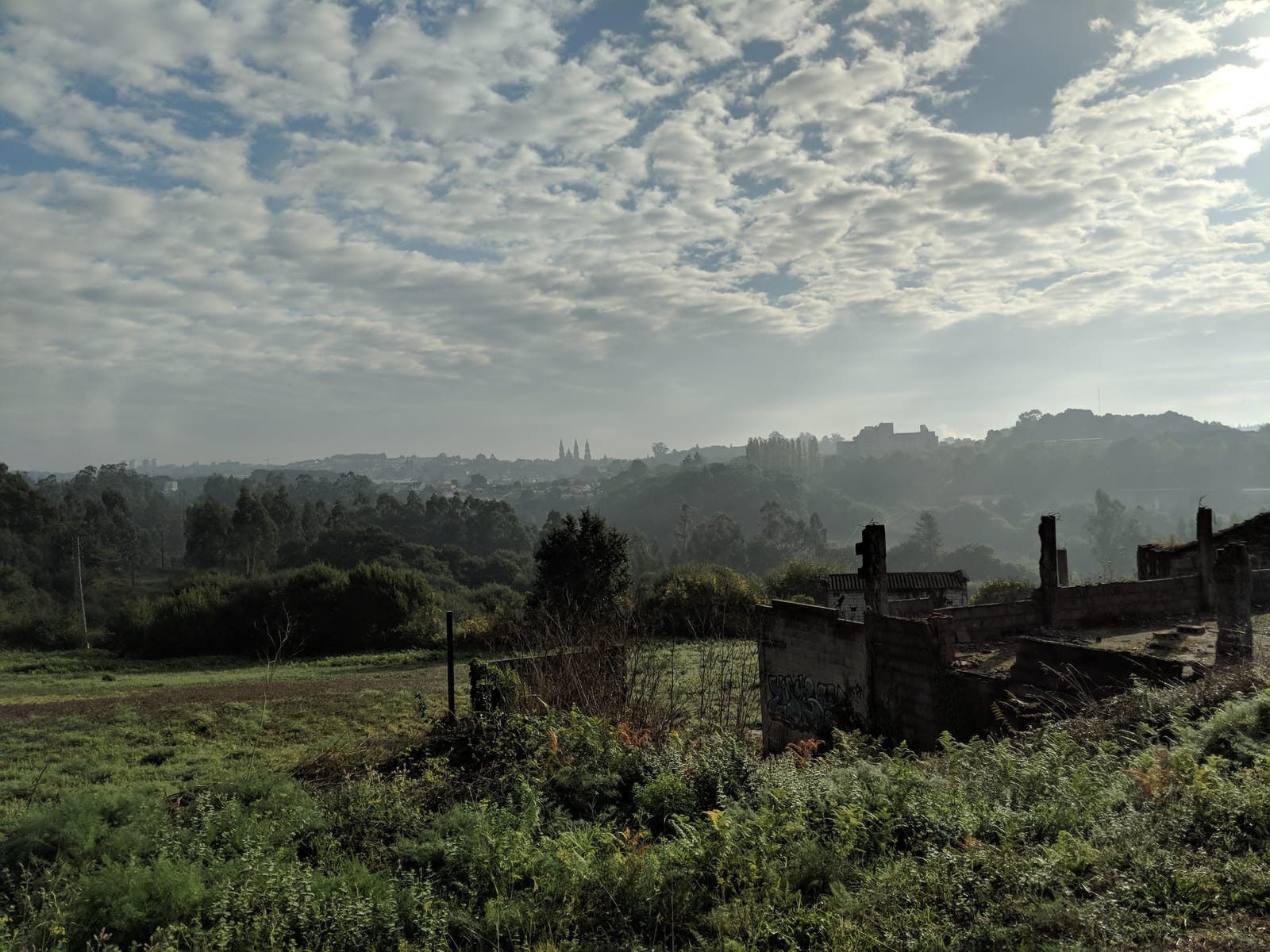
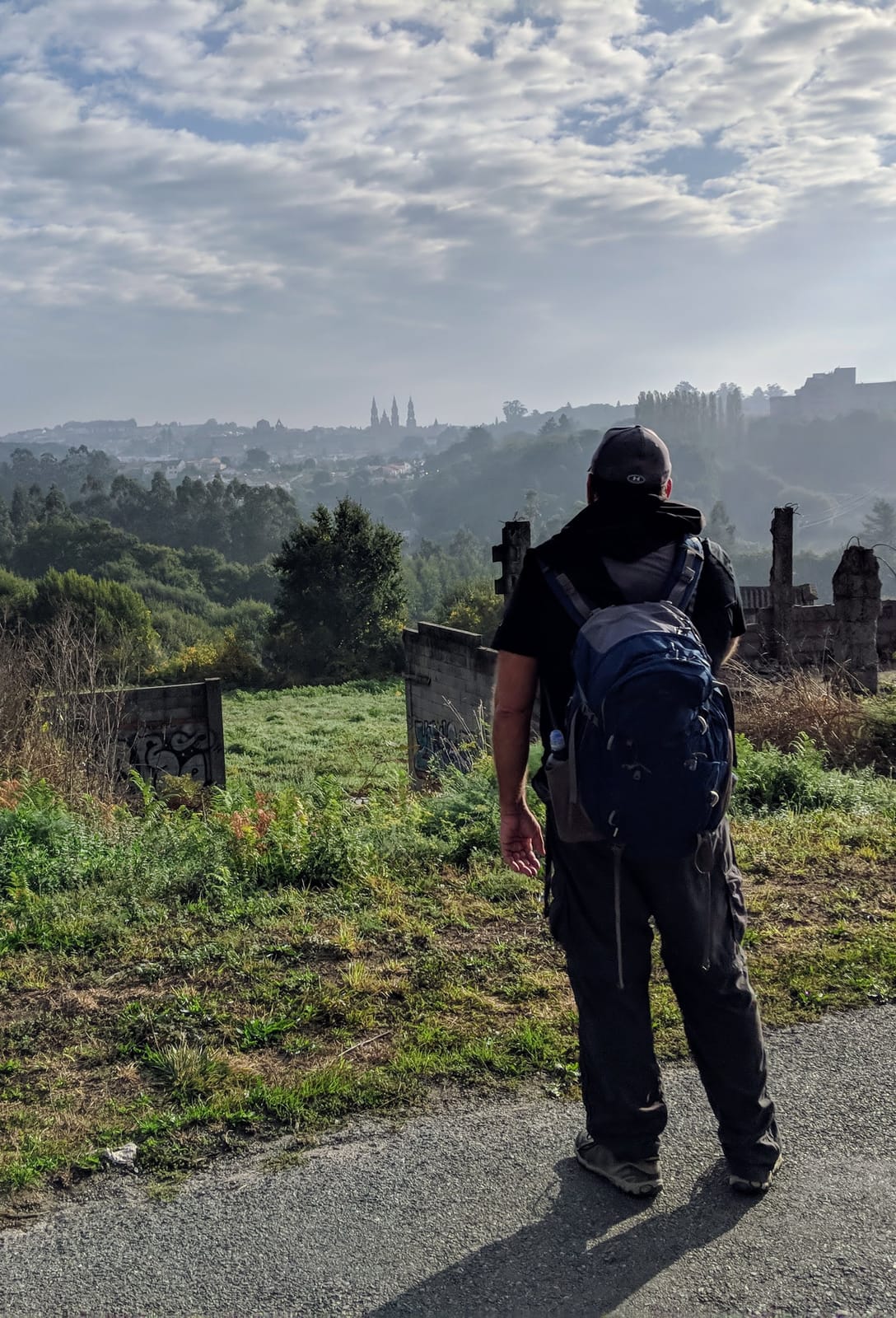
While we enjoyed the streets of Santiago, we were happy when we encountered some paths through the woods — but not before looking back on Santiago in the distance, getting smaller behind us.
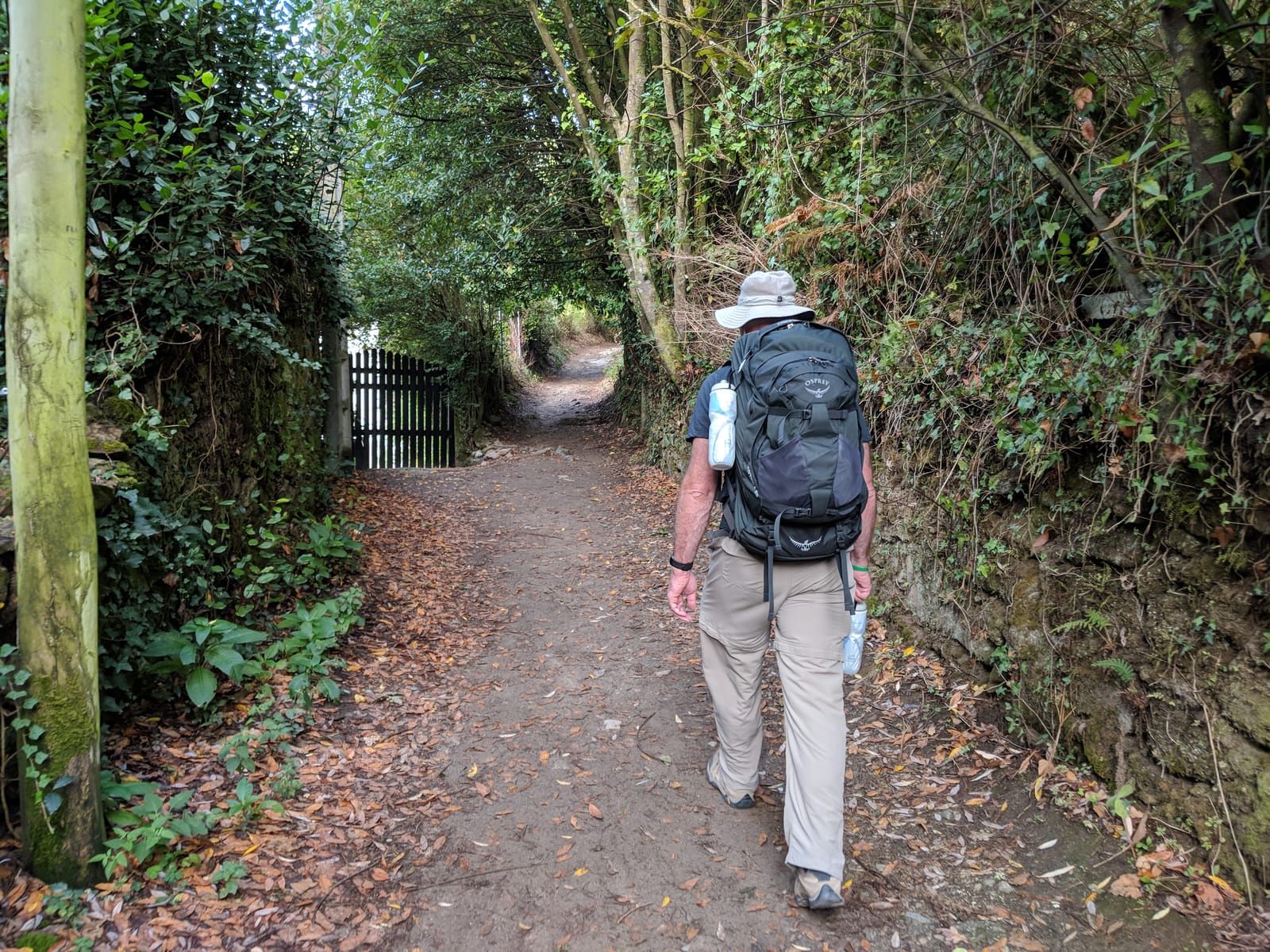
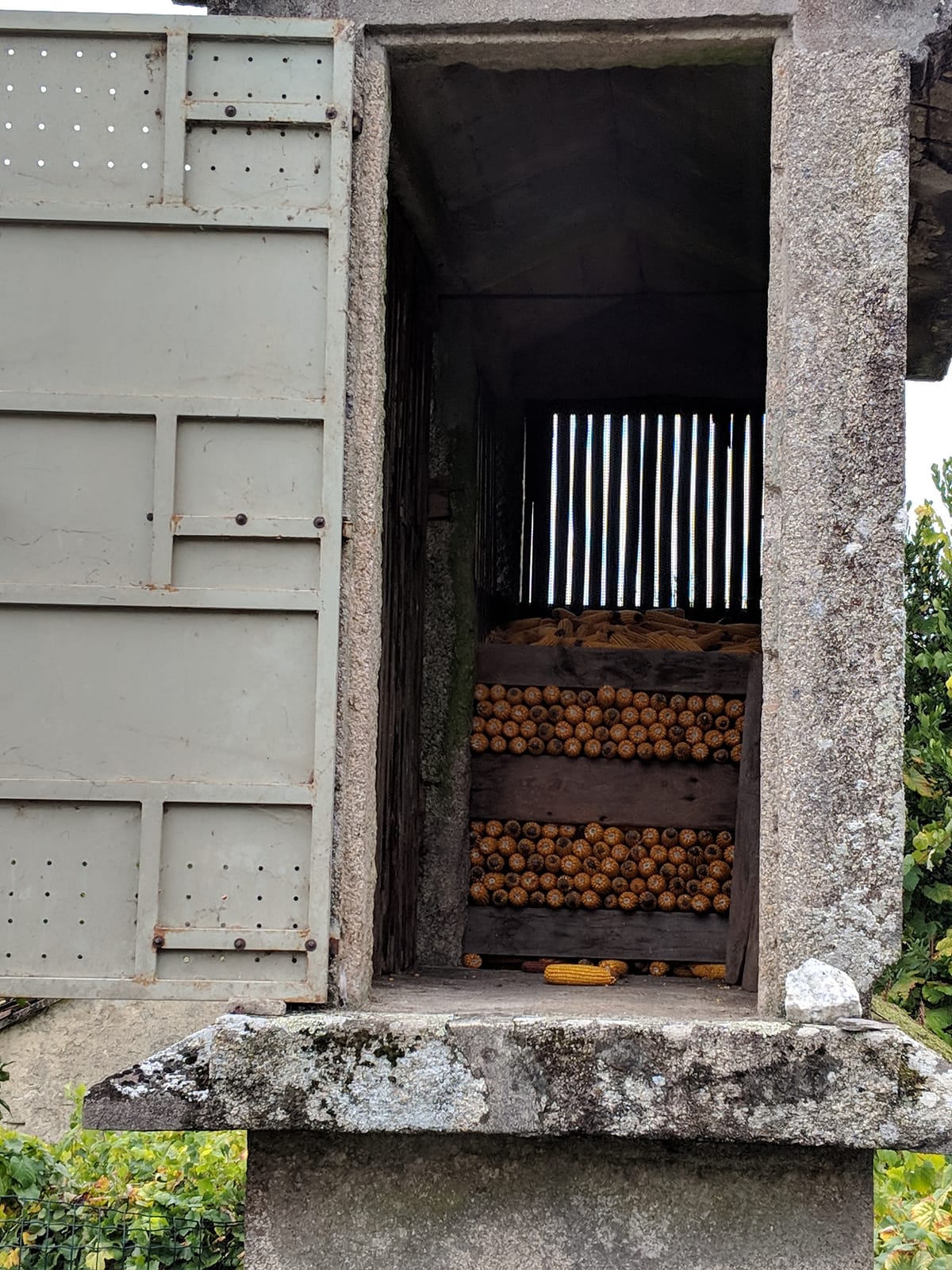
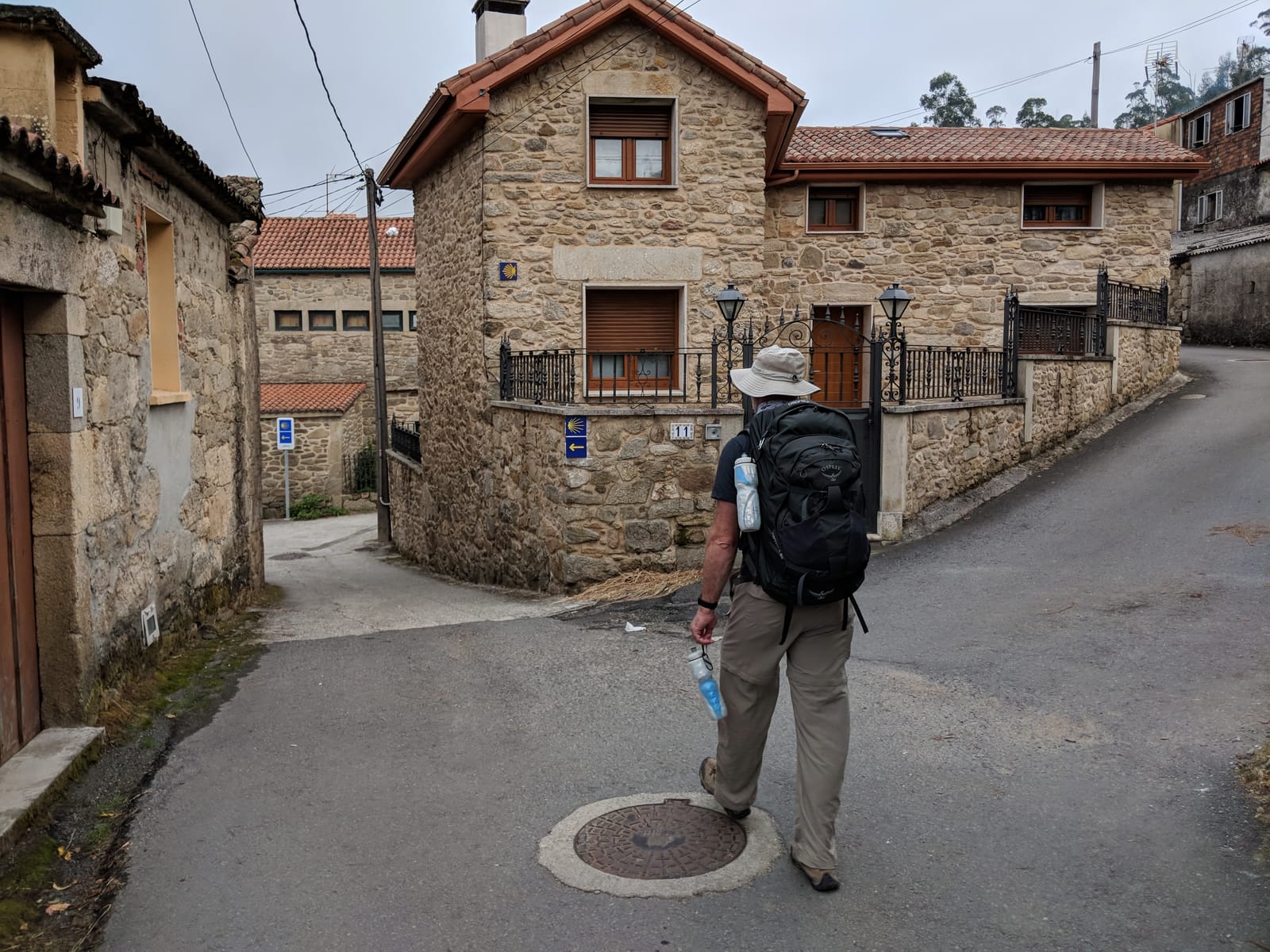
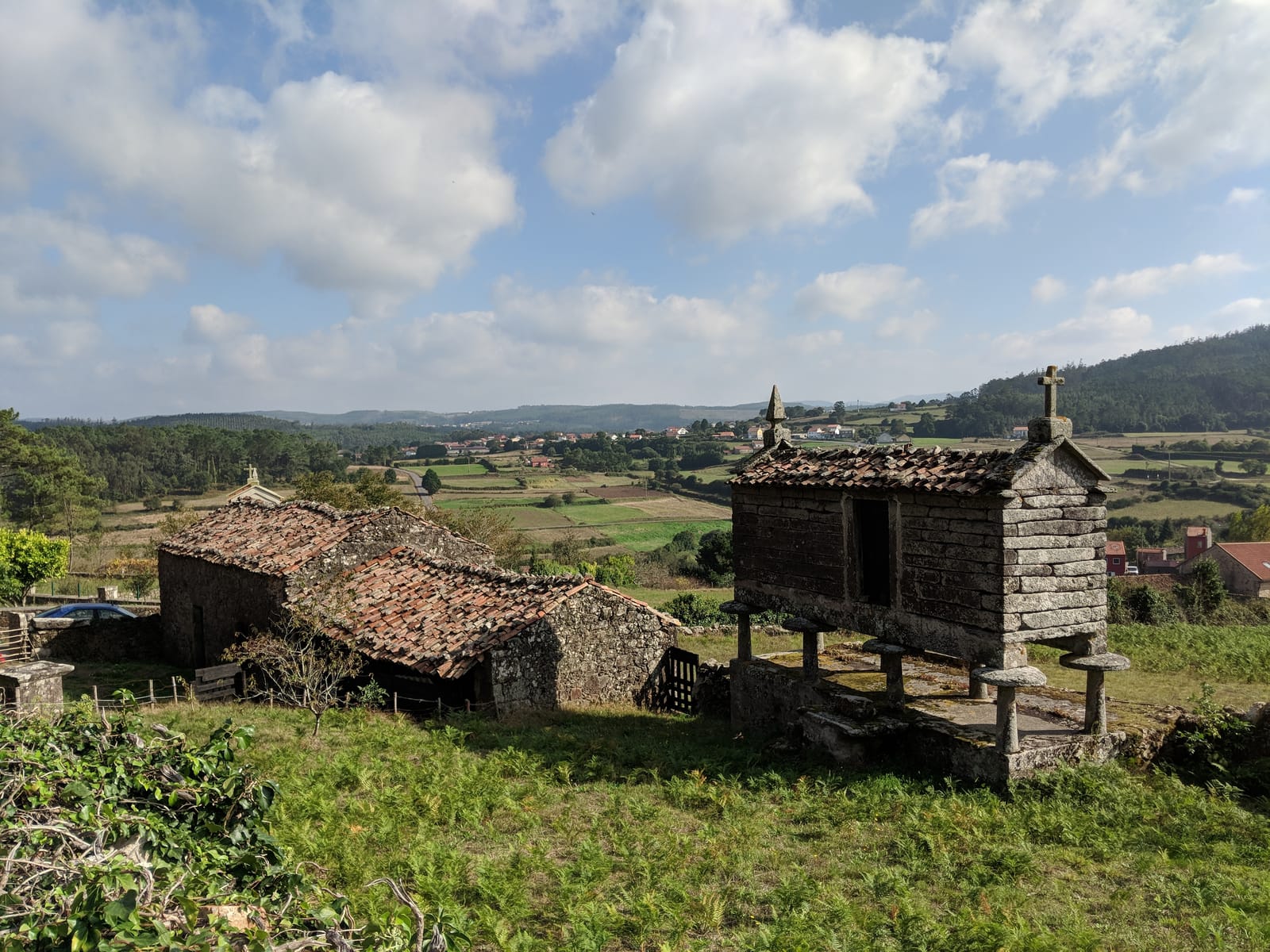
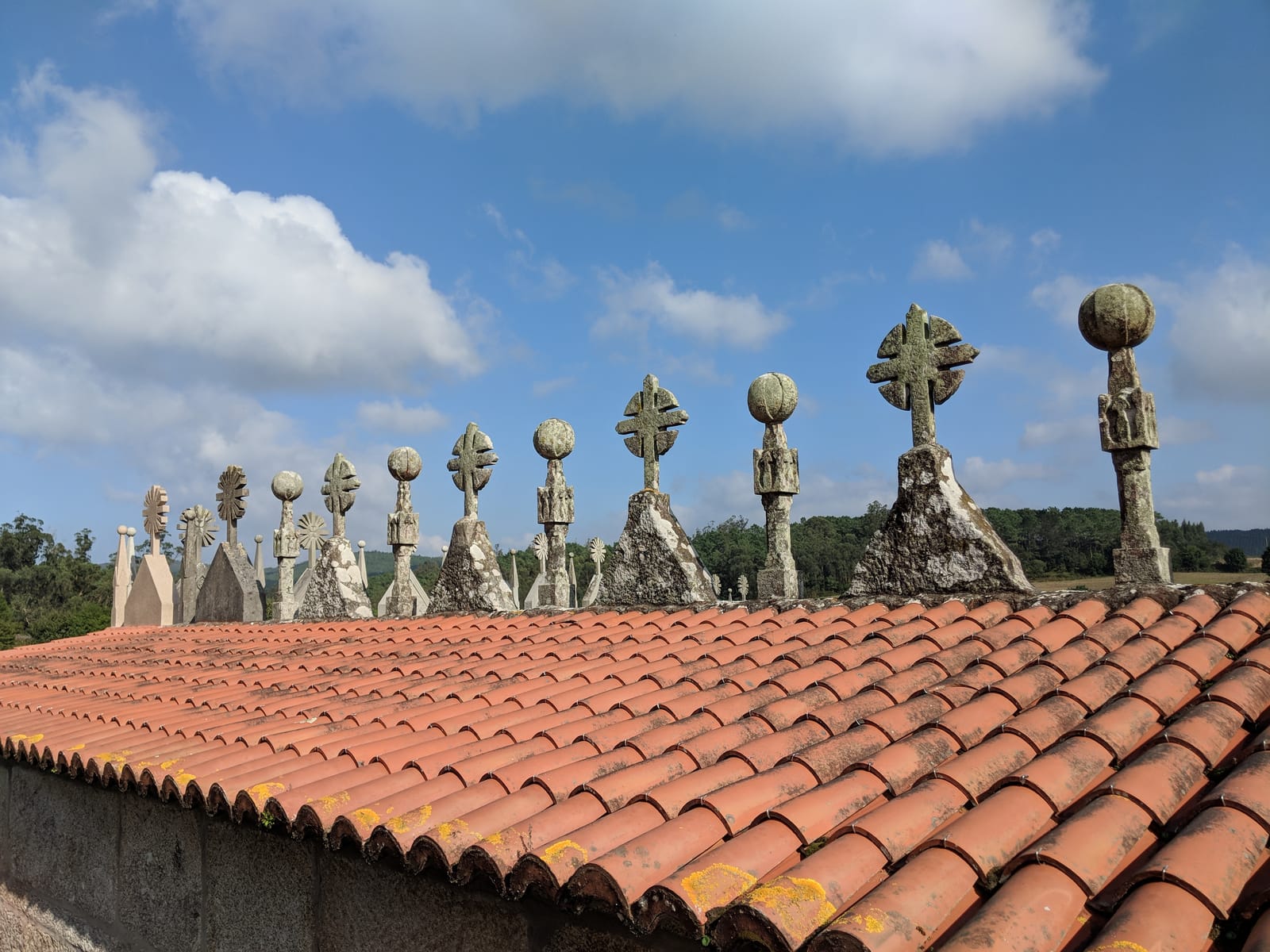
As we walked, we began to notice the distinctive wooden buildings with slanted roofs scattered throughout the landscape — hórreos. These charming structures are traditional Galician corn cribs, built up on stone pillars to elevate the stored grain and protect it from rodents and moisture. We'd first learned what they were on the walk out to meet my mom, and we would go on to see a countless number of them along our journey, each one a reminder of rural Galician farming traditions.
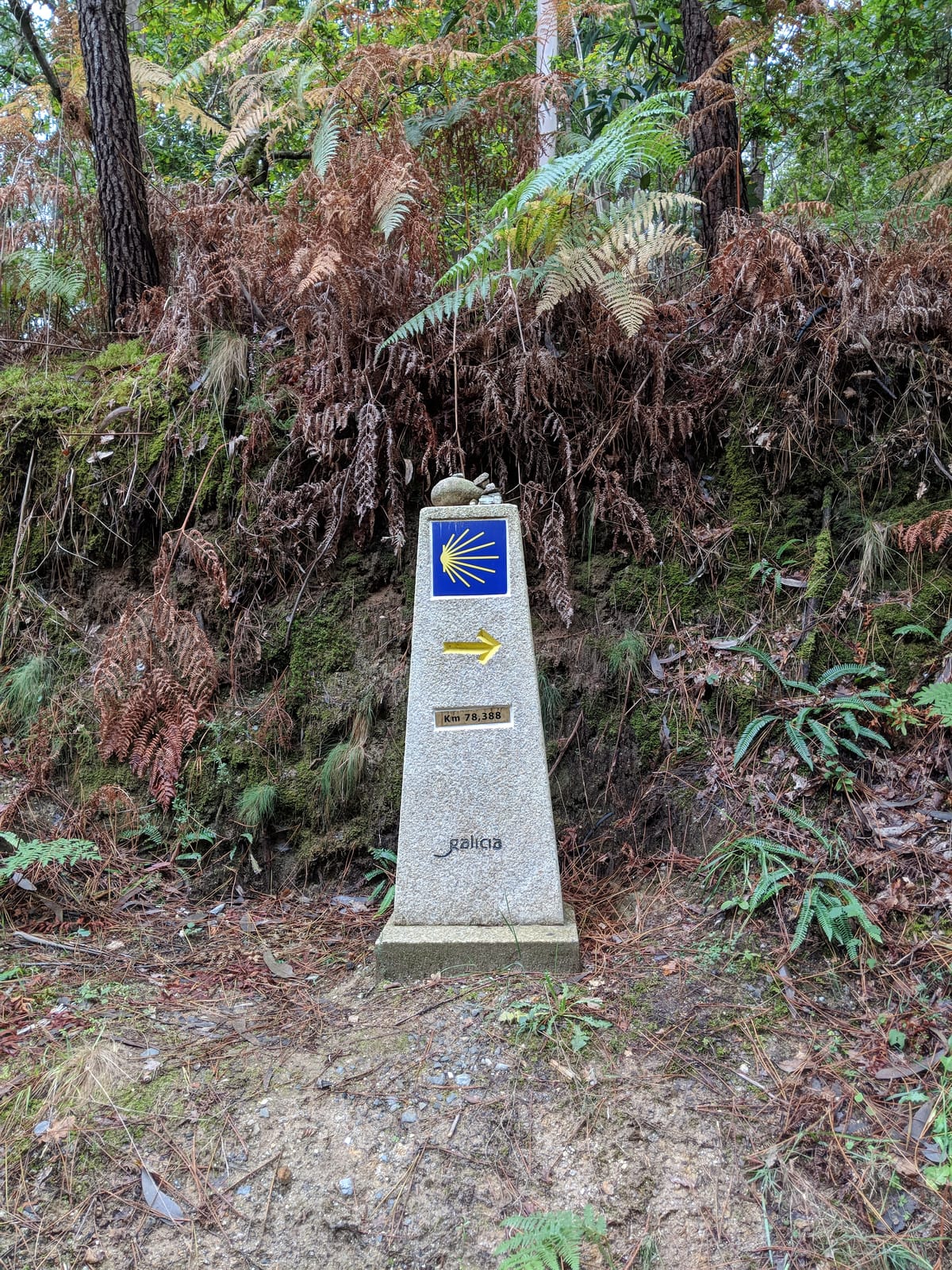
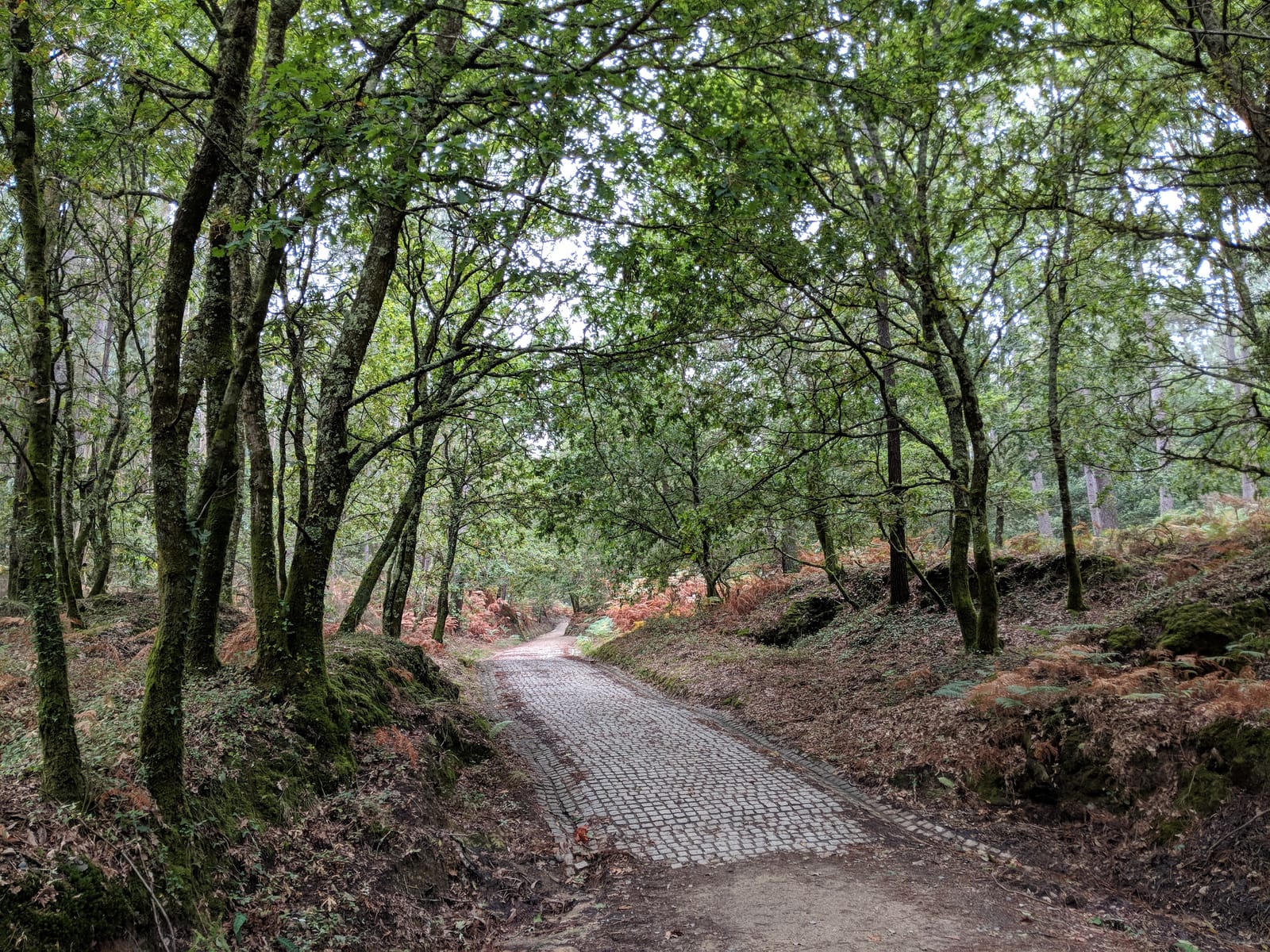
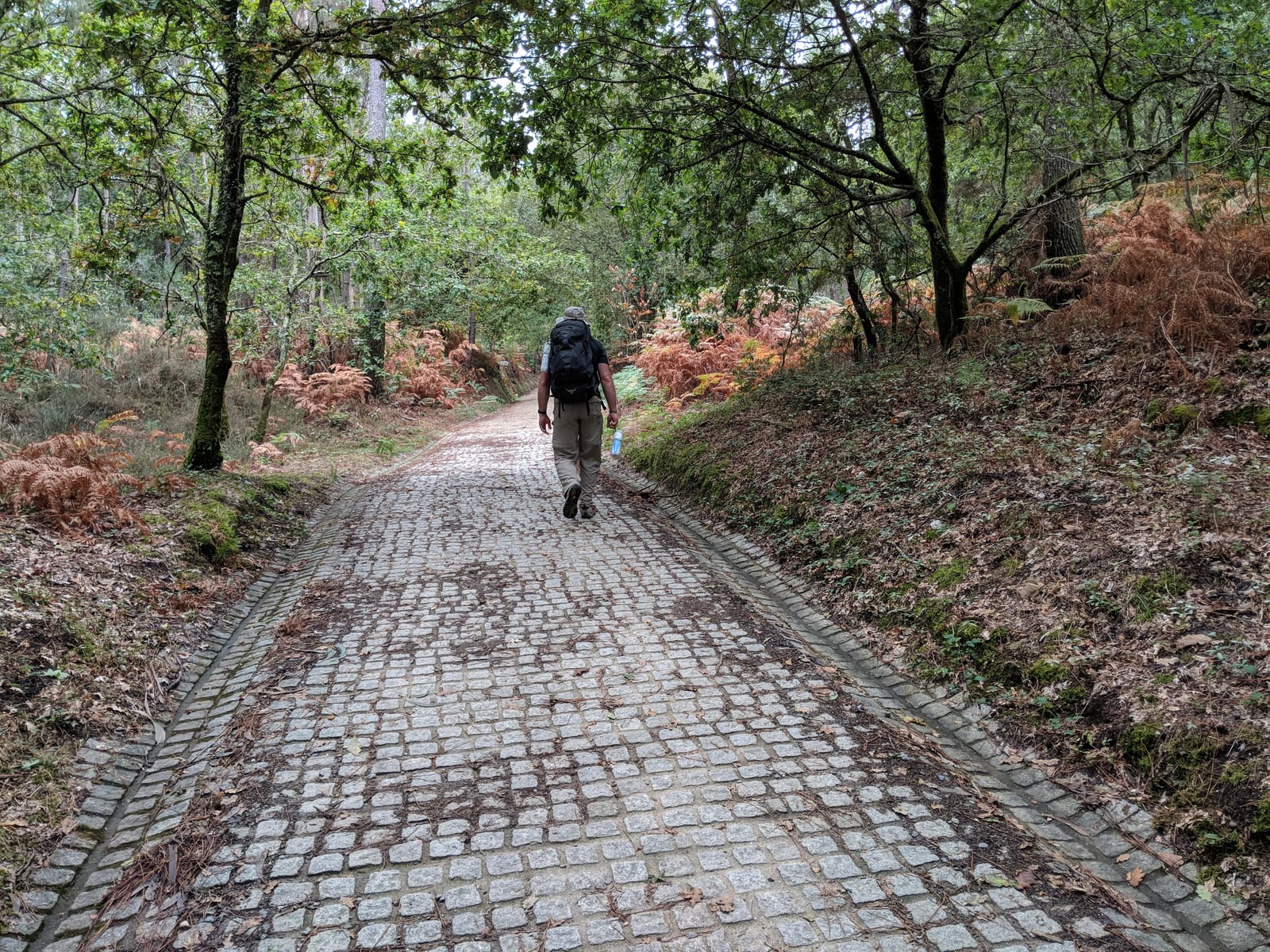
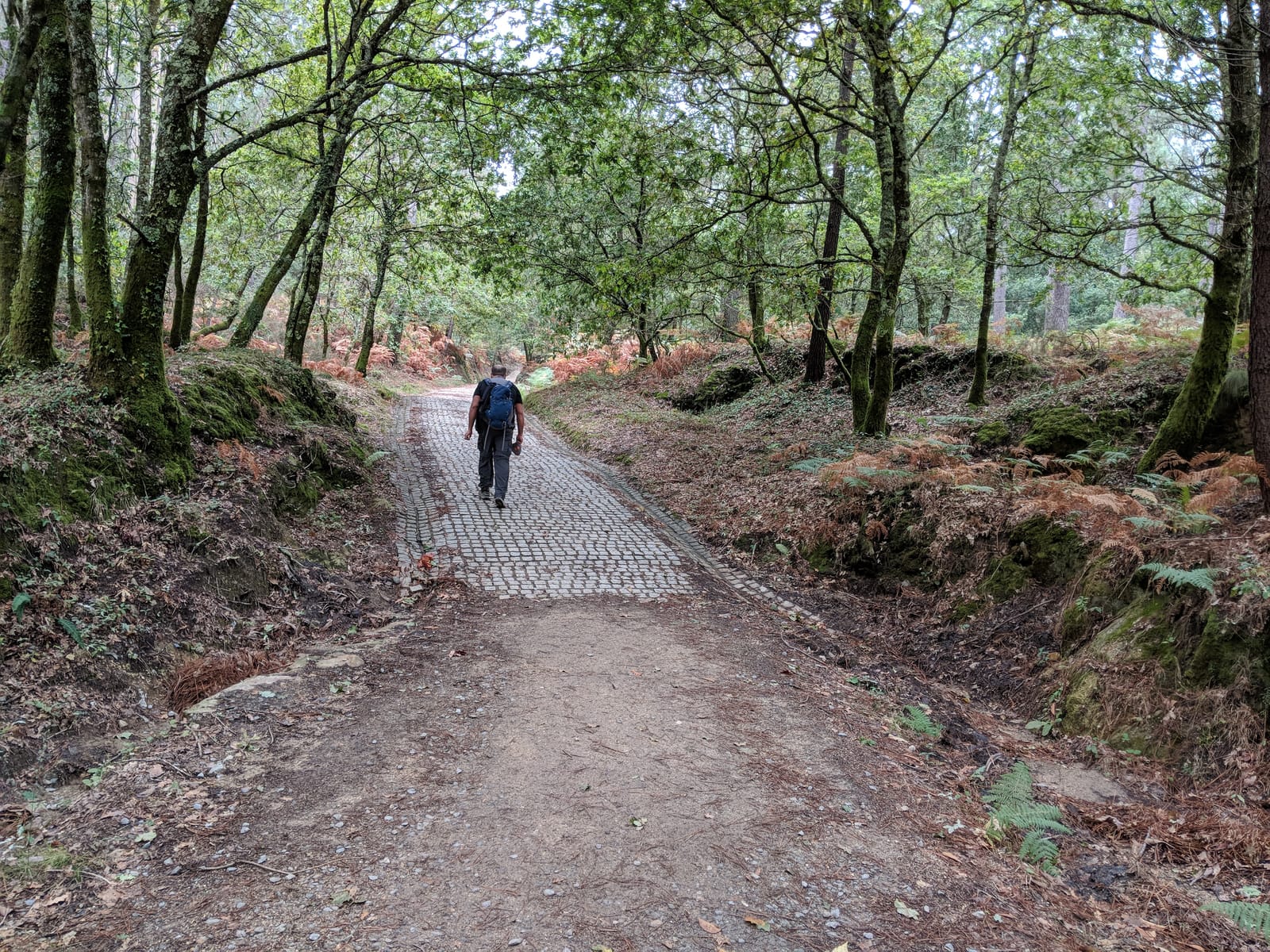
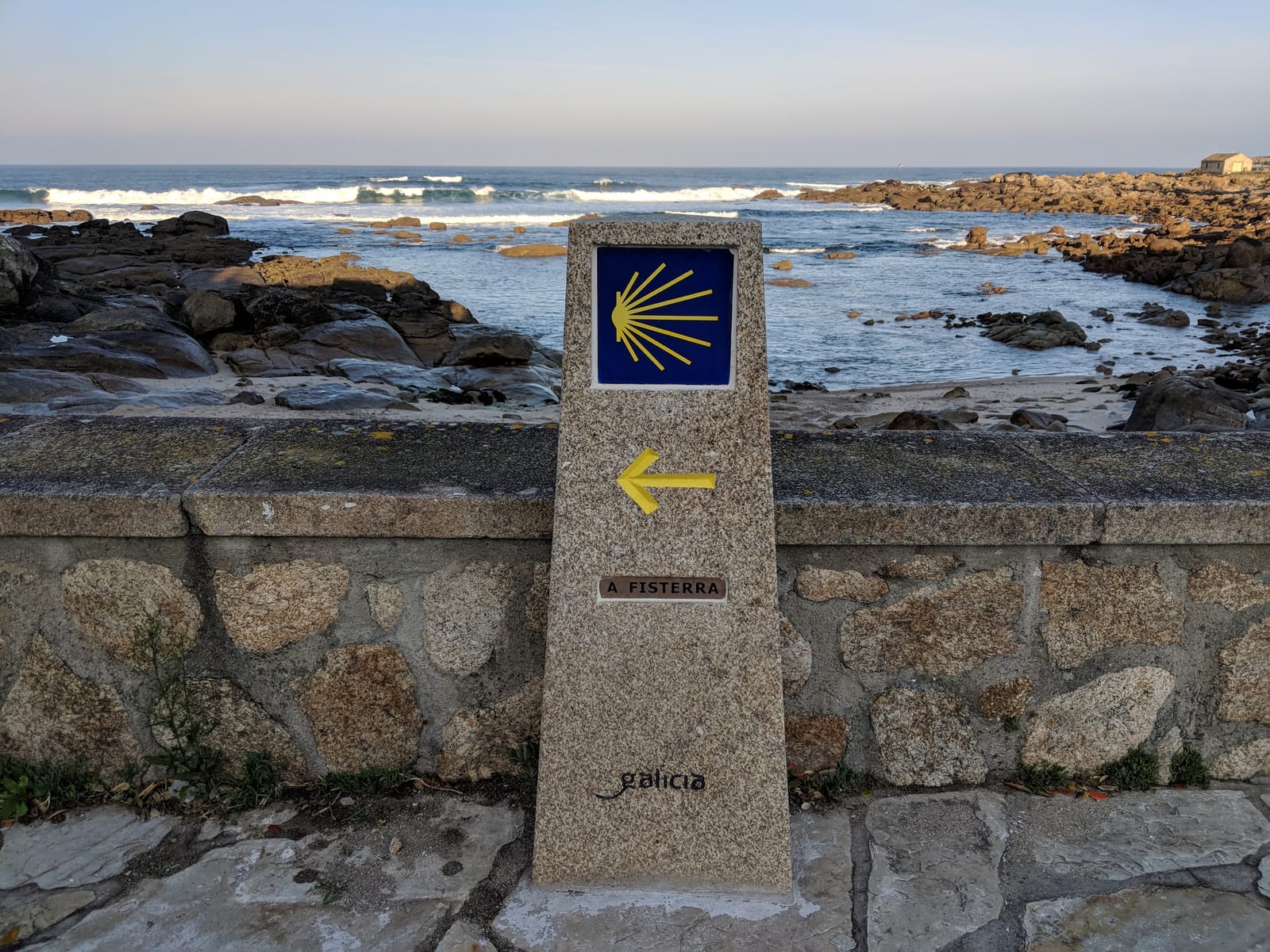
The Camino de Finisterre-Muxía is marked with distinctive signs along the way, with distance indicators that help pilgrims gauge their progress. We walked cobblestone paths that felt historic beneath our feet — some sections dated back centuries, the worn stones showing generations of pilgrims who had walked before us. That sense of history made the journey feel even more meaningful.
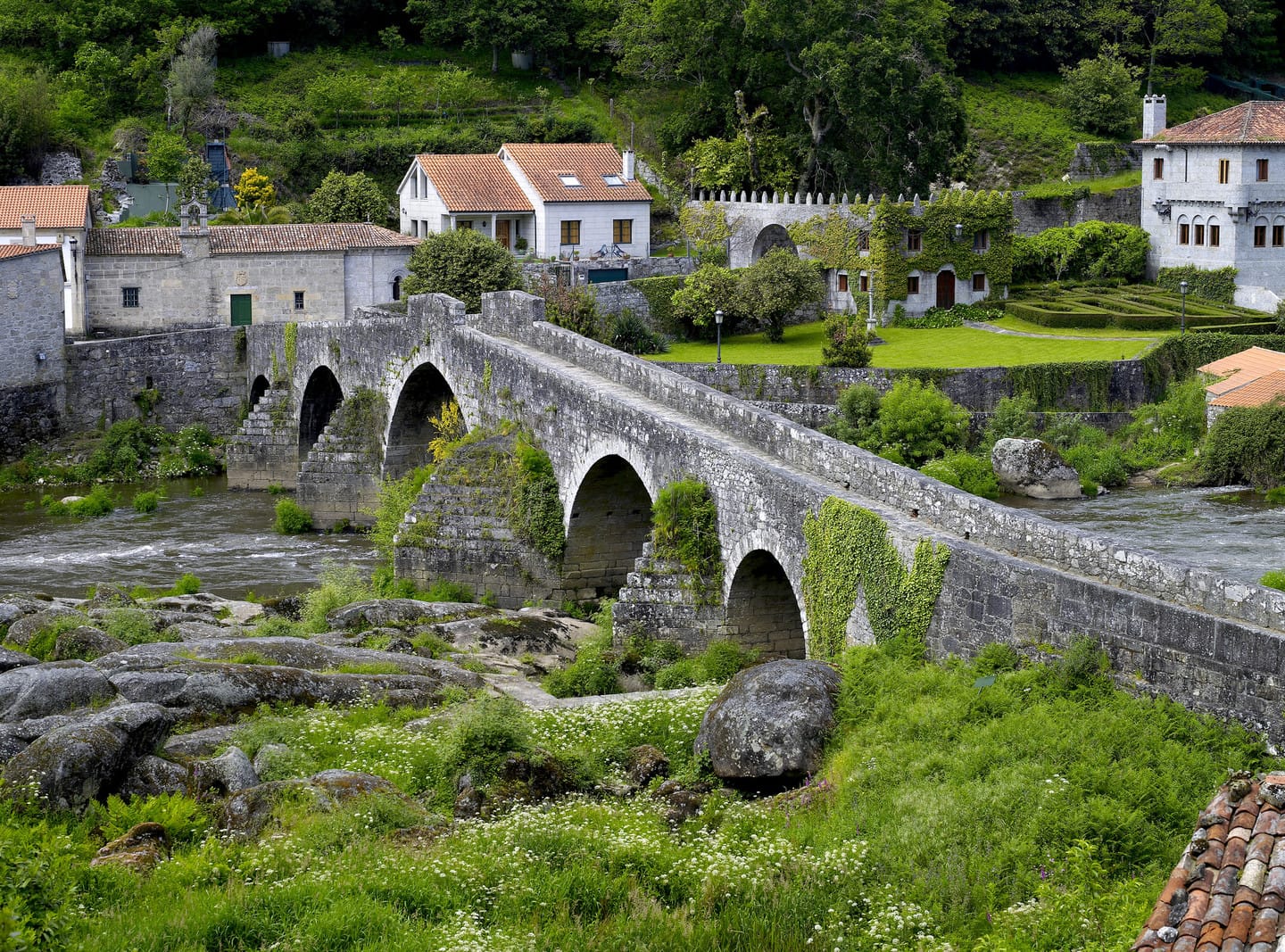
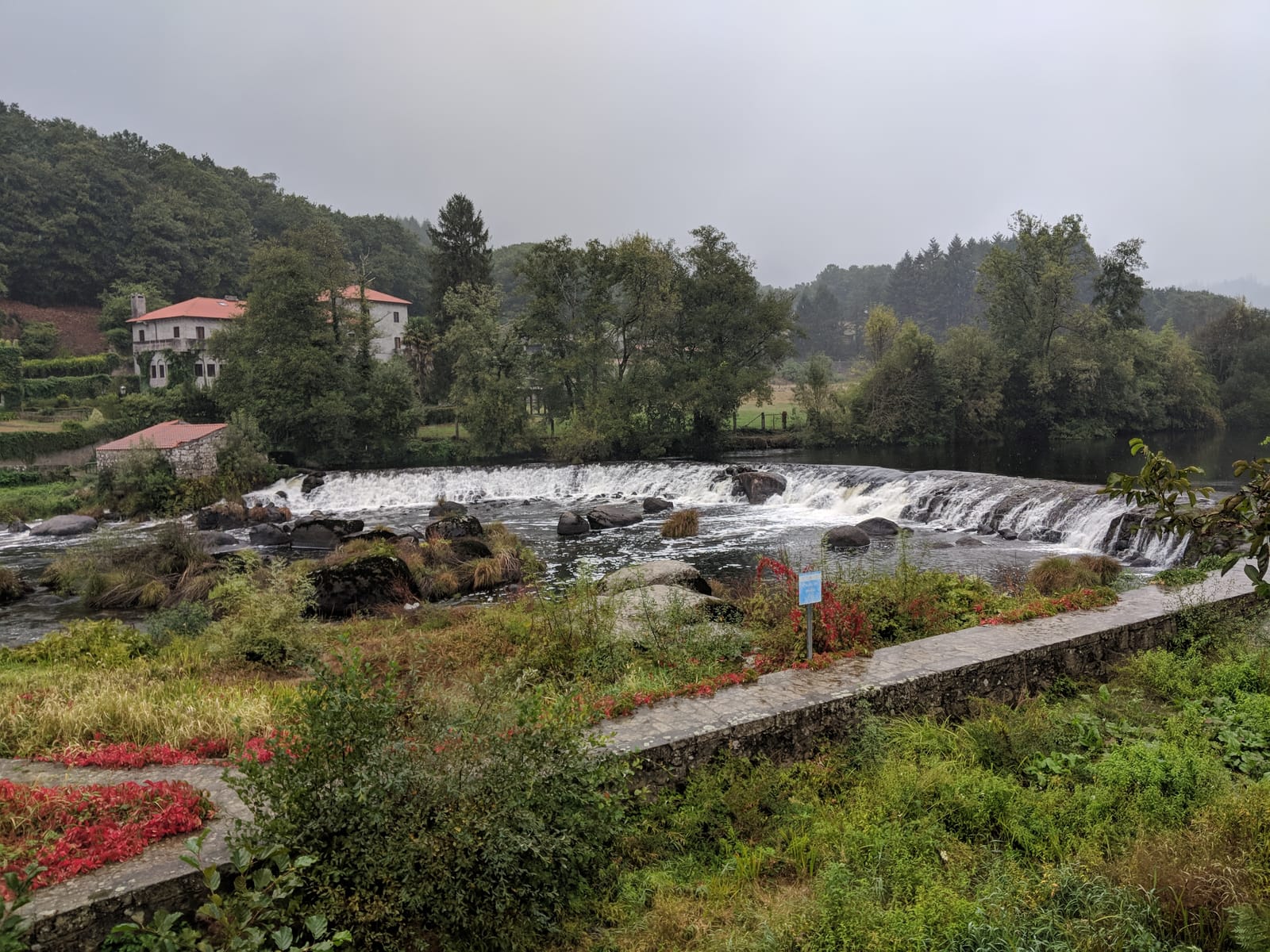
As we continued, we came upon what we believed to be an old medieval bridge spanning a river. We later discovered it was Ponte Maceira (A Ponte Vella), a stunning 13th-century stone bridge that crosses the Tambre River in Galicia. It's one of the most iconic landmarks along the Camino de Finisterre-Muxía, a symbolic gateway on the scenic extension of the Camino for pilgrims continuing past the Santiago cathedral toward the Atlantic coast. The blue tile on the left wall features the classic yellow scallop shell and arrow, guiding walkers along the path — a symbol you see throughout the entire Camino.
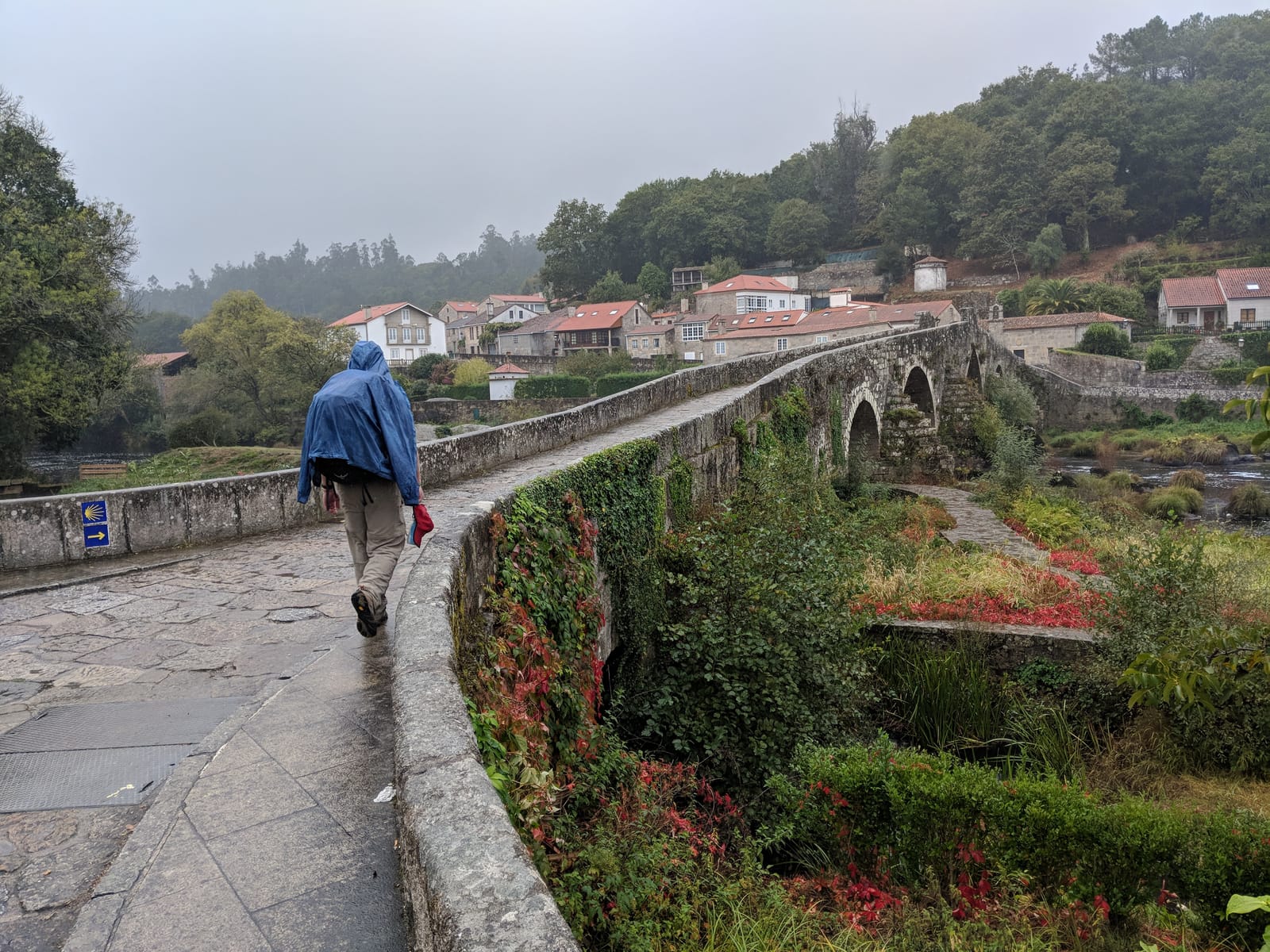
While filming Doug on the bridge, I forgot to hit record — the second time that happened on this trip! So we had to do a take two, as you can hear referenced in the video audio.
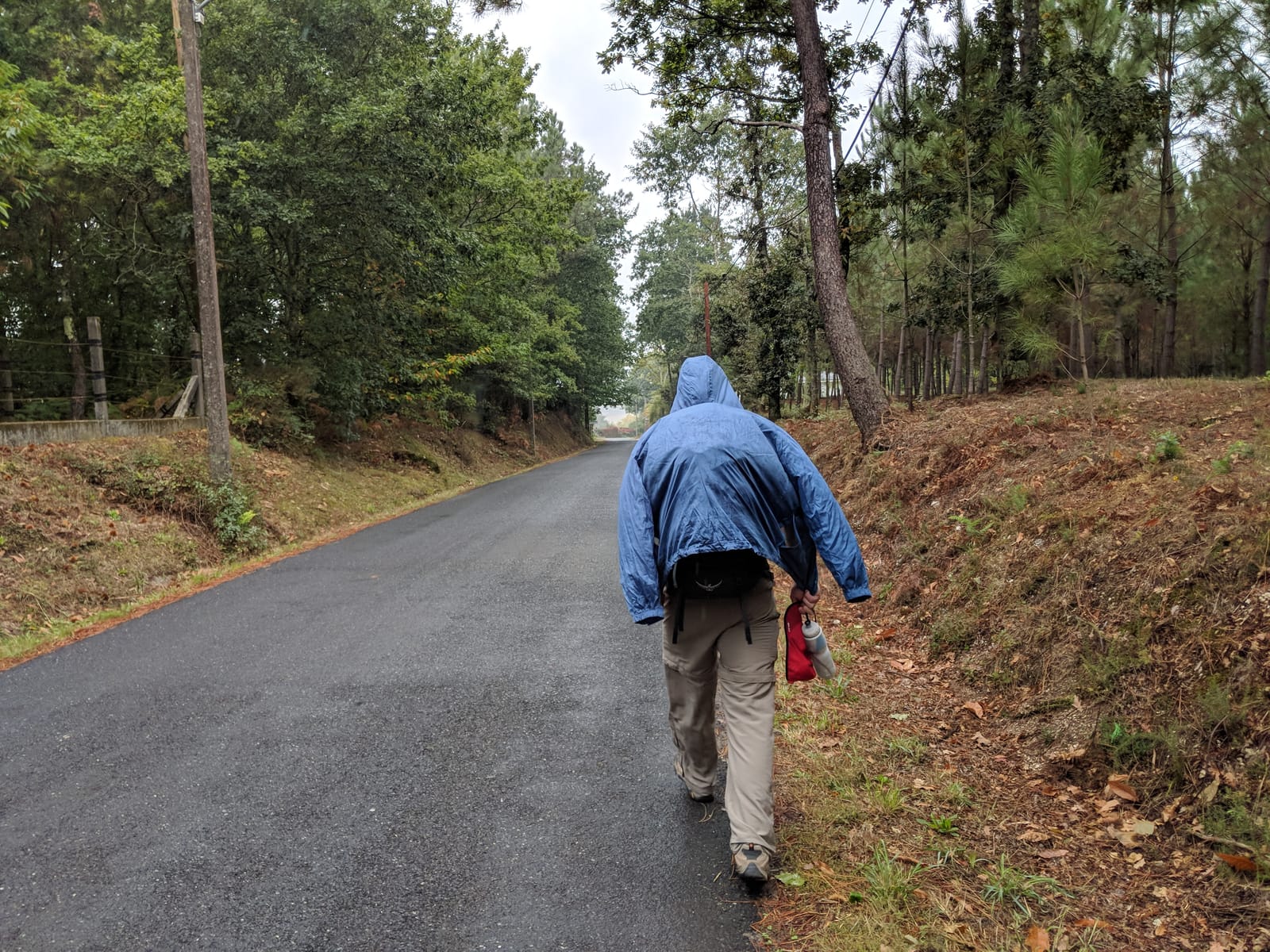
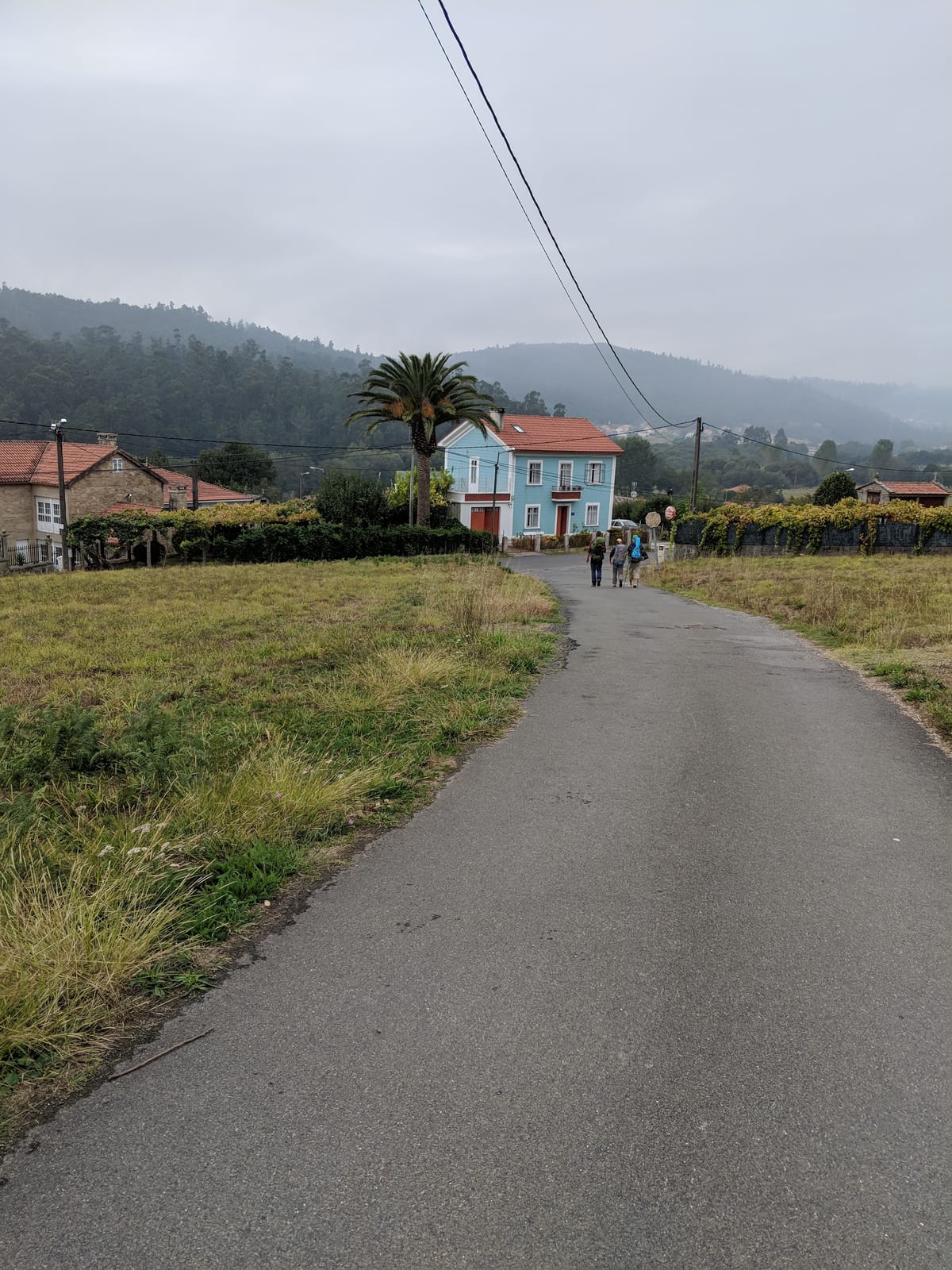
We did catch some rain as the day went on, but it was more of a light drizzle — refreshing rather than dampening our spirits. It was a short walk today at 13.37 miles, and we didn't take a bunch of photos because of the rain, but that didn't diminish the experience. The misty conditions gave the landscape a mystical quality that felt right for a pilgrimage.
We arrived in town in time for lunch, then spent the rest of the afternoon walking around, trying to dry out our clothing. The hotel had no air conditioning, and with it so humid both inside and out, even the dry clothes we had with us turned a bit damp overnight — a minor inconvenience on a pilgrimage.
We had dinner at the hotel, enjoying a pilgrim meal: for €10 each you get two courses, a simple dessert, and a beverage. When we ordered wine, we figured they'd give us a small glass — instead we were handed an entire bottle. Our first day on our own Camino was complete. Tomorrow would be a bigger mileage day.
Click any photo to enlarge it and read its caption.
The long stage of the Camino Finisterre · an early start out of Negreira · 22.06 mi
Day 2 was the big one — a 22-mile push from Negreira west to Olveiroa, the longest single stage of our walk and nearly double the day before. We set out early, well before seven, to give ourselves the daylight for it, and settled in for a long, rewarding day on the Camino.
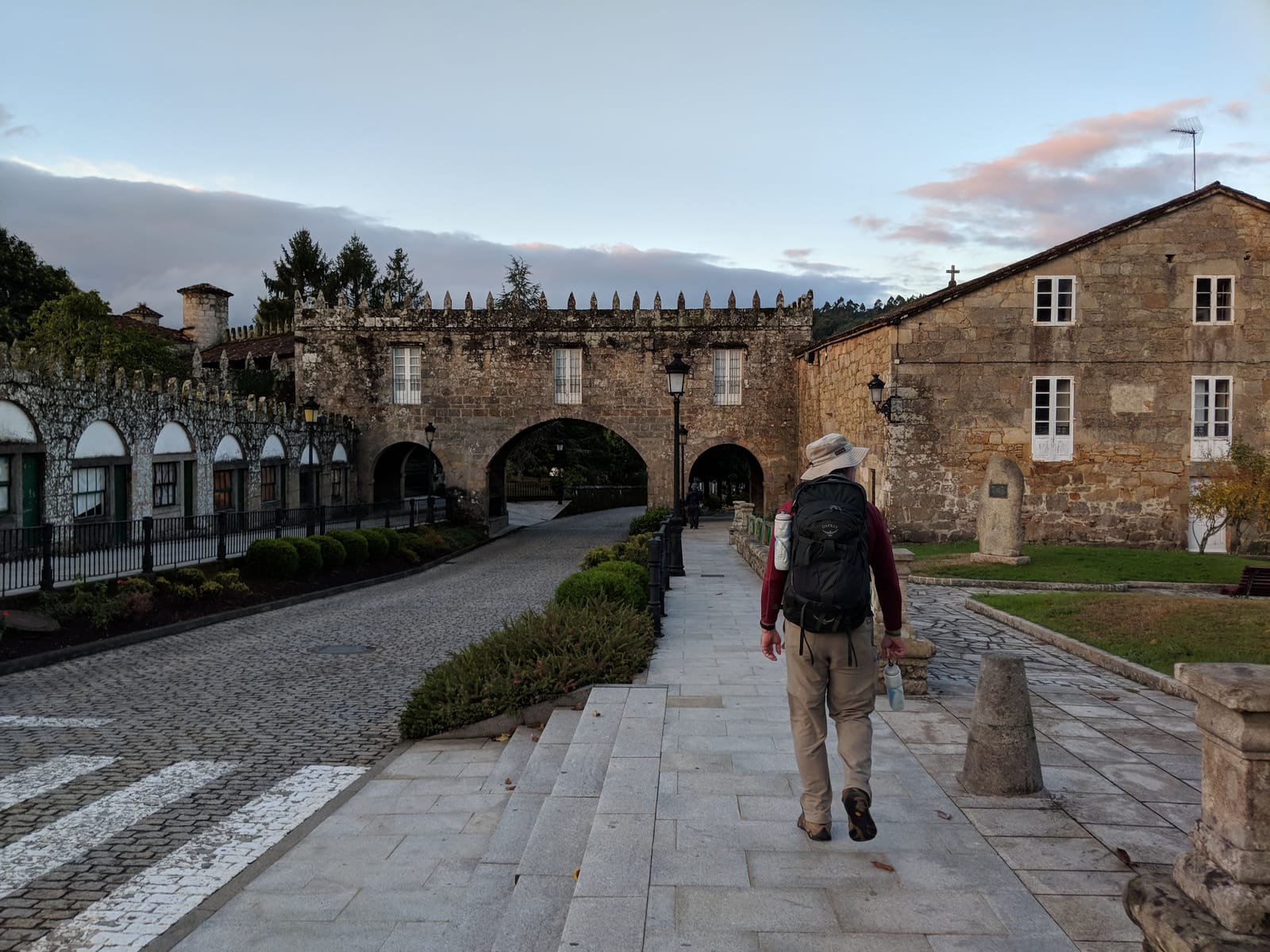
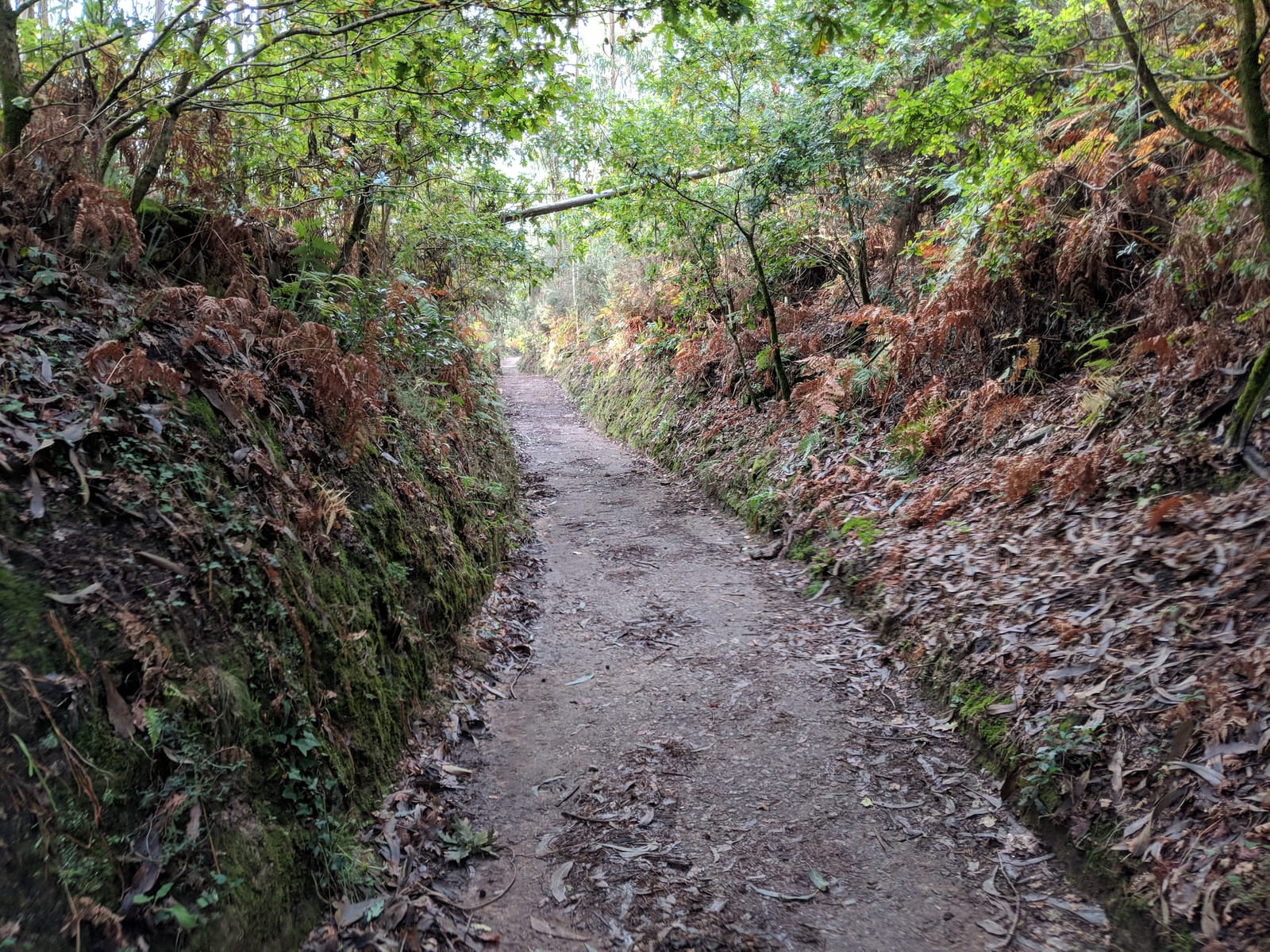
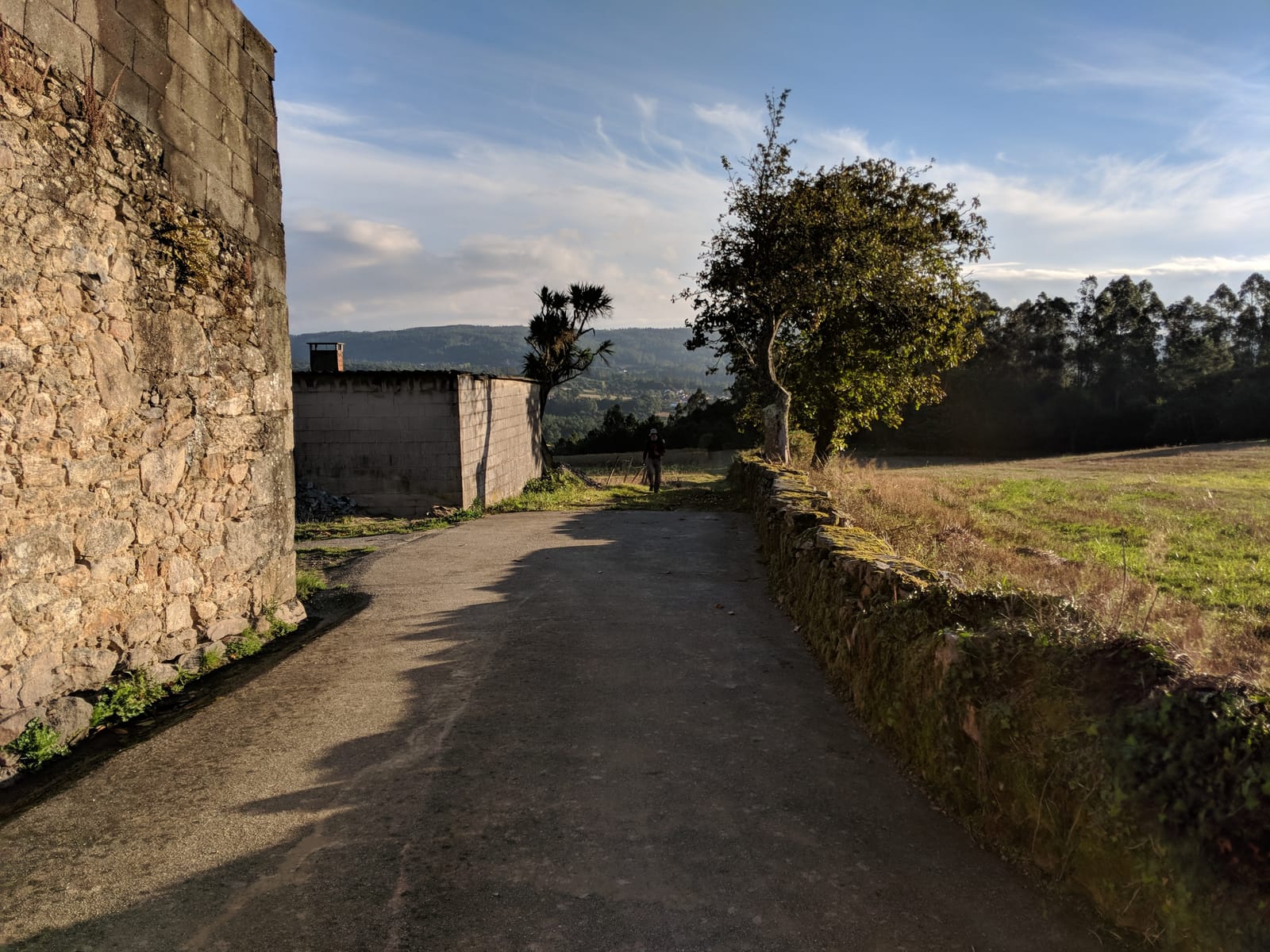
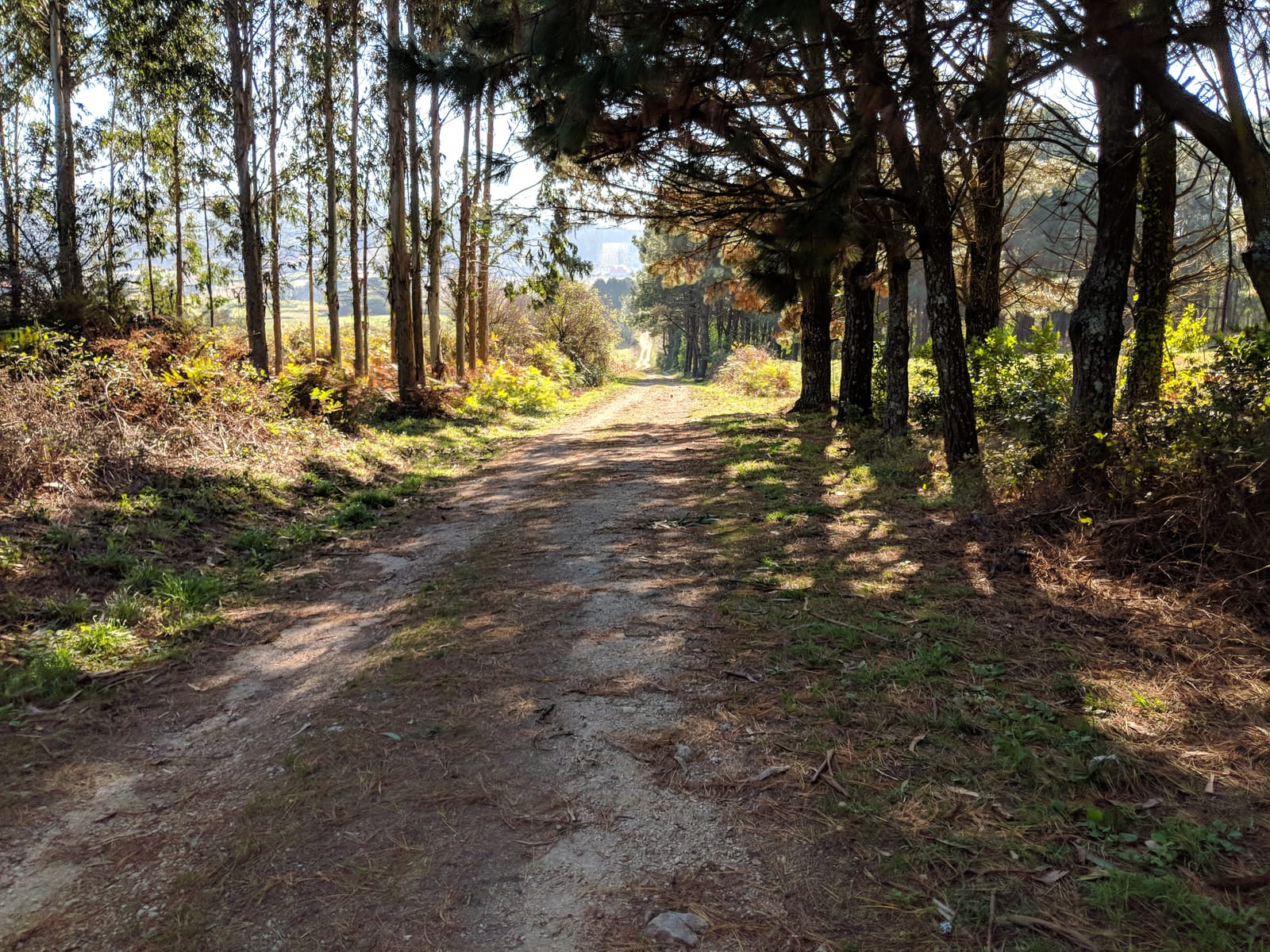
The scenery was beautiful and constantly changing, one of the things that made the long distance fly by. The trade-off was the surface: a good stretch of the day was spent on road or paved surfaces rather than soft trail. What we enjoyed most were the sections that got us off the pavement — the dirt trails and gravel paths, and especially the hilly Galician countryside, which was our favorite part of the whole day.
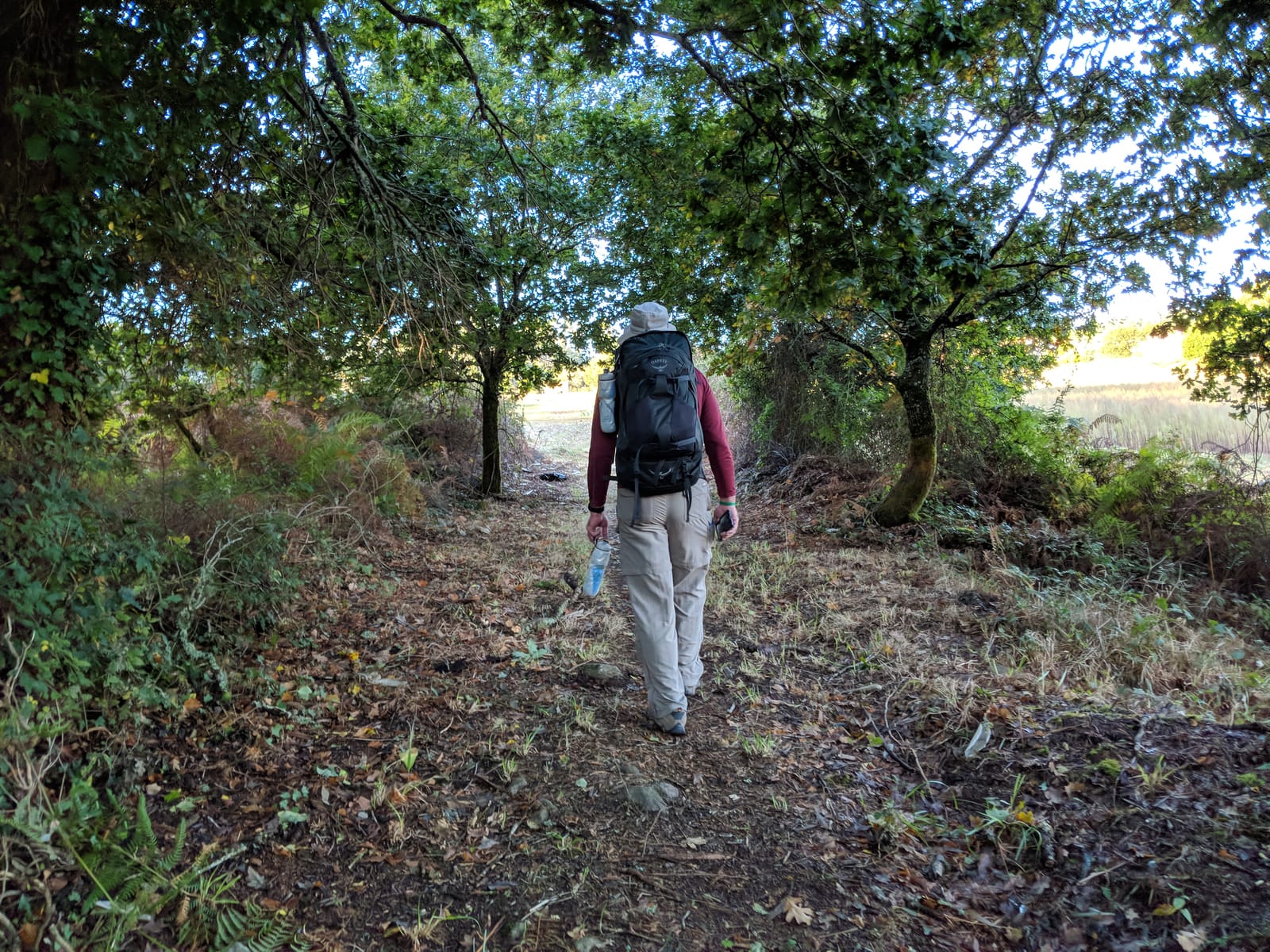
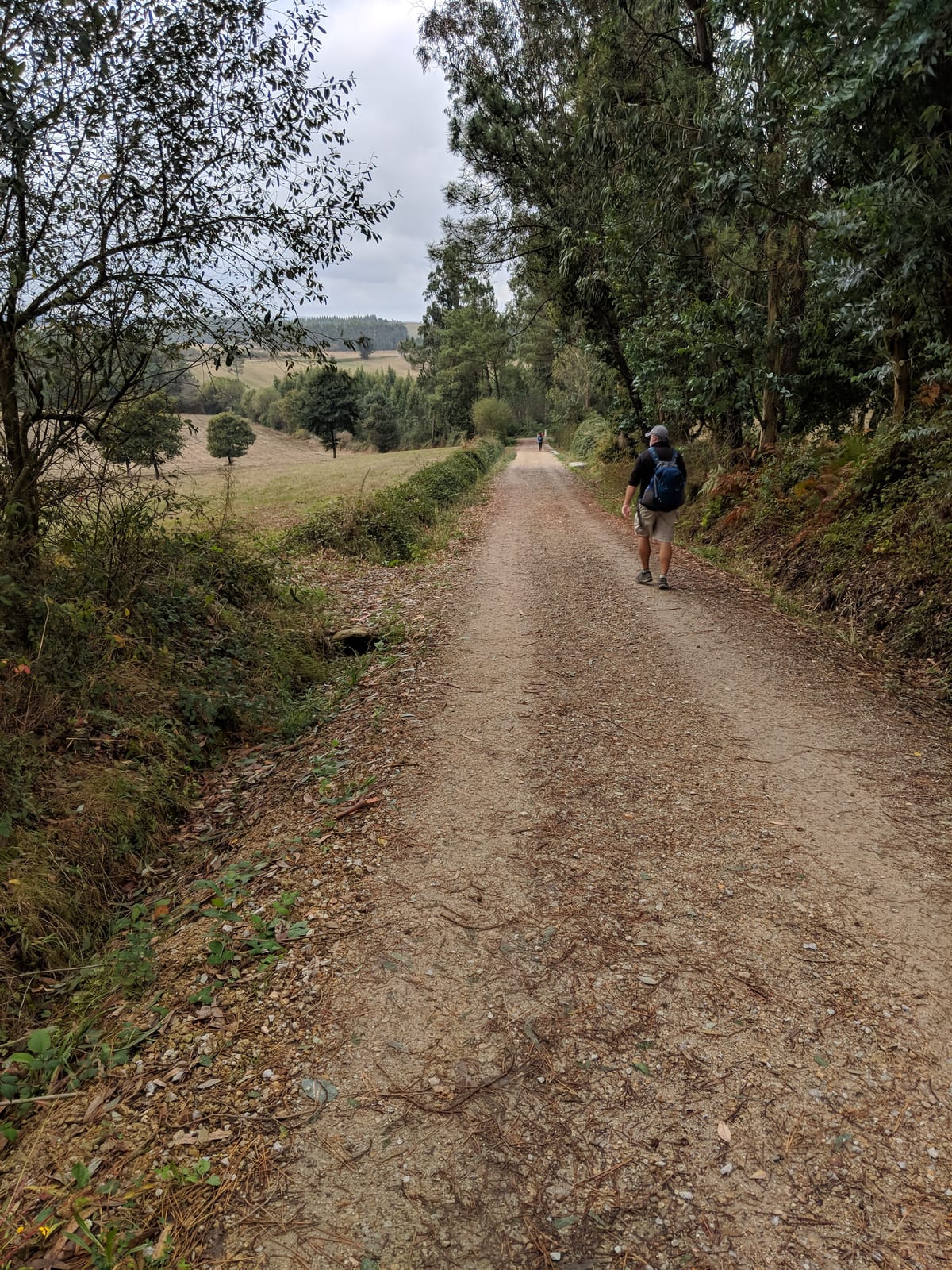
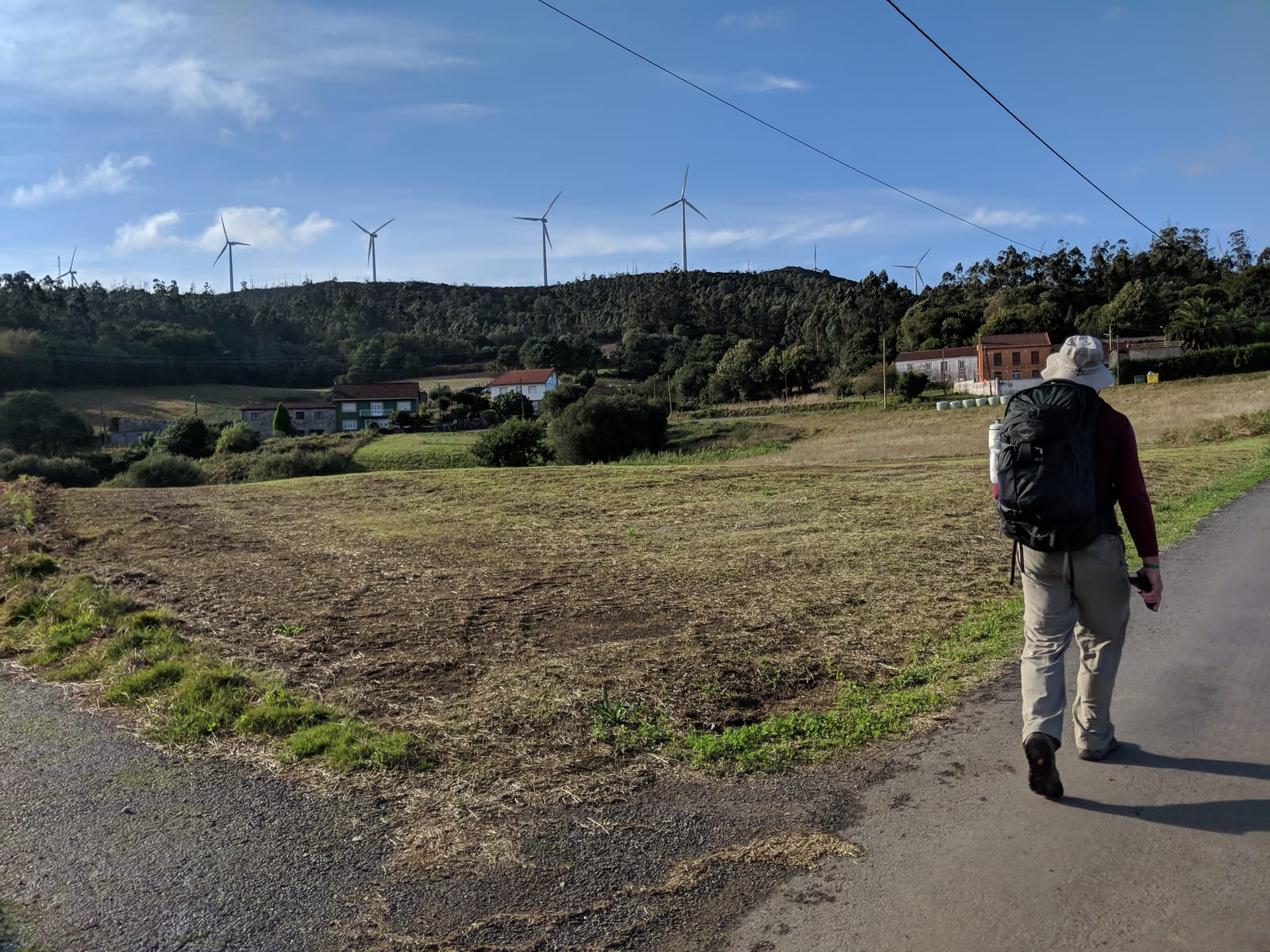
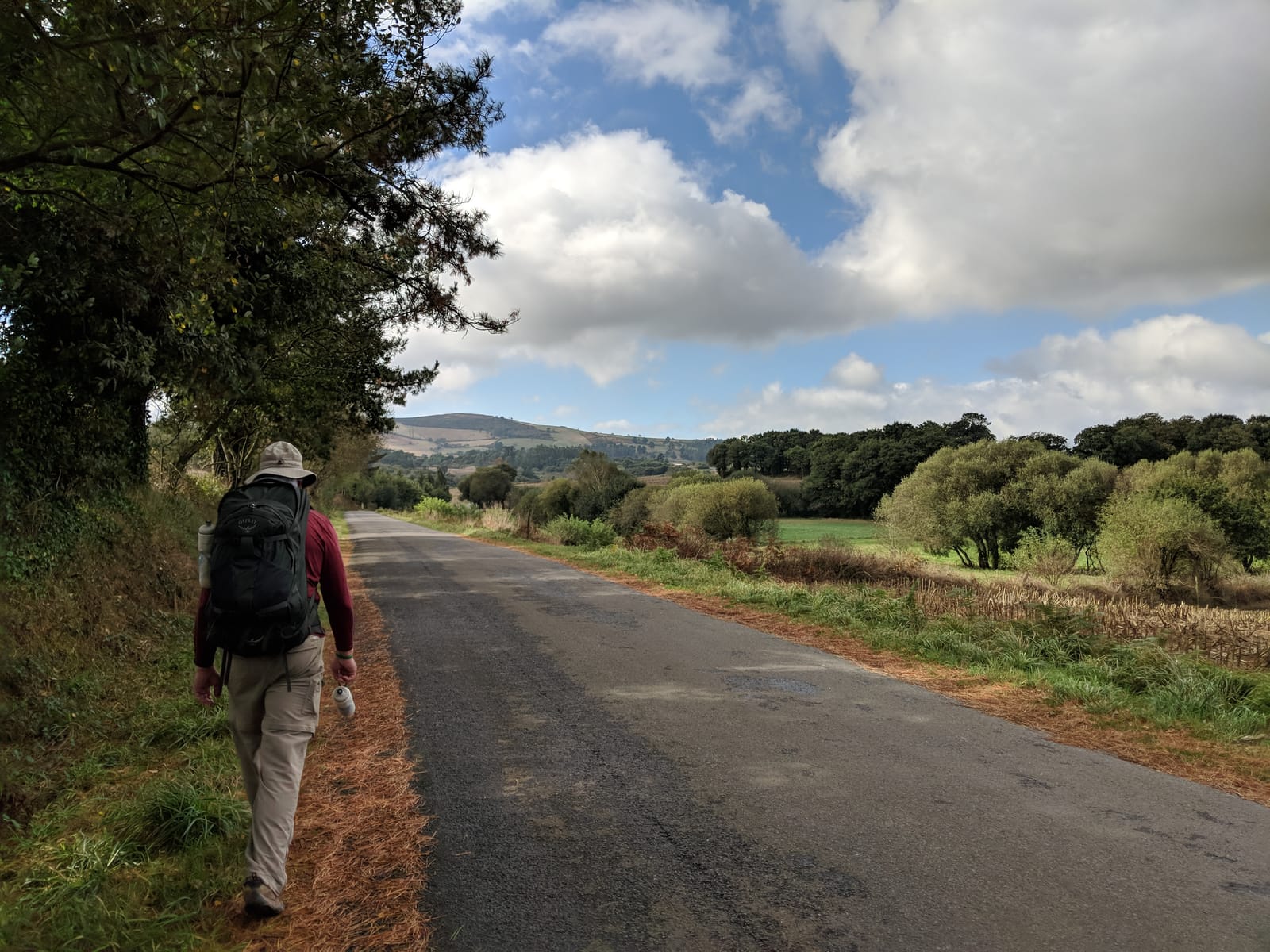
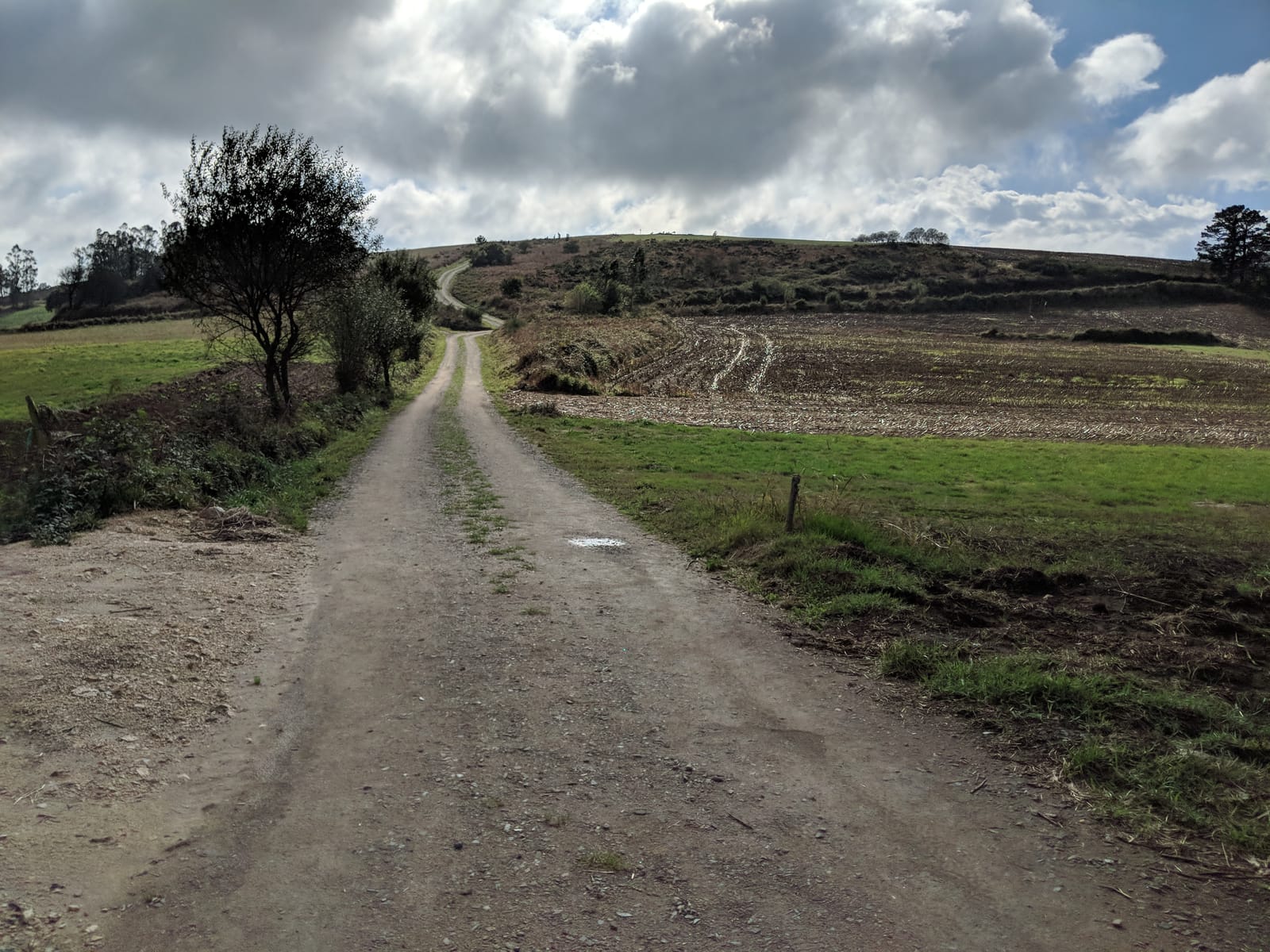
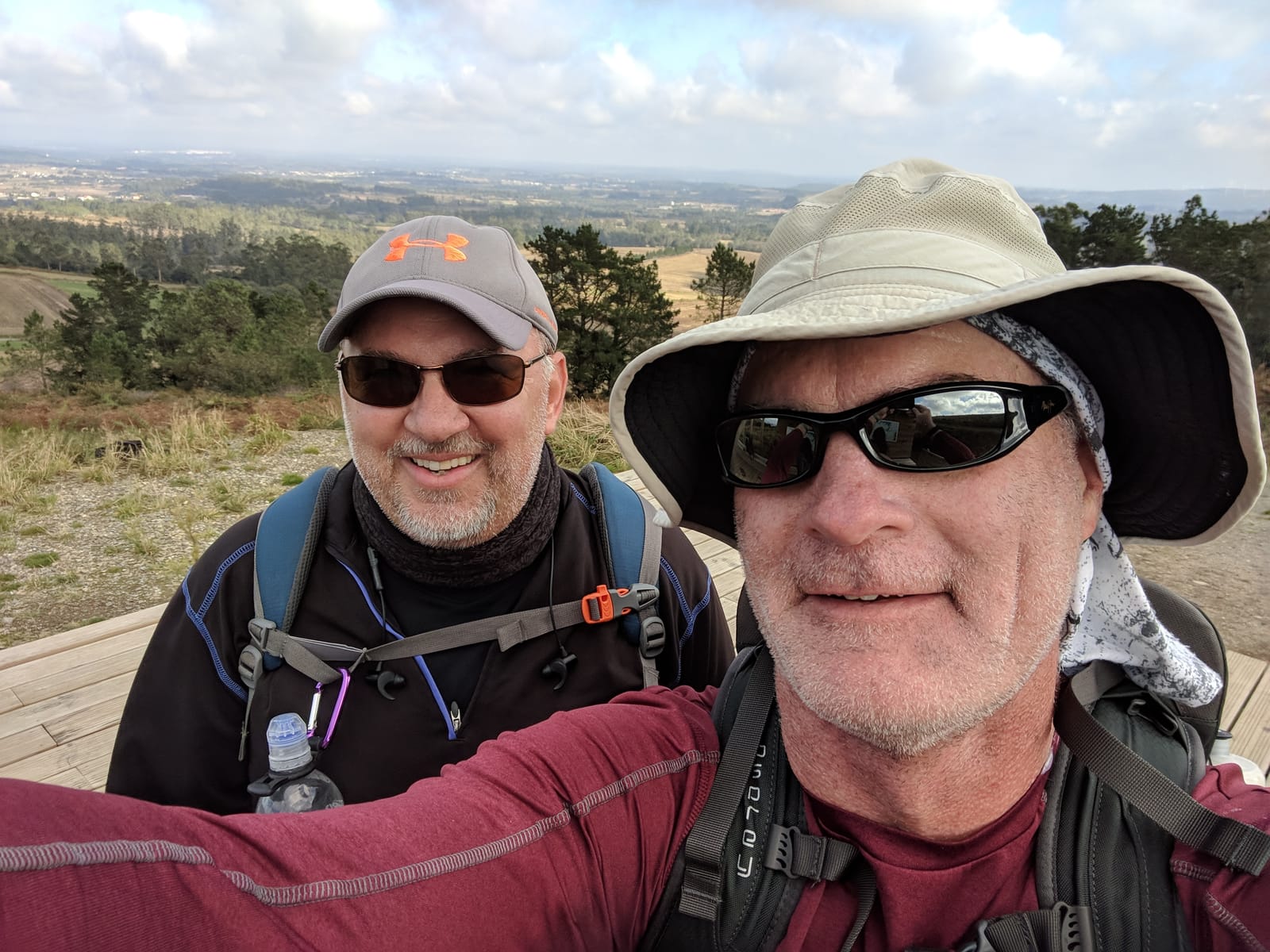
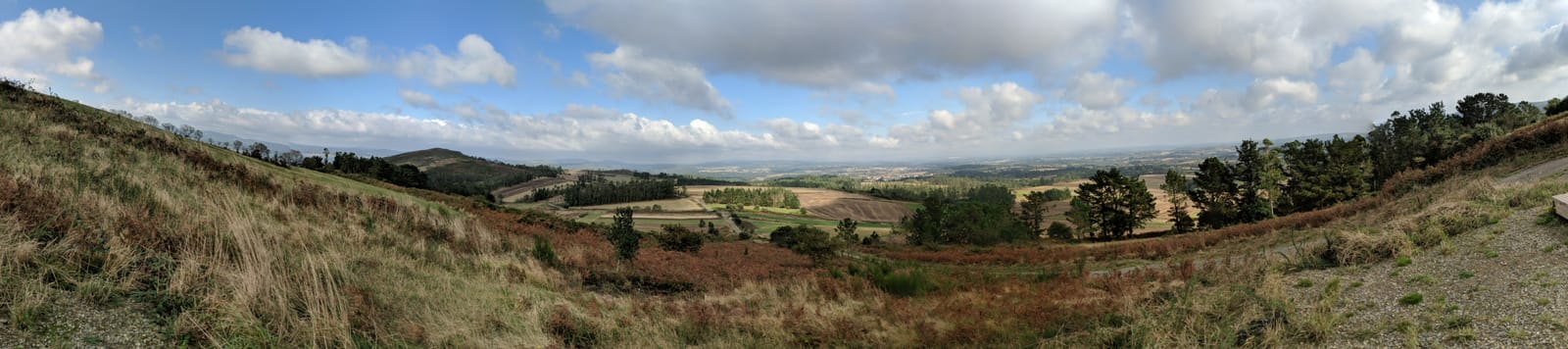
We weren't alone out there — Day 2 brought a lot of pilgrims onto the trail, and it was one of the real pleasures of the day. Being around other walkers, falling into step with people for a while and chatting as we went, gave the miles a sociable rhythm and reminded us we were all sharing the same road to the coast.
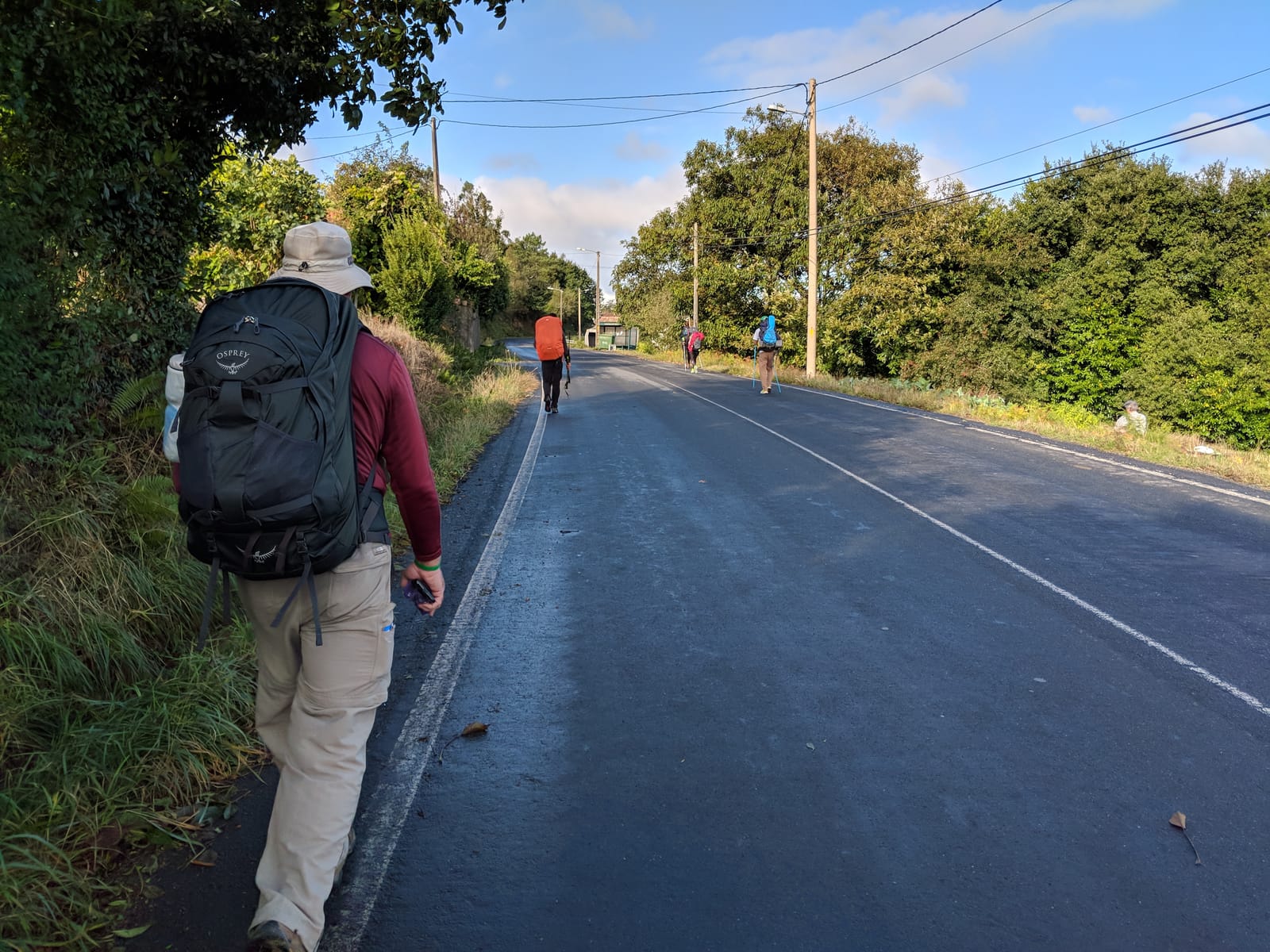
By the end of the day, we both had sore feet — 22 miles with so much of it on hard pavement will do that. In hindsight, trail runners or other cushioned shoes would have been a better choice for this particular section than what we had on. But sore feet and all, we really enjoyed the day: the varied scenery, the hilly countryside, the company on the trail, and the whole Camino experience made it one to remember.
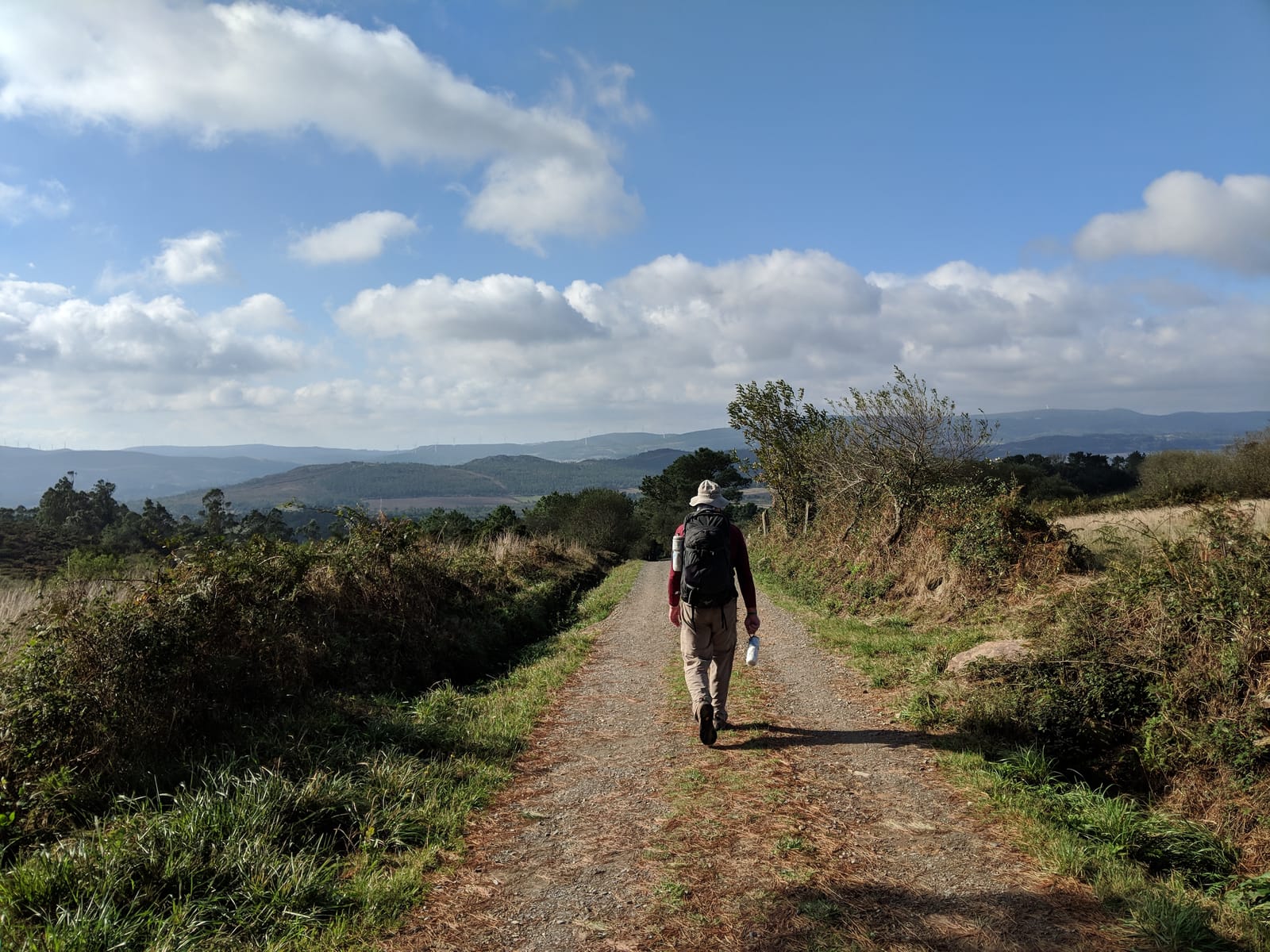
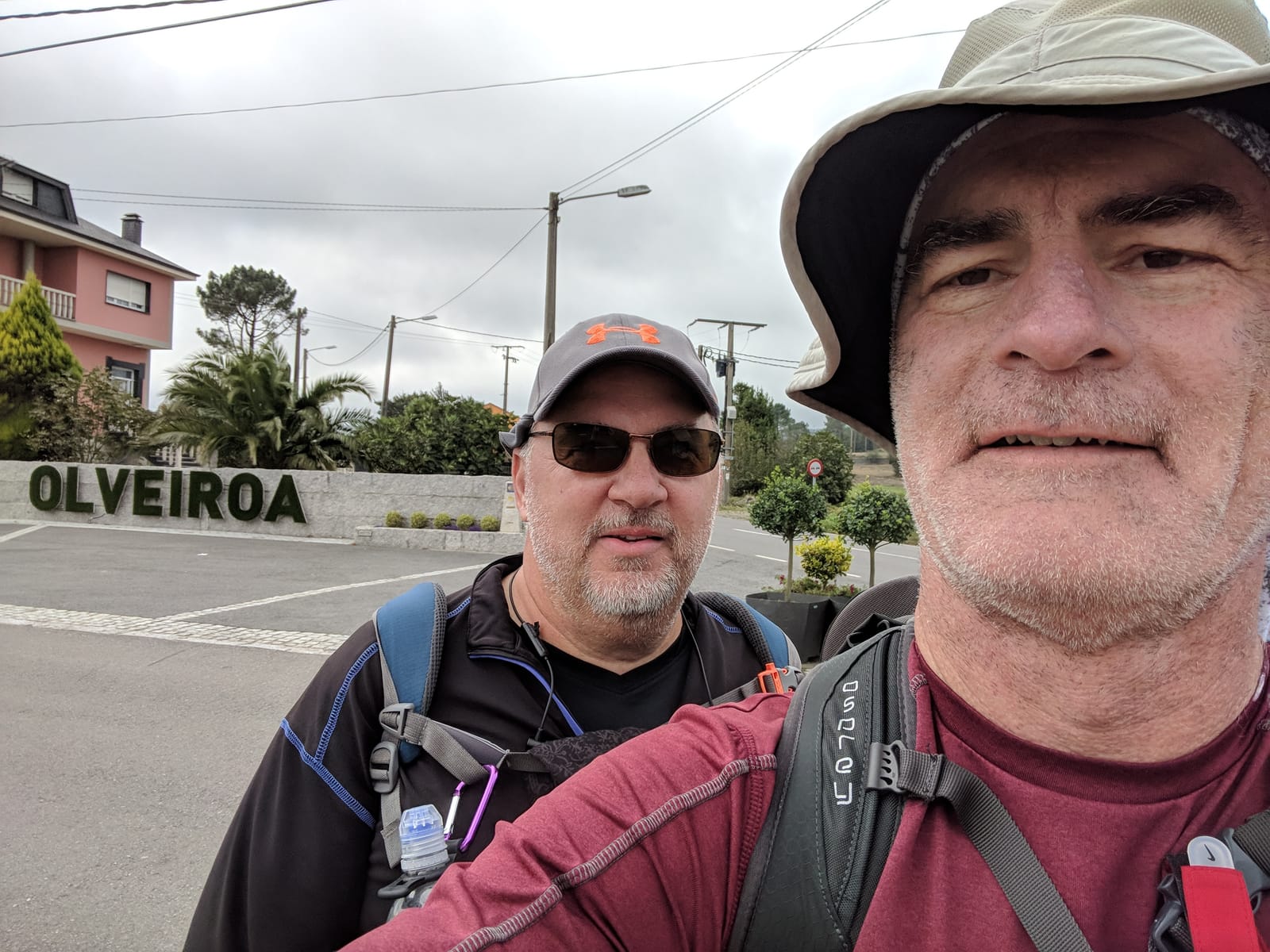
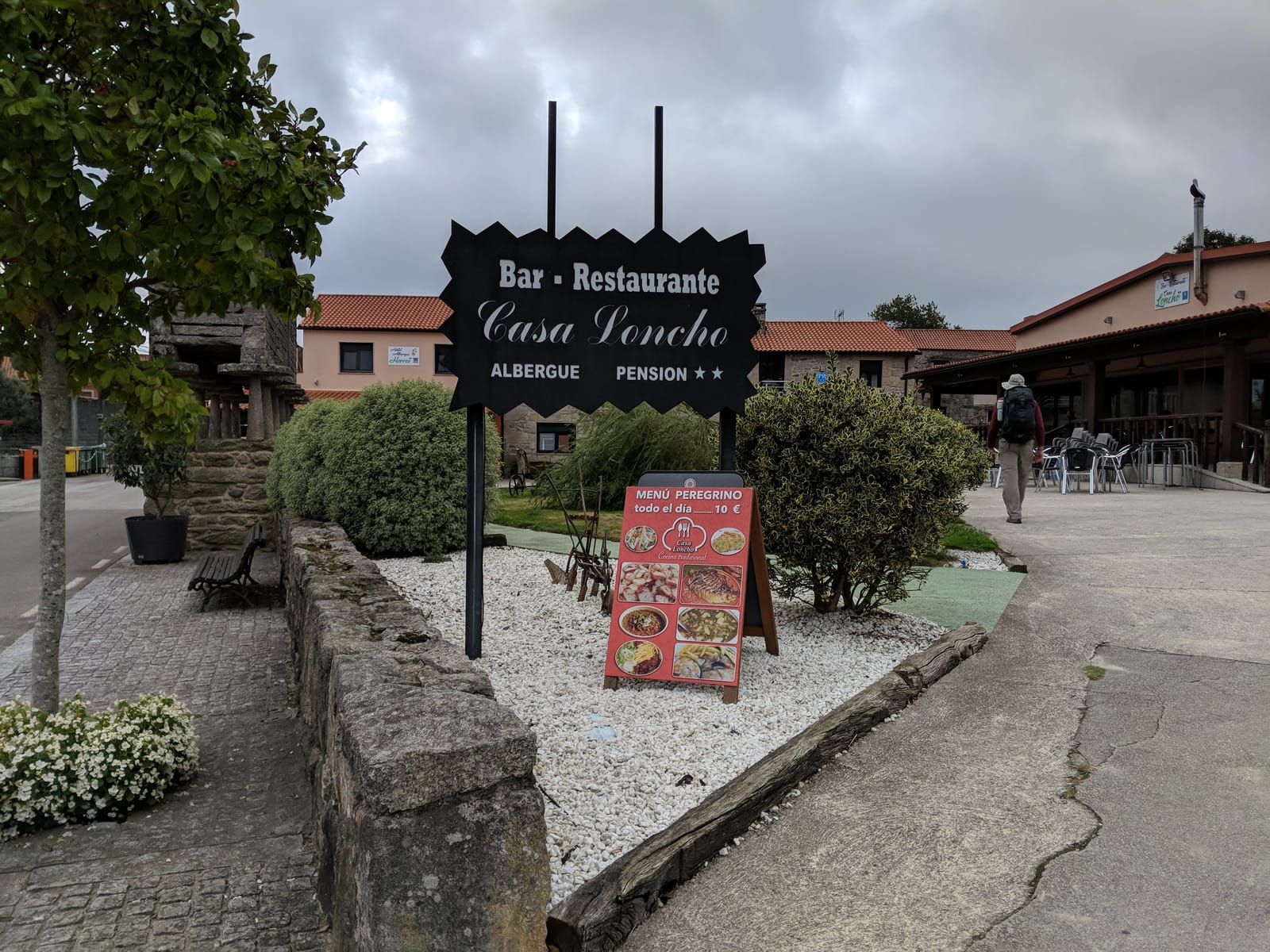
After twenty-two miles, the sign we'd been waiting for: OLVEIROA. Rolling into the little stone village at the end of such a long day felt like a real accomplishment. Like the night before, dinner was the classic menú peregrino — the €10 pilgrim menu you see advertised on boards all along the Camino — and it was more than earned.
Click any photo to enlarge it and read its caption.
The last push to the Atlantic · the Fisterra–Muxía fork · the coast at Km 0 · 19.94 mi
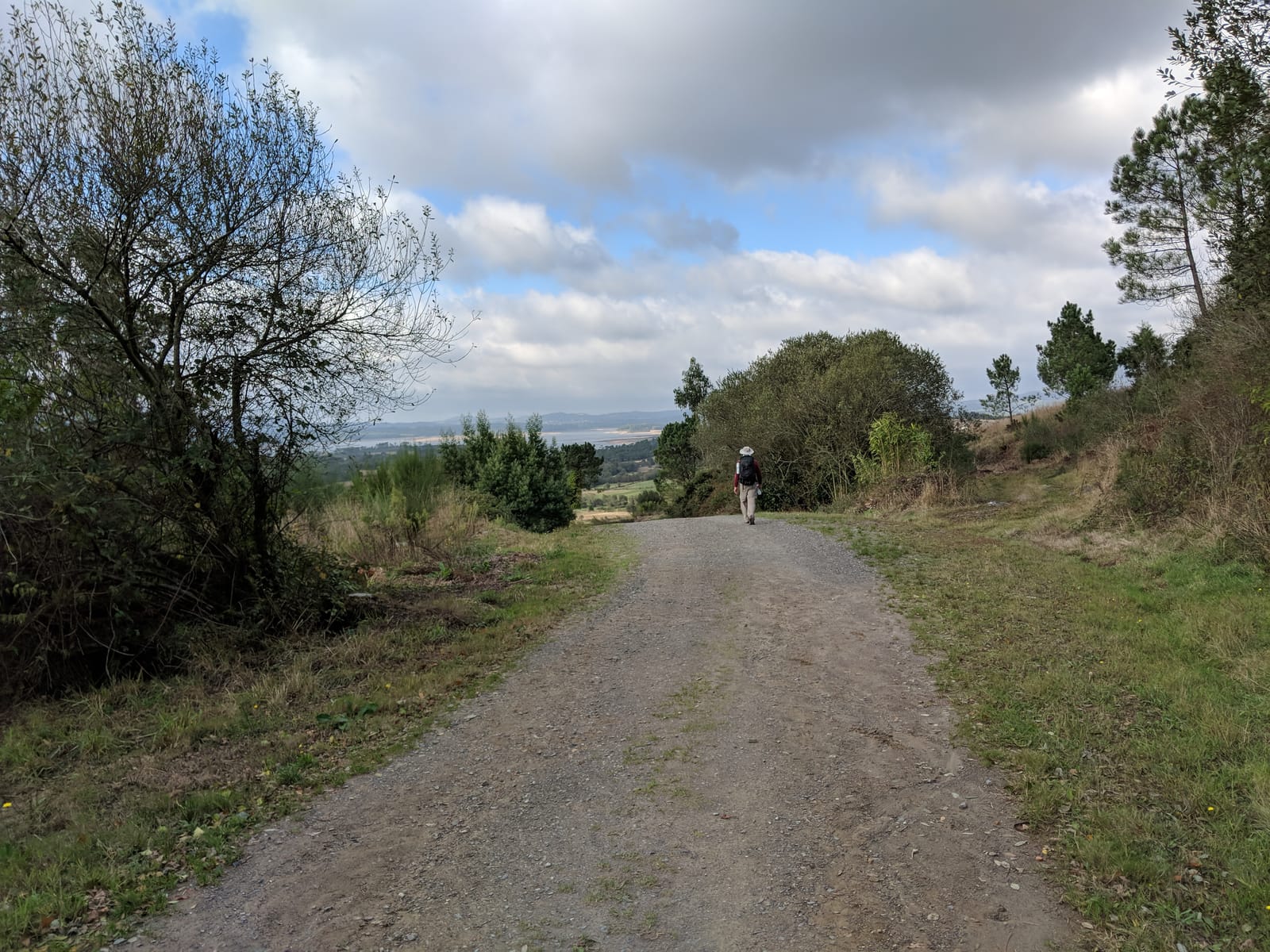
This was the day the walk reached the ocean. Just under twenty miles from Olveiroa out to Muxía, the little town on the wild Costa da Morte (the "Coast of Death") — one of the two places where the Camino meets the Atlantic. It's not the finish for us, though: Finisterre, the fabled "end of the world," still lay ahead. We set out from Olveiroa around seven and wouldn't stand at the ocean until mid-afternoon.
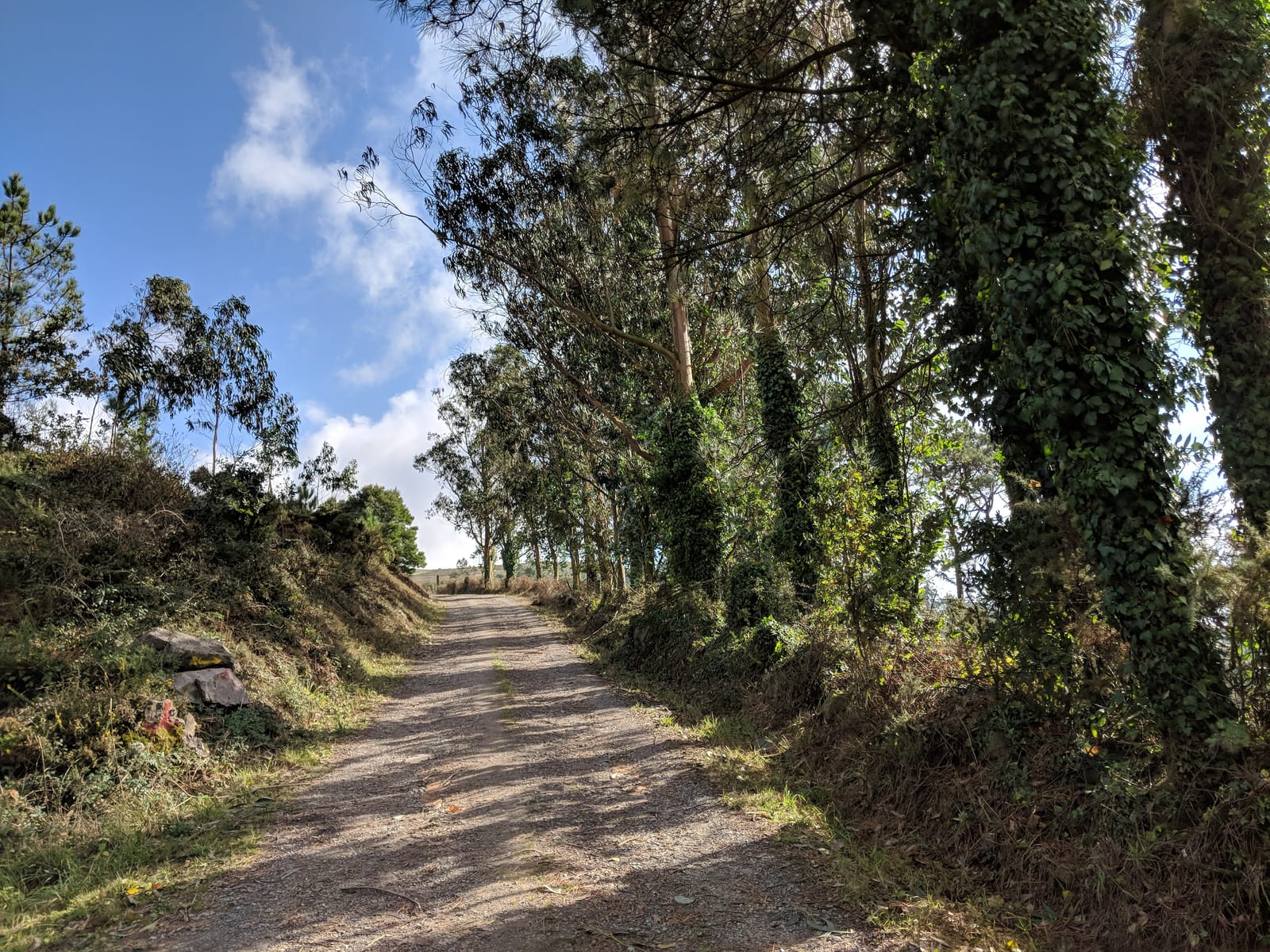
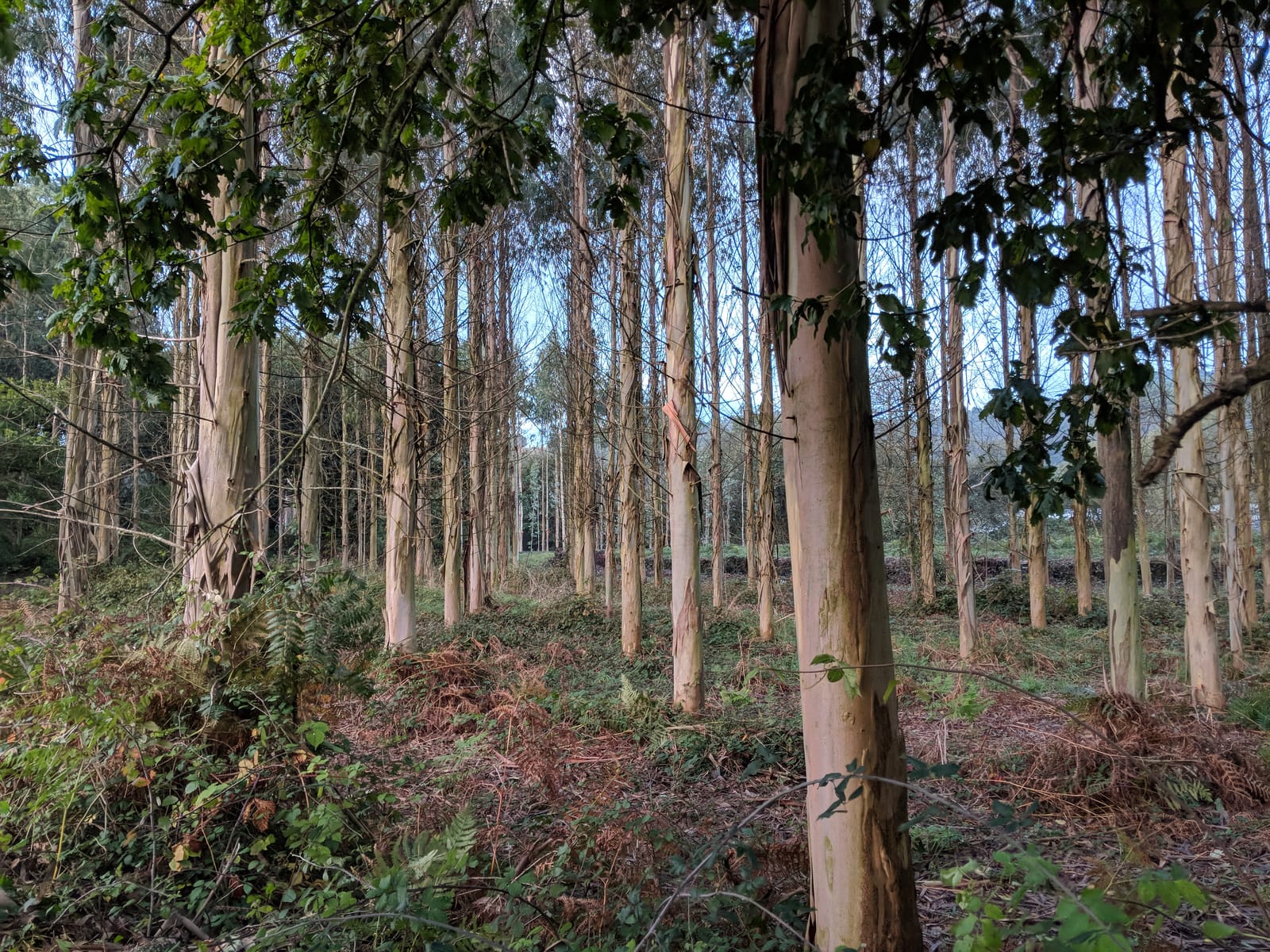
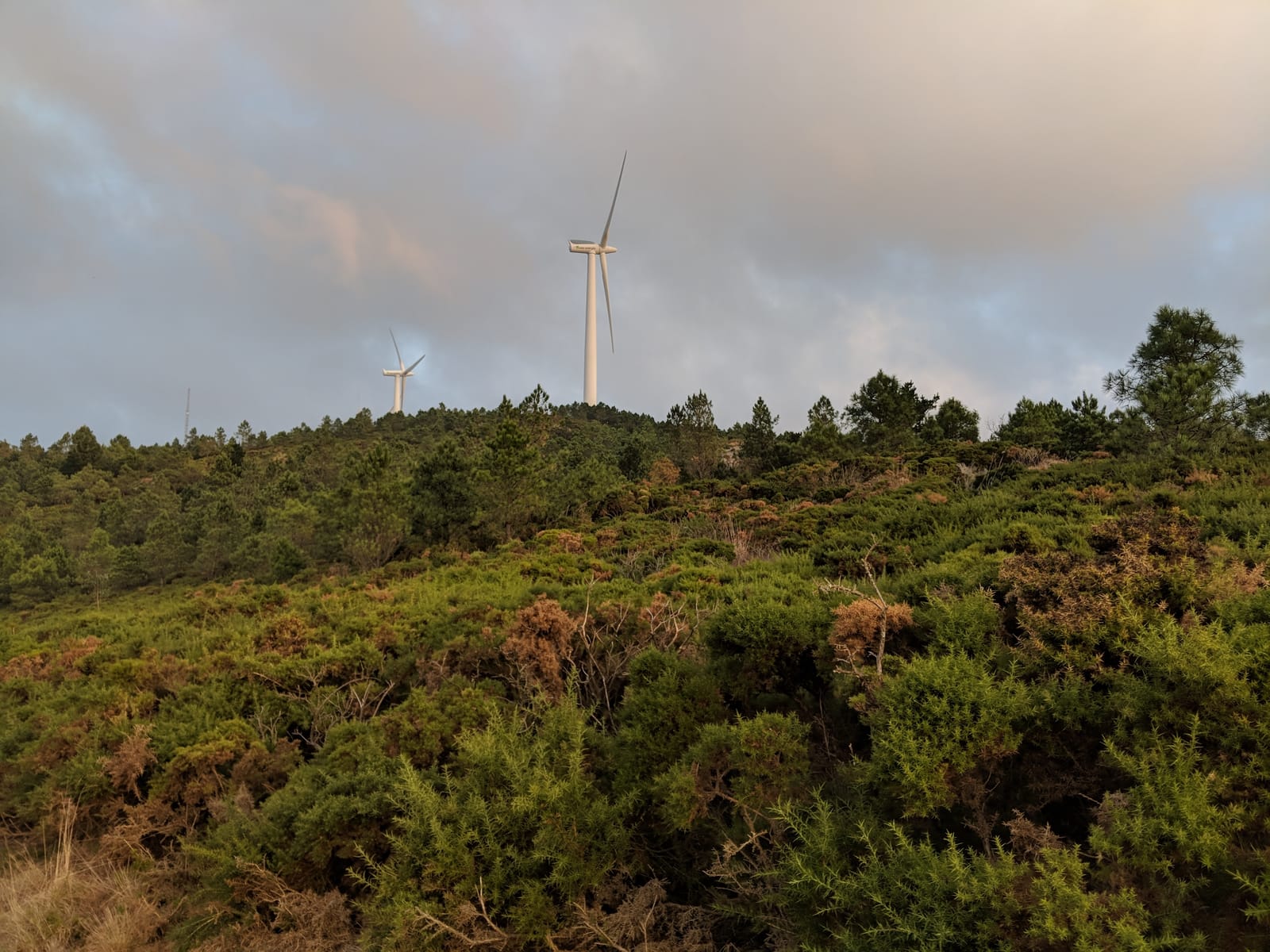
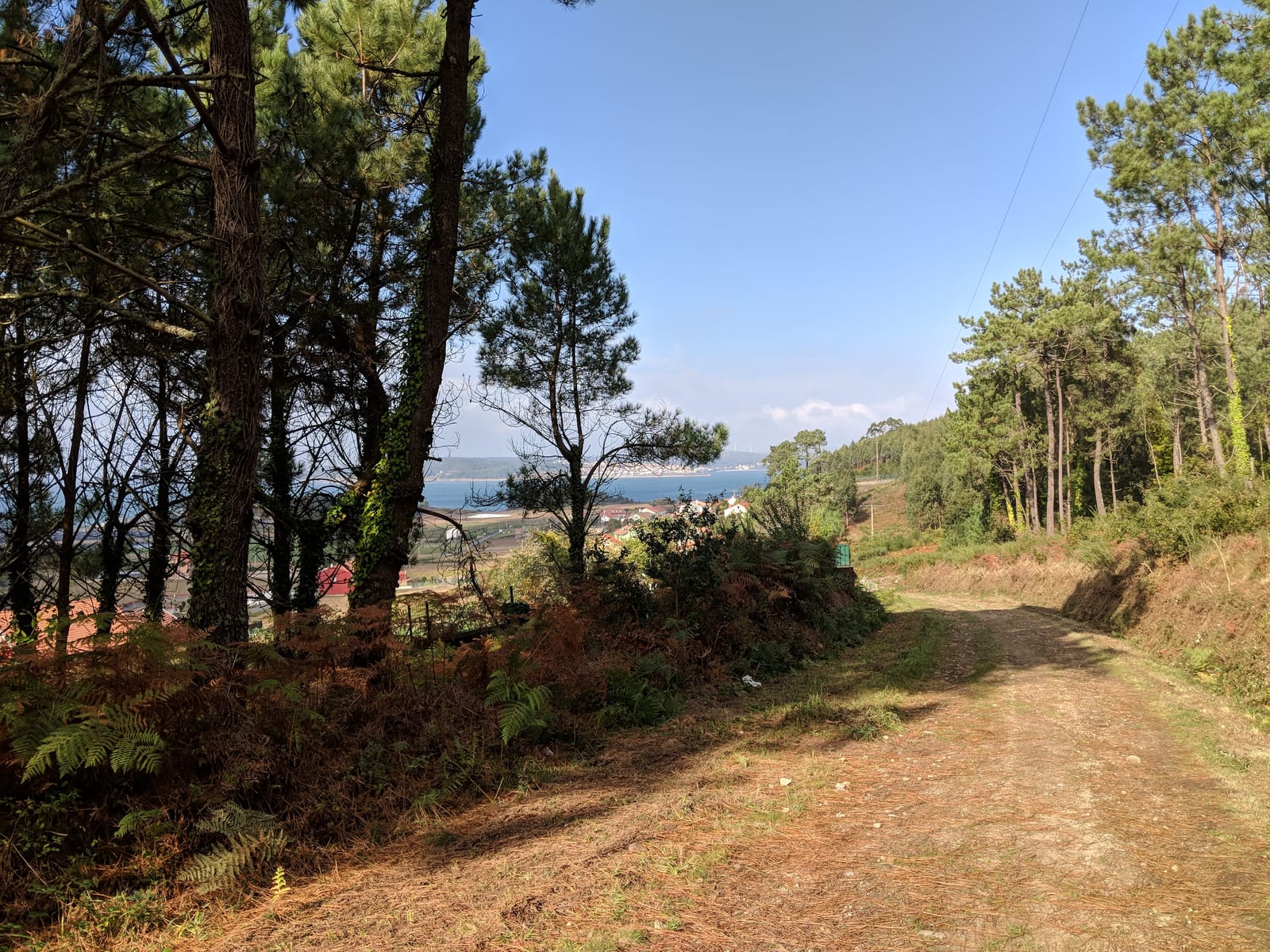
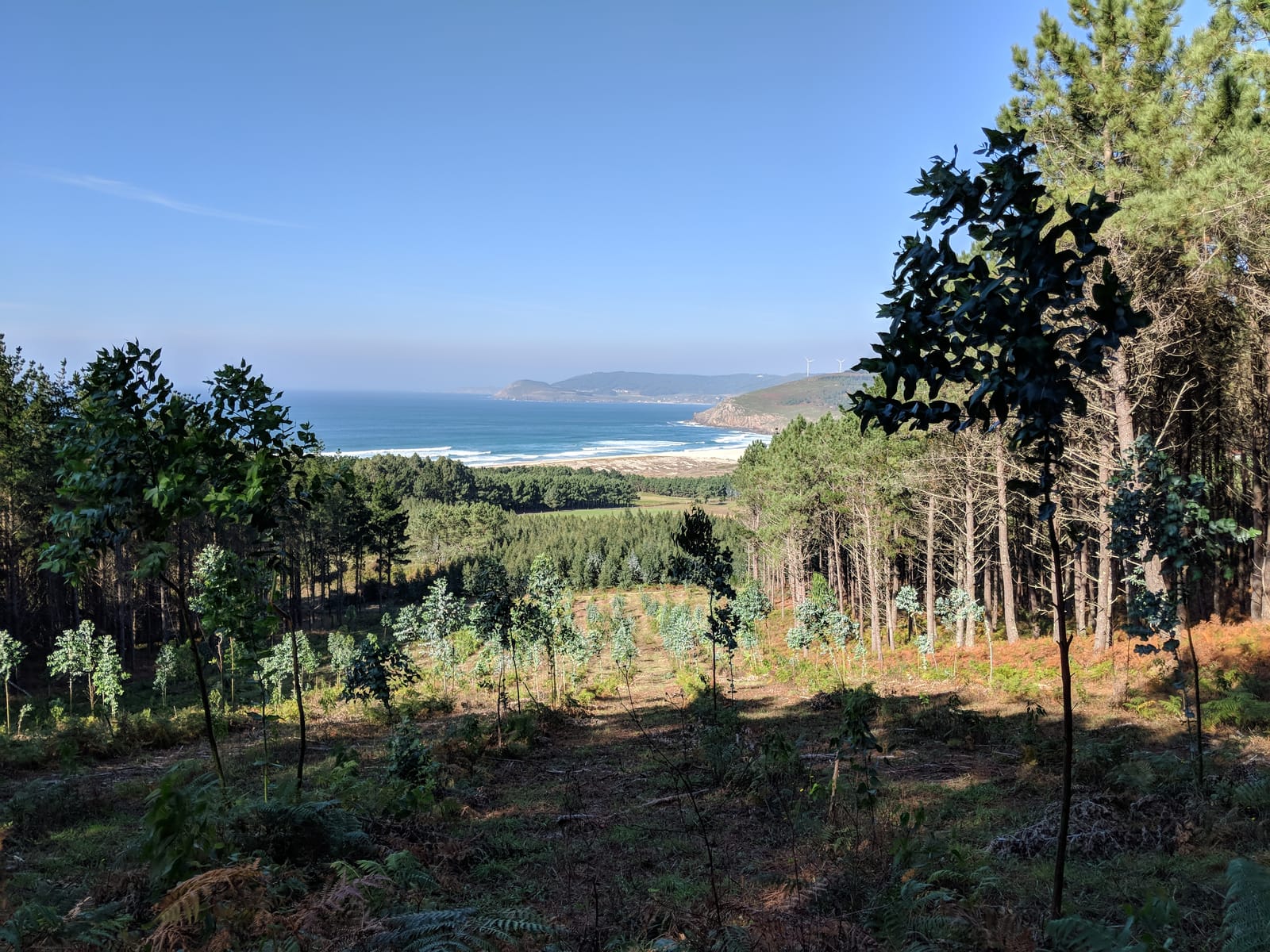
We left in the half-light and climbed straight into it — tall eucalyptus woods first, then up onto open, scrubby ridges where lines of wind turbines turned slowly against a moody morning sky. It was atmospheric walking, the kind that makes an early start worth it.
Early in the day we reached the split we'd been reading about. At the roundabout above the town of Hospital, the Camino Finisterre divides: one arm bends south to Fisterra (Finisterre), the other northwest to Muxía. A big yellow board lays out both options, and two waymarker pillars stand side by side — a yellow arrow left for Fisterra, a yellow arrow right for Muxía. We went right, toward Muxía.
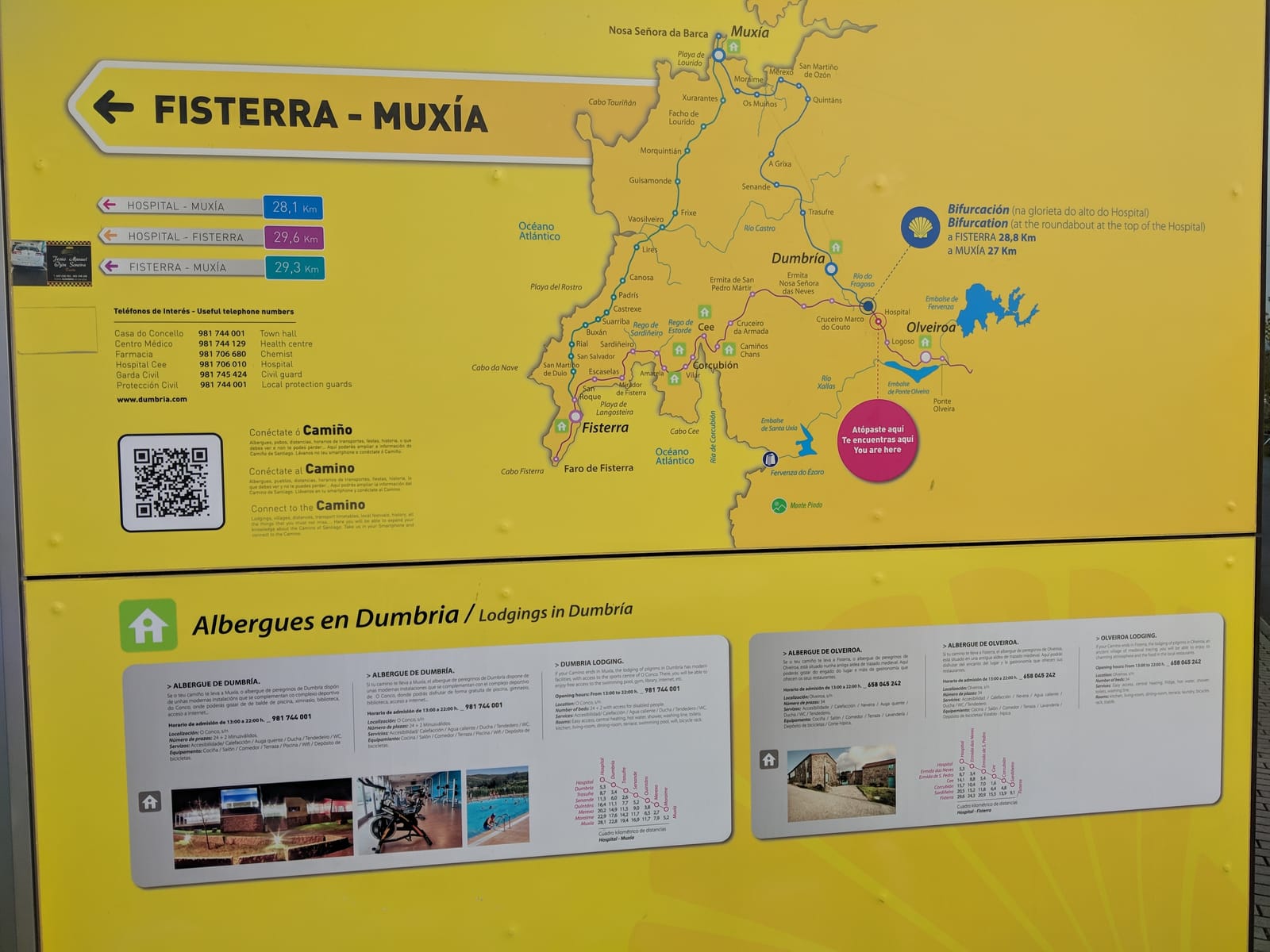
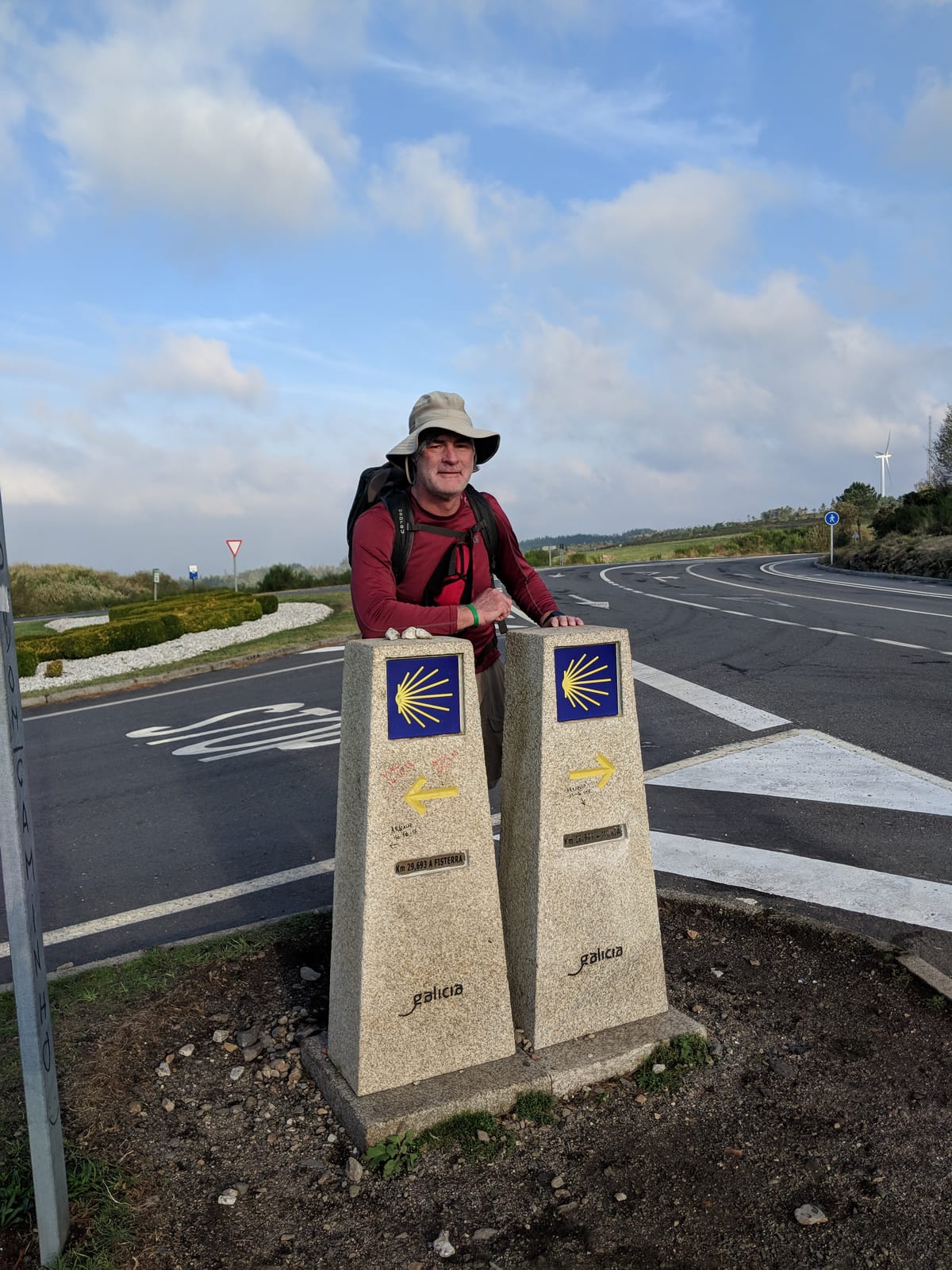
From what we could see, we were the only pilgrims heading to Muxía that morning — and we didn't cross paths with another one the rest of the day. After the crowds of the days before, having the trail entirely to ourselves suited us just fine.
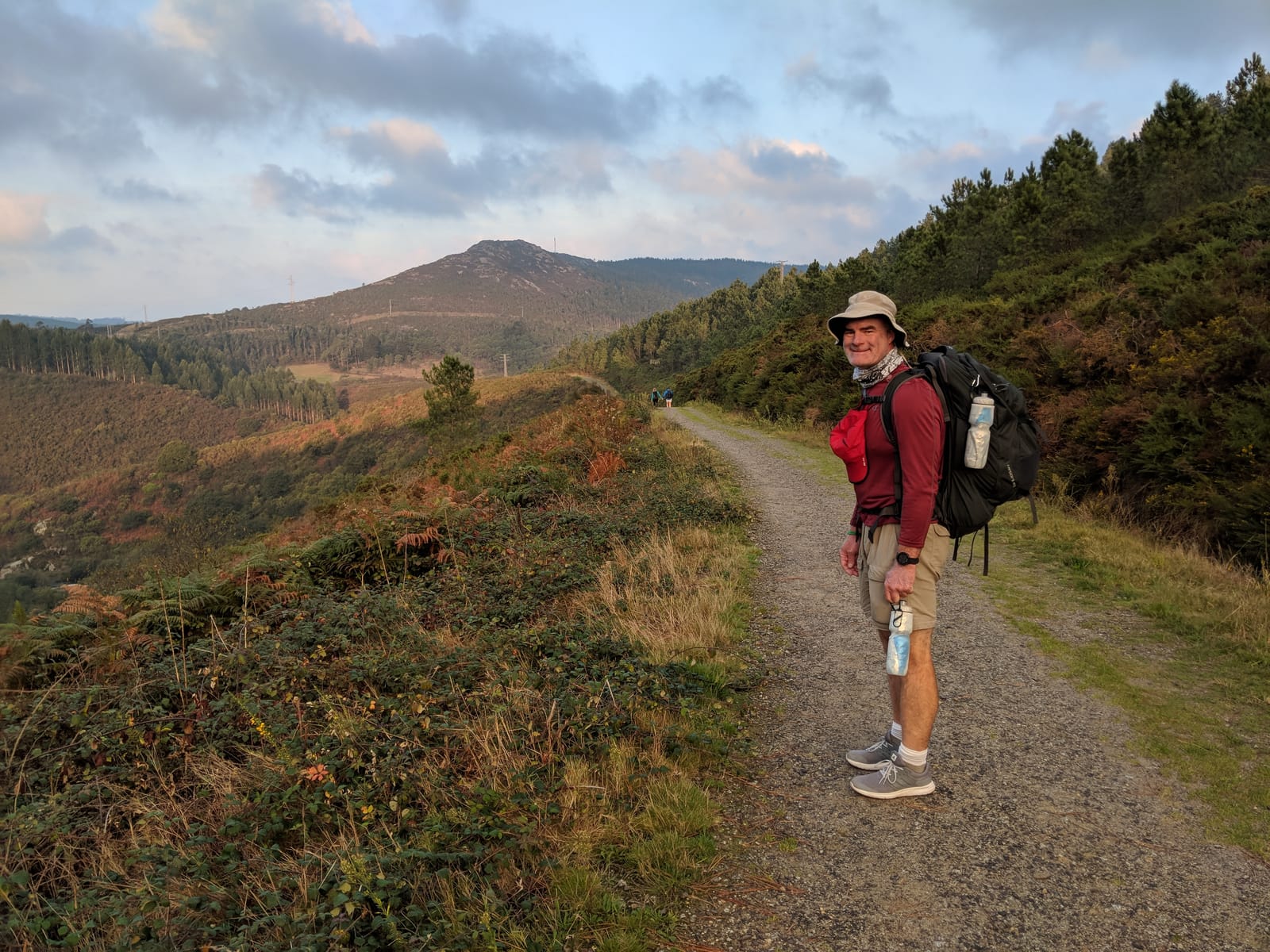
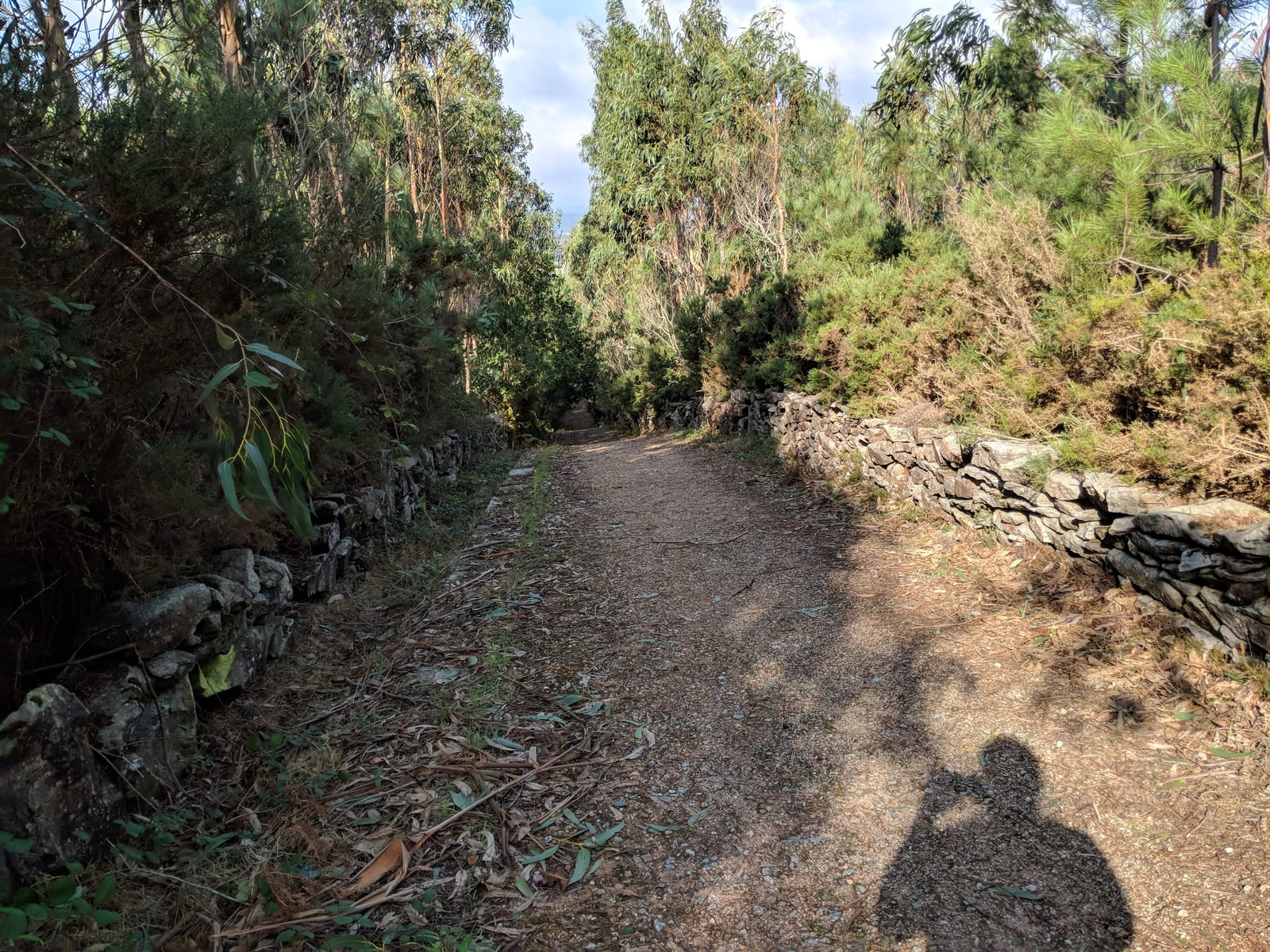
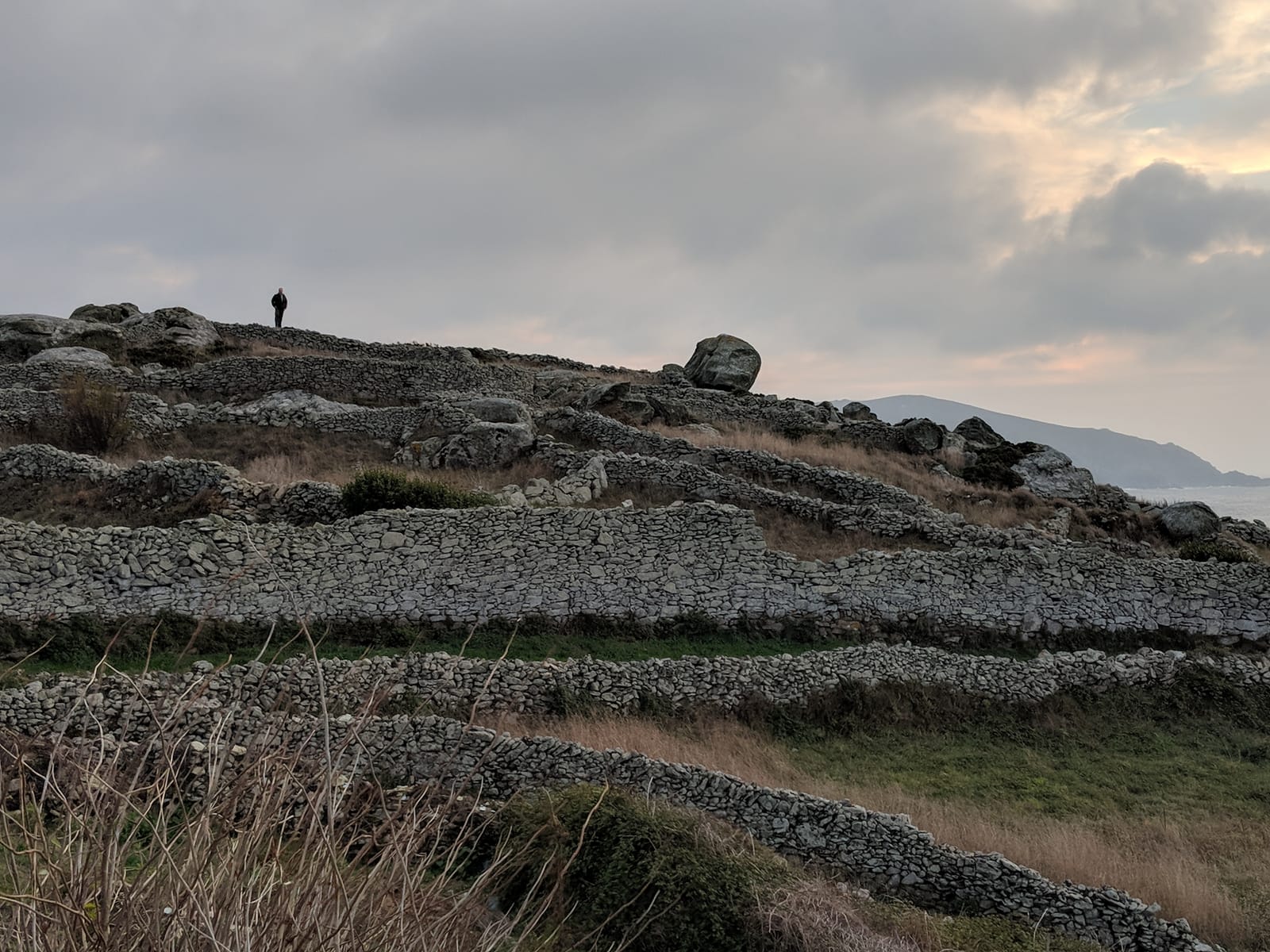
The terrain stayed varied and interesting the whole way — eucalyptus and pine woods, old dry-stone-walled lanes, granite hórreos standing over the valleys, and open ridgelines. The nearer we got to Muxía, the more the sea breezes picked up, until you could feel the Atlantic ahead before you could see it.
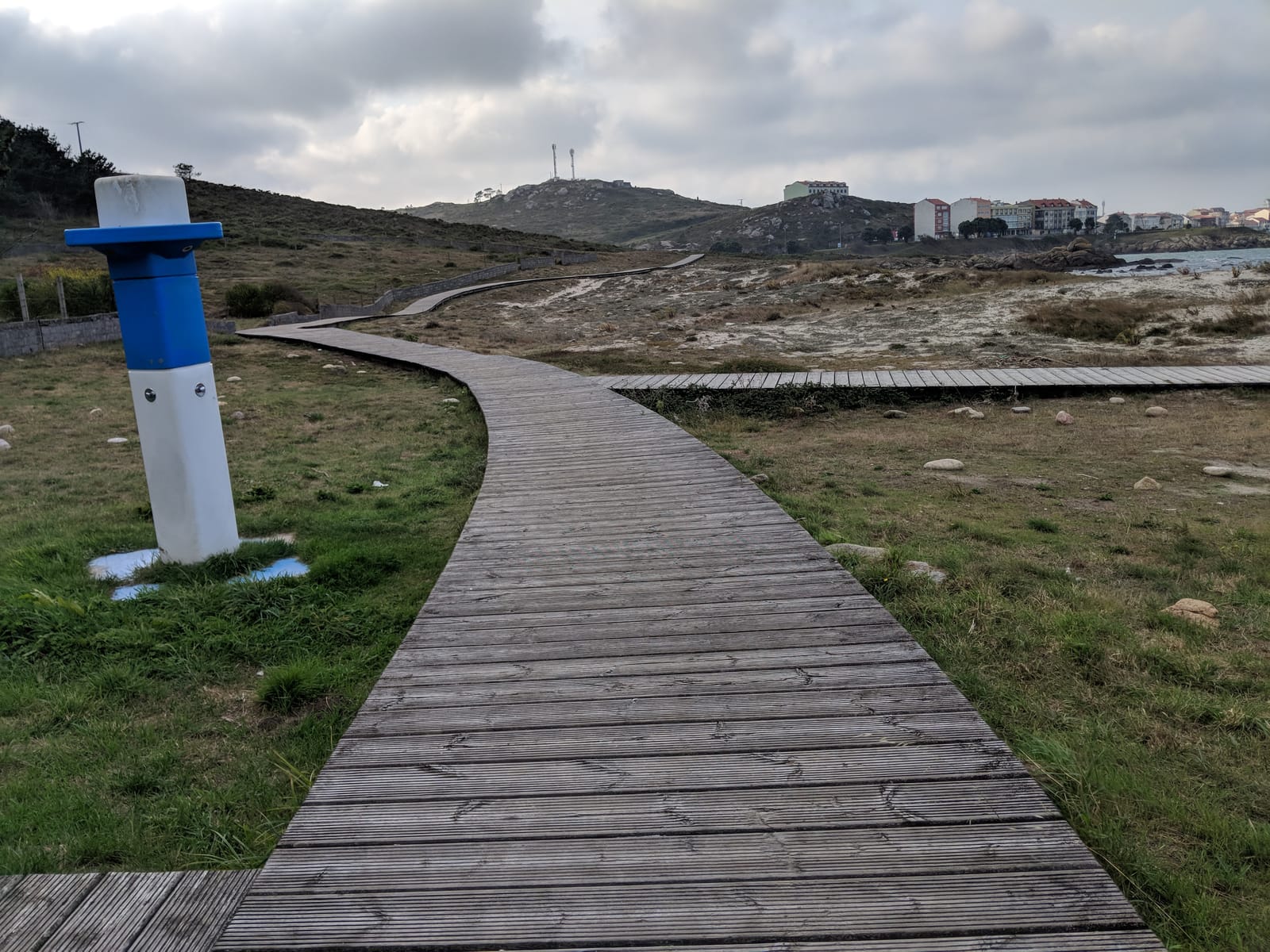
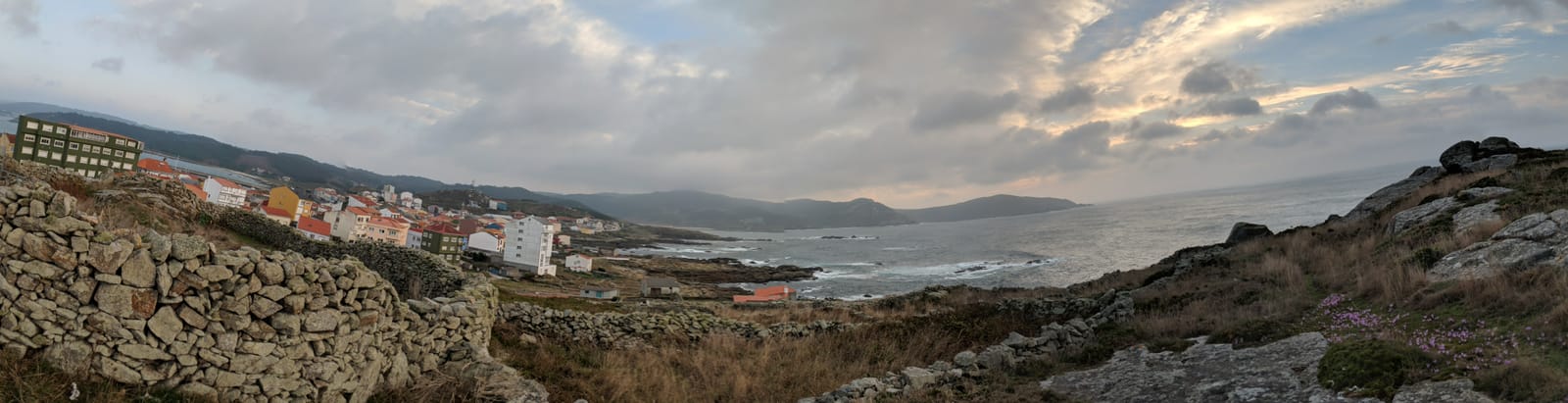
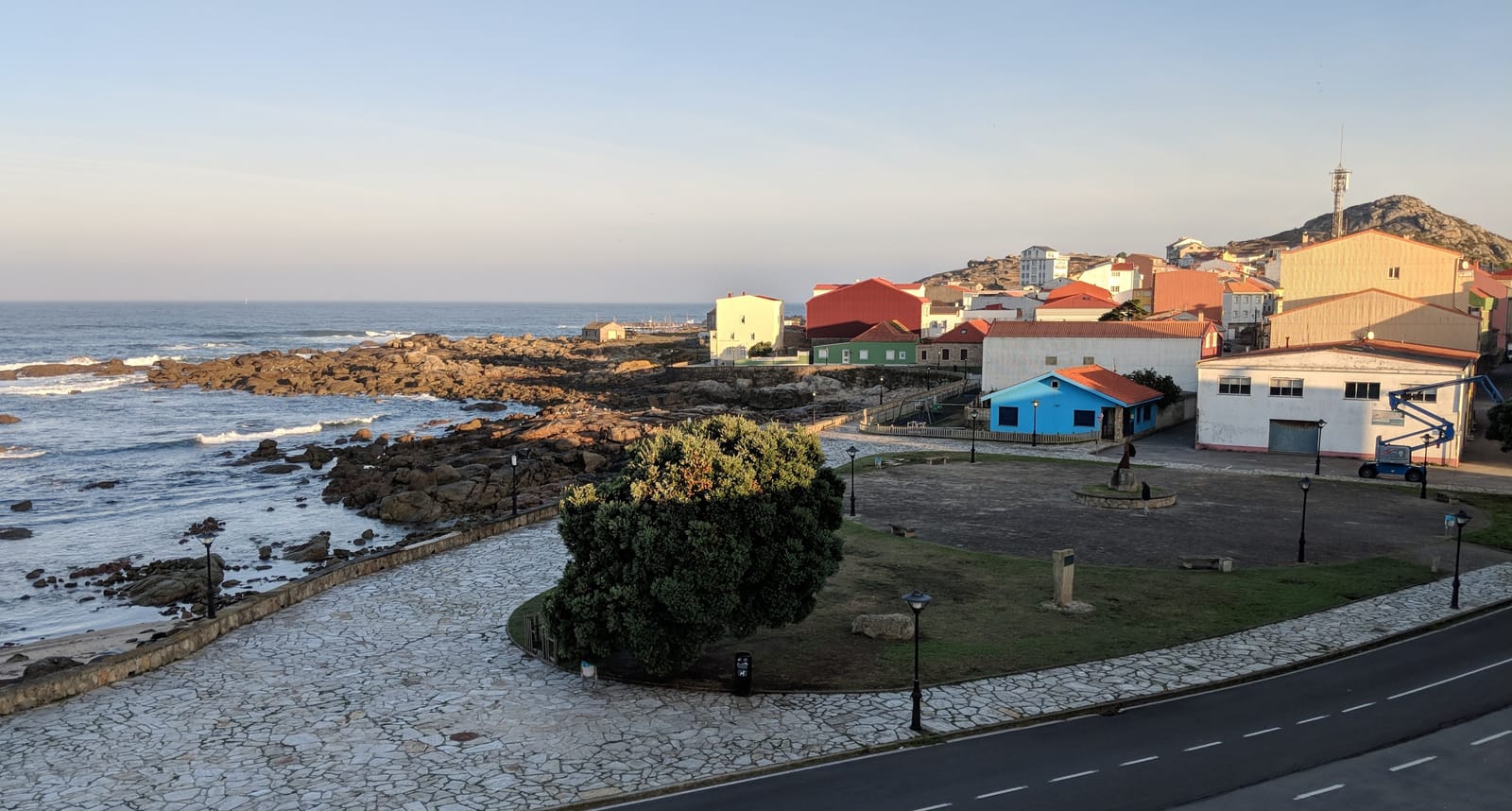
A long wooden boardwalk carried us the last stretch across the dunes and into town. Muxía had a solemn feel that afternoon — gray, cooler, the wind up and the sea rough against the rocks. But it was genuinely exciting to arrive, to have walked the whole way from Santiago to the edge of the ocean. We dropped our packs and headed out to the point to see it.
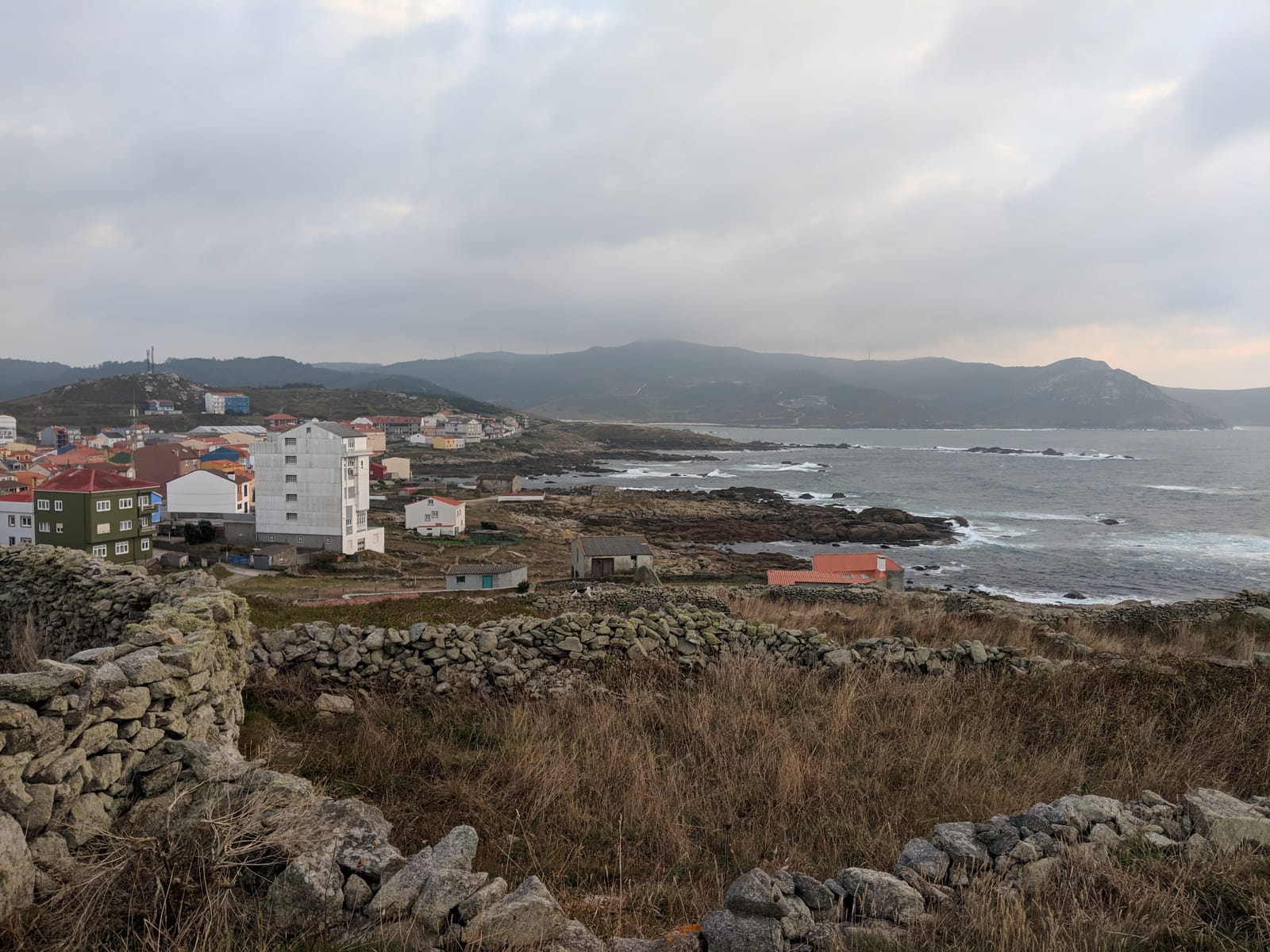
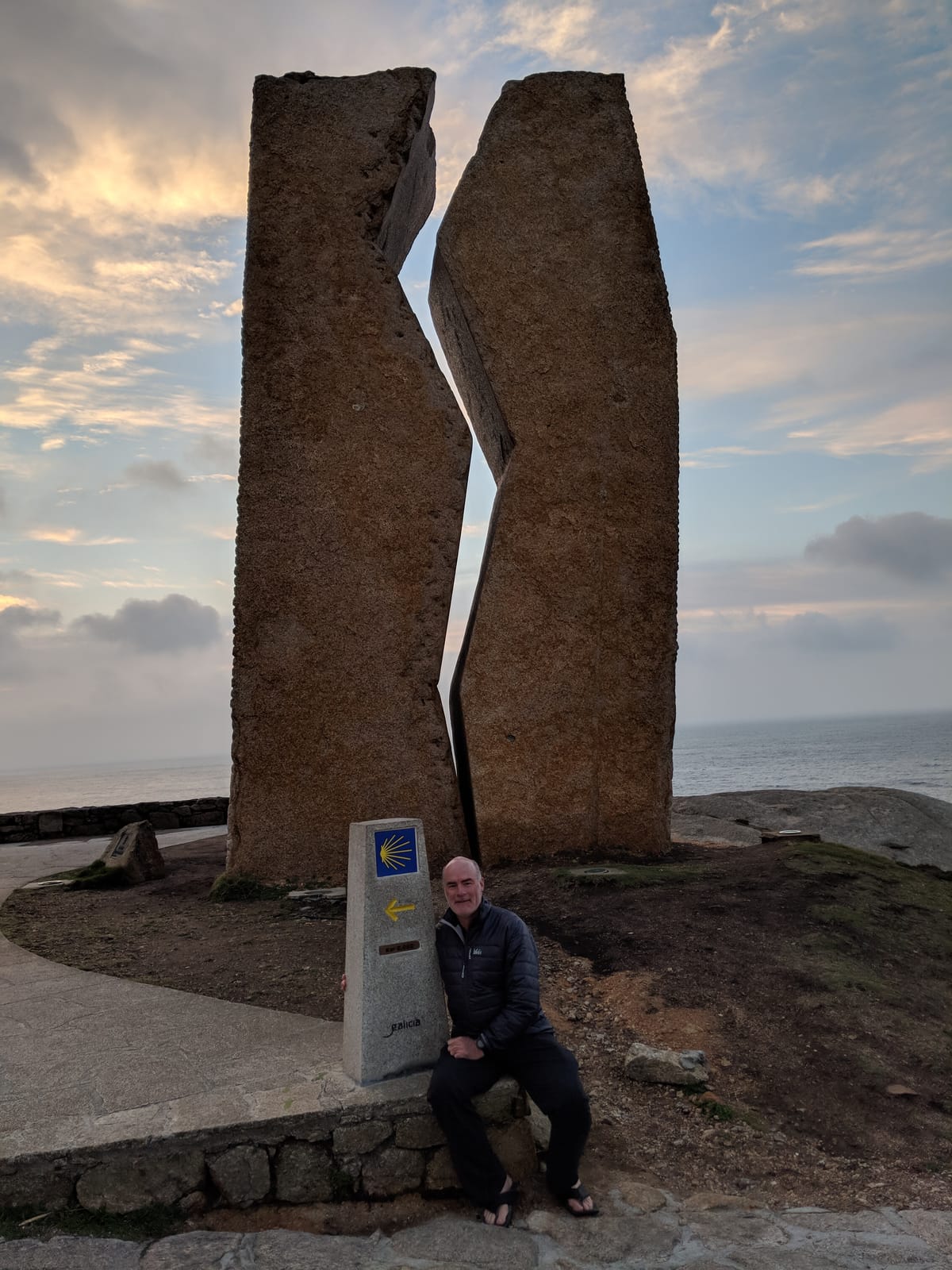
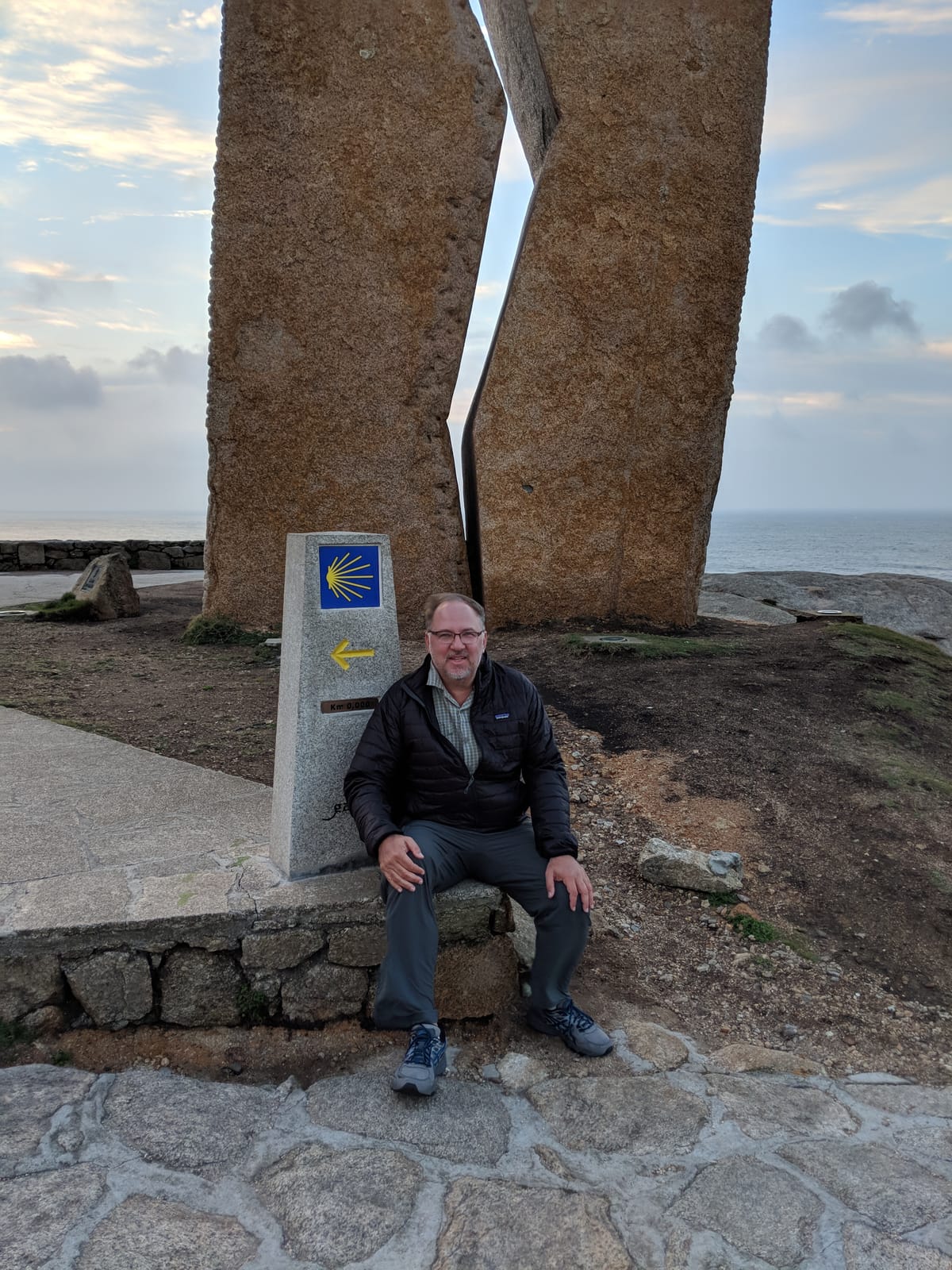
Out on the point stands the structure we found so fascinating: two towering slabs of granite, split apart with a jagged gap running between them. It's a sculpture called A Ferida — Galician for "The Wound" — carved by the sculptor Alberto Bañuelos and raised here in 2003. It commemorates the Prestige disaster: in November 2002 the oil tanker Prestige broke apart and sank off this coast, spilling some 63,000 tonnes of heavy fuel oil and fouling the Costa da Morte in one of the worst environmental catastrophes Europe has seen. Tens of thousands of volunteers came to scrub the black oil from these rocks and beaches. The split stone is exactly that — an open wound in the granite, a scar on the land and its people.
At the foot of the monument sits a Camino waymarker reading "Km 0,000" — the Muxía branch of the Camino counts all the way down to zero right here at the water's edge. For us, though, Muxía was only the first coast: we still had Finisterre, the "end of the world," to walk to.
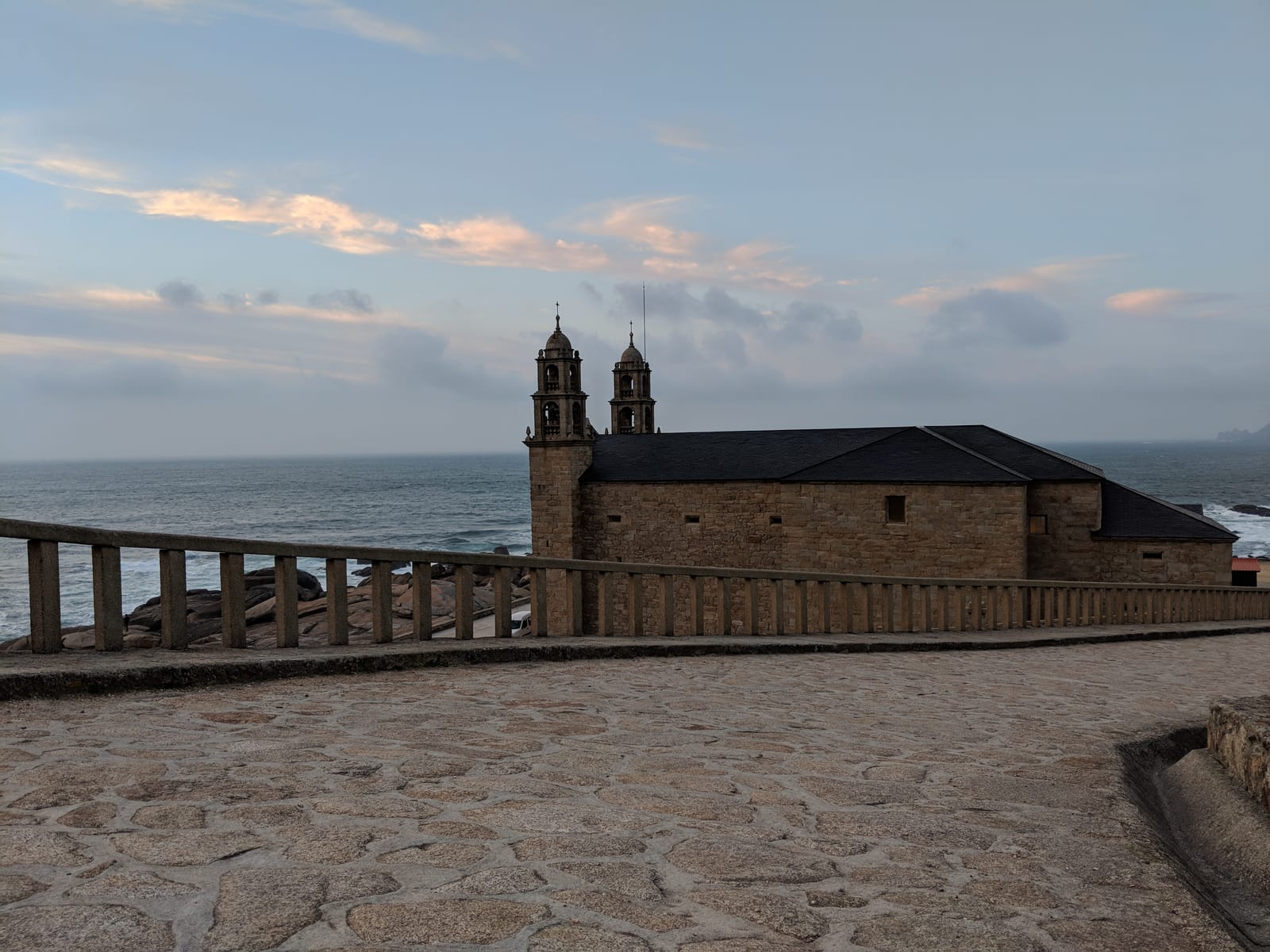
Beside the monument, right on the rocks, stands the Santuario da Virxe da Barca — the Sanctuary of Our Lady of the Boat. Its legend gives the place its name: the Virgin Mary is said to have come to this shore in a stone boat to encourage the Apostle St. James as he preached across Galicia. The great flat rocks scattered along the shoreline are held to be the remains of that boat — the Pedra de Abalar (the hull, a "rocking stone" that shifts underfoot) and the Pedra dos Cadrís (the sail, with a hollow pilgrims crawl beneath for healing). The present Baroque church was built in the 1700s, and it remains one of Galicia's most important Marian pilgrimage sites. A lightning strike gutted the interior on Christmas Day 2013; it was carefully restored, and the gilded altarpiece inside — where the Virgin sits above a small stone boat — glows again as it did before.
If the setting looks familiar, it may be from the movies: Muxía and this sanctuary feature in The Way (2010). In the film's final scenes, Martin Sheen's character walks on past Santiago to this very coast to scatter the last of his son's ashes — the final stop of his journey. Ours wasn't over yet, though: the "end of the world" at Finisterre still lay ahead of us.
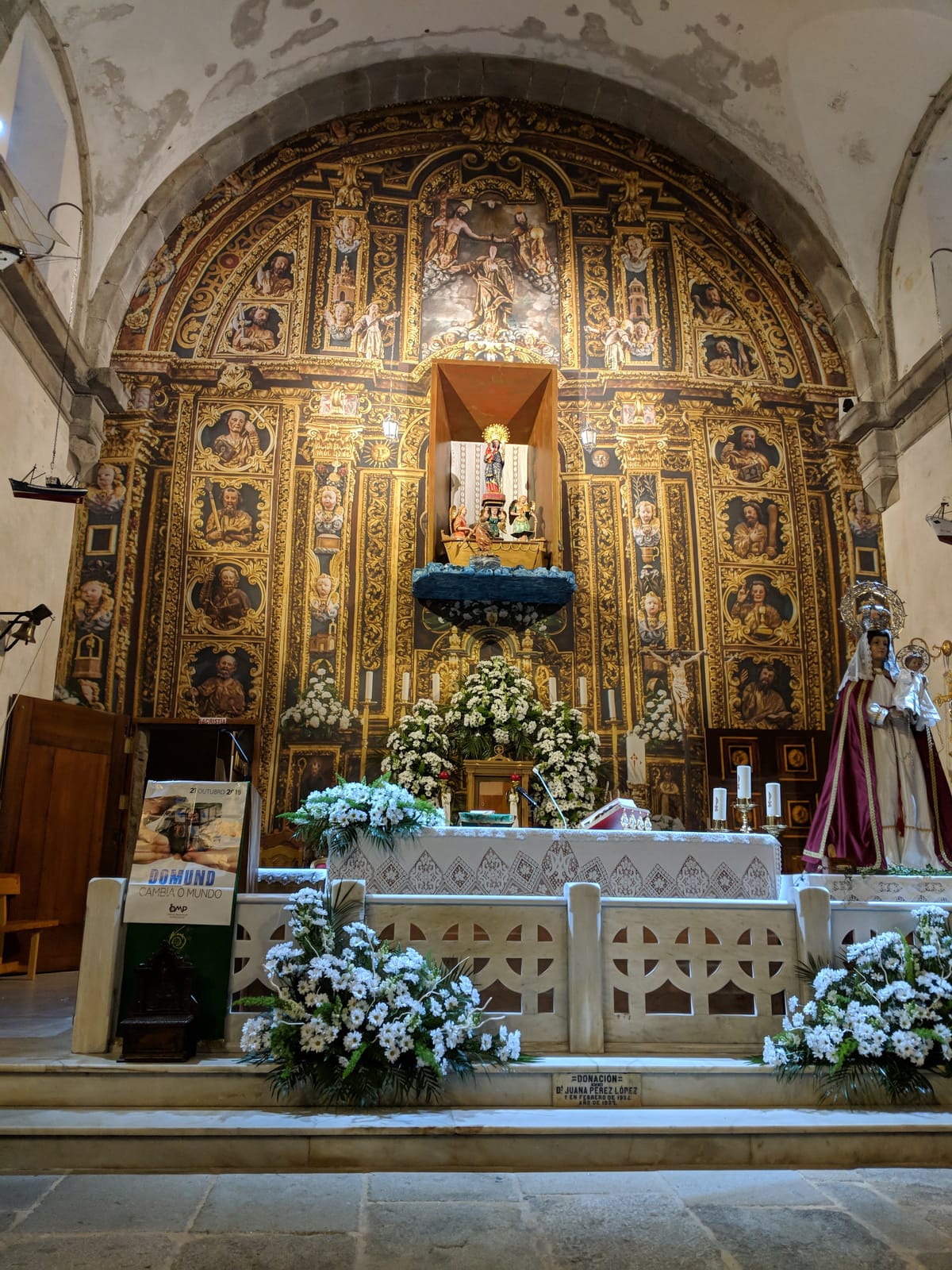
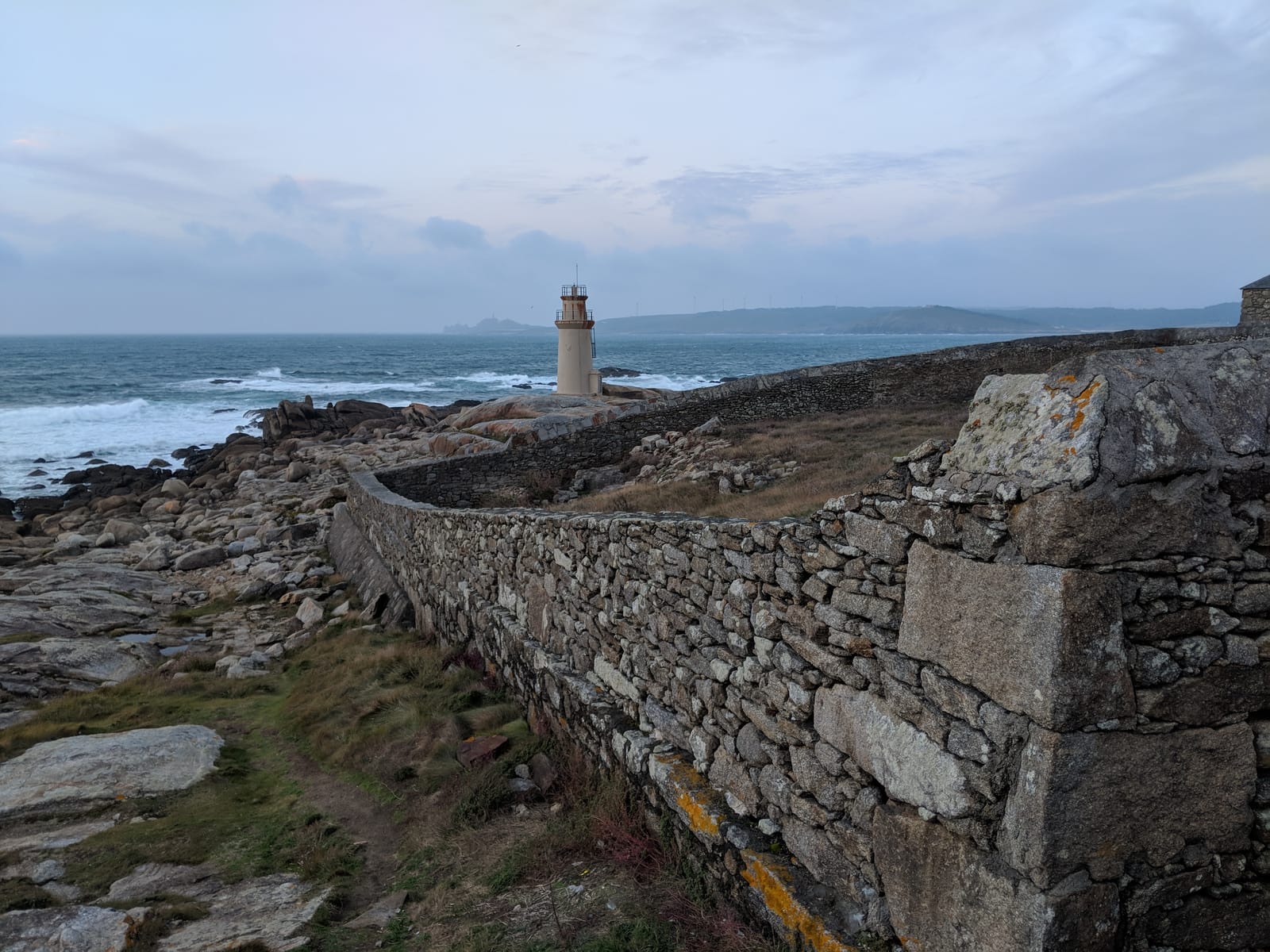
After checking into our accommodations, we set off on a loop around Muxía to stretch the legs and take it all in — the harbor, the old streets, the coast. Before long we found a bar open, settled in for some food and a cold beer, and toasted a very good day's walk to the sea.
Our evening loop around Muxía — about 1.9 miles, harbor to point and back.
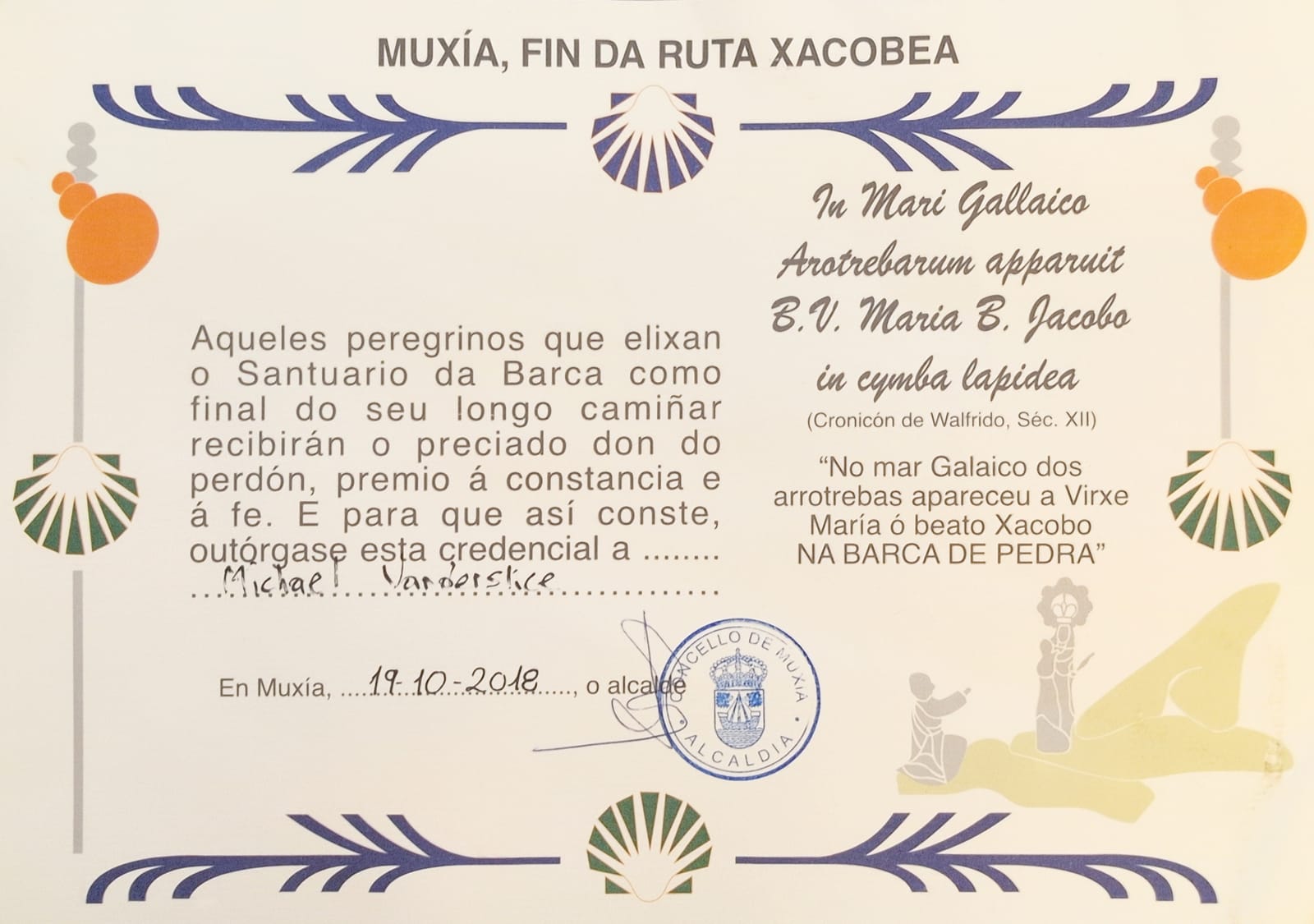
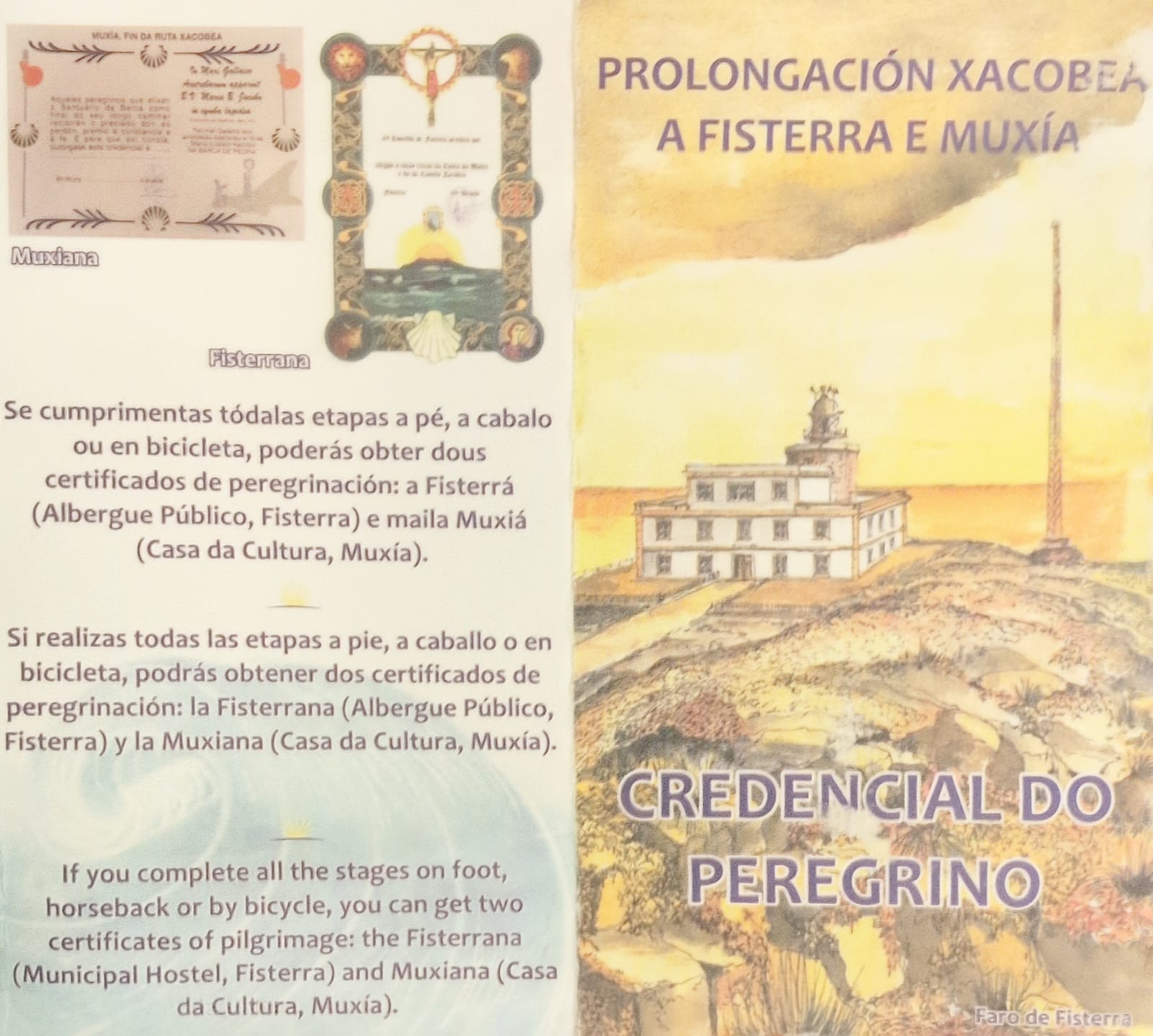
Just as pilgrims who reach Santiago earn the Compostela, those who walk on to the Atlantic can claim a certificate for each coast they reach. For completing the walk to the Santuario da Barca in Muxía, we were awarded the Muxiana — dated the very day we arrived, 19 October 2018. Its words honor "those pilgrims who choose the Sanctuary of the Boat as the end of their long walk." (Finisterre — and its own certificate — was still to come.)
Click any photo to enlarge it and read its caption.
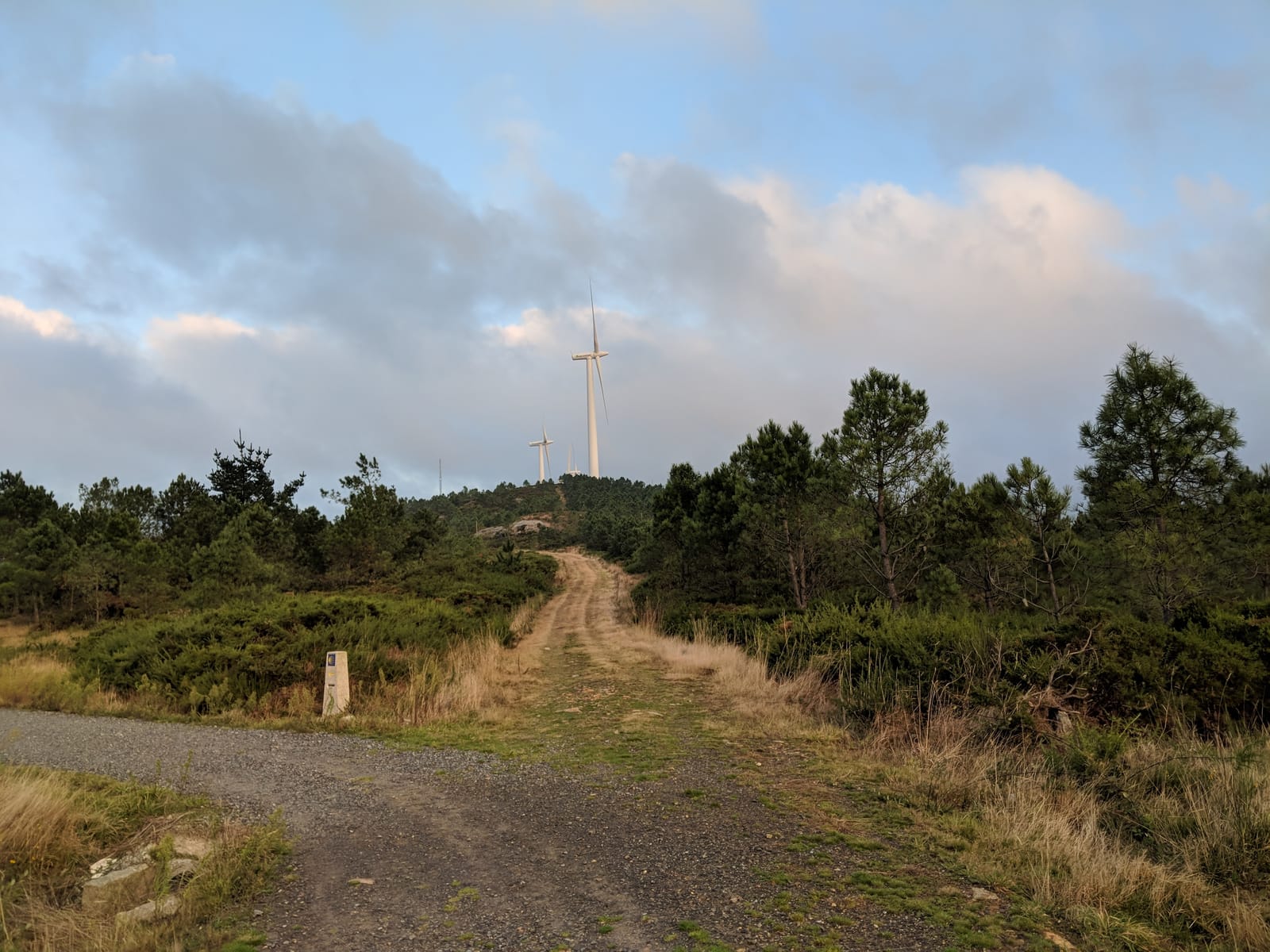
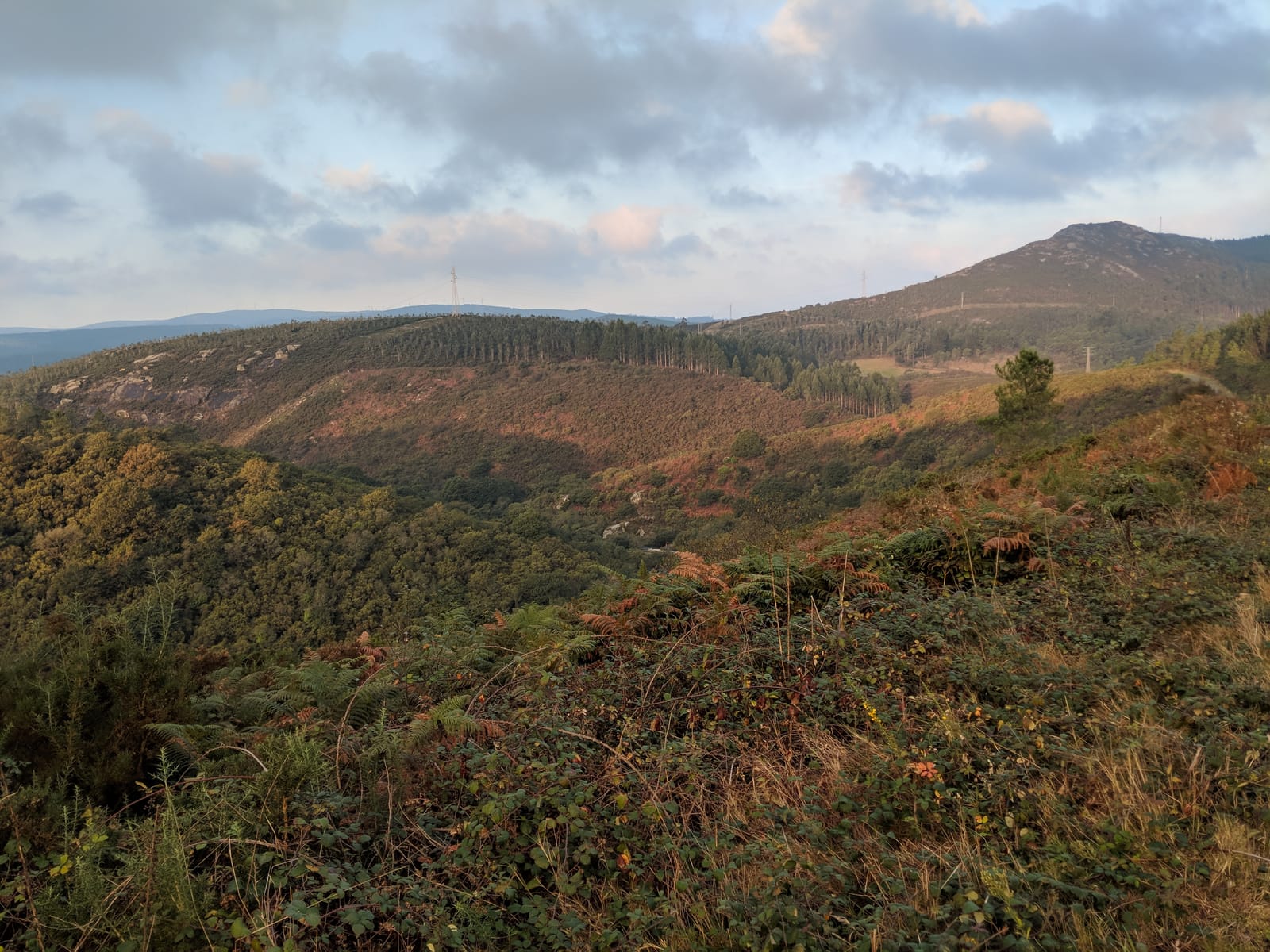
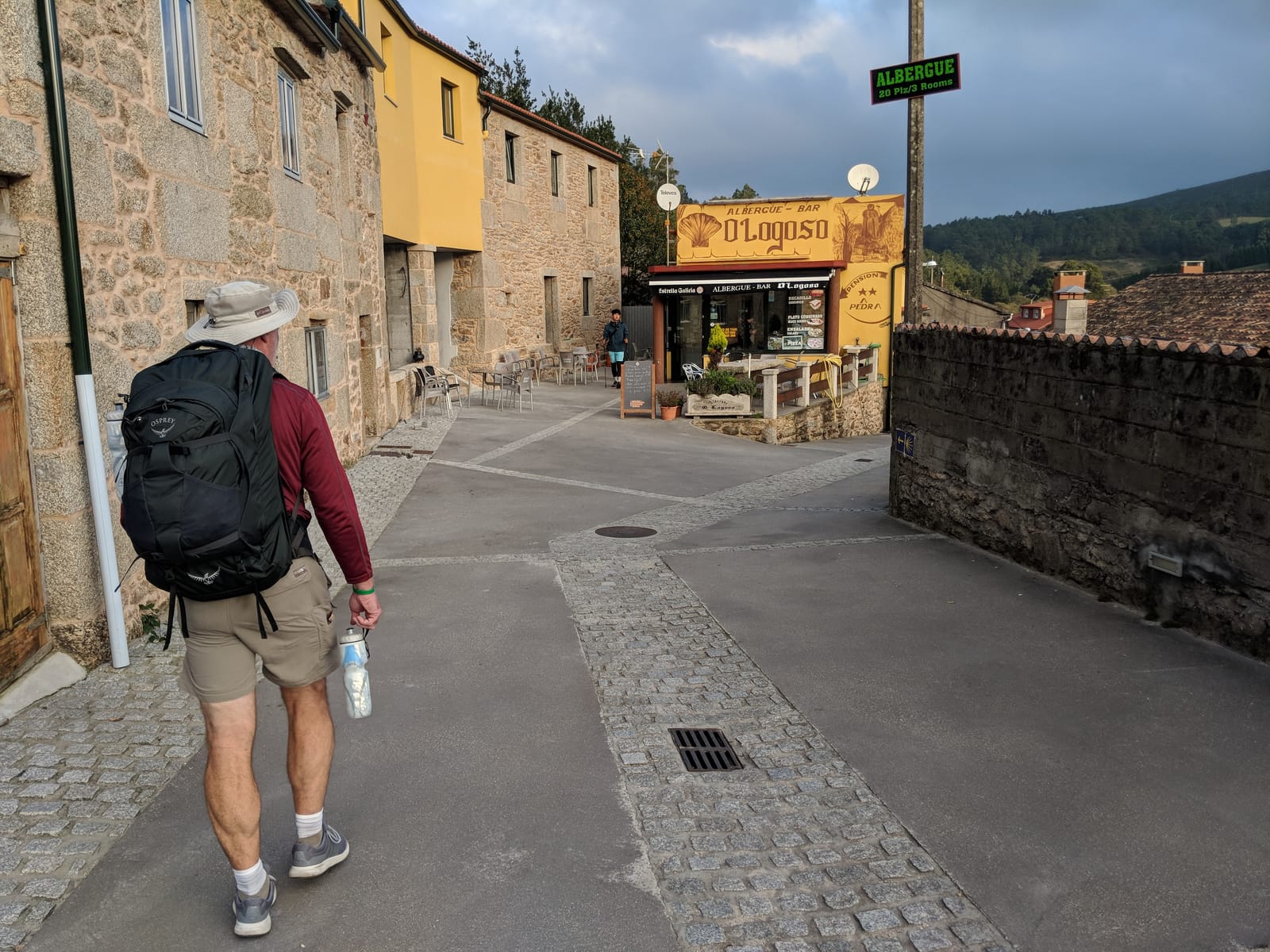
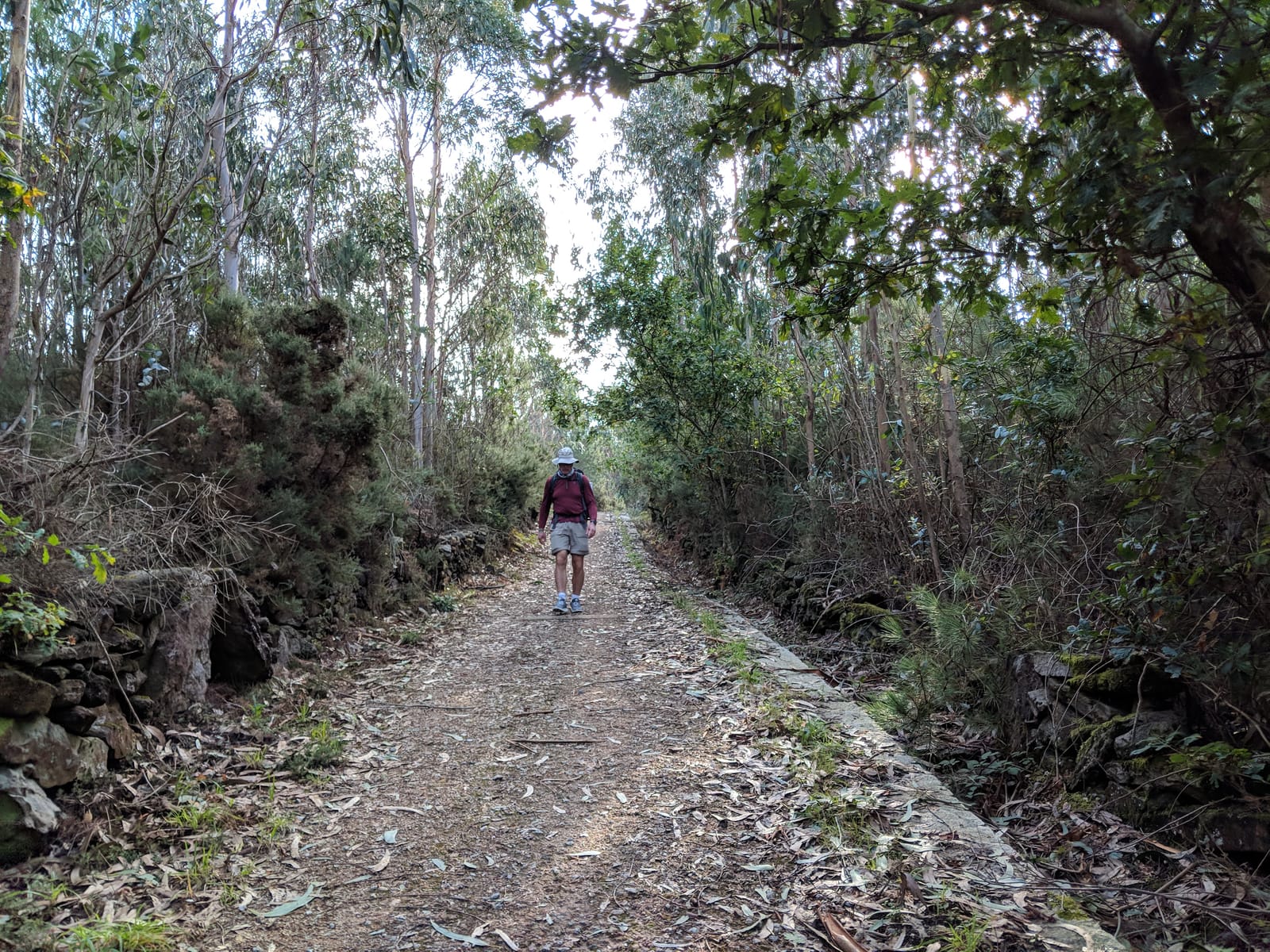
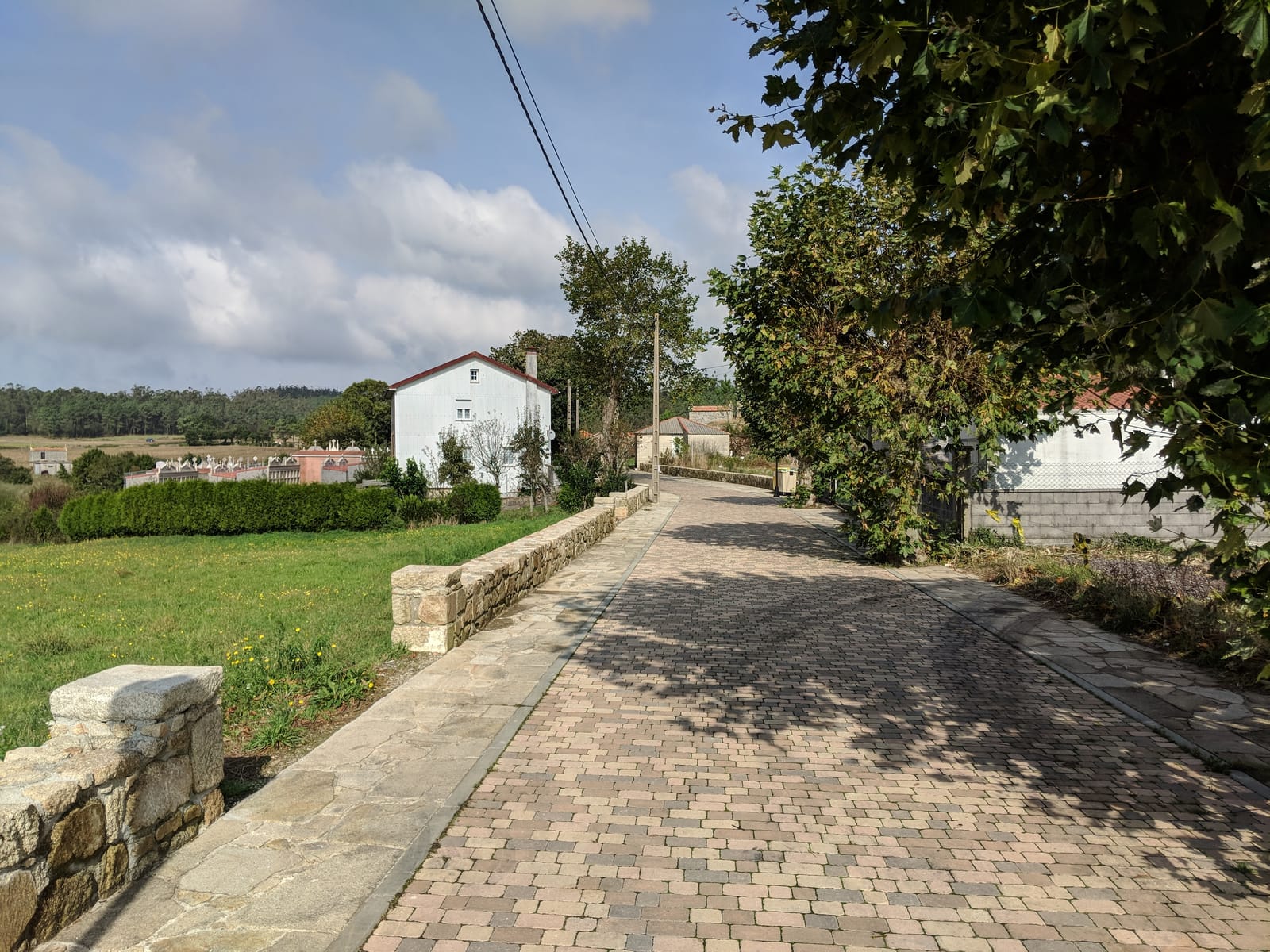
Sunny skies at last · a coast-or-inland fork · the "Caribbean" of the Atlantic · 18.02 mi
With Muxía behind us, we set off for Finisterre. We'd heard this stage had a steep climb and very few services along the way — but we also had something we hadn't the day before: sunny skies. In the good light, Muxía felt like it had a better vibe than the gray afternoon we'd arrived in.
We were in no hurry to leave. We took our time getting out of town — stopping for a few photos, and even wandering down onto the beach a little, glad to get off the road and feel the sand for a bit before the long day ahead.
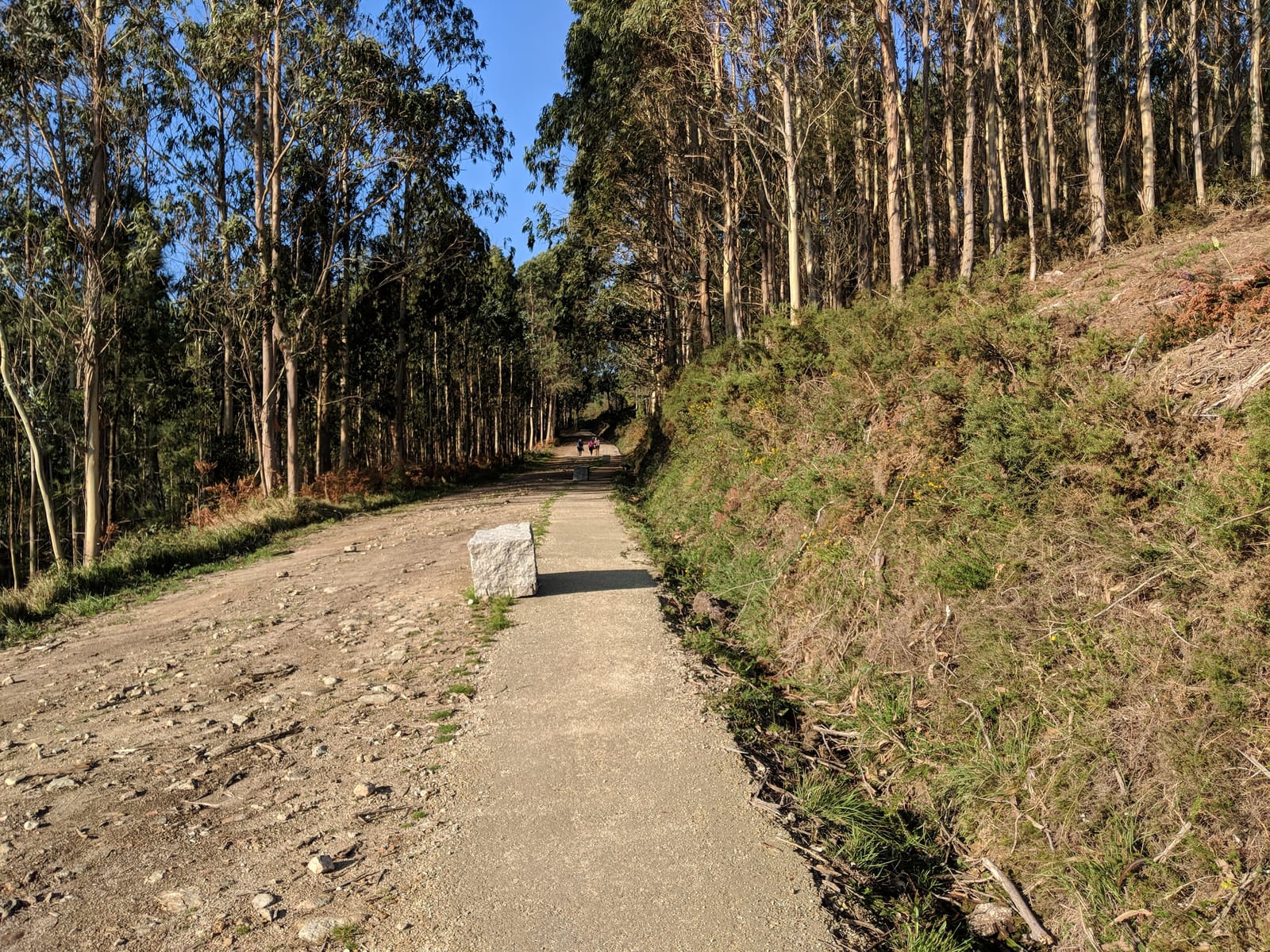
Shortly out of town, the uphill began — the steep climb everyone had told us about. But we'd spent our share of days hiking in and out of the Grand Canyon, and by that measure this was nothing. It turned out to be far less punishing than we'd been led to believe.
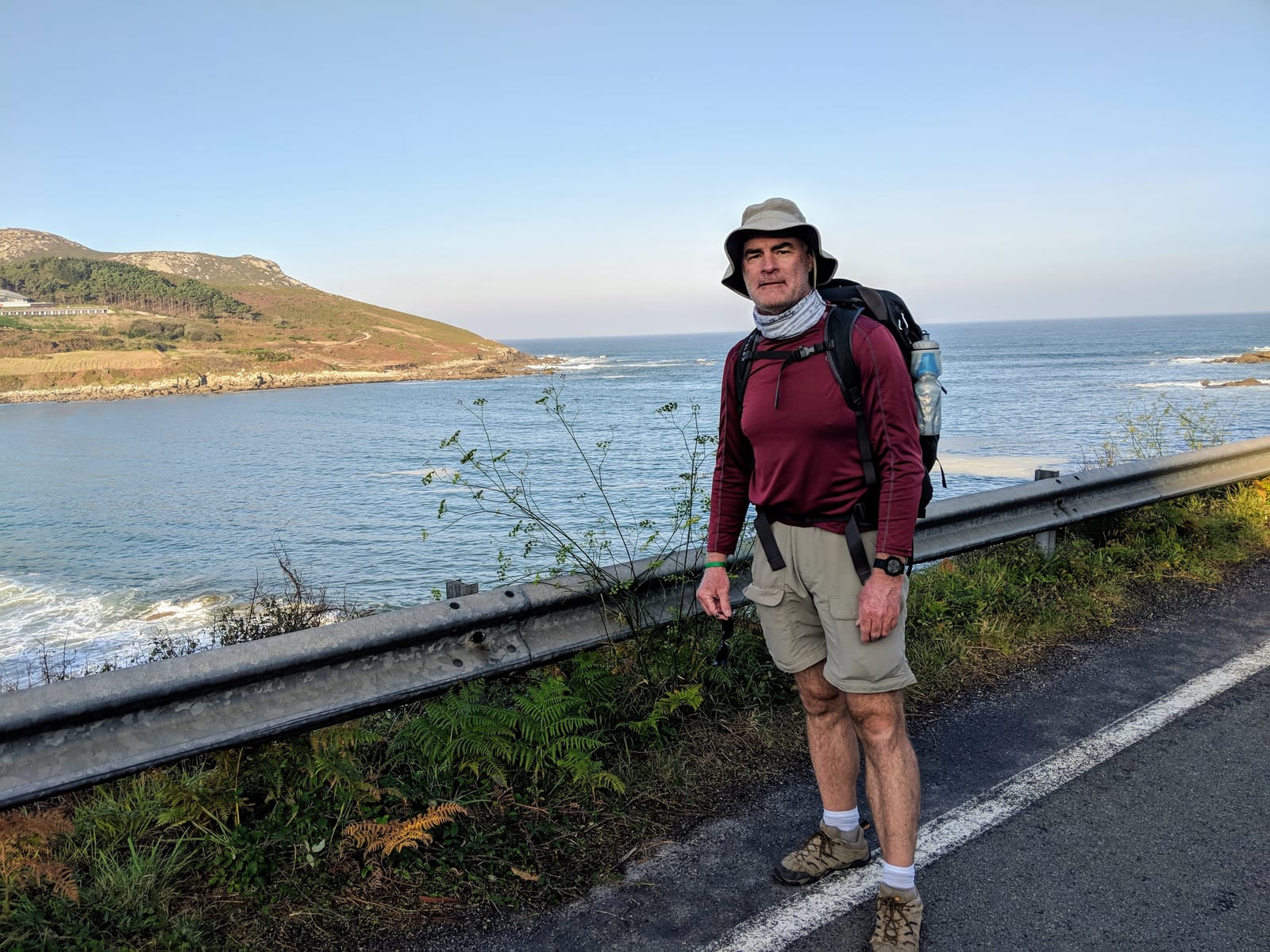
Partway along, we reached a point where the trail split — you could follow the coast or stay inland. The inland route was shorter, and Doug was battling a few blisters from the past two long days, so he chose the inland path. I took the coastal one, and we agreed to meet back up where the two rejoined.
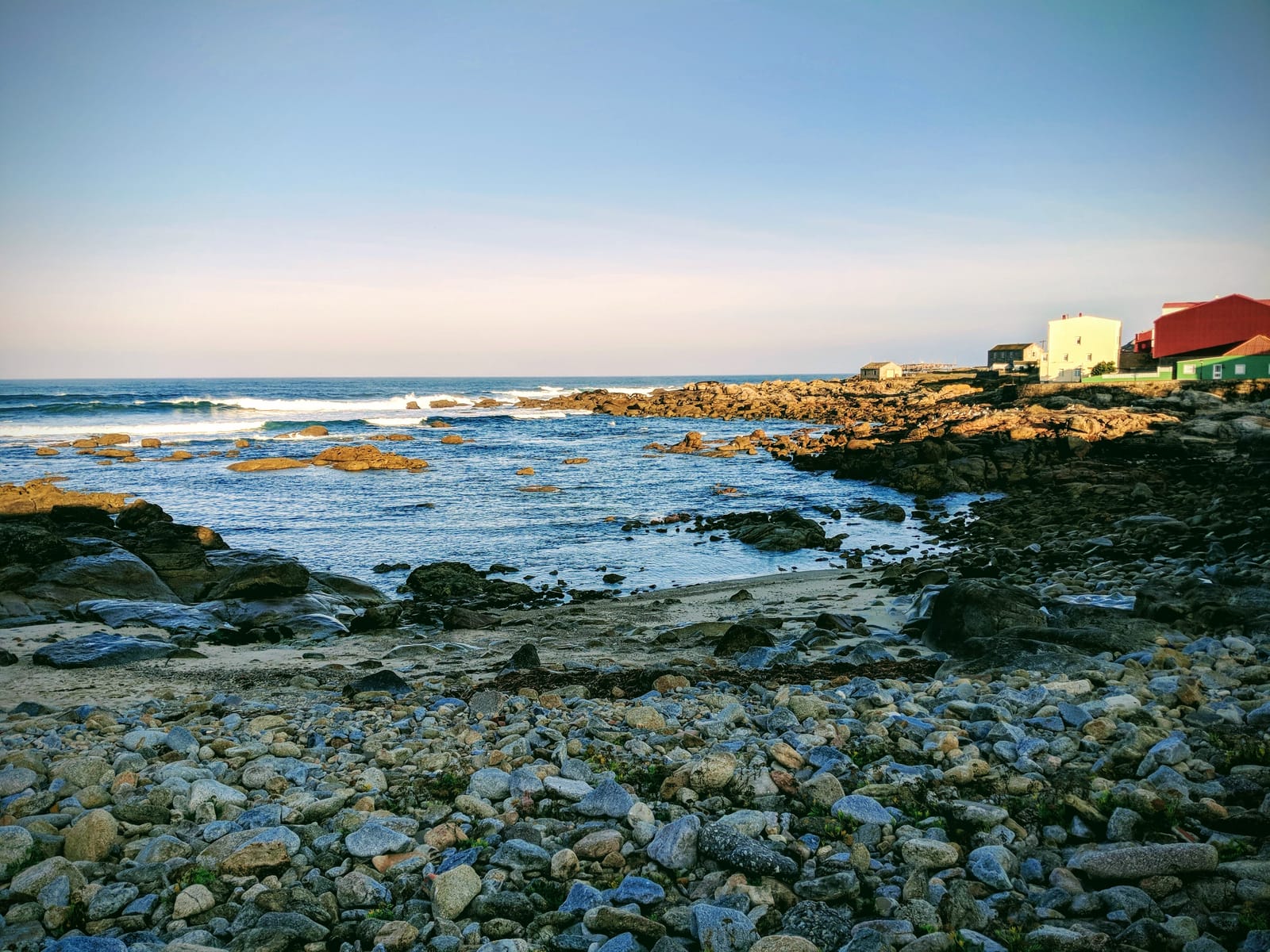
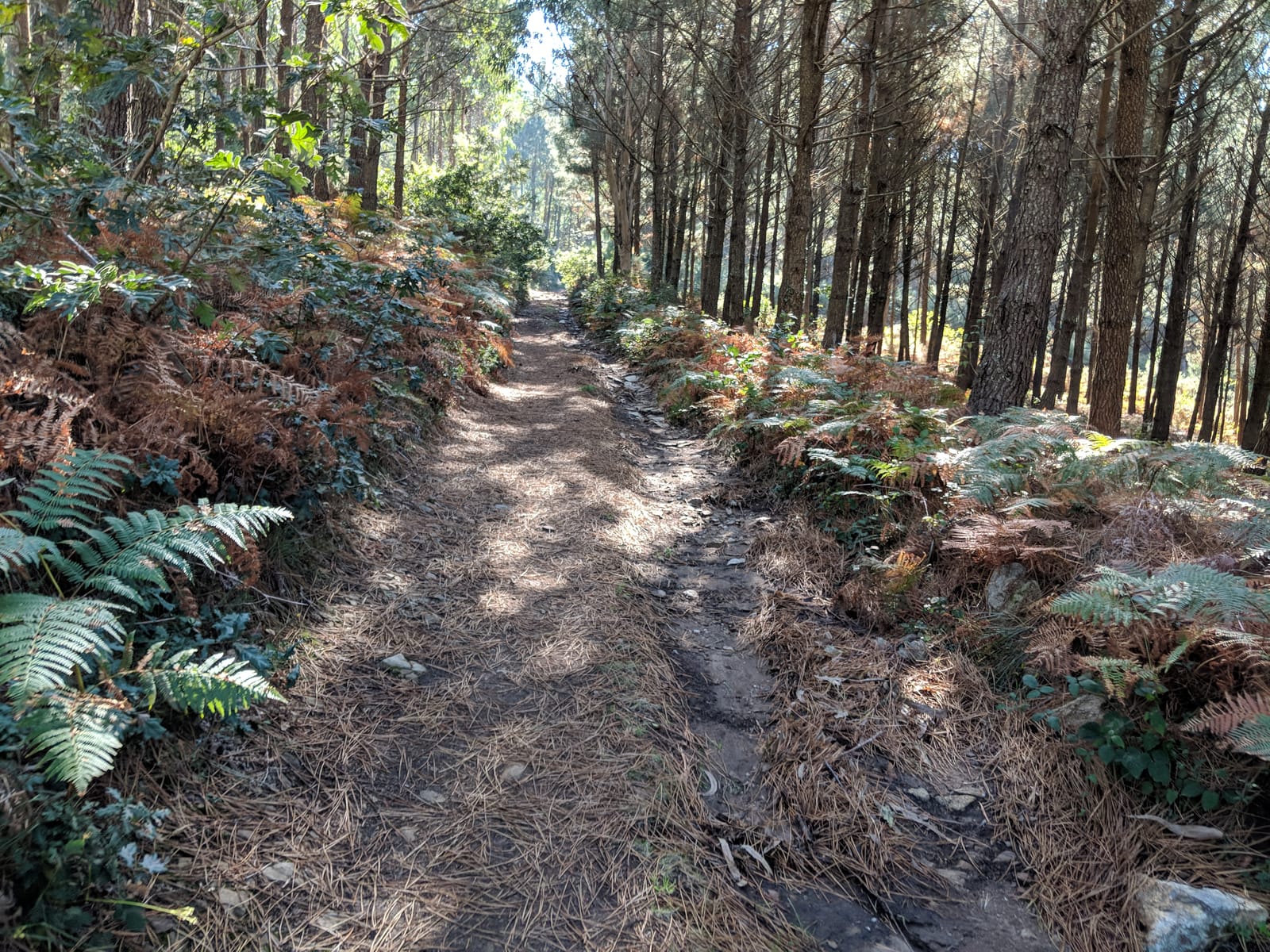
I'm so glad I did — the coastal route was absolutely stunning. To this day, people who see my photos of this stretch assume it's the Caribbean, or somewhere tropical: turquoise water, pale sand, the works. But this is the Atlantic, on the wild edge of Galicia. I was sorely tempted to head down and take a dip — I still wish I had — but I didn't want to leave Doug waiting too long. After the beach, the path turned up into the woods onto a lovely bit of hiking trail, and I followed it until I met back up with Doug right where the two routes came together again.
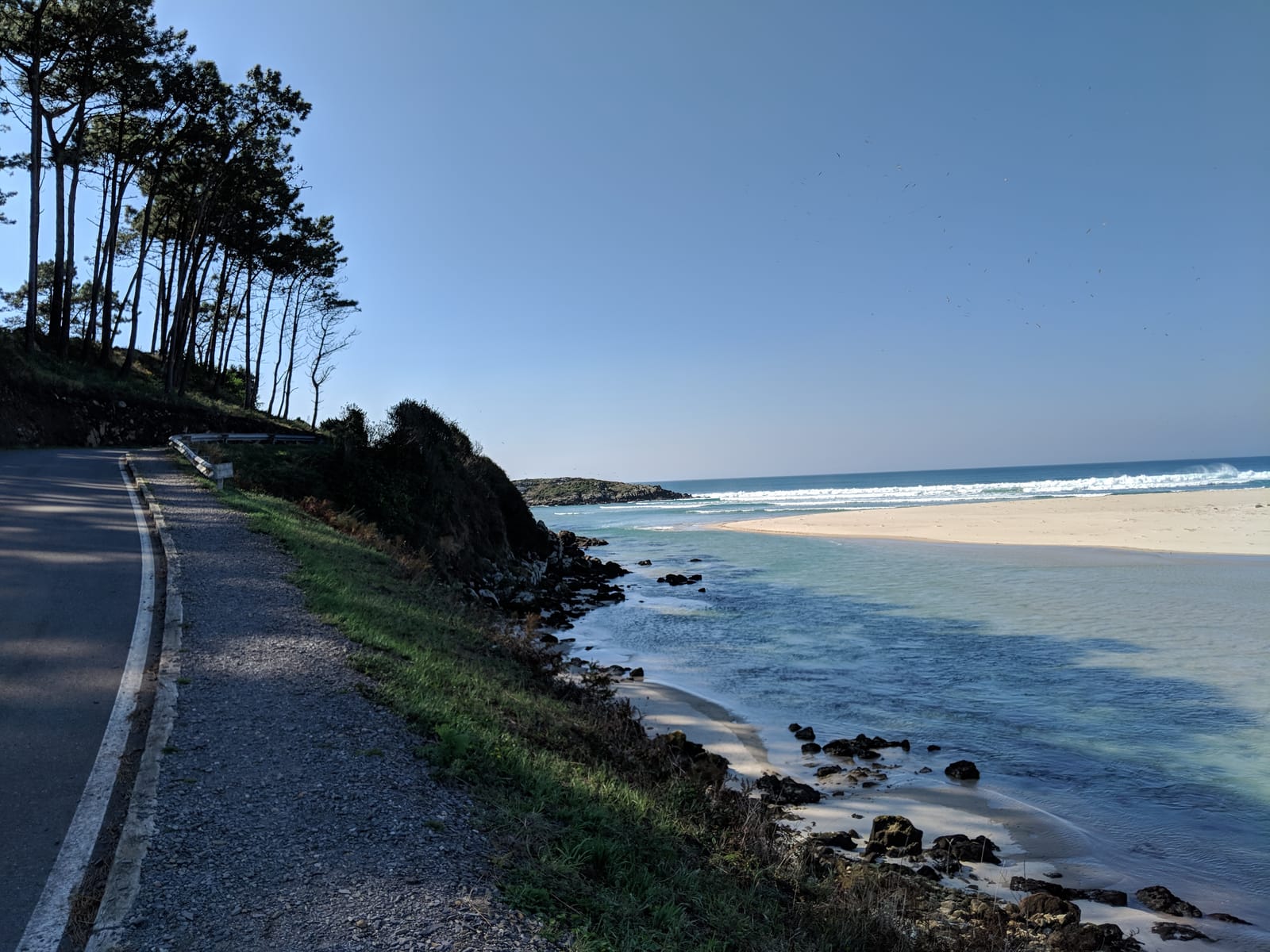
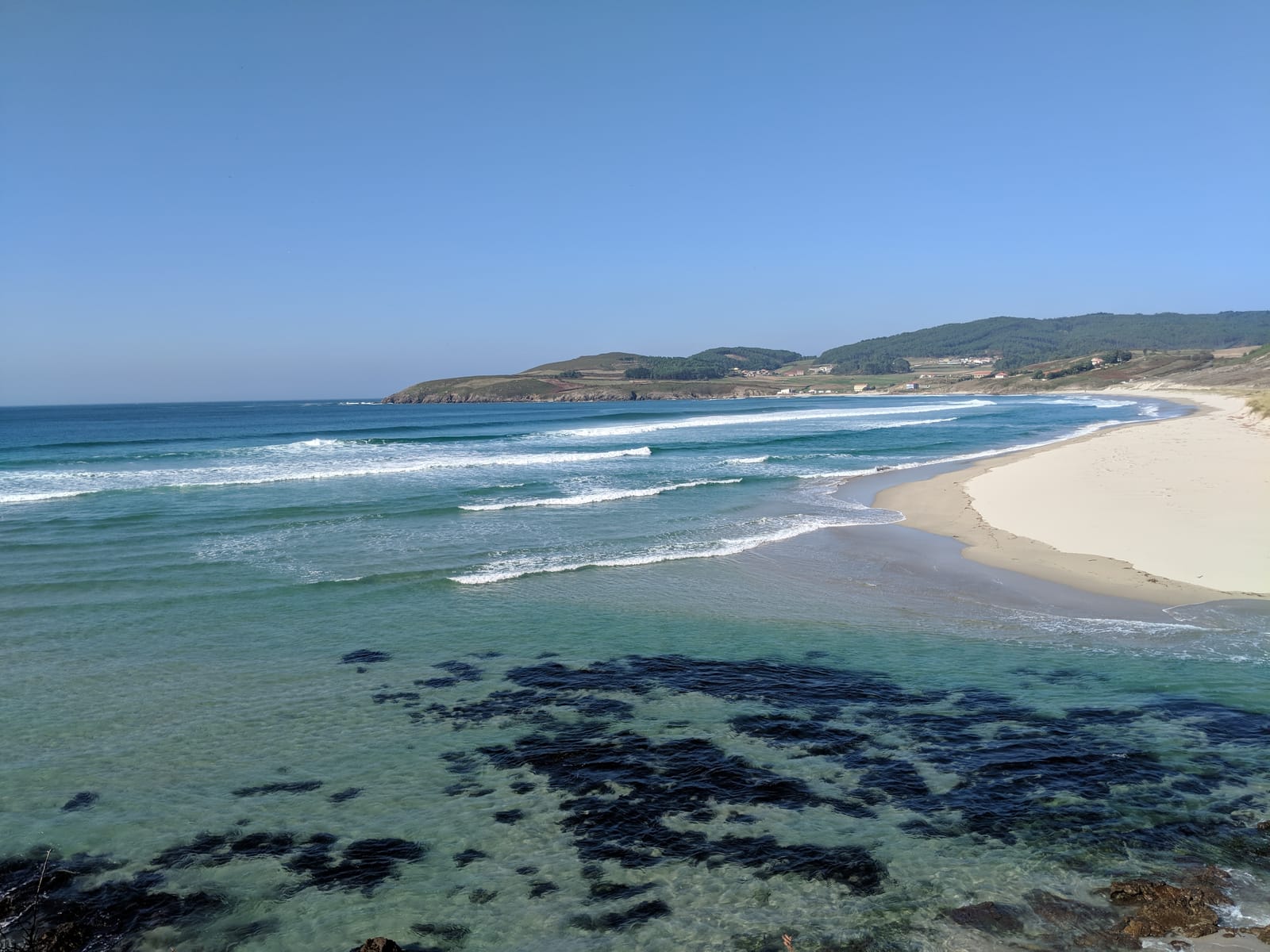
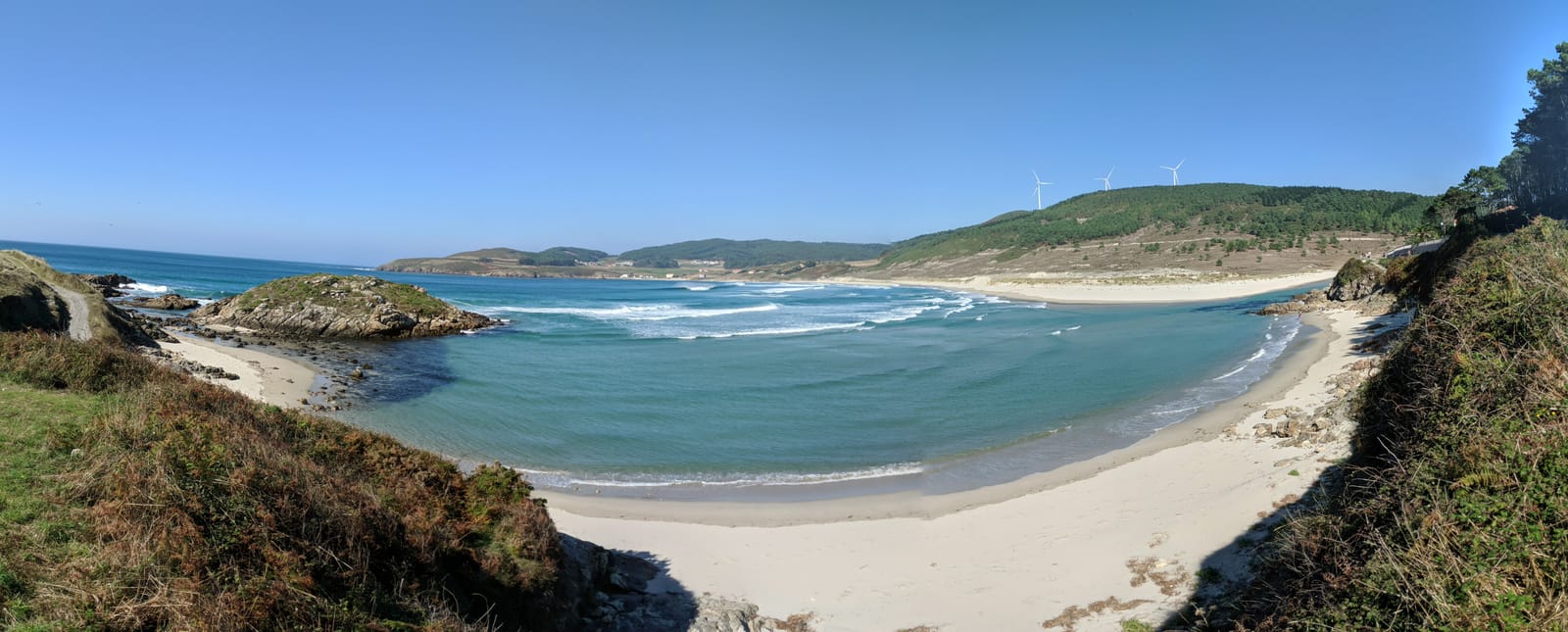
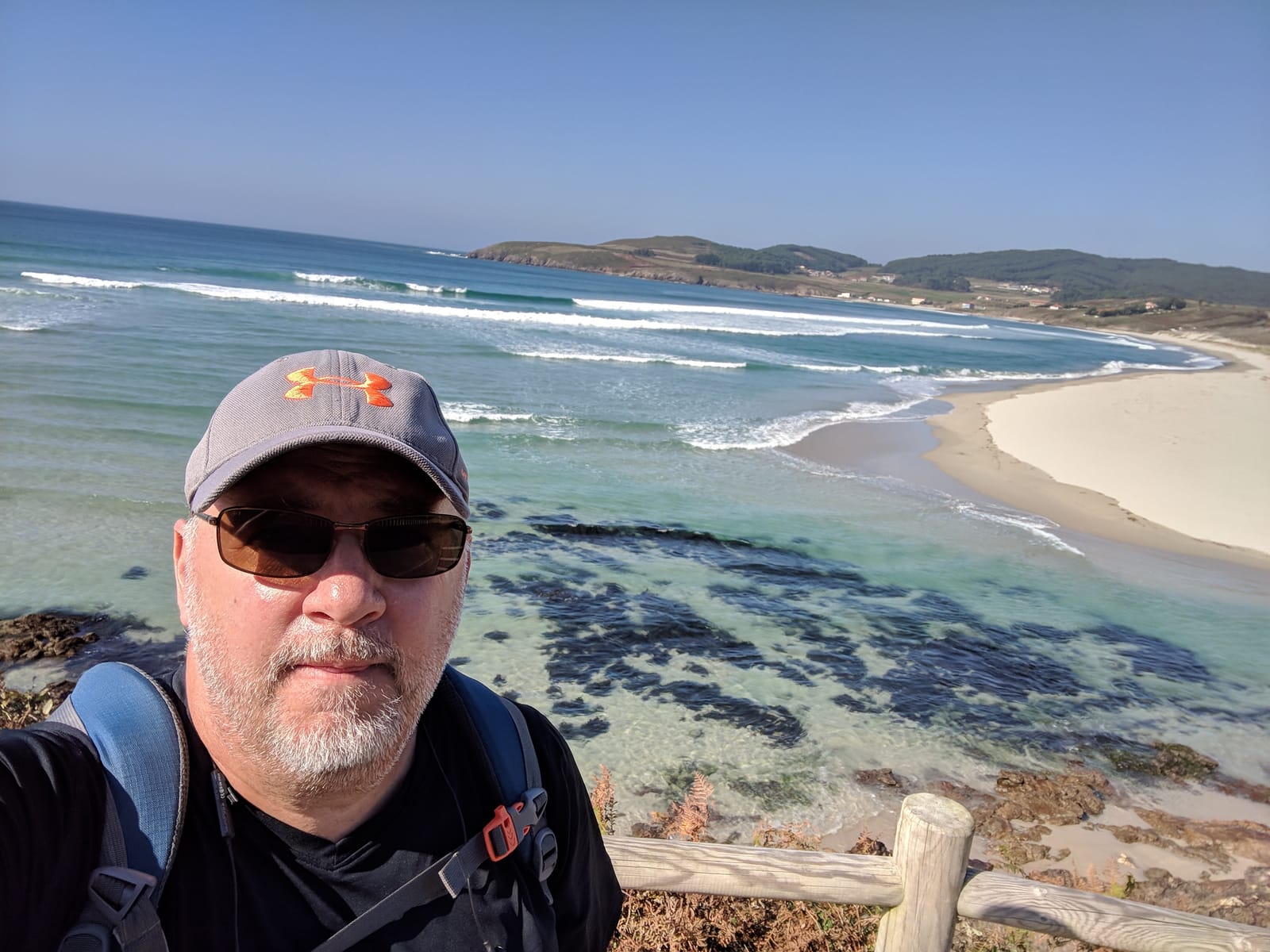
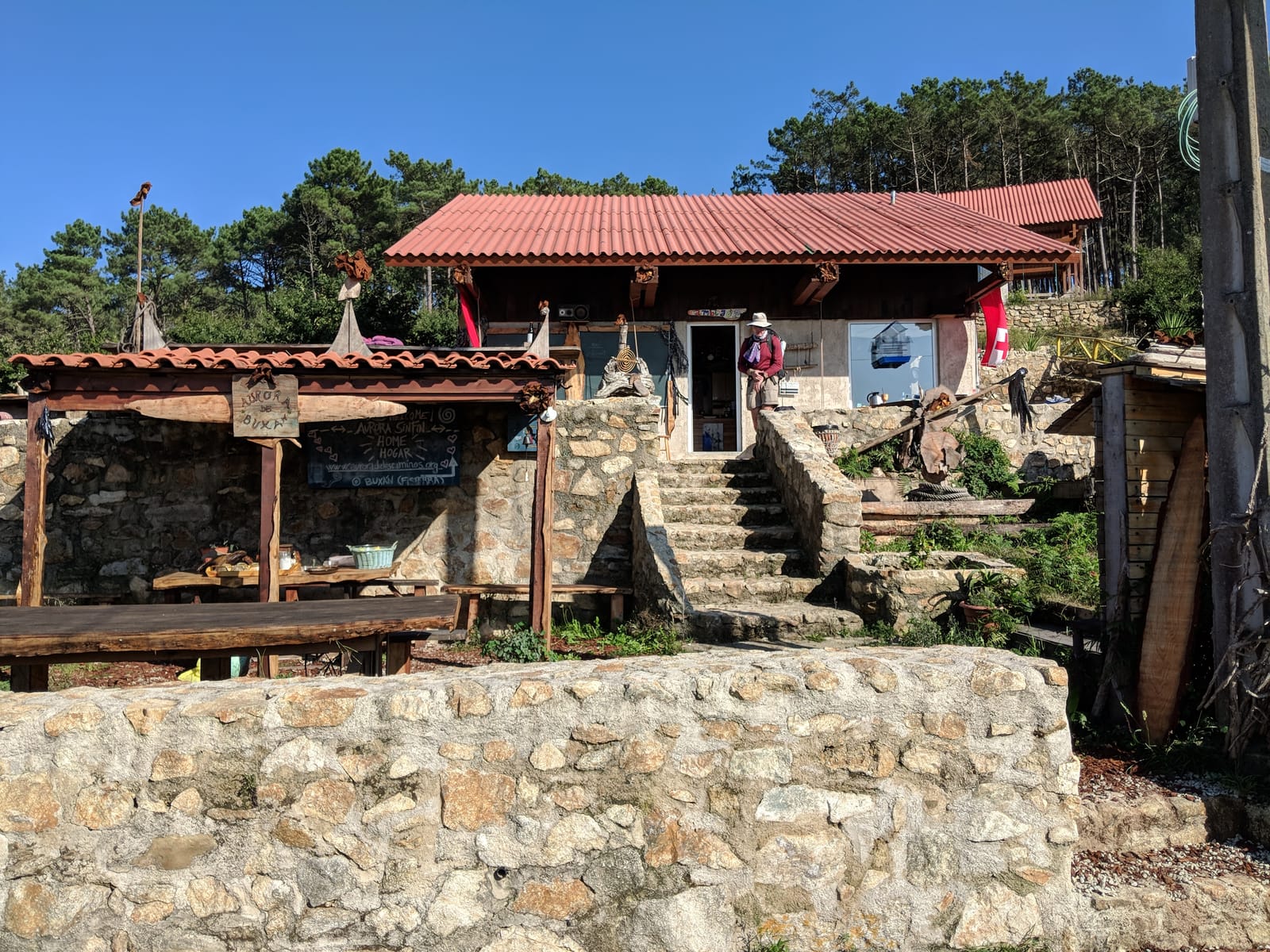
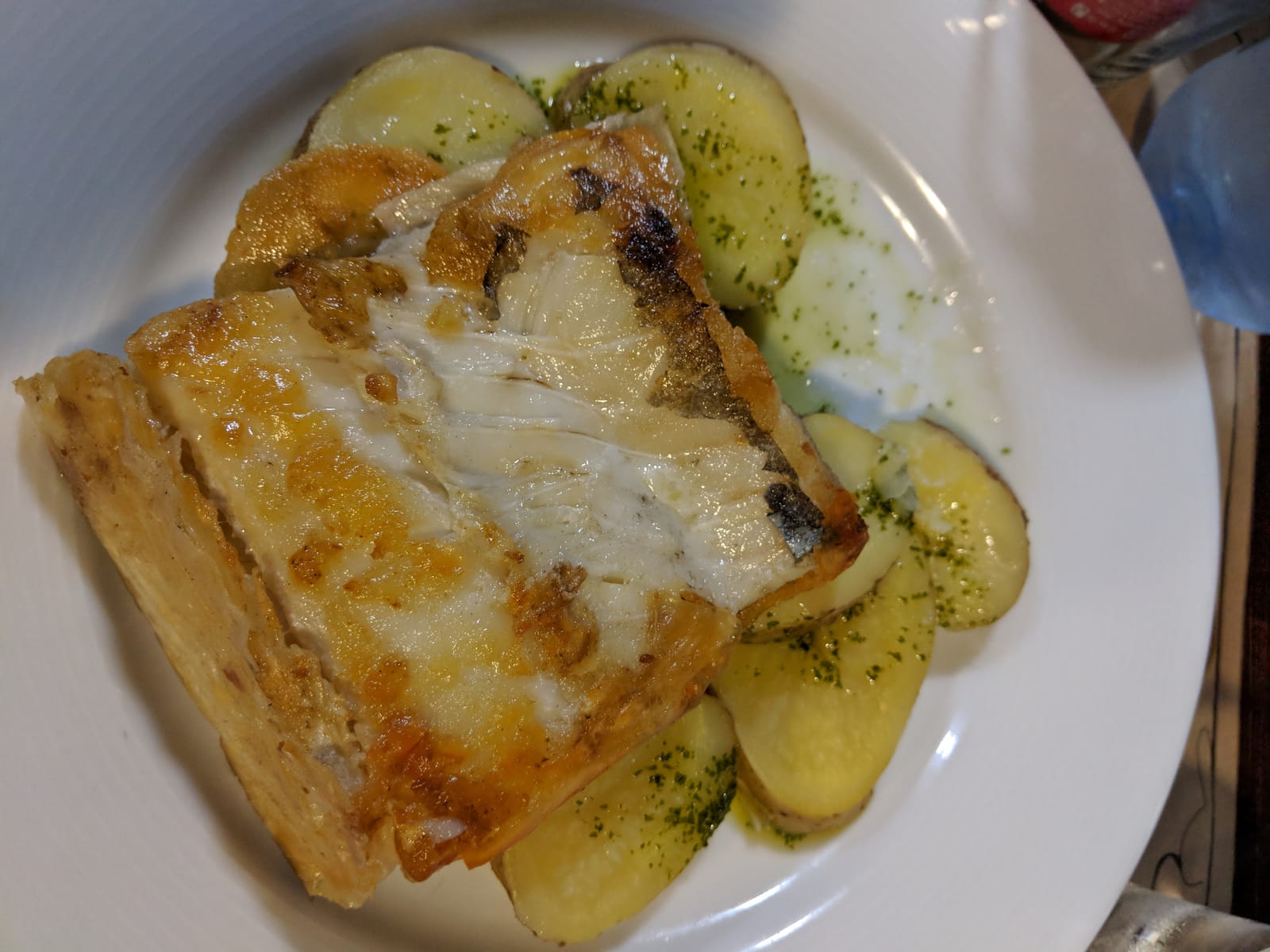
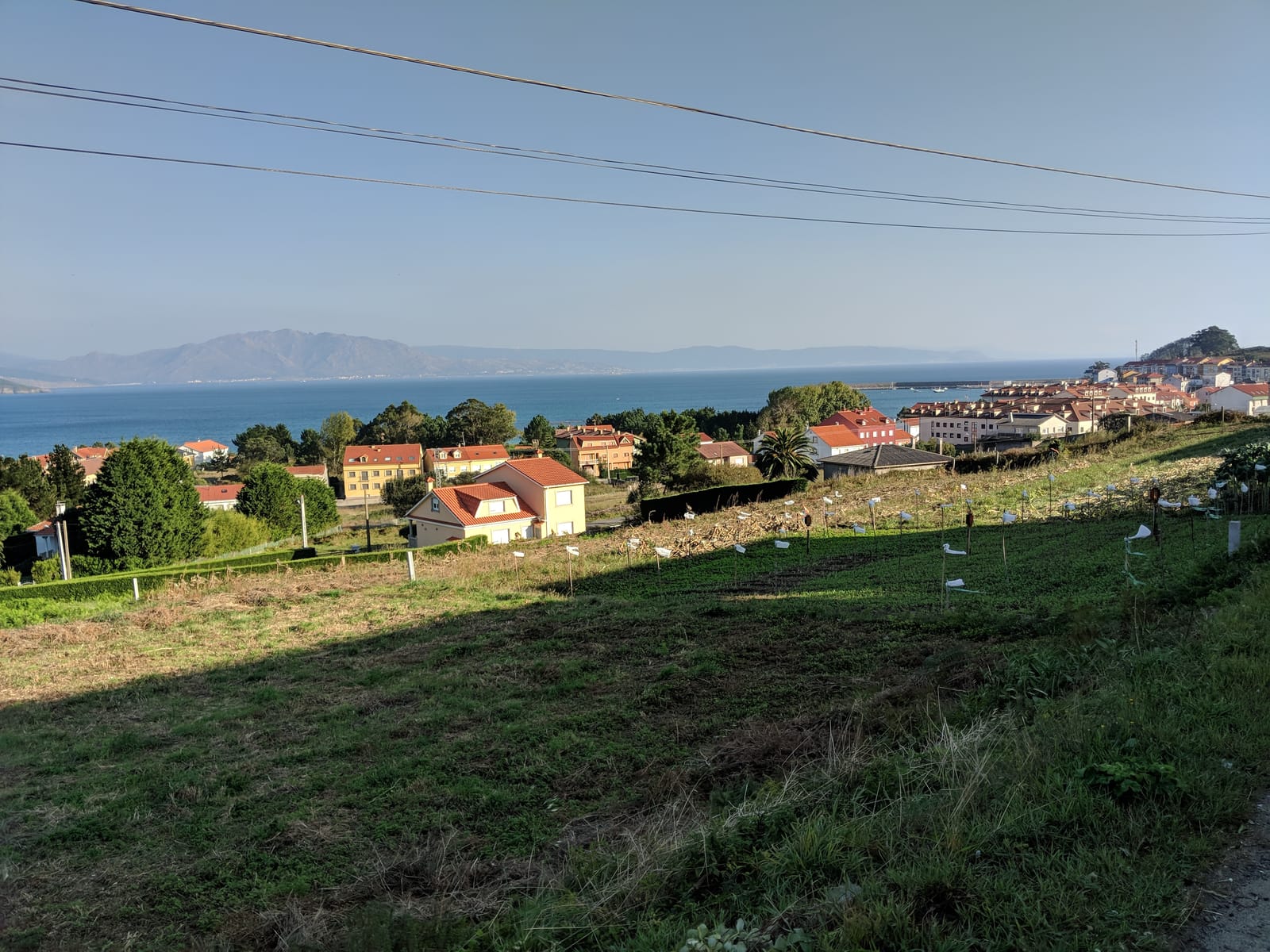
We made it into Finisterre, stopping at a cool little shop to grab something to drink and a snack — a wonderfully ramshackle, driftwood-decked donativo place perched above the trail, more art project than store. But the walk out to the "end of the world" itself — the cape, the lighthouse, and the Km 0 marker at the tip of the land — would keep until the next day. We'd earned a night off: we spent the evening in town and treated ourselves to a great fish dinner, the cape waiting for us in the morning.
Click any photo to enlarge it and read its caption.
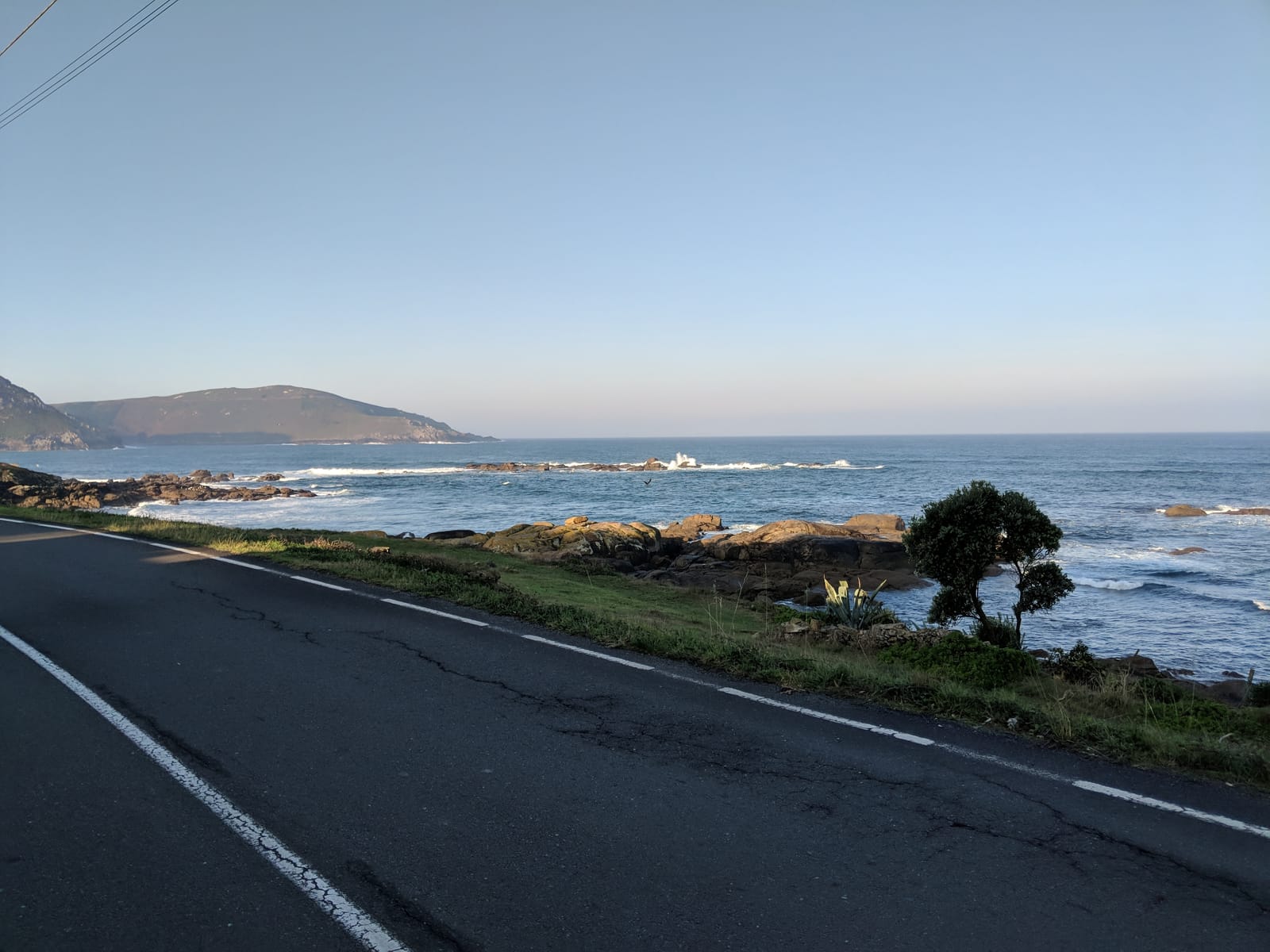
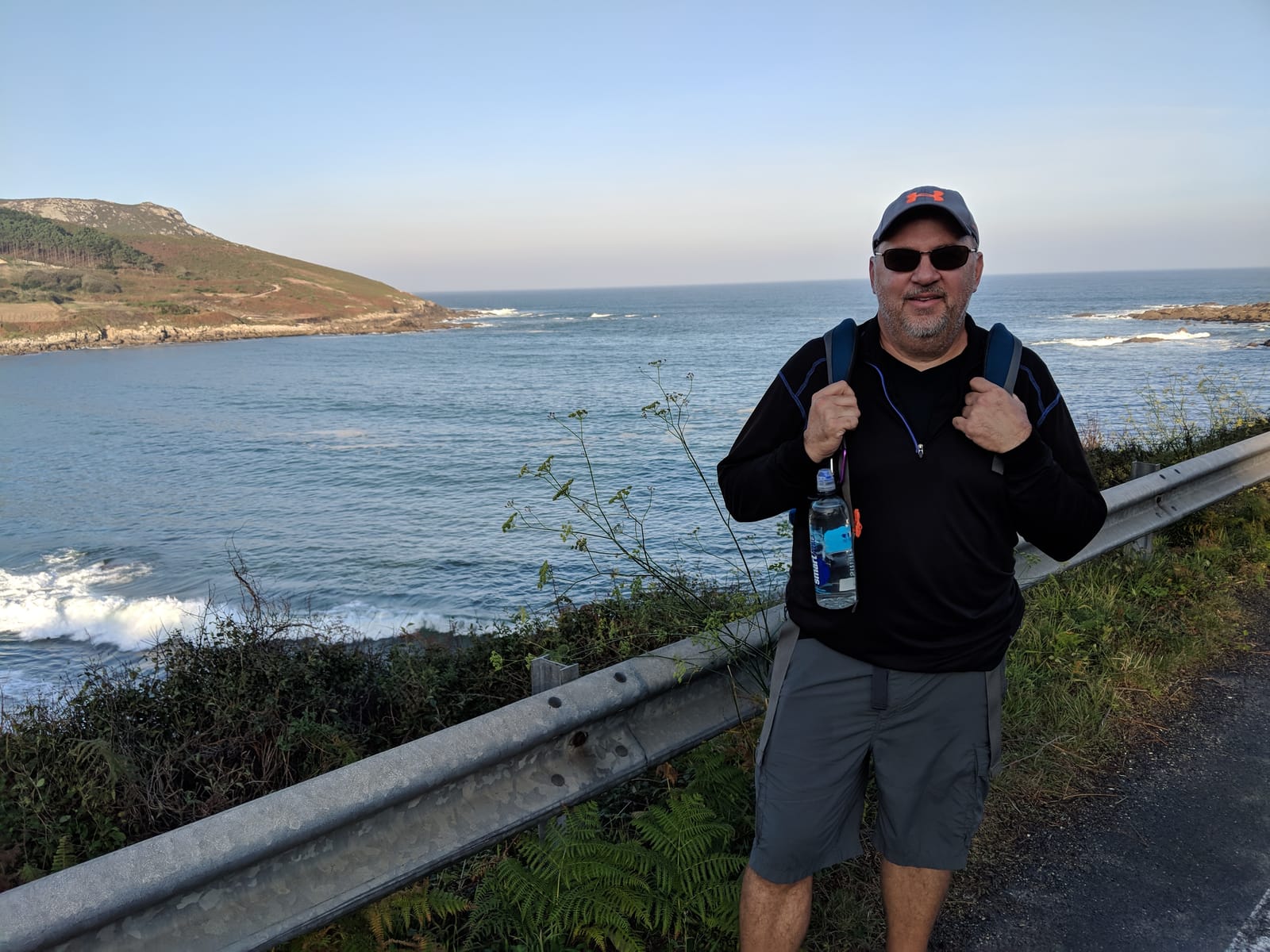
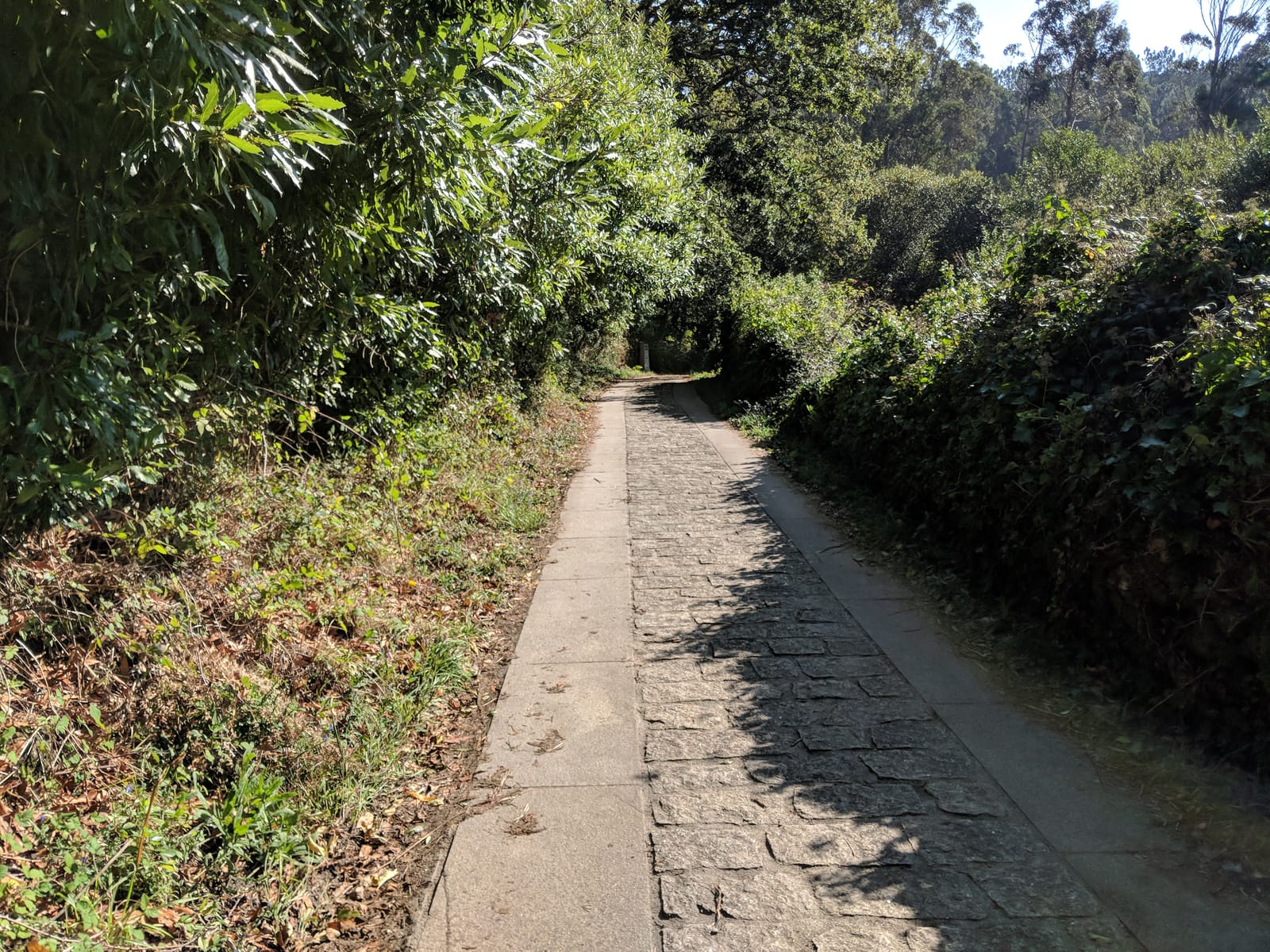
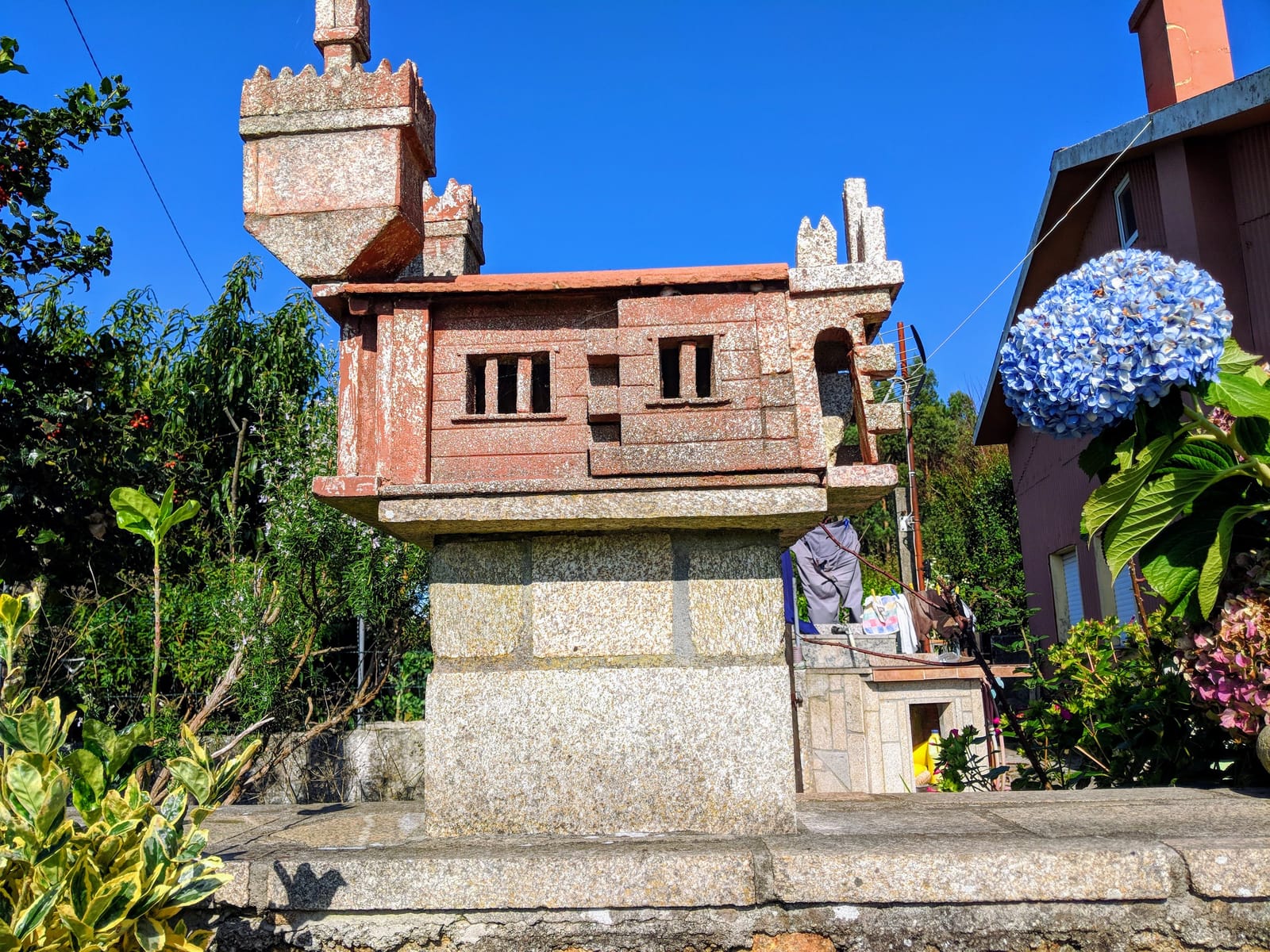
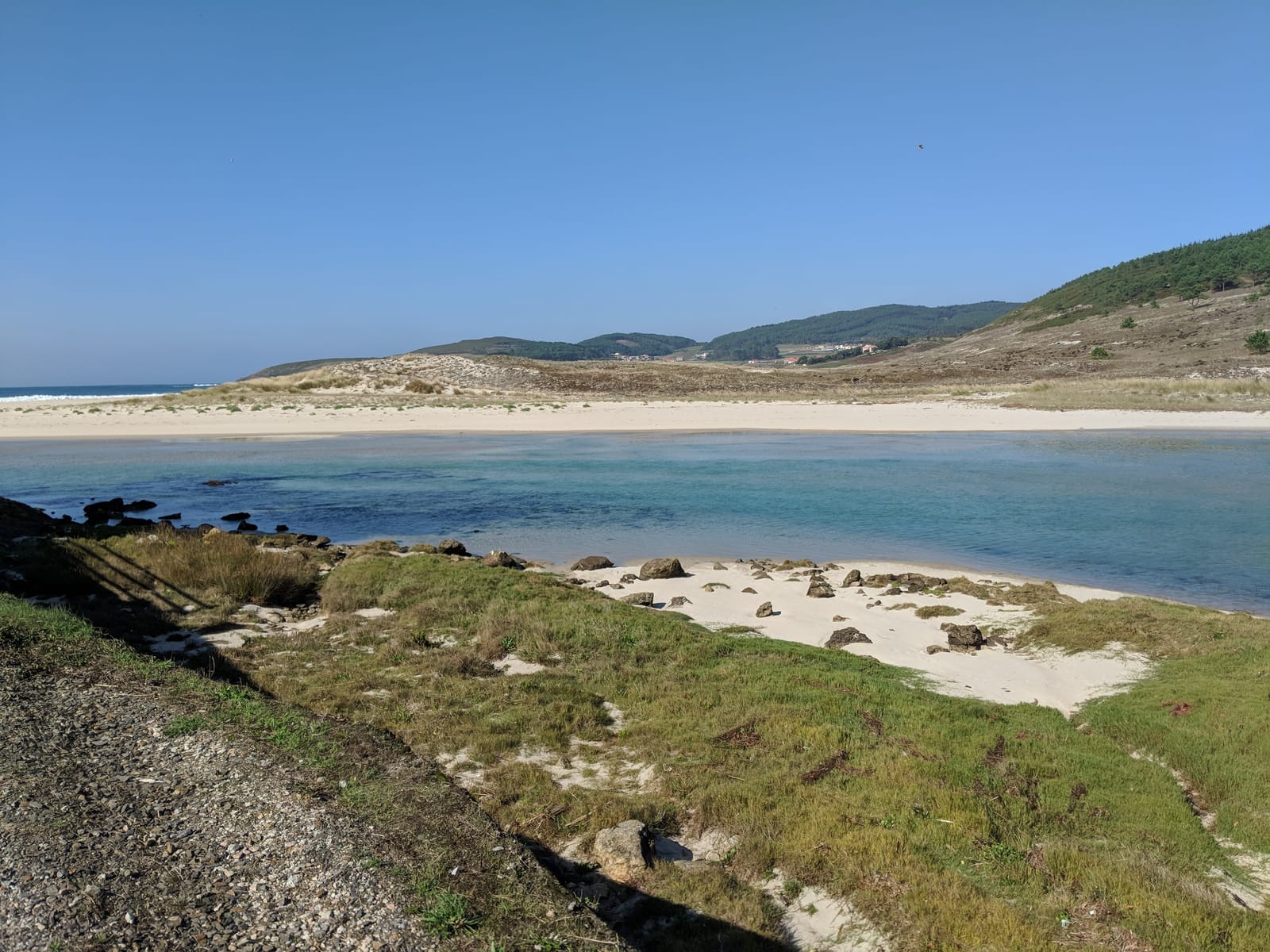
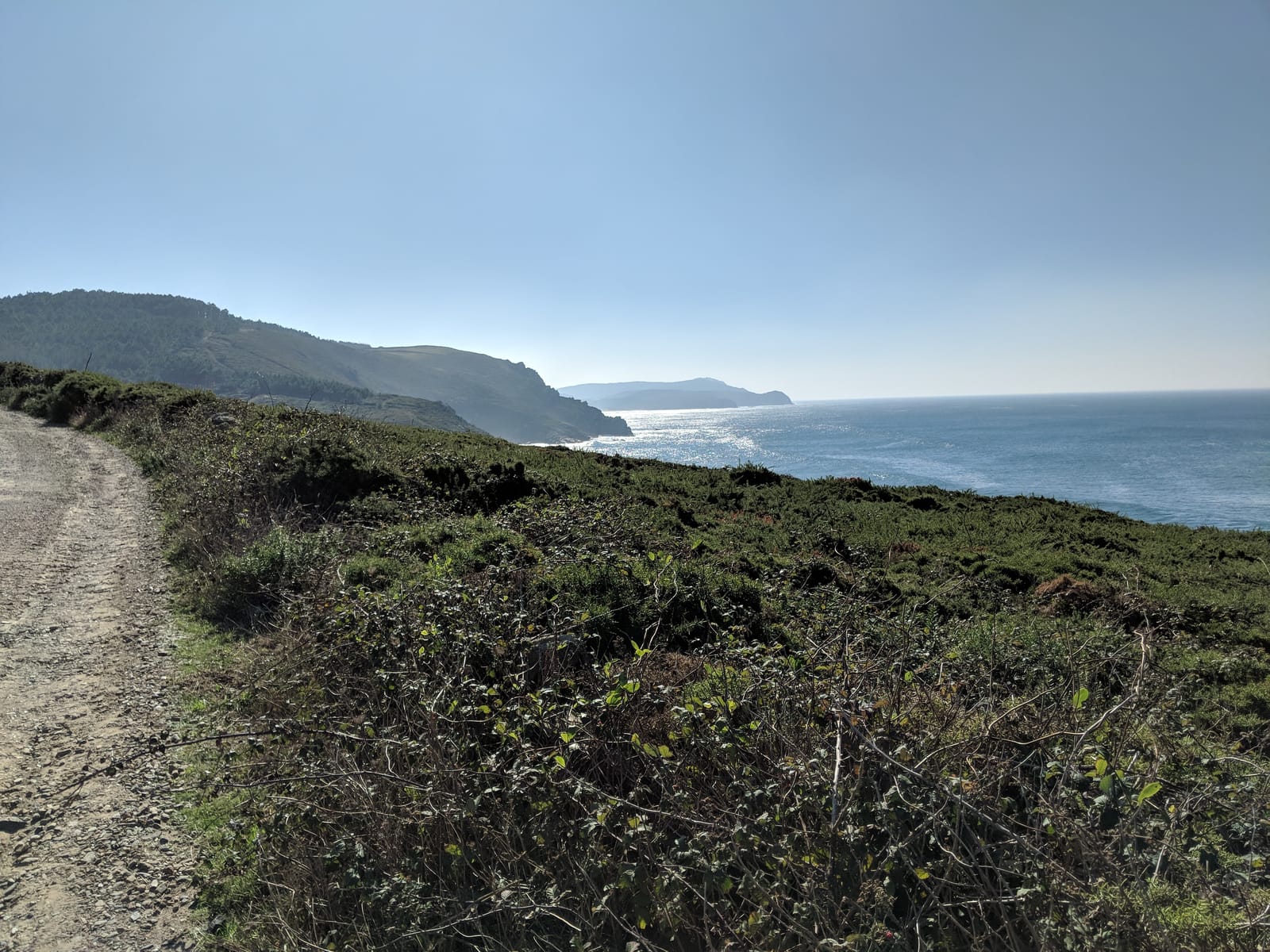
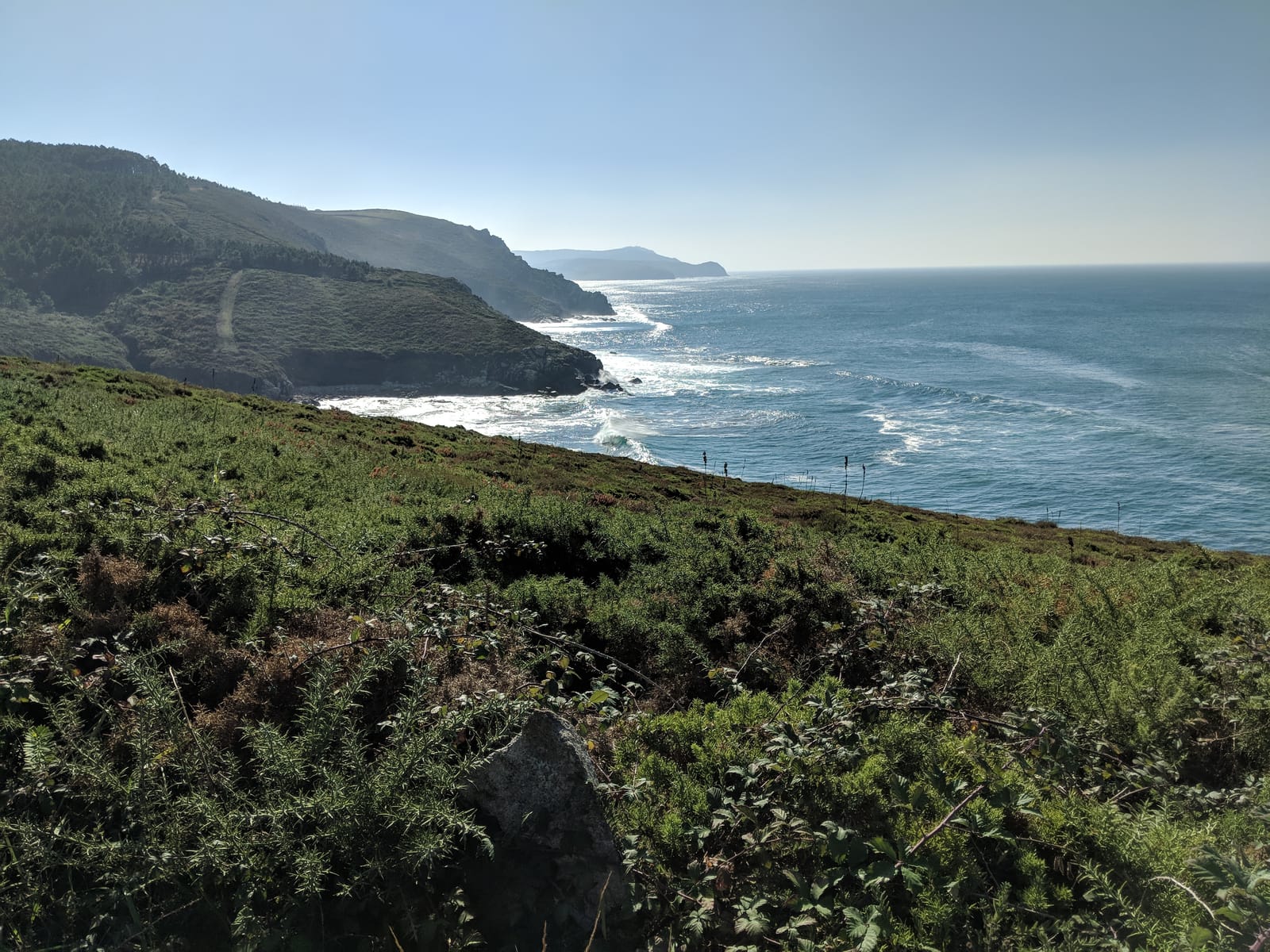
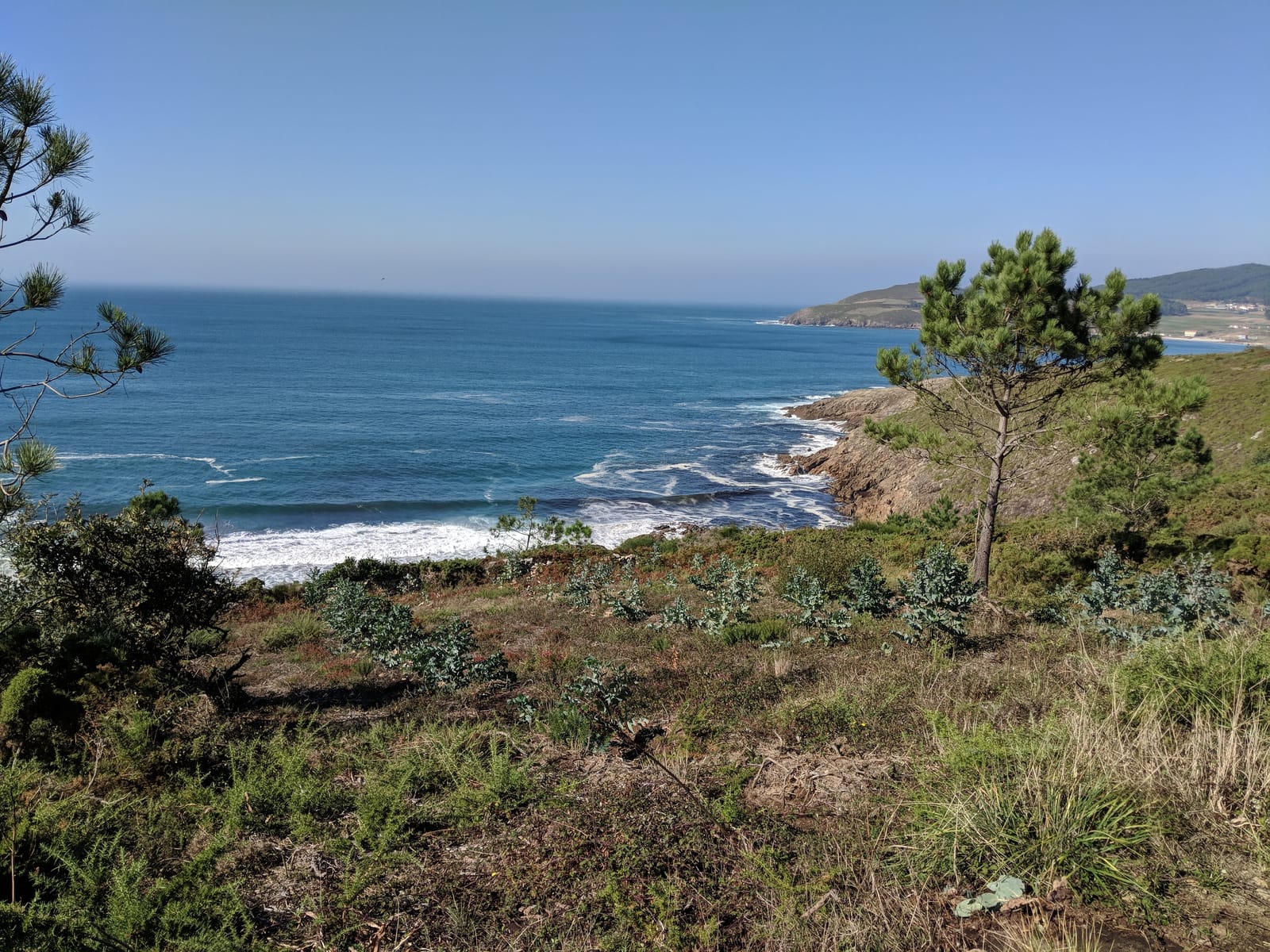
The short walk out to Cabo Fisterra · Km 0 & the lighthouse · sitting at the edge of the earth · our certificate by the harbor
We'd saved the best for last. Rather than rush out to the cape the evening we arrived, we gave it its own morning — the short walk from town out to Cabo Fisterra, the lighthouse, and the Km 0 stone that marks the true end of the Camino. It's only a couple of miles from Finisterre town to the point, an easy stroll after everything that had come before.
That last stretch — from Finisterre town south along the cape to the Faro de Fisterra and the Km 0 stone at the tip of the land.
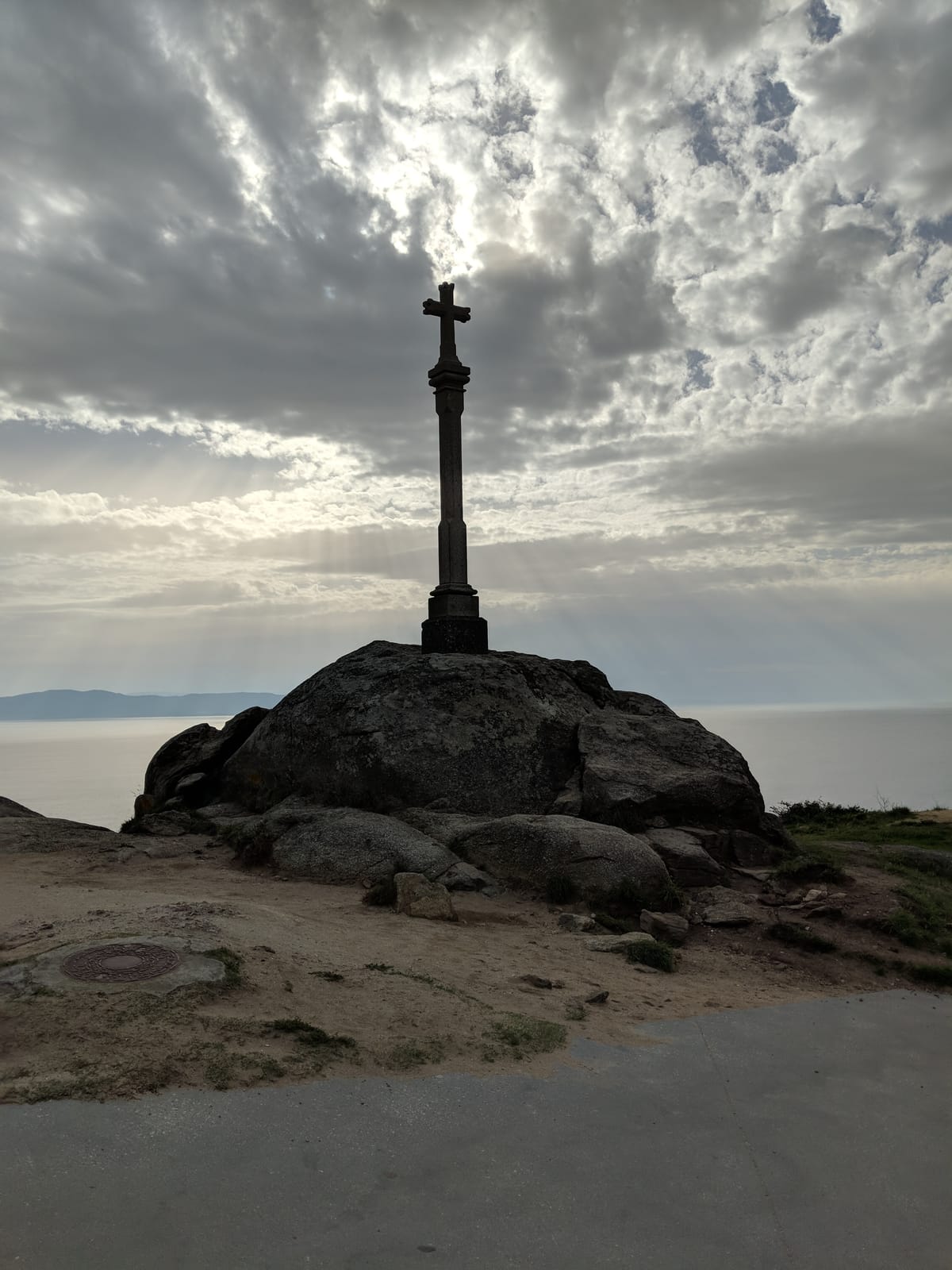
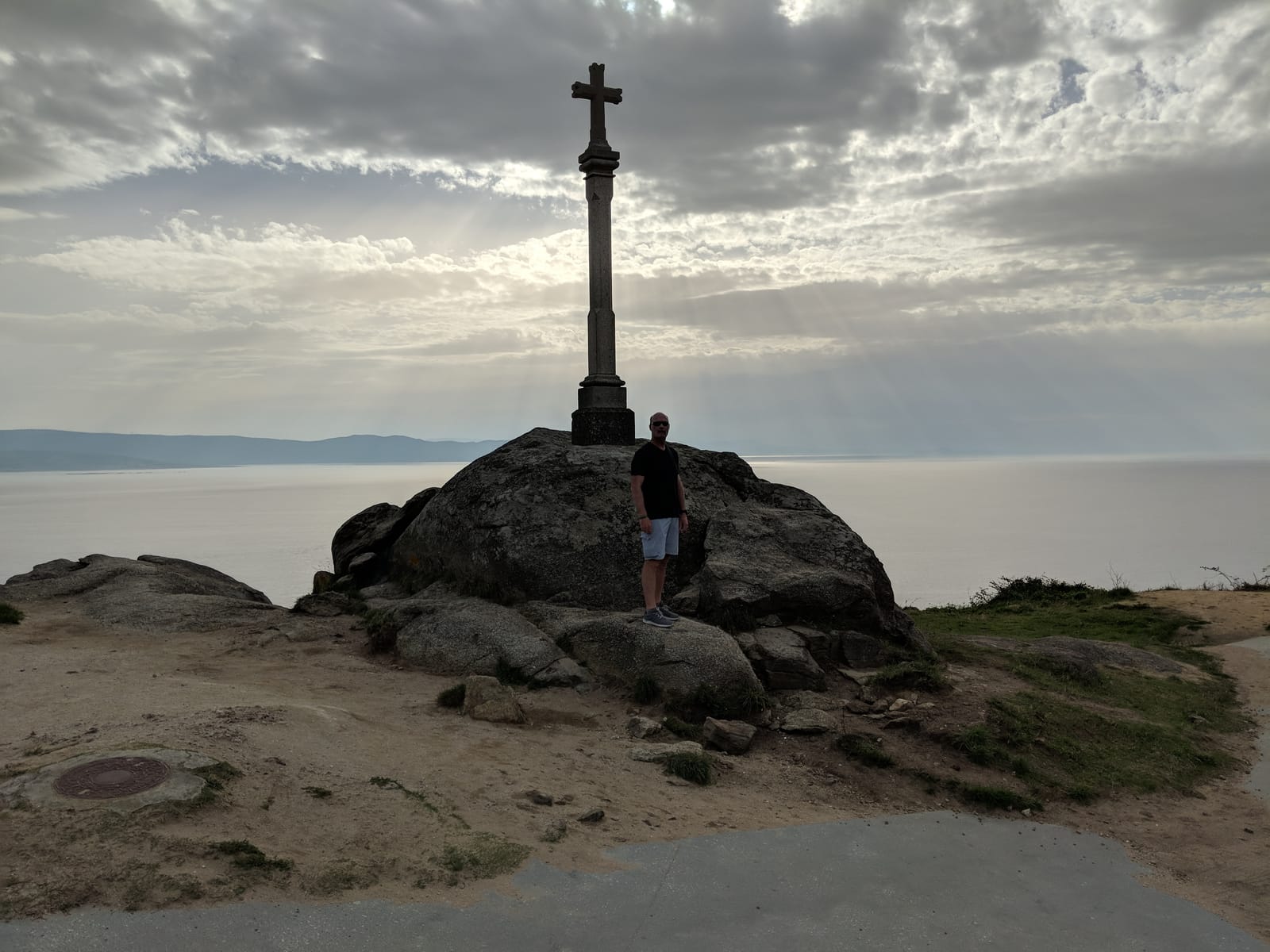
There's a moment every pilgrim on this route walks toward: the granite marker at the tip of the cape, stamped Km 0,000. After Santiago, after Muxía, after the long coast road, this little stone is where the mileage finally runs out. We took our time with it — a few photos at the marker, the Faro de Fisterra standing white behind us, the Atlantic falling away on every side.
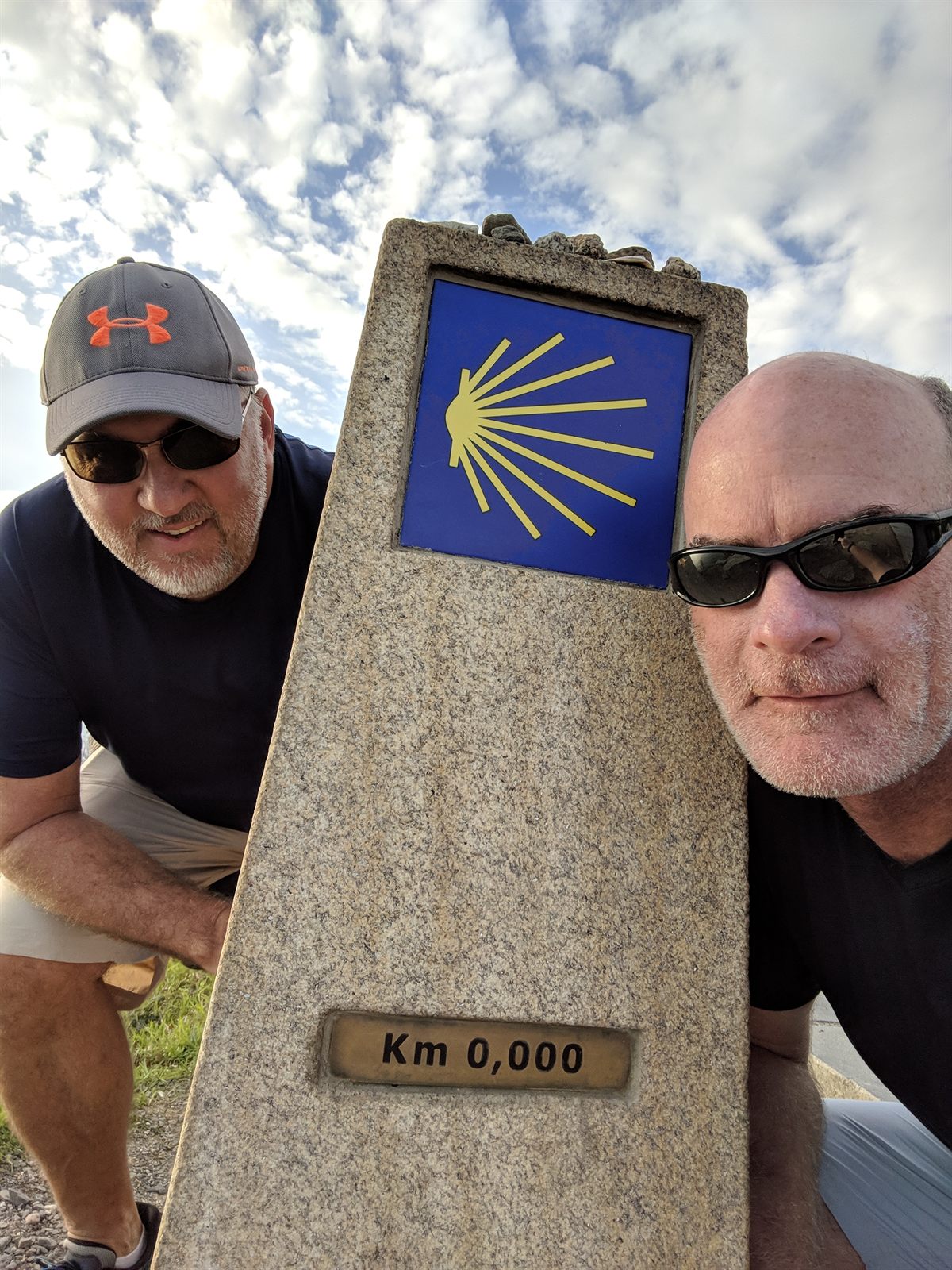
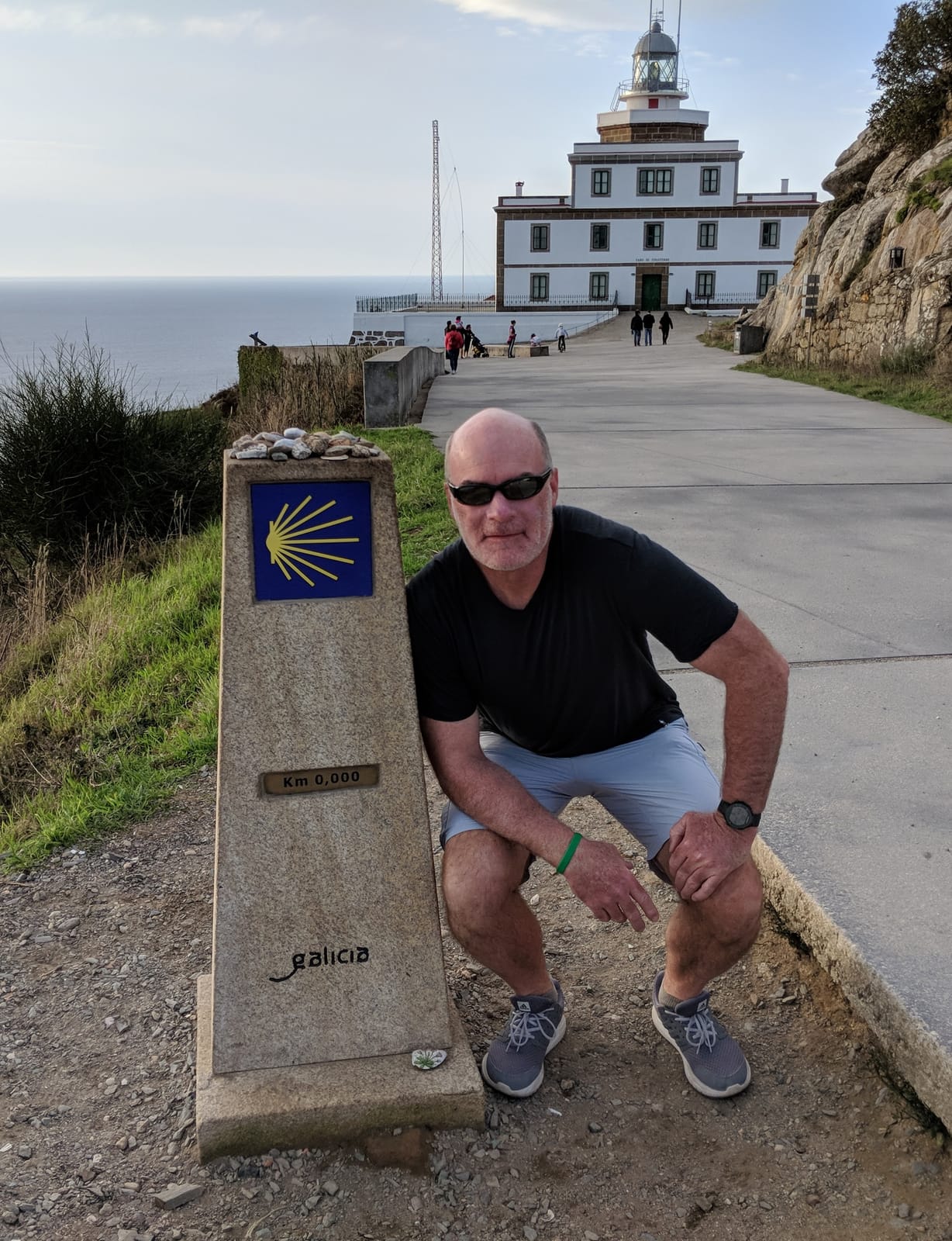
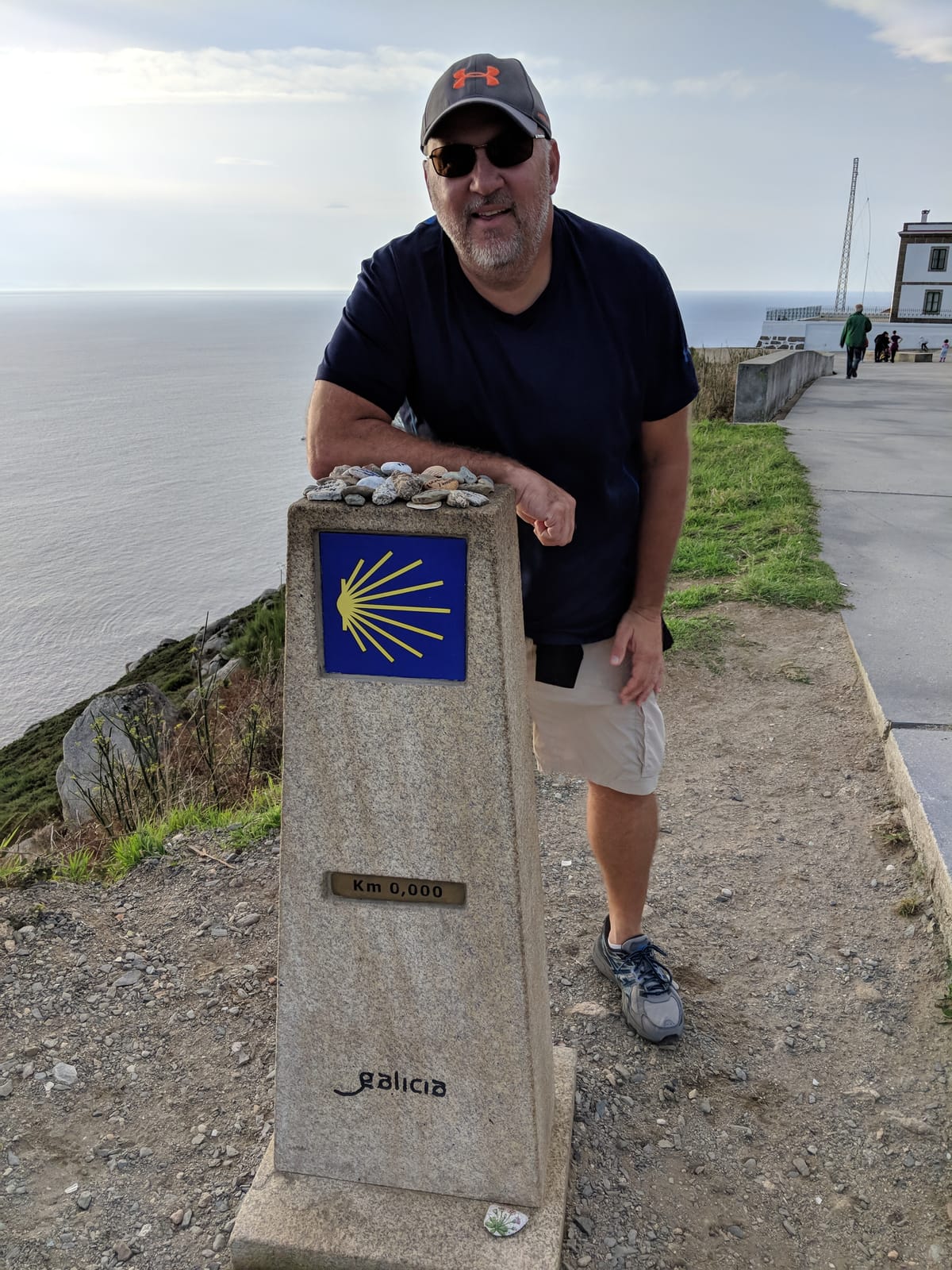
The name says it plainly: Finisterre — from the Latin finis terrae, "the end of the earth." To the Romans and to medieval Europe, this rocky cape was the westernmost edge of the known world; beyond it lay nothing but the great, uncharted ocean. People came here to watch the sun sink straight into the Atlantic and believed they were standing at the very rim of the world, where the land simply stopped. Long before the Christian pilgrimage, it was a sacred place of sun worship — the Romans were said to have raised an Ara Solis, an altar to the sun, out on these rocks — and the wild, wreck-strewn shoreline all around earned its name: the Costa da Morte, the Coast of Death. Even today the tradition holds that a pilgrim's journey isn't truly finished in Santiago, but out here, watching the sun go down at the end of the world.
So that's what we did — we found a spot on the cliff's edge and just sat for a long while, taking it in. No more trail to walk, no town to reach by dark, nowhere to be. Just the two of us, the wind, and the whole Atlantic spread out below. After days of always moving, it was the first time we could simply stop and let it all land.
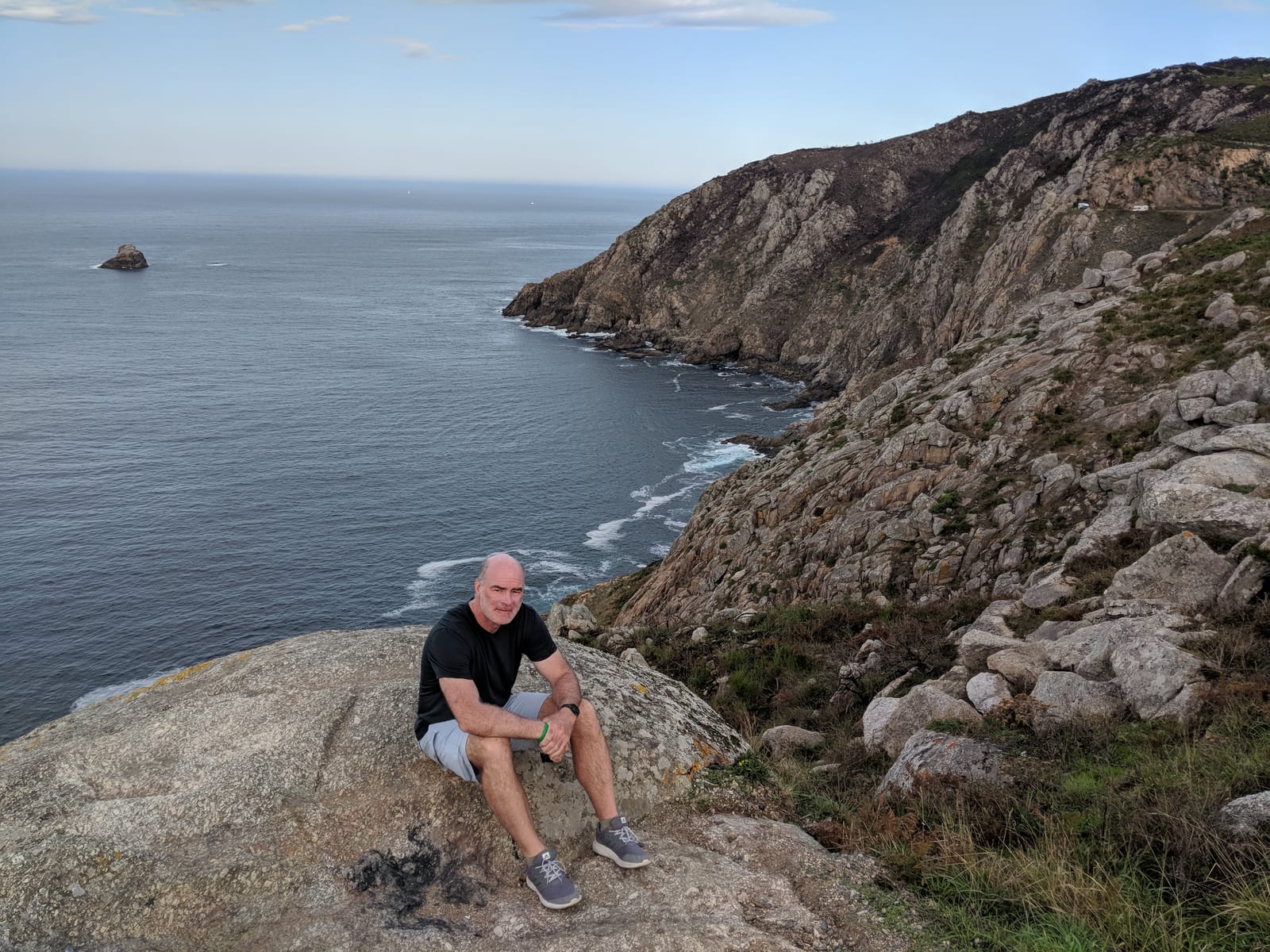
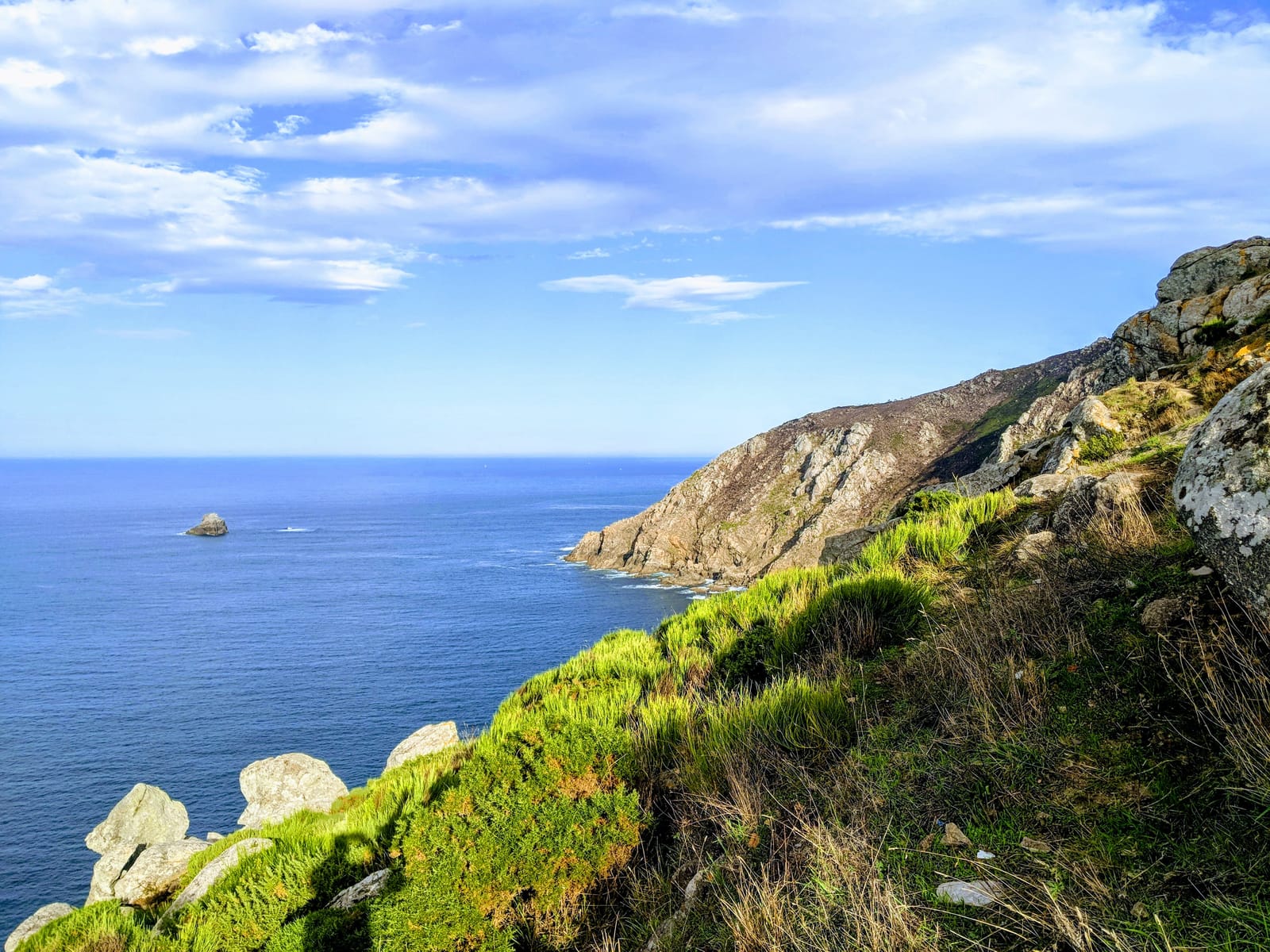
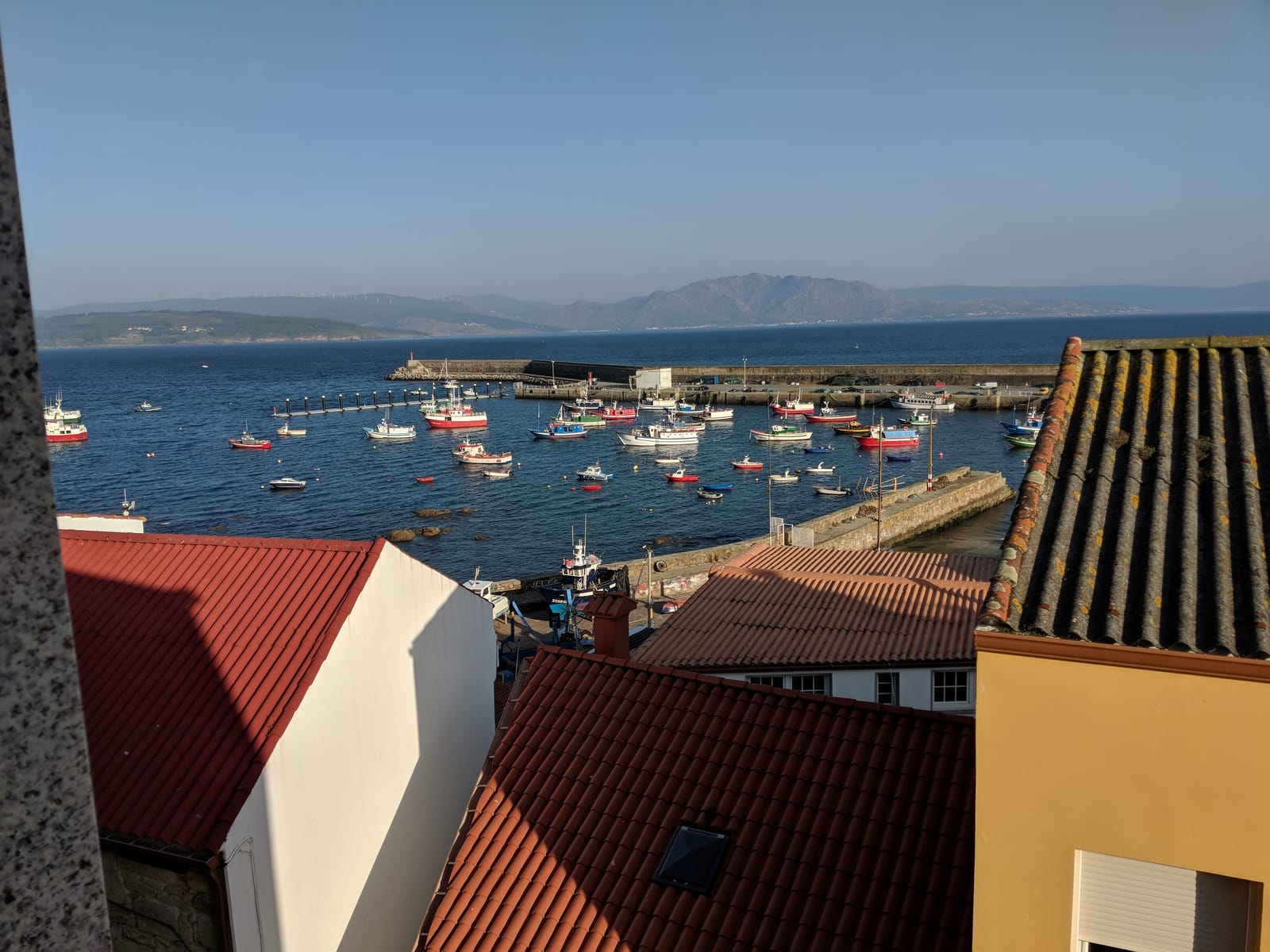
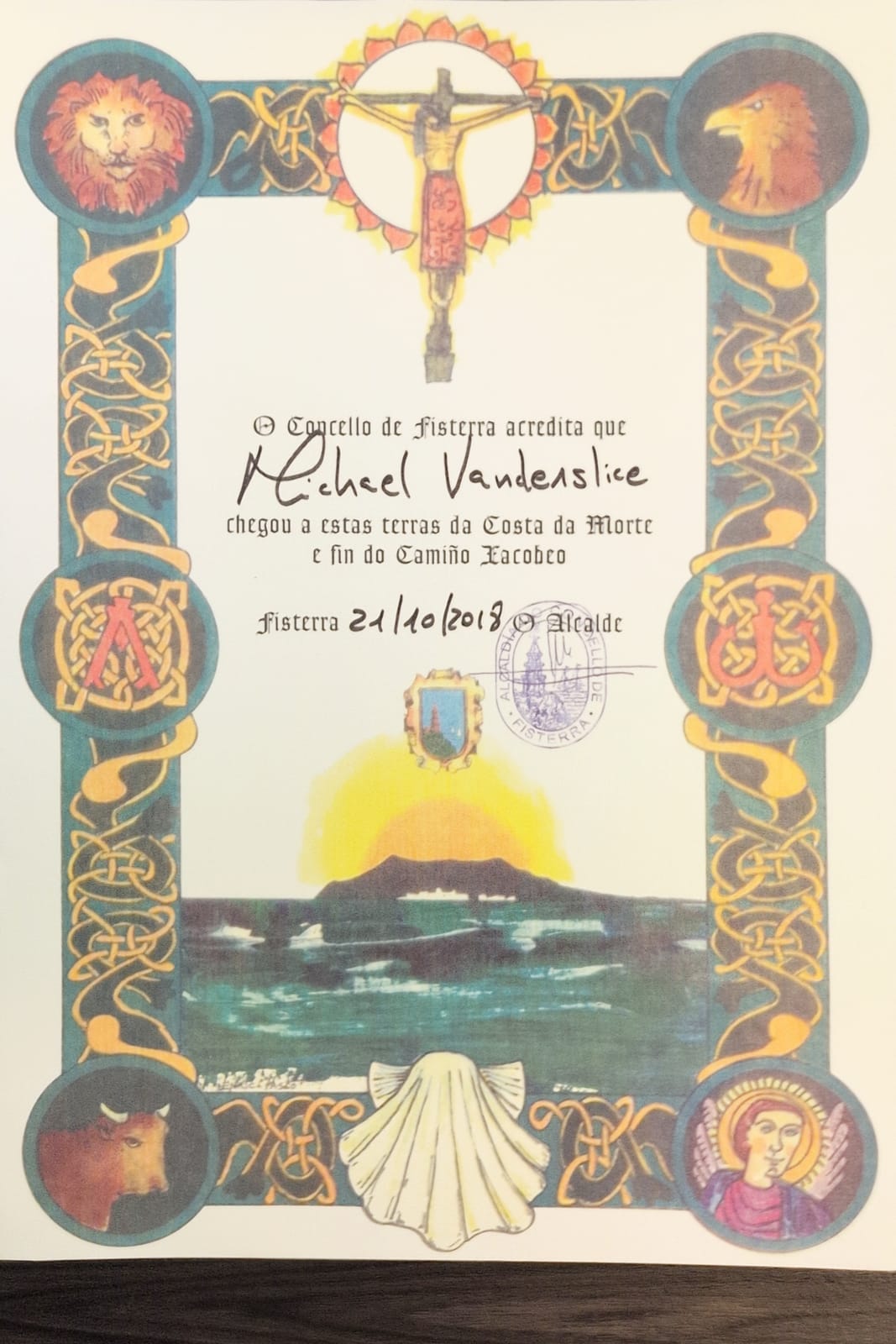
Back down in town, we stopped at the tourism office to collect our certificate for reaching the coast — the Fisterrana, the end-of-the-earth counterpart to the Compostela pilgrims receive in Santiago. It closed the book on our little Camino in the best way: proof, in illuminated ink, that we'd walked all the way to the end. Then we did just what you should do in a Galician fishing town — found lunch near the harbor and wandered the small streets with nowhere in particular to be.
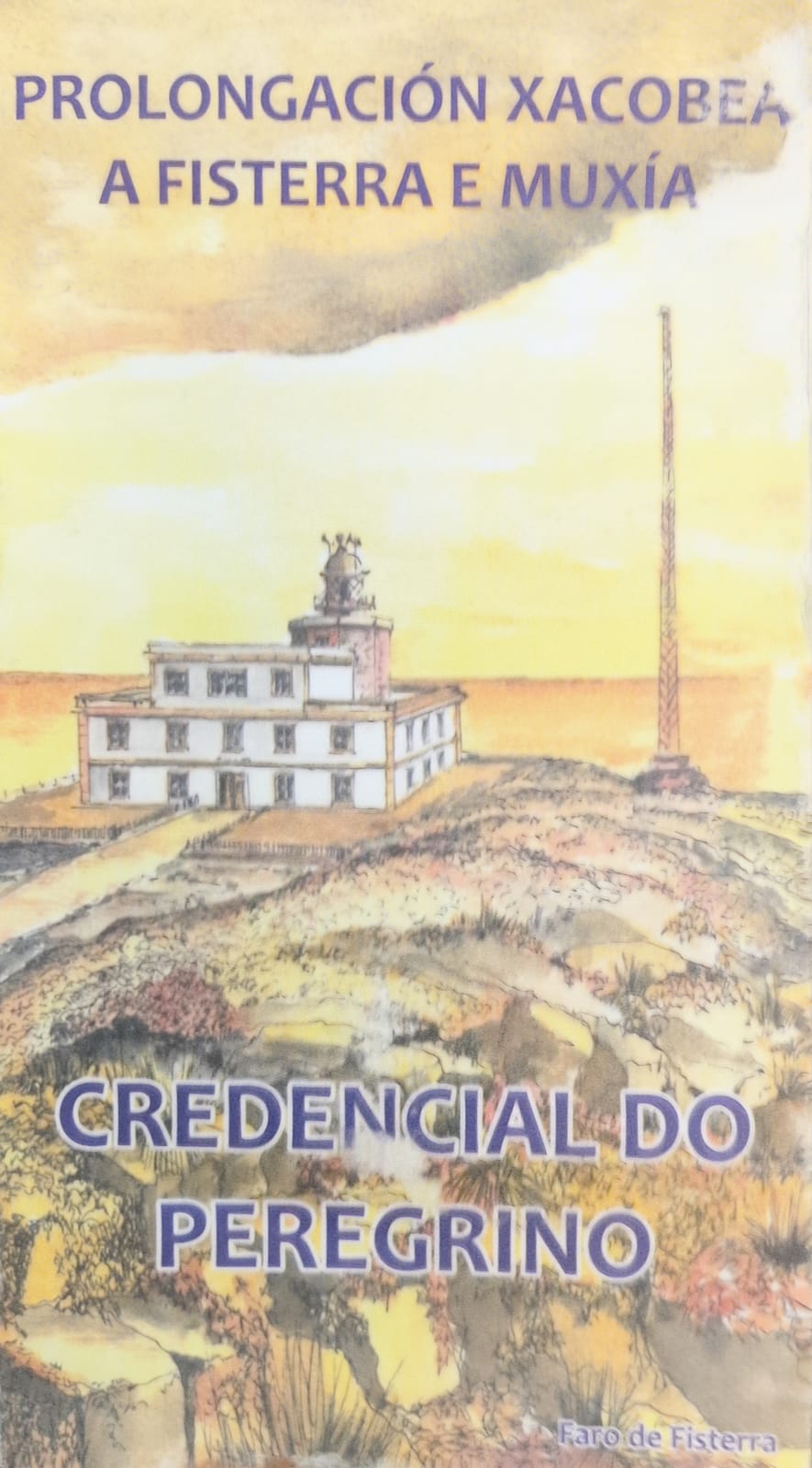
Doug's feet had more than earned a rest, so he stayed in that afternoon while I headed back out on my own as the day wound down. I ended up by the harbor again, the boats settled on still water, and pulled out the camera to record a few thoughts — the kind of thing you only really say out loud once a long walk is finally behind you.
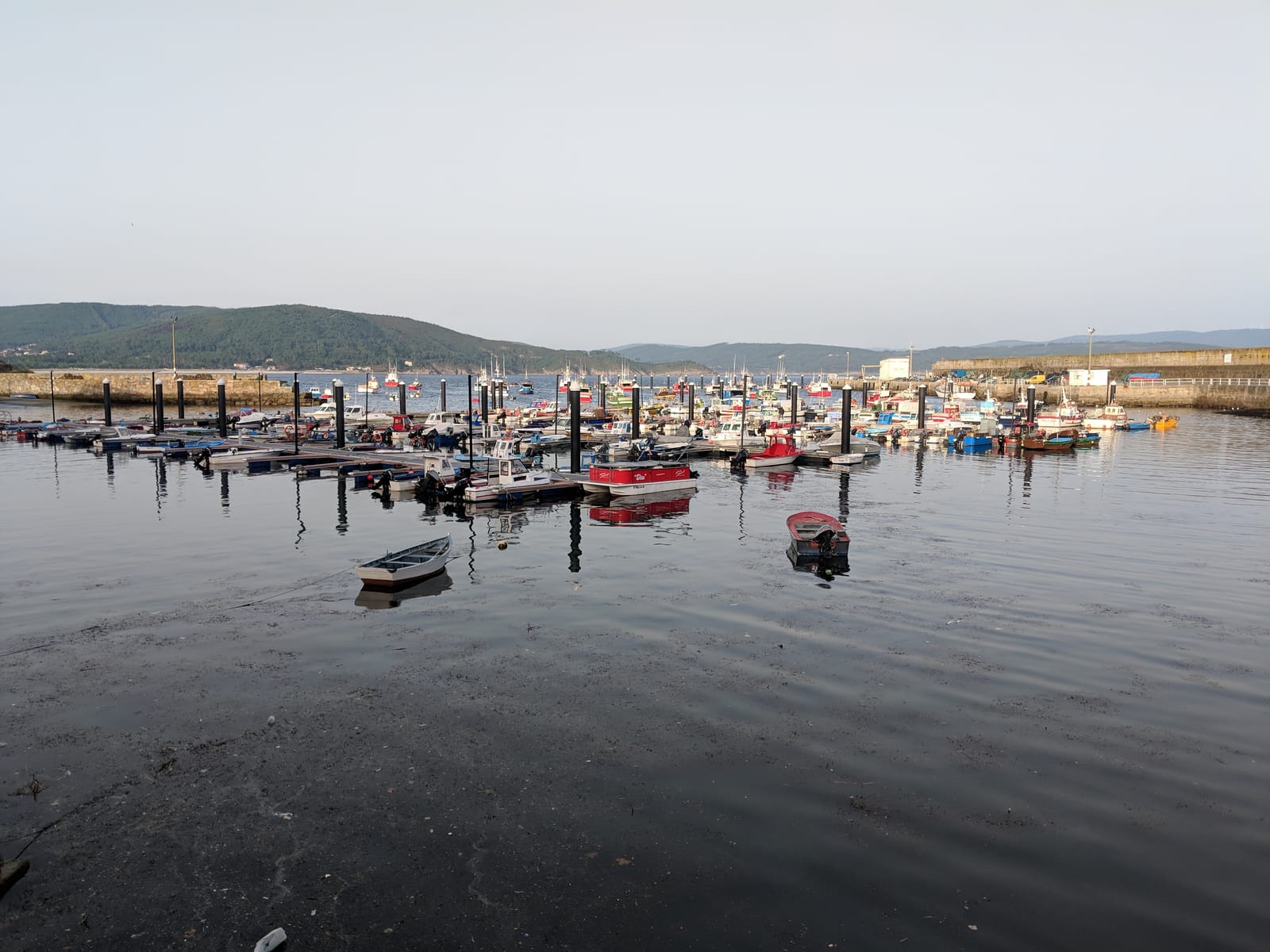
Click any photo to enlarge it and read its caption.
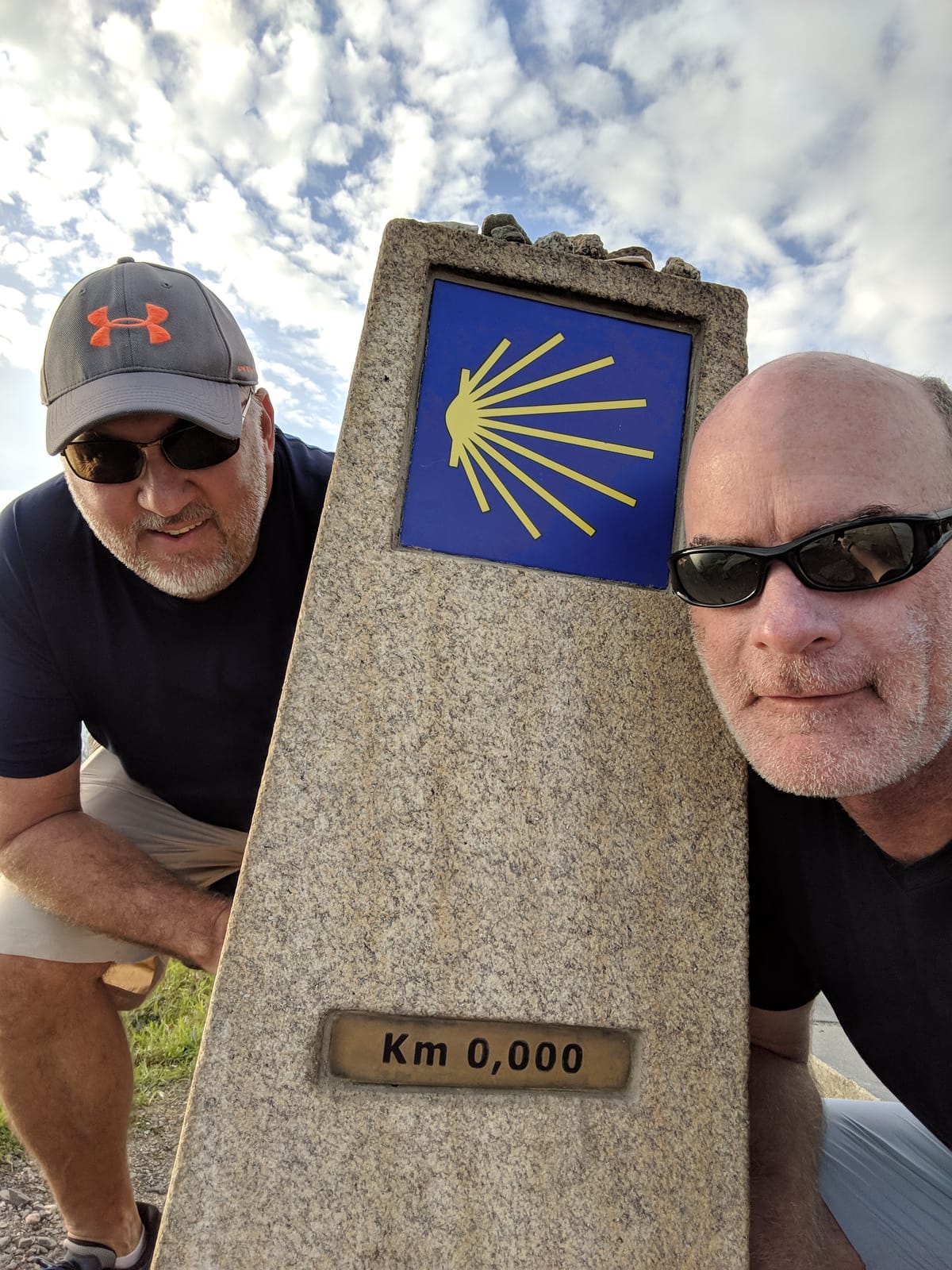
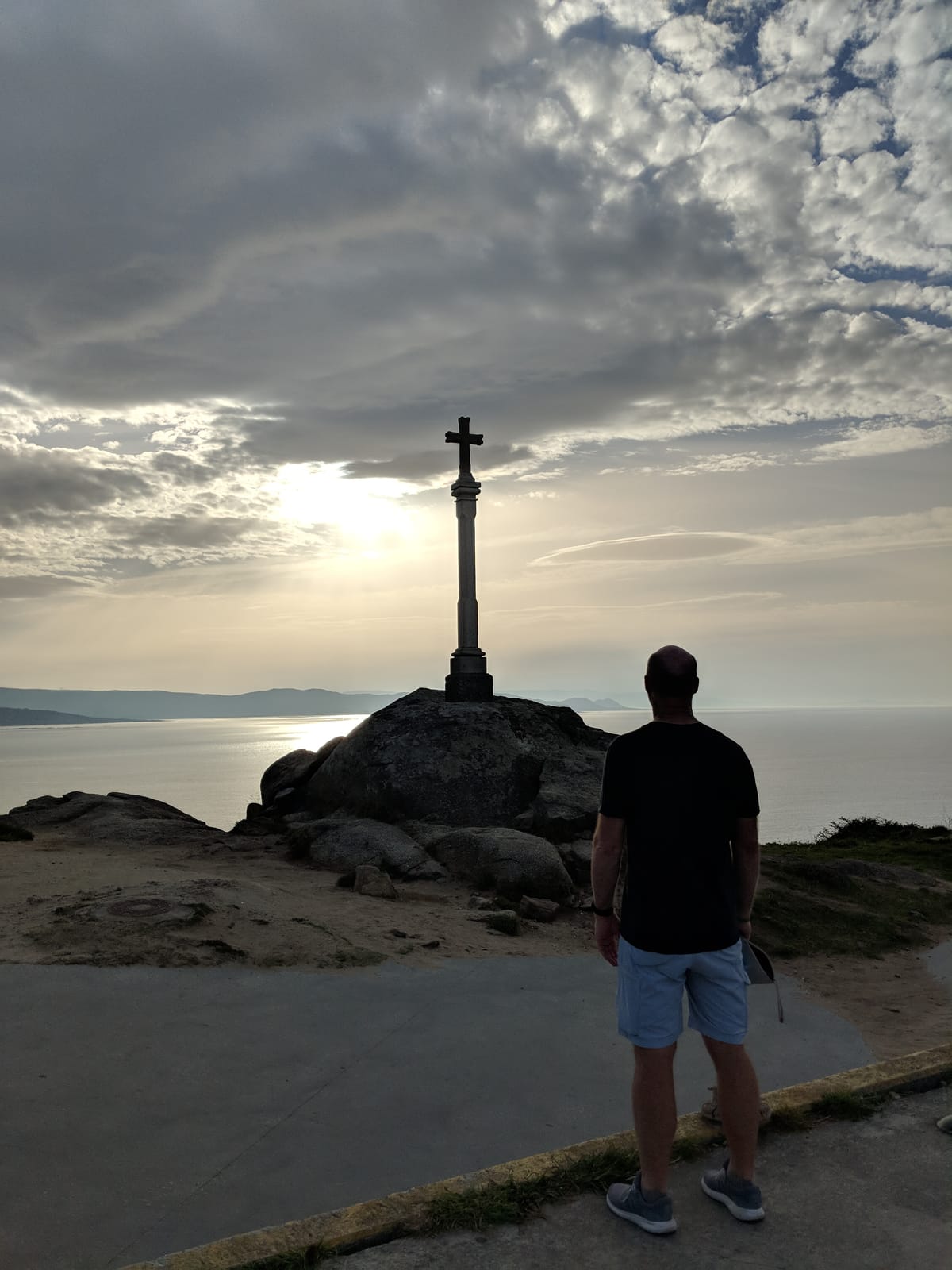
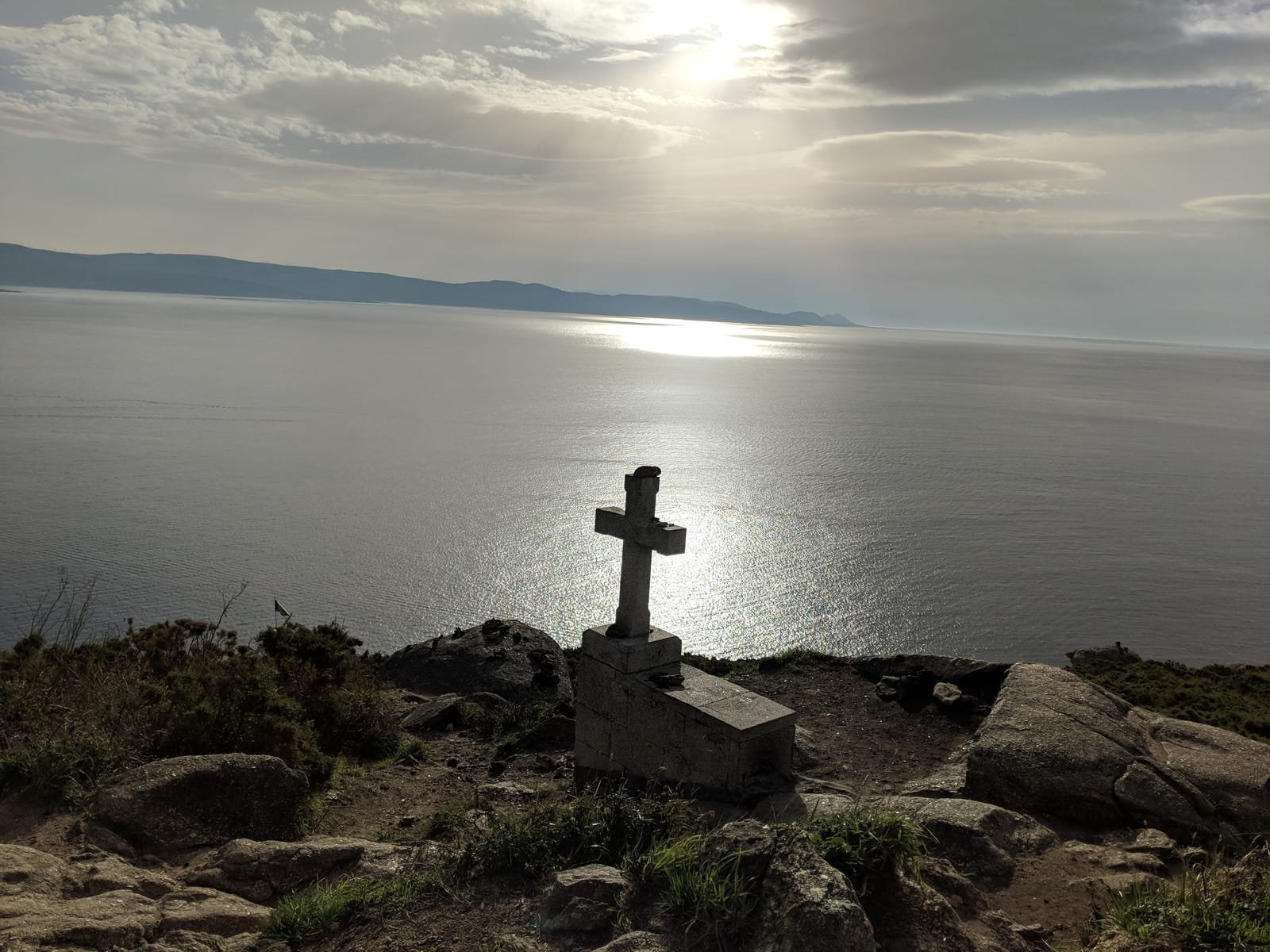
The next morning we caught a bus back to Santiago and spent a little while wandering the city again, in no hurry at all. At some point Doug bought a candy bar — one of the big ones — for us to share on the long train ride ahead. We tucked it away and made our way to the train station. Remember the candy bar. It matters later.
While we waited, I got to talking with a young American woman — mid-twenties, easy to talk to. She'd just accepted a new job — near the town I grew up in, of all places — and before it started she'd carved out this stretch of time to walk the Camino. She told me about her sister, who'd walked the French Way a few years earlier and met the man who would become her husband along the route — a Spaniard. They're married now and living in Spain. It's the kind of story that sounds made up, except it isn't.
There was a quiet wistfulness under it, though. For all that she'd loved her own Camino — and she clearly had — I got the sense she hadn't quite found the thing she'd half-hoped to find out there. Then she asked about ours, and I told her how I'd flown all this way to surprise my mom at the finish of her pilgrimage. That did it — her eyes welled up. She gave me a hug and told me how wonderful it was that I'd come so far to be there for something so big for my mom, almost like she wanted to say thank you on my mom's behalf. Her emotions were right at the surface, and my story clearly touched something. Nothing more to it than that — just two travelers trading stories in a train station, and one of those stories landing at exactly the right moment. It's funny how the small, unplanned exchanges so often turn out to be the ones you remember most.
The train back to Madrid was long — eight hours or so — and wonderfully relaxing. I'm fairly sure Doug and I both dozed off for a good chunk of it. When I woke up I was a little peckish and thought, ah yes, the candy bar. So I asked Doug where it was. He flashed me this sheepish little grin and confessed he'd eaten it. The whole thing. Solo. LOL. Reader, I have never let him forget it — and I never will. To this day it comes up all the time, and I make a big show of buying chocolate and sharing it with him, every single time, just to keep the record straight. 😄 (Fair warning: the Great Candy Bar Betrayal turns up in a few of my other stories too.)
Back where the whole trip had started, we had our final dinner in Madrid and took one last walk through the city — an easy, fitting way to wind it all down before flying home to the States.
Well — almost. Our Madrid apartment was a beauty: big, gracious, and set in one of those grand old buildings with the giant, heavy skeleton keys you could just about club someone with. On our way out, the host had told us not to fuss with the keys — just leave them inside and pull the door shut behind us. Simple enough… except this was one of those old buildings where you need a key to get out through the main doors to the street, too. And ours were now locked safely inside the apartment.
So there we were, trapped in the entryway with our flight clock ticking. We spent a good twenty or thirty minutes hunting for another way out, trying to get back into the apartment, and turning over every other option we could think of — every one a dead end. In the end, brute force won the day: we wrestled the two big front doors open just wide enough to slip past the latch and squeeze out onto the street. Free at last — and now properly behind schedule. We made a quick dash to catch our train to the airport, and somehow rolled up with just enough time to spare.
It was, start to finish, an amazing trip. But the thing that made it mean as much as it did wasn't the coast or the cathedrals or the miles — it was the reason we'd come in the first place, and my mom's quiet, hard-won triumph at the end of her own long walk. That's what we carried home.
And here's the part I keep coming back to: without her journey, Doug and I would never have had ours. Her Camino is the only reason we were there at all — and it opened the door to an adventure of our own, and to memories the two of us will never forget. One good thing has a way of leading to another.
I don't think this will be my last Camino, either. One day I hope to walk a few of them with my wife. And Doug? He's already floated doing the next one by bike — which, honestly, is just him quoting The Way almost word for word, the same thought that crossed our minds more than once out on the trail: "What, you can do this on a bike? Why the hell are we walking?"
Thinking about a Camino of your own? I put together a starter's guide to walking the Camino — the routes, how it works, and the best places to learn more. And if you've walked it, or you're dreaming about it, I'd love to compare notes.
Walking the Camino: a starter's guide →